Find the Best Geothermal Heat Pump Contractors for Your Business
No obligation • Fast responses • Nationwide coverage

Why you can trust HVAC Firms
HVAC Firms is a leading United States resource for evaluating HVAC service providers. Our team researches companies, checks credentials, and reviews customer feedback to present clear, unbiased information. Listings and rankings are based on merit, and companies cannot pay to change our editorial content.
Search providers near you
Find Geothermal Heat Pump Contractors near you
A geothermal heat pump, or ground-source heat pump, is a highly efficient heating and cooling system that leverages the Earth's stable underground temperature. This technology matters because it can dramatically reduce your home's energy consumption and environmental footprint while providing reliable comfort year-round. You can use this information to understand the process, benefits, and financial considerations, helping you connect with qualified local professionals for assessment and installation.
Search providers near you
How Geothermal Systems Work: Tapping into Earth's Constant Energy
Unlike air-source heat pumps that exchange heat with the outside air, a ground-source heat pump (GSHP) uses the ground as its heat source in winter and its heat sink in summer. Just a few feet below the surface, the Earth maintains a nearly constant temperature between 45°F and 75°F, depending on your location. A geothermal system capitalizes on this stable thermal resource through a simple, elegant process.
The core of the system is a closed loop of piping, buried in the ground and filled with a water-based fluid. In the heating mode, this fluid circulates through the underground loops, absorbing the Earth's gentle warmth. It then travels to the heat pump unit inside your home. The unit compresses this low-grade heat to a higher temperature and distributes the warm air through your existing ductwork or a hydronic system.
In the summer, the process reverses for cooling. The system extracts heat from your home's air and transfers it into the circulating fluid. The now-warmed fluid travels back into the underground loops, where the cooler ground absorbs the excess heat. This "free" cooling is remarkably efficient because the ground is significantly cooler than the summer air, allowing the system to work with less effort than a conventional air conditioner.
Types of Ground Loop Systems
The underground portion, or ground loop, is the most critical and site-specific component of a geothermal installation. The right type for your property depends on soil conditions, land availability, and local geology. The three primary configurations are vertical, horizontal, and pond/lake loops.
- Vertical Closed Loops: This is the most common installation for homes with limited yard space. Contractors drill boreholes, typically 150 to 400 feet deep, and insert U-shaped high-density polyethylene pipes. The holes are then grouted for optimal thermal conductivity. Vertical loops are often the most expensive to install due to the drilling equipment required, but they are highly efficient and require the least amount of land.
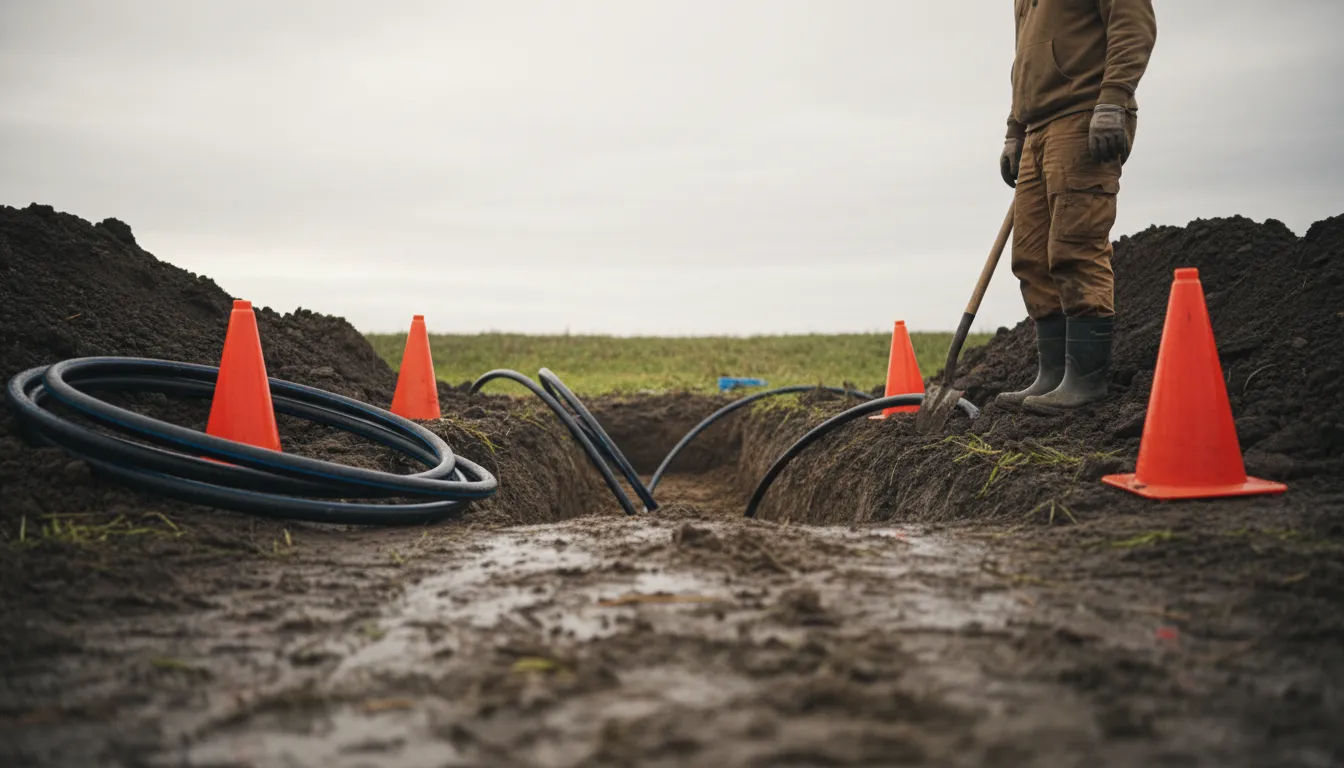
- Horizontal Closed Loops: If you have ample, open land, a horizontal loop field may be more cost-effective. Trenchers dig trenches 4 to 6 feet deep and several hundred feet long. Pipes are laid in the trenches in a slinky-coil or straight-run configuration before being backfilled. This method generally has a lower installation cost than vertical drilling but requires a much larger plot of land 1 2 3.
- Pond/Lake Loops (Open or Closed): If you have a suitable body of water, this can be the most economical option. A closed-loop system involves coils of pipe submerged at the bottom of the pond or lake. An open-loop system, which is less common for residential use, directly pumps water from a well or the water body, runs it through the heat pump, and discharges it to a second well or back to the source. Both types rely on the consistent temperature of the water.
The Installation Process: From Assessment to Activation
Installing a geothermal heating and cooling system is a significant project that requires careful planning and expert execution. It's not a DIY job. The process typically follows these key stages:
- Site Evaluation and Design: A qualified installer will first conduct a thorough assessment of your property. This includes evaluating soil composition, available land, and your home's heating and cooling load (calculated using a Manual J assessment). This data is used to design the most effective and efficient loop field and select the correctly sized heat pump unit.
- Loop Field Installation: This is the major earthwork phase. For a vertical system, a drilling rig will create the boreholes. For a horizontal system, a trencher will dig the necessary trenches. The high-density polyethylene pipe is then placed, connected, and pressure-tested to ensure there are no leaks before being buried or grouted.
- Indoor Unit Installation: The geothermal heat pump unit-which is typically about the size of a small furnace-is installed inside your home, usually in a basement, utility room, or garage. The installer will connect it to your home's existing ductwork or radiant floor system. An air handler or compatible equipment is also set up to circulate the conditioned air 4.
- Connection and Commissioning: The indoor unit is connected to the underground loop field via supply and return lines that enter the home. The entire system is filled with fluid, purged of air, and pressurized. Finally, a technician will start the system, check all electrical and refrigerant connections, and calibrate it for optimal performance.
Long-Term Benefits and Maintenance
One of the most compelling advantages of a geothermal system is its durability and low maintenance requirements. The underground piping often comes with warranties of 25 to 50 years and is expected to last for generations, as it is protected from the elements and corrosion. The indoor heat pump unit typically has a lifespan of 20 to 25 years, which is longer than most conventional HVAC systems.
Maintenance is straightforward. Homeowners should change the standard air filters regularly, just as with any forced-air system. It is recommended to have a professional service the system annually. This check-up includes inspecting the refrigerant charge, checking electrical connections, cleaning coils, and ensuring the loop pump and fluid levels are correct. This minimal upkeep stands in stark contrast to the annual servicing often required for fossil-fuel furnaces or the external units of air-source systems exposed to weather.
The energy savings are the other pillar of long-term value. By using the stable temperature of the earth, geothermal heat pumps operate with exceptional efficiency. They can deliver three to five units of heating or cooling for every one unit of electricity used to run the system 5. This translates to a reduction in energy consumption for heating and cooling by 25% to 75% compared to conventional systems, leading to significantly lower utility bills.
Find the perfect geothermal heat pump contractors for your needs
Get personalized recommendations and expert advice
Understanding Costs and Financial Incentives
The primary barrier to geothermal adoption is the upfront installation cost, which is higher than that of a standard HVAC system. For a typical residential home, total installed costs for a complete geothermal system typically range from $15,000 to $40,000 or more 6 7. The final price depends heavily on your home's size, the chosen loop type (vertical systems are more expensive), local labor rates, and site conditions.
However, it's crucial to view this as a long-term investment with a compelling payback period, especially with available incentives. The federal government offers a Residential Clean Energy Tax Credit, which provides a 30% tax credit on the total installed cost of a qualifying geothermal heat pump system, with no upper limit 8 9. Many states, municipalities, and utility companies offer additional rebates and incentives that can further reduce the net cost.
Here's a simplified example of how incentives can work:
- Total System Cost: $45,000
- Federal Tax Credit (30%): -$13,500
- State & Utility Rebates (example): -$12,750
- Net Cost After Incentives: ~$18,750 10 11
When you combine these substantial incentives with the dramatic monthly energy savings, the payback period-the time it takes for your savings to cover the net investment-often falls between 5 and 15 years 12. After that, you enjoy decades of drastically reduced operating costs, making a geothermal system one of the most financially sound home energy upgrades available.
Is a Geothermal System Right for Your Home?
Geothermal technology is a versatile solution suitable for new construction projects, where the loop field can be integrated into the site plan, as well as for retrofits in existing homes. The key factors for a successful retrofit are having adequate space for the loop field (or access for a drilling rig) and a ductwork or heating distribution system in good condition. During a consultation, a qualified installer will determine your home's specific feasibility.
The environmental benefits are significant. By slashing fossil fuel consumption or reducing the strain on the electrical grid (due to high efficiency), a ground-source heat pump system drastically lowers your household's carbon emissions. It's a clean, renewable technology that uses the planet's own natural heat to create a comfortable living environment.
Frequently asked questions
Sources
Footnotes
-
How Does A Geothermal Heat Pump Work? Complete 2025 ... - https://solartechonline.com/blog/how-does-geothermal-heat-pump-work/ ↩
-
Geothermal Heating and Cooling Systems - MN Dept. of Health - https://www.health.state.mn.us/communities/environment/water/wells/geothermal.html ↩
-
Installation of a Ground Source Heat Pump in the UK - https://www.renewableenergyhub.co.uk/main/heat-pumps-information/how-to-install-a-ground-source-heat-pump ↩
-
All You Need to Know About Home Geothermal Heating & ... - https://dandelionenergy.com/all-you-need-to-know-about-home-geothermal-heating-cooling ↩
-
Geothermal (Ground Source) Heat Pumps - NY.gov - https://cleanheat.ny.gov/geothermal-heat-pumps/ ↩
-
Ground Source Heat Pump Cost: How Much Will You Pay in 2025? - https://www.energysage.com/heat-pumps/costs-benefits-geothermal-heat-pumps/ ↩
-
Geothermal Heat Pump Guide: Installation Costs, Types And Benefits - https://modernize.com/hvac/heating-repair-installation/heat-pump/geothermal ↩
-
Geothermal Heat Pumps - Department of Energy - https://www.energy.gov/energysaver/geothermal-heat-pumps ↩
-
Geothermal Heating and Cooling - Open Energy Information - https://openei.org/wiki/GeoBridge/Heating_and_Cooling ↩
-
Guide to Geothermal Heat Pumps - https://www.energy.gov/sites/prod/files/guide_to_geothermal_heat_pumps.pdf ↩
-
How Much Does a Geothermal Heat Pump Cost? - aces-energy.com - https://aces-energy.com/2024/06/20/geothermal-system-installation-cost/ ↩
-
Installation and Operating Costs of GHP Systems | EGEE 102: Energy Conservation and Environmental Protection - https://www.e-education.psu.edu/egee102/node/2095 ↩