Find the Best Geothermal Heat Pump Contractors for Your Business
No obligation • Fast responses • Nationwide coverage

Why you can trust HVAC Firms
HVAC Firms is a leading United States resource for evaluating HVAC service providers. Our team researches companies, checks credentials, and reviews customer feedback to present clear, unbiased information. Listings and rankings are based on merit, and companies cannot pay to change our editorial content.
Search providers near you
Best Geothermal Heat Pump Contractors in Utah Ranked
A geothermal heat pump (GHP) is a highly efficient heating and cooling system that uses the stable temperature of the earth to regulate your home's climate. For Utah residents, these systems offer a powerful way to combat both frigid winters and hot summers while significantly reducing energy bills. This guide provides essential information on regulations, costs, and suitability to help you connect with qualified local professionals for your geothermal project.
Understanding Geothermal Systems in Utah's Climate
Often called ground-source heat pumps, these systems leverage the earth's constant underground temperature-typically between 45°F and 75°F in Utah-as a heat source in winter and a heat sink in summer. This is exceptionally effective in Utah's varied climate, where air-source systems must work hard against extreme seasonal temperatures. A fluid circulates through a loop of pipes buried underground, exchanging heat with the earth before being concentrated by the indoor heat pump unit to warm or cool your home.
The core components are the ground loop (a network of buried pipes) and the indoor heat pump unit. Their efficiency is measured by Coefficient of Performance (COP) for heating and Energy Efficiency Ratio (EER) for cooling, with high-quality geothermal systems often achieving COPs of 3.0 to 5.0, meaning they deliver 3 to 5 units of heat for every unit of electricity used.
Key Regulations and Permitting in Utah
Installing a geothermal system in Utah involves specific regulatory steps, primarily managed by the Utah Division of Water Rights.
- Water Rights Approval: This is a critical first step. Any drilling for a ground loop-whether for a closed-loop system requiring boreholes or an open-loop system using groundwater-requires approval from the Division of Water Rights. This ensures proper water management, especially in areas with water depletion concerns where reinjection of water is often mandatory.
- Local Building Permits: You will need standard building permits from your county or city. Some jurisdictions, like Salt Lake County, have additional guidelines, particularly for properties within Drinking Water Source Protection Zones.
- Licensed Drilling Contractors: The drilling contractor must be licensed by the state. Upon completion, they are required to submit a well log to the Division of Water Rights, documenting the construction of the borehole or well 1.
Financial Incentives and Cost Analysis
The upfront investment for a geothermal system is significant, but substantial incentives and long-term savings improve the financial outlook.
- Upfront Installation Cost: A typical residential geothermal heat pump system in Utah ranges from $20,000 to over $45,000 2. The single largest cost factor is often the ground loop installation, which can account for about 50% of the total project cost, depending on the loop type and soil conditions 3.
- Federal Tax Credit (ITC): The most significant incentive is the federal Residential Clean Energy Credit, which offers a 30% tax credit on the total installed cost of a qualifying geothermal system, with no upper dollar limit 4.
- Local Utility Rebates: Rocky Mountain Power offers Wattsmart rebates for the installation of qualified geothermal heat pumps, providing direct savings on your project costs.
- Long-Term Operating Savings: The high efficiency of GHPs translates to dramatically lower utility bills. Homeowners can expect 50% to 70% lower heating costs and 20% to 50% lower cooling costs compared to conventional systems, leading to a payback period that incentives can shorten considerably 5 6.
Find the perfect geothermal heat pump contractors for your needs
Get personalized recommendations and expert advice
Assessing Your Property's Suitability
Not every Utah property is identical, but geothermal technology is adaptable. A professional site assessment is essential, focusing on:
- Land Availability: Closed-loop systems are the most common. Vertical loops are ideal for smaller lots, requiring deep boreholes. Horizontal loops need more land area but are typically shallower and less expensive to install if space allows 7.
- Soil and Rock Composition: The thermal conductivity of your soil affects loop length and efficiency. While most soil types in Utah are suitable, a professional will assess this during the design phase.
- Groundwater for Open-Loop Systems: Open-loop systems (which pump and reinject groundwater) are possible but less common. They require a sufficient, sustainable groundwater source and strict adherence to Division of Water Rights regulations for proper reinjection 8 9.
The Installation Process: A Step-by-Step Overview
A professional installation follows a structured process to ensure system efficiency, longevity, and regulatory compliance.
- Site Assessment & System Design: A contractor evaluates your property, heating/cooling loads, and soil conditions to design an optimally sized ground loop and select the correct indoor unit.
- Permitting: The contractor files the Water Rights application and secures all necessary local building permits 10.
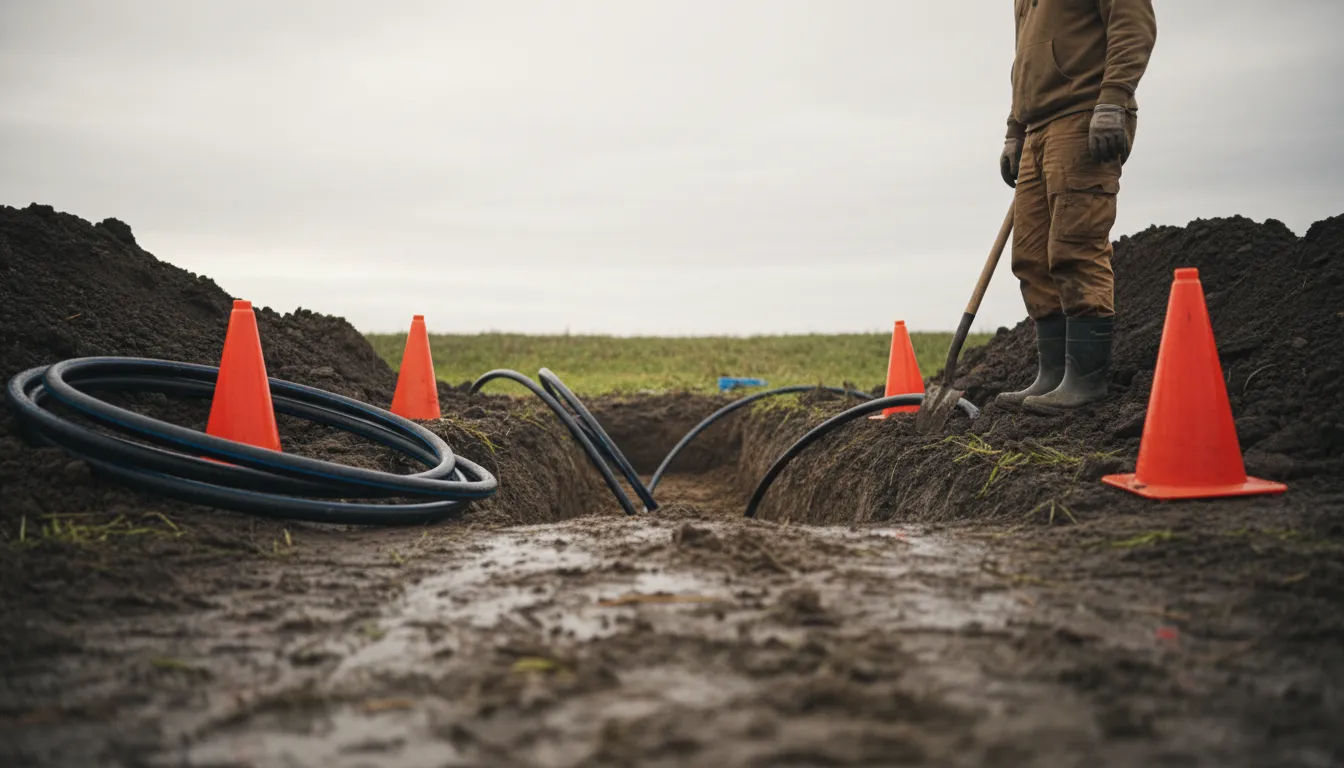
- Ground Loop Installation: Licensed drillers excavate trenches (horizontal) or drill boreholes (vertical). High-density polyethylene pipe is inserted, connected into a continuous loop, and pressure-tested.
- Indoor Unit Installation: The geothermal heat pump unit is installed indoors (often in a basement or utility room) and connected to your home's existing ductwork or hydronic distribution system.
- System Charging & Commissioning: The loop is filled with a water-antifreeze solution, the system is purged of air, and the heat pump is started. Technicians perform final checks on refrigerant charge, airflow, and controls 11.
Maintenance, Repairs, and Decommissioning
Geothermal systems are known for durability, but they are not maintenance-free.
- Common Repair Issues: Over time, you may encounter decreased efficiency, unstable temperatures, unusual noises, or system shutdowns. Typical repairs involve fixing refrigerant or loop fluid leaks, replacing circulation pumps or compressors, and addressing electrical control problems 12.
- Professional Maintenance: Annual check-ups by a qualified technician are recommended. These include inspecting the heat pump components, checking refrigerant levels, and ensuring the loop circulation pump is operating correctly.
- System Decommissioning: If a ground loop system is to be permanently taken out of service, a formal decommissioning process is required by the Utah Division of Water Rights. This involves properly sealing boreholes to protect groundwater and submitting documentation to the state 13.
Frequently asked questions
Sources
Footnotes
-
Chapter 17.35 - GEOTHERMAL POWER PLANT | Iron County, UT - https://library.municode.com/ut/iron_county/codes/code_of_ordinances?nodeId=TIT17ZO_CH17.35GEPOPL_17.35.020DE ↩
-
Cost of Buying a Geothermal Heat Pump - Carrier - https://www.carrier.com/residential/en/us/products/geothermal-heat-pumps/cost-buying-geothermal-heat-pump/ ↩
-
Geothermal Energy Pros and Cons: Complete Guide 2025 - https://a1solarstore.com/blog/pros-and-cons-of-geothermal-energy-digging-deep.html ↩
-
2024 HVAC Tax Incentives | HVAC Services in Salt Lake City - https://justrightair.com/2024-hvac-tax-incentives/ ↩
-
Geothermal Heating and Cooling Savings Over Time: What Utah ... - https://www.authorityheating.com/blog/2025/august/geothermal-heating-and-cooling-savings-over-time/ ↩
-
Guide to Geothermal Heat Pumps - https://www.energy.gov/sites/prod/files/guide_to_geothermal_heat_pumps.pdf ↩
-
Geothermal Heat Pumps - Department of Energy - https://www.energy.gov/energysaver/geothermal-heat-pumps ↩
-
Geothermal Heat Exchange - Utah Division of Water Rights - https://waterrights.utah.gov/geothermal/heat-exchange.asp ↩
-
Geothermal Systems in Utah - https://waterrights.utah.gov/geothermal/resources/Utah-Geothermal-Systems.pdf ↩
-
Ground Source Heat Pumps - Construction & Contractors - https://www.saltlakecounty.gov/health/construction-contractors/ground-source/ ↩
-
The Complete Guide To Geothermal Heat Pump Installation - https://ultrageothermal.com/the-complete-guide-to-geothermal-heat-pump-installation/ ↩
-
Geothermal Heat Pump Installation & Repairs in Utah - https://www.rmhvacutah.com/heating/geothermal-heating/ ↩
-
Ground Source Heat Pump Installation and Design Guideline - https://www.saltlakecounty.gov/globalassets/1-site-files/health/programs/construction--contractors/guidelines_gshp.pdf ↩