Find the Best Geothermal Heat Pump Contractors for Your Business
No obligation • Fast responses • Nationwide coverage

Why you can trust HVAC Firms
HVAC Firms is a leading United States resource for evaluating HVAC service providers. Our team researches companies, checks credentials, and reviews customer feedback to present clear, unbiased information. Listings and rankings are based on merit, and companies cannot pay to change our editorial content.
Search providers near you
Best Geothermal Heat Pump Contractors in Minnesota Ranked
Geothermal heat pumps, also known as ground-source heat pumps, are a highly efficient way to heat and cool your Minnesota home or business by leveraging the stable temperatures underground. This technology offers significant long-term energy savings and comfort, especially in a state with extreme seasonal temperature swings. Finding a qualified local installer is crucial, as proper system design, permitting, and installation are key to performance and longevity. This guide provides the essential information you need to understand the process, benefits, and regulations for geothermal systems in Minnesota.
Binder Heating and Air Conditioning, Inc
222 Hardman Ave N, South St Paul, MN 55075
Binder Heating and Air Conditioning, Inc is a family-owned heating and cooling company serving Minneapolis, MN, and the surrounding Twin Cities metro area. With nearly 100 years of experience, they provide a range of services including air conditioning, furnace and boiler repair and installation, geothermal heat pump systems, indoor air quality solutions, and custom commercial HVAC services. Their skilled union technicians focus on delivering tailored heating and cooling solutions without commission-based sales pressure. Binder Heating and Air Conditioning also offers 24-hour on-call emergency service for their maintenance plan customers.
ENVIROWORLD USA
Minneapolis, MN
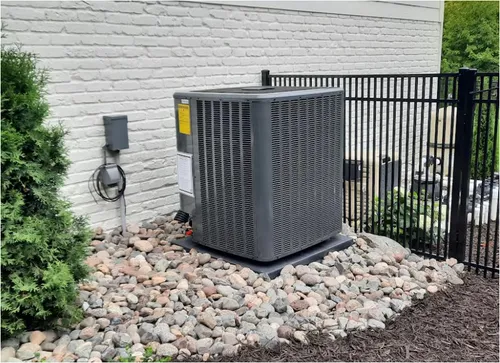
ENVIROWORLD USA is an HVAC contractor based in Minneapolis, MN, specializing in heating, air conditioning, heat pump, and geothermal system installation and repair. They focus on improving indoor air quality and home comfort through design-build solutions that address airflow, ventilation, and temperature consistency. Their services include installing steam humidifiers, air exchangers, and advanced filtration systems to enhance respiratory health and energy efficiency. With decades of industry experience and master licensing, ENVIROWORLD USA offers tailored HVAC solutions for both new construction and existing homes, aiming to resolve chronic indoor air and comfort issues effectively.
HLT Heating & Cooling LLC
244 Richmond St W, South St Paul, MN 55075
HLT Heating & Cooling LLC is a heating and cooling company based in St Paul, MN. They provide a range of services including installation and repair of air conditioners, furnaces, heat pumps, boilers, mini splits, and geothermal heat pumps. Their capabilities cover HVAC tune-ups and comprehensive HVAC system services to maintain home comfort. The company also offers flexible financing options to support their customers' needs.
How Geothermal Systems Work in Minnesota's Climate
A geothermal or ground-source heat pump system doesn't create heat by burning fuel; it moves it. In the winter, a fluid circulating through underground pipes (called a ground loop) absorbs the Earth's stable warmth-typically 45-55°F in Minnesota-and carries it to a heat pump inside your building. The heat pump concentrates this energy and distributes it as warm air or water through your existing ductwork or radiant system. In the summer, the process reverses, pulling heat from your building and depositing it into the cooler ground 1.
This process is exceptionally efficient because moving heat requires far less energy than generating it. For Minnesota's cold winters and warm summers, this translates to consistent comfort and dramatically lower utility bills, with systems often achieving 40-60% savings on heating and cooling costs compared to conventional systems.
Key Considerations for Minnesota Properties
Not every property is equally suited for a geothermal installation. Several local factors must be evaluated by a professional.
- Soil Composition: The thermal conductivity of your soil directly impacts system efficiency and loop length. Clay soils, common in parts of Minnesota, transfer heat better than sandy soils. A proper site evaluation will determine the best loop design for your geology.
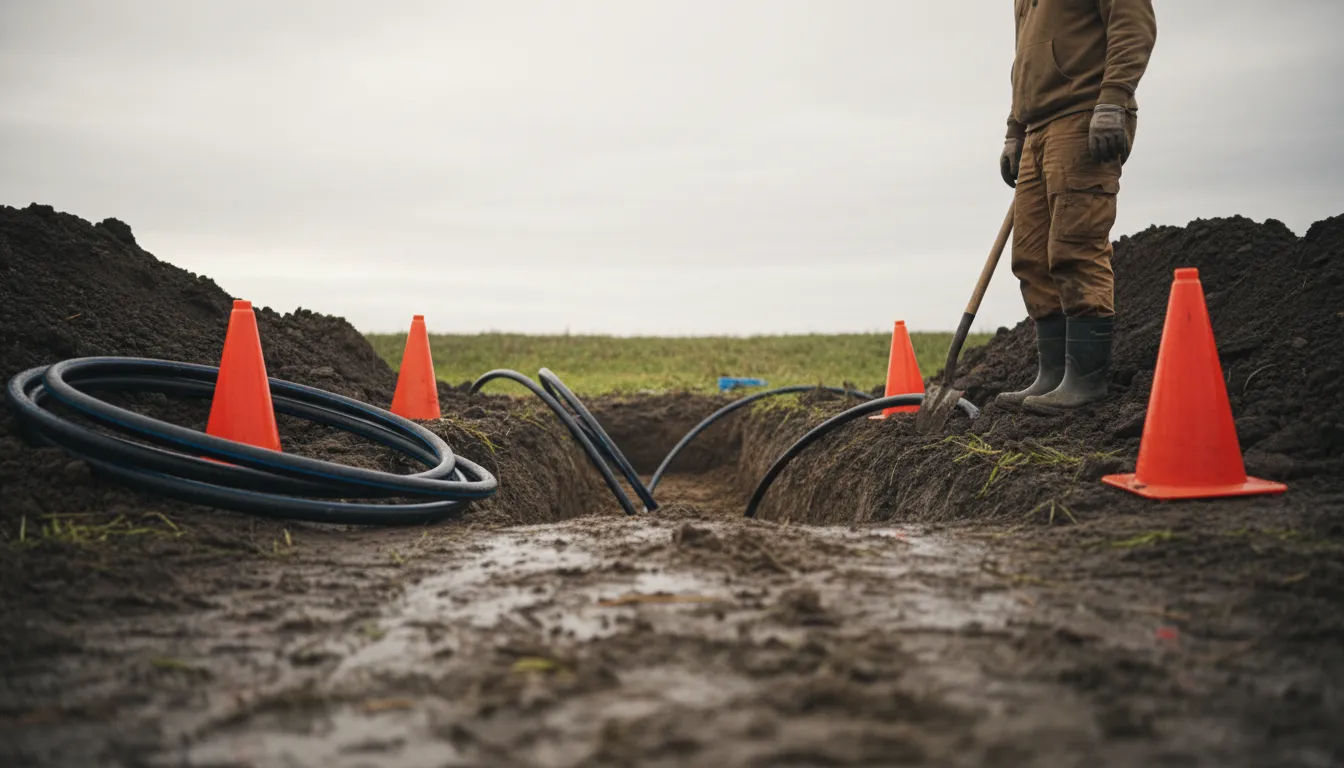
- Available Land: The type of ground loop you can install depends heavily on space. Horizontal loops, placed in trenches 6-8 feet deep, require a significant amount of unobstructed land. Vertical loops, installed in boreholes, are ideal for smaller lots but involve specialized drilling equipment.
- Minnesota Frost Depth: With frost lines reaching 4 to 7 feet deep across the state, horizontal loop trenches must be dug below this level to ensure year-round operation. This deep trenching requirement makes vertical boreholes a more common and reliable choice for many Minnesota installations 2.
- Water Table and Geology: The presence of a high water table can improve heat transfer in closed-loop systems. Your installer will assess subsurface conditions to ensure a safe and effective installation.
Understanding Ground Loop Options
The underground portion of the system, the ground loop, is the most critical and site-specific component. In Minnesota, the primary options are closed-loop systems.
- Vertical Closed-Loop: This is the most common installation type in Minnesota, especially for residential properties with limited space. Holes are bored 150 to 450 feet deep, and U-shaped pipes are inserted and grouted. Vertical systems are less susceptible to surface temperature fluctuations and are ideal for dealing with the state's deep frost 3.
- Horizontal Closed-Loop: Pipes are laid in trenches at least 6 feet deep. This requires a larger, clear parcel of land-often several thousand square feet-but can be less expensive than vertical boring if the site is suitable. The trench depth must account for Minnesota's frost line 4.
- Pond/Lake Loop (Closed-Loop): If you have a sufficient, deep body of water on your property, coils of pipe can be submerged on the bottom. This can be a very cost-effective loop option, but it depends entirely on water availability, depth, and quality.
Important Minnesota Restriction: "Once-through" or "pump and dump" systems, which draw groundwater and discharge it to the surface, are heavily restricted for new installations in Minnesota. The Department of Natural Resources (DNR) generally prohibits new appropriations for this purpose due to water conservation concerns, so most new installations will be closed-loop.
The Installation Process: A Step-by-Step Overview
A successful geothermal installation in Minnesota follows a structured process involving multiple professionals.
- Site Evaluation and Load Calculation: A certified installer assesses your property's soil, space, and geology. They also perform a detailed calculation of your building's heating and cooling demands (Manual J) to right-size the system.
- System Design and Proposal: Based on the evaluation, the designer selects the appropriate loop type (vertical/horizontal), determines its size, and specifies the indoor heat pump unit. You'll receive a detailed proposal outlining costs, expected performance, and a timeline.
- Permitting: This is a critical step in Minnesota. Your contractor must obtain a Bored Geothermal Heat Exchanger (BGHE) or Groundwater Thermal Exchange Device (GTED) permit from the Minnesota Department of Health (MDH) for the drilling and loop installation. If the system requires a large volume of water (over 1 million gallons per year), a water appropriation permit from the DNR may also be necessary.
- Ground Loop Installation: Licensed drilling or excavation contractors install the underground loop field. For vertical systems, this involves a well-drilling rig. The pipes are pressure-tested, connected, and the boreholes are grouted with a special thermally enhanced material to seal the well and improve heat transfer.
- Indoor Unit Installation: The geothermal heat pump unit (which resembles a furnace) is installed indoors, typically in a basement or mechanical room. It is connected to the ground loop, your ductwork or hydronic system, and the electrical supply.
- System Start-up and Commissioning: The installer fills the loop, purges air, and starts the system. They verify refrigerant charge, airflow, and overall operation to ensure it meets design specifications. Final inspections by the MDH or local authority may be required.
Find the perfect geothermal heat pump contractors for your needs
Get personalized recommendations and expert advice
Costs, Savings, and Financial Incentives
Understanding the investment and payback is essential for any homeowner or business owner.
- Installation Cost: A complete geothermal heat pump system in Minnesota typically ranges from $15,000 to over $40,000. The wide range depends on your home's size, the chosen loop type (vertical loops are more expensive to install than horizontal), site accessibility, and the indoor equipment selected. Costs often break down to roughly $2,500 per ton of capacity, plus the drilling and trenching work.
- Operational Savings: The primary financial benefit comes from dramatically lower utility bills. By using much less electricity to move heat rather than create it, these systems can reduce your heating and cooling energy use by 40% to 60% 5. With Minnesota's climate, these savings add up quickly, often leading to a payback period of 5 to 10 years when incentives are factored in.
- Durability and Lifespan: The indoor heat pump unit typically lasts 20-25 years, similar to a high-quality furnace. The underground polyethylene loop system is incredibly durable and often comes with warranties of 25-50 years, with an expected lifespan of 50+ years.
Available Incentives in Minnesota
To offset the upfront cost, take advantage of these financial incentives:
- Federal Residential Energy Clean Energy Tax Credit: This is the most significant incentive. You can claim 30% of the total installed cost of a qualifying geothermal heat pump system on your federal income taxes, with no upper limit 6.
- Utility Rebates: Many Minnesota utility companies, such as Otter Tail Power, offer rebates for installing geothermal systems, often calculated on a per-ton basis. Check with your local electricity provider for specific programs.
- State Planning Grants: The Minnesota Department of Commerce offers Geothermal Planning Grants to help fund feasibility studies for large community-scale geothermal systems, which can benefit multi-family or commercial projects 7.
Minnesota Regulations and Permitting
Adhering to state regulations is non-negotiable for a legal and safe installation.
- MDH Permitting: The Minnesota Department of Health regulates the construction of the ground loop. Your installer must obtain the proper permit (BGHE or GTED) before drilling begins. This ensures the loop is constructed to state standards, protecting groundwater and ensuring system integrity.
- Contractor Licensing: The drilling and loop installation must be performed by a contractor licensed by the MDH for this specific work. Always verify your installer's credentials 8.
- DNR Water Use: As noted, once-through systems using groundwater are effectively banned for new installations. Closed-loop systems are the standard and are encouraged 9.
- Property Lines: Minnesota administrative code (4725.7050) explicitly states that bored geothermal heat exchanger piping cannot cross property lines without written consent from the adjoining property owner 10.
Frequently asked questions
Sources
Footnotes
-
Guide to Geothermal Heat Pumps - https://www.energy.gov/sites/prod/files/guide_to_geothermal_heat_pumps.pdf ↩
-
The Complete Guide To Geothermal Heat Pump Installation - https://ultrageothermal.com/the-complete-guide-to-geothermal-heat-pump-installation/ ↩
-
FAQ | MNGHPA - Minnesota Geothermal Heat Pump Association - https://www.minnesotageothermalheatpumpassociation.com/geothermal/frequently-asked-questions/ ↩
-
Geothermal Loop Options | MNGHPA - https://www.minnesotageothermalheatpumpassociation.com/geothermal/earth-loop-options/ ↩
-
Ground Source Heat Pump Cost: How Much Will You Pay in 2025? - https://www.energysage.com/heat-pumps/costs-benefits-geothermal-heat-pumps/ ↩
-
Geothermal Heat Pumps: Cost and Installation - https://www.energyhomes.org/renewable-technology/geoinstallation.html ↩
-
Geothermal Planning Grants / Minnesota Department of Commerce - https://mn.gov/commerce/energy/consumer/energy-programs/geothermal.jsp ↩
-
Geothermal Heating and Cooling Systems - MN Dept. of Health - https://www.health.state.mn.us/communities/environment/water/wells/geothermal.html ↩
-
Once-Through Geothermal Systems Fact Sheet - files - https://files.dnr.state.mn.us/waters/forms/once-through-geothermal_fact-sheet_08052015.pdf ↩
-
4725.7050 bored geothermal heat exchangers. - MN Revisor's Office - https://www.revisor.mn.gov/rules/4725.7050/ ↩