Find the Best Geothermal Heat Pump Contractors for Your Business
No obligation • Fast responses • Nationwide coverage

Why you can trust HVAC Firms
HVAC Firms is a leading United States resource for evaluating HVAC service providers. Our team researches companies, checks credentials, and reviews customer feedback to present clear, unbiased information. Listings and rankings are based on merit, and companies cannot pay to change our editorial content.
Search providers near you
Best Geothermal Heat Pump Contractors in Delaware Ranked
A geothermal heat pump is a highly efficient heating and cooling system that leverages the stable temperatures underground to regulate your home's climate. For Delaware residents, this technology offers a reliable way to reduce energy bills and environmental impact, thanks to the state's favorable ground conditions. This guide explains the key considerations, process, and local resources for installing a ground-source heat pump in Delaware, helping you connect with qualified professionals for your project.
How Geothermal Systems Work in Delaware
A geothermal or ground-source heat pump system doesn't create heat by burning fuel; it moves it. In winter, it extracts heat from the ground and transfers it into your home. In summer, the process reverses, pulling heat from your home and depositing it into the cooler earth. This exchange happens through a loop of pipes buried in your yard, filled with a water-based solution.
Delaware's climate and geology are particularly well-suited for this technology. The ground temperature below the frost line remains a consistent 50-55°F year-round, providing an ideal heat source and sink. This consistency is the key to the system's high efficiency, often delivering three to four units of heating or cooling for every one unit of electricity used to run the system.
Key Benefits for Delaware Homeowners
Installing a geothermal system in Delaware comes with significant advantages:
- Substantial Energy Savings: By tapping into the earth's stable temperature, these systems can reduce heating and cooling costs by 30% to 70% compared to conventional systems.
- Lower Environmental Impact: Geothermal systems use electricity and have no on-site emissions, reducing your home's carbon footprint.
- Long System Lifespan: The indoor heat pump components typically last 20-25 years, while the underground loop system can have a lifespan of 50 years or more 1.
- Quiet Operation and Comfort: With no noisy outdoor condenser unit, operation is very quiet. They also provide even, draft-free heating and cooling.
- Eligibility for Financial Incentives: Delaware homeowners can take advantage of significant federal and potential local incentives to offset the upfront cost (detailed below).
Understanding System Types and Site Evaluation
The first step is determining which type of ground loop is feasible for your property. The two main categories are closed-loop and open-loop systems, with closed-loop being far more common in residential applications.
Closed-Loop Systems:
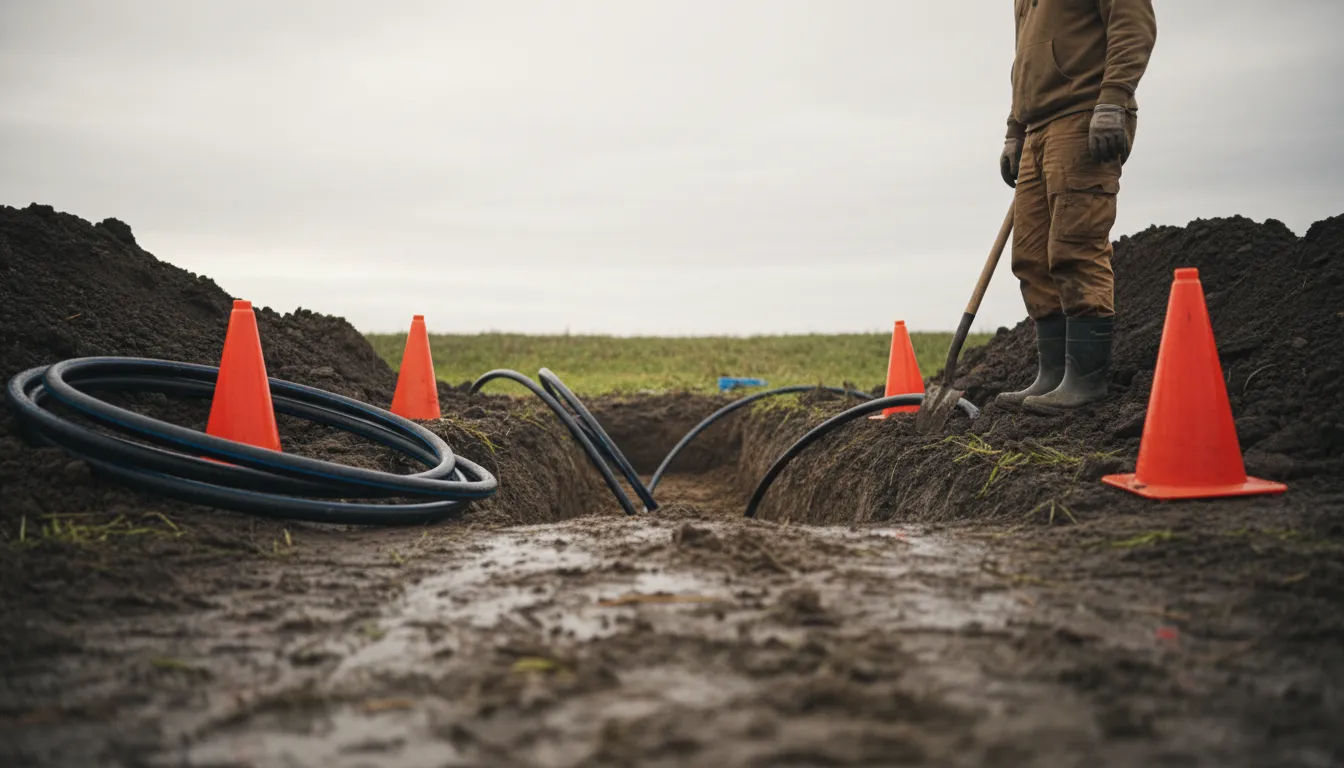
- Horizontal: Pipes are laid in trenches 4 to 6 feet deep. This requires a larger amount of available land but is often less expensive than vertical drilling if space allows.
- Vertical: Pipes are run through holes drilled 150 to 450 feet deep. This is ideal for smaller lots and is the most common installation type in Delaware, as it minimizes landscape disturbance and performs well in most soil types 2.
Open-Loop Systems: These use groundwater from a well as the heat exchange fluid, then return it to the ground. They are less common due to more complex permitting and potential water quality regulations.
A professional site evaluation is critical. An installer will assess your property's soil composition, available space, and accessibility to recommend the optimal loop type and size. Proper sizing, calculated using a Manual J load calculation, is essential for efficiency, comfort, and system longevity.
The Installation Process in Delaware
Installing a geothermal system is a significant project that follows a structured process.
- Consultation and Design: A qualified contractor performs a site survey and home energy assessment to design a correctly sized system.
- Permitting: This is a crucial step in Delaware. You will need a well permit from the Delaware Department of Natural Resources and Environmental Control (DNREC) for the drilling or trenching work. Additionally, you must obtain local permits from your municipality (e.g., a Geothermal Closed-Loop permit in Bethany Beach). The DNREC permit is valid for one year.
- Ground Loop Installation: For vertical systems, a drilling rig bores the necessary holes. For horizontal systems, a backhoe digs the trenches. Pipes are installed, connected, and pressure-tested. Local codes, like those in Bethany Beach, require buried pipes to be marked with a warning tape placed 12 inches above them.
- Indoor Unit Installation: The heat pump unit is installed inside your home, typically in a basement, utility room, or garage, and connected to your existing ductwork or a new air distribution system.
- System Startup and Testing: The loop is filled, the system is charged, and all components are tested for proper operation. The entire installation process typically takes one to two weeks 3.
Find the perfect geothermal heat pump contractors for your needs
Get personalized recommendations and expert advice
Costs and Financial Incentives
The upfront cost of a geothermal system in Delaware is higher than a conventional HVAC system, but significant incentives and long-term savings improve the value proposition.
Typical Costs: A complete residential geothermal system in the Delmarva region can range from $10,000 to over $40,000 4 5. The wide range depends heavily on your home's size, the chosen loop type (vertical drilling alone can cost $10,000-$30,000), soil conditions, and the complexity of the indoor installation 4 6.
Federal Incentive: The most impactful incentive is the Federal Residential Clean Energy Credit (IRA Section 25D). This provides a tax credit for 30% of the total installed cost of a qualifying geothermal heat pump system, with no upper dollar limit 7. This credit applies through 2032.
State and Local Incentives: It's worth investigating additional programs. For example, the Delaware Electric Cooperative has offered a Geothermal Heat Pump Grant Program in the past. Always check with the DNREC Energy Office and your local utility for current rebates or financing options.
Permitting and Regulations Overview
Navigating local and state regulations is a key part of the process. All geothermal drilling in Delaware requires authorization from DNREC's Groundwater Discharges Section. Your installer should handle this, but being informed is helpful. Key requirements include:
- DNREC Well Permit: Required before any drilling or major excavation for the ground loop begins 8.
- Pre-Drilling Authorization: Contractors must call DNREC to get an authorization number on the day drilling is scheduled to start.
- Local Municipal Permits: Towns like Bethany Beach have specific geothermal codes covering permits, loop burial depth, marking, and system efficiency standards.
- System Standards: Installations should meet the efficiency and warranty standards set by organizations like the International Ground Source Heat Pump Association (IGSHPA) and are often required by local code or incentive programs 9 10.
Maintenance and Long-Term Care
Geothermal systems are known for their durability and low maintenance. The underground loop is virtually maintenance-free. The indoor heat pump unit requires similar care to a traditional furnace or air handler:
- Regular Filter Changes: Replace or clean air filters every 1-3 months.
- Annual Professional Check-up: Have a qualified technician inspect the system, check refrigerant levels, and clean coils annually.
- Monitoring: Residential systems should have pressure/temperature (P/T) ports for monitoring loop performance, and commercial systems require gauges 11.
Routine maintenance ensures the system operates at peak efficiency and can prevent minor issues from becoming major repairs. Always rely on technicians experienced with geothermal technology for any service needs.
Finding a Qualified Installer in Delaware
Your choice of installer is the most critical factor in a successful geothermal project. Look for contractors with:
- Specific experience and certifications in geothermal heat pump installation (e.g., IGSHPA certification).
- A strong local reputation and references from past geothermal projects.
- The ability to handle the entire process, including site evaluation, system design, and securing necessary Delaware permits.
- Proper licensing and insurance.
A professional installer will provide a detailed proposal, explain the recommended system, outline the full cost, and guide you through the incentive application process.
Frequently asked questions
Sources
Footnotes
-
Cost of Buying a Geothermal Heat Pump - Carrier - https://www.carrier.com/residential/en/us/products/geothermal-heat-pumps/cost-buying-geothermal-heat-pump/ ↩
-
Geothermal Heat Pump | Wilmington, DE - Hentkowski Inc. - https://hentkowski.com/geothermal-heat-pumps ↩
-
Geothermal Installation & Replacement Services - TTM Mechanical - https://www.ttmmechanical.com/geothermal/installation ↩
-
Ground Source Heat Pump Cost: How Much Will You Pay in ... - https://www.energysage.com/heat-pumps/costs-benefits-geothermal-heat-pumps/ ↩ ↩2
-
Geothermal Heating and Cooling Pros and Cons - https://abovenbeyondservices.com/geothermal-hvac/ ↩
-
Installation ... - Geothermal Heat Pump Repair Delaware (DE) - https://geothermalheatpumprepairs.netlify.app/de/ ↩
-
Inflation Reduction Act - DNREC - Delaware.gov - https://dnrec.delaware.gov/climate-coastal-energy/energy-office/ira/ ↩
-
Administrative Code - Delaware Regulations - https://regulations.delaware.gov/AdminCode/title7/2103 ↩
-
Town of Bethany Beach, DE Geothermal Closed-Loop Heat ... - https://ecode360.com/15929961 ↩
-
Geothermal Heat Pump Grant Program Application - https://www.delaware.coop/sites/default/files/2024-04/2024%20Geothermal%20Heat%20Pump%20Grant%20Application.pdf ↩
-
Geothermal Heat Pumps | Installation, Repair | Hockessin, DE - https://www.jfrederickandsons.com/residential/geothermal-heat-pumps/ ↩