Find the Best Geothermal Heat Pump Contractors for Your Business
No obligation • Fast responses • Nationwide coverage

Why you can trust HVAC Firms
HVAC Firms is a leading United States resource for evaluating HVAC service providers. Our team researches companies, checks credentials, and reviews customer feedback to present clear, unbiased information. Listings and rankings are based on merit, and companies cannot pay to change our editorial content.
Search providers near you
Best Geothermal Heat Pump Contractors in South Carolina Ranked
Geothermal heat pumps, also known as ground-source heat pumps, are a highly efficient method for heating and cooling your home by leveraging the Earth's stable underground temperature. For South Carolina residents, this technology offers a powerful way to reduce energy bills and environmental impact, especially given the state's favorable soil conditions and strong financial incentives. This guide provides a clear overview of how geothermal systems work, what to expect during installation, and how to connect with qualified local professionals who can assess your property and provide a customized solution.
Why Geothermal is a Smart Choice for South Carolina
South Carolina's climate, with its hot, humid summers and relatively mild winters, creates a significant demand for both air conditioning and heating. A geothermal system is uniquely suited to meet this demand efficiently. Unlike traditional air-source heat pumps or furnaces that work against the outside air temperature, a ground-source system exchanges heat with the earth, which remains a consistent 50-60°F year-round just a few feet below the surface 1. This constant temperature source allows the system to heat your home in winter and cool it in summer using far less electricity, leading to operational savings of up to 70% on heating and 50% on cooling compared to conventional systems.
Beyond the climate, South Carolina's geology is generally well-suited for the underground loop systems required. While soil composition and the water table can influence the optimal loop design, professional installers can successfully implement systems across most of the state.
Understanding Financial Incentives and Long-Term Savings
The upfront investment for a geothermal heat pump system is significant, but South Carolina offers some of the most attractive financial incentives in the country to offset these costs and accelerate your return on investment.
- Federal Tax Credit: You can claim a 30% tax credit on the total cost of installing an Energy Star-certified geothermal heat pump system. This credit applies to both the equipment and labor, and is available for systems installed through 2034 2.
- South Carolina State Tax Credit: The state offers an additional 25% income tax credit on the purchase and installation costs. This credit can be carried forward for up to 10 years if it exceeds your tax liability for the installation year 3 4.
- Utility Rebates: Some local electric cooperatives and utilities provide further incentives. For example, Blue Ridge Electric Cooperative offers rebates of up to $500 per ton for qualifying geothermal installations 5.
- Combined Savings: When combined, these incentives can reduce your net installation cost by over 55%, making the long-term economics much more favorable 6 7.
While installation costs typically range from $15,000 to $40,000 or more depending on your home's size, loop type, and site conditions, the long-term savings are substantial 8 9. The systems themselves are incredibly durable, with the indoor heat pump unit lasting 20+ years and the underground piping loop often guaranteed for 50 years 8 10.
The Installation Process: From Design to Commissioning
A professional geothermal installation is a multi-step process that requires careful planning and expertise.
- Site Evaluation and System Design: A qualified installer will perform a Manual J load calculation to determine your home's exact heating and cooling needs. They will also assess your property-considering soil type, land availability, and water table-to recommend the best type of ground loop: horizontal (trenches), vertical (boreholes), or pond/lake.
- Permitting: Before any digging begins, your installer will typically secure the necessary permits from your local city or county building department. This often includes building, excavation, and, for vertical or open-loop systems, potentially groundwater permits 11 12 13.
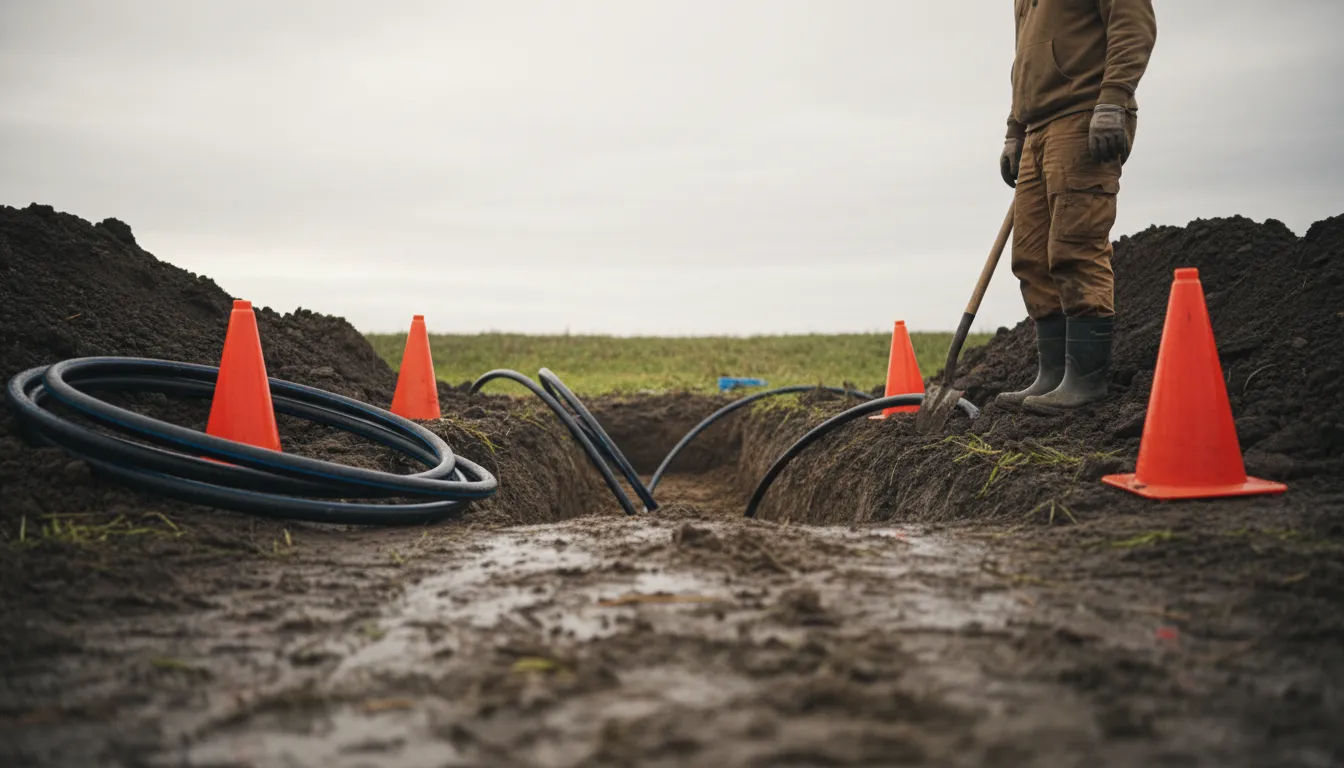
- Loop Field Installation: This is the major ground work. For a horizontal system, trenches are dug. For a vertical system, a drilling rig bores deep holes. High-density polyethylene (HDPE) pipe is then installed in the trenches or boreholes and connected into a continuous loop.
- Indoor Unit Installation: The geothermal heat pump unit is installed inside your home, typically in a basement, utility room, or garage. It is connected to the ground loop and to your home's existing ductwork or hydronic distribution system 14.
- System Charging and Commissioning: The loop is filled with a water-based solution, the system is pressurized and tested for leaks, and the heat pump is started. A technician will calibrate the system for optimal performance and efficiency.
Find the perfect geothermal heat pump contractors for your needs
Get personalized recommendations and expert advice
Maintenance and Repair Considerations
Geothermal systems are known for their reliability and require less maintenance than conventional HVAC systems. Annual check-ups are recommended, focusing on the indoor components like air filters, coils, and blowers. The underground loop is virtually maintenance-free.
However, if a problem does arise, repairs require a specialist familiar with geothermal technology. Issues can be with the indoor unit (similar to traditional HVAC repairs) or, more rarely, with the ground loop itself. Loop repairs are complex and may require excavation, which is why using a certified, experienced professional for the initial installation is critical to minimize future risks 15.
Choosing the Right Loop System for Your Property
The type of ground loop installed is the most site-specific part of a geothermal system. Your installer will recommend the best option based on your land.
- Horizontal Loop: This is often the most cost-effective option if you have sufficient flat, open land. Trenches are dug about 4-6 feet deep, and pipes are laid in a series of parallel trenches 16.
- Vertical Loop: Ideal for smaller lots or where soil conditions make trenching difficult. Contractors drill boreholes 150 to 400 feet deep and insert U-shaped loops of pipe. This type is common in South Carolina and may be necessary depending on local geology.
- Pond/Lake Loop: If you have a suitable body of water, a closed loop of pipe can be submerged. This can be a very efficient and lower-cost option if conditions are right 17.
Frequently asked questions
Sources
Footnotes
-
Geothermal | Energy.SC.Gov - https://energy.sc.gov/focus-area/renewable-energy/geothermal ↩
-
Geothermal Heat Pump Pros, Cons, and Incentives - Palmetto - https://palmetto.com/home-electrification/a-guide-to-geothermal-heat-pumps-cost-pros-and-tax ↩
-
Time is Running Out for Geothermal Tax Credits! - https://www.orangetrucks.com/time-is-running-out-for-geothermal-tax-credits ↩
-
South Carolina Tax Credit - WaterFurnace - https://www.waterfurnace.com/literature/collateral/BR1509MW%E2%80%93SC-Tax-Credit-Residential.pdf ↩
-
Geothermal - https://blueridge.coop/gogeo ↩
-
South Carolina Loves Geothermal Heat Pumps - https://enertechusa.com/south-carolina-geothermal ↩
-
Save with Geothermal Heating and Cooling in South Carolina - https://www.waterfurnace.com/south-carolina ↩
-
Ground Source Heat Pump Cost: How Much Will You Pay in ... - https://www.energysage.com/heat-pumps/costs-benefits-geothermal-heat-pumps/ ↩ ↩2
-
Guide to Geothermal Heat Pumps - https://www.energy.gov/sites/prod/files/guide_to_geothermal_heat_pumps.pdf ↩
-
Geothermal Heat Pump Installation And Service | SC & NC - https://tntheatandair.com/residential/geothermal-heat-pumps/ ↩
-
Coupling Geothermal Heat Pumps (GHP) with Underground ... - https://s3.us-gov-west-1.amazonaws.com/sepub-demo-0001-124733793621-us-gov-west-1/s3fs-public/2024-02%2FEW18-5316%20Guidance%20Document_1.pdf ↩
-
What Are the Permitting Requirements Typically Needed for a Geothermal Installation? → Learn - https://lifestyle.sustainability-directory.com/learn/what-are-the-permitting-requirements-typically-needed-for-a-geothermal-installation/ ↩
-
How Much Does a Geothermal Heat Pump Cost? (2025) - https://homeguide.com/costs/geothermal-heat-pump-cost ↩
-
Ground Source Heat Pumps for New Constructions - https://www.rehagenhvac.com/blog/ground-source-heat-pumps-new-constructions ↩
-
Geothermal Heating and Cooling Services in Charleston, SC - https://www.holycityhvac.com/geothermal/heating-geothermal-heating-and-cooling ↩
-
Geothermal Heat Pump Installation (Steps, Benefits...) - https://pantherhvac.com/blog/geothermal-heat-pump-installation/ ↩
-
The Complete Guide To Geothermal Heat Pump Installation - https://ultrageothermal.com/the-complete-guide-to-geothermal-heat-pump-installation/ ↩