Find the Best Geothermal Heat Pump Contractors for Your Business
No obligation • Fast responses • Nationwide coverage

Why you can trust HVAC Firms
HVAC Firms is a leading United States resource for evaluating HVAC service providers. Our team researches companies, checks credentials, and reviews customer feedback to present clear, unbiased information. Listings and rankings are based on merit, and companies cannot pay to change our editorial content.
Search providers near you
Top Geothermal Heat Pump Contractors in Vacaville, California Ranked
A geothermal heat pump, often called a ground-source heat pump, is a highly efficient system that uses the Earth's stable underground temperature to heat and cool your home. This technology matters because it can dramatically reduce your energy bills and environmental impact while providing exceptional comfort year-round. For Vacaville residents, this guide explains how these systems work, their benefits, and how you can find qualified local professionals to assess your property and handle the installation.
Big Air Heating & Air Conditioning
1000 Detroit Ave, Concord, CA 94518
Big Air Heating & Air Conditioning is an HVAC company serving Oakland, CA, with over 20 years of experience. They provide installation, repair, and tune-up services for air conditioning, furnaces, heat pumps, boilers, mini splits, and geothermal heat pumps. Their technicians are certified, drug screened, and background checked, ensuring professional and knowledgeable service. The company works with both commercial and residential clients, offering clear pricing by the job.
Clean Air HVAC INC
428 N Buchanan Cir #1, Pacheco, CA 94553
Clean Air HVAC INC is an HVAC contractor based in Oakland, CA, providing heating and cooling solutions for residential customers. The company offers a wide range of services including installation, repair, and maintenance of furnaces, air conditioners, heat pumps, mini-split systems, and geothermal heat pumps. They also provide indoor air quality services such as air filtration, humidifiers, and ventilation systems. Clean Air HVAC INC serves the East Bay area and is experienced in handling various HVAC systems, including Lennox Healthy Climate Solutions and zoning systems.
How Geothermal Systems Work: Tapping into the Earth's Constant Temperature
The core principle behind a geothermal heating and cooling system is remarkably simple: it moves heat, rather than creating it by burning fuel. Just a few feet below the surface, the Earth maintains a nearly constant temperature of 50-60°F, regardless of Vacaville's hot summer days or cooler winter nights 1. A geothermal system uses this stable resource as a heat source in winter and a heat sink in summer.
The process involves three key components:
- The Ground Loop: A network of pipes buried in your yard, circulating a water-based fluid.
- The Heat Pump Unit: Located inside your home, this device concentrates and transfers heat.
- The Distribution System: Your existing ductwork or radiant floor system that delivers conditioned air.
In the heating mode, the fluid in the underground pipes absorbs the Earth's warmth. This warm fluid is pumped to the indoor heat pump unit, where a refrigerant cycle extracts and concentrates the heat, which is then blown through your ducts 2. For cooling, the process reverses: the system extracts heat from your home's air, transfers it to the fluid in the loop, and deposits it into the cooler ground 3. This efficient exchange is why geothermal heat pumps, or geoexchange systems, are so effective.
Types of Ground Loop Systems for Vacaville Properties
The design of the underground piping, or ground loop, is critical and depends on your land's characteristics. There are two primary types of closed-loop systems, and one open-loop option, each with different space and geological requirements.
Closed-Loop Horizontal Systems
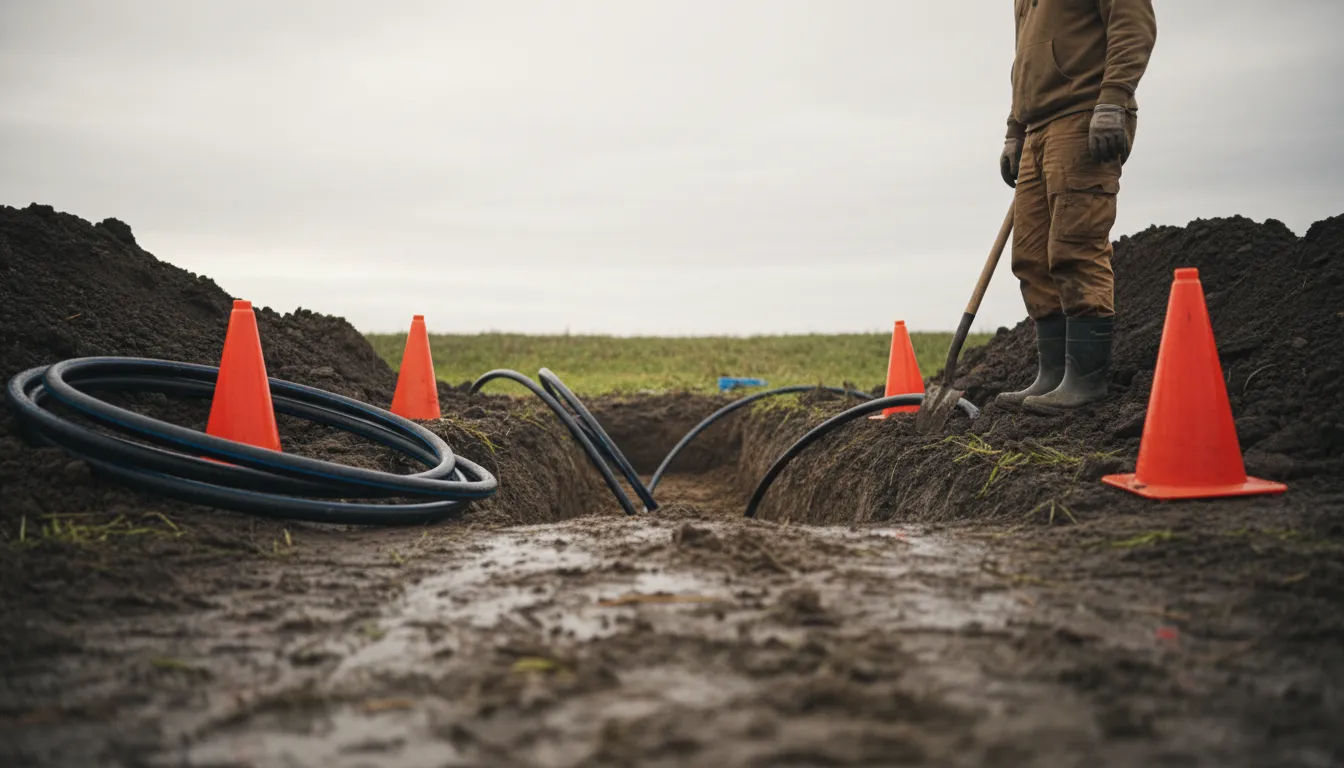
This is often the most cost-effective installation method if you have sufficient land. Contractors dig trenches four to six feet deep and lay pipes in a series of loops. While trenching is generally less expensive than drilling, it requires a larger, clear area of your property 4 5. This makes it a great option for homes in Vacaville with spacious yards.
Closed-Loop Vertical Systems
For homes with smaller lots, a vertical ground-source heat pump system is the ideal solution. Installers drill boreholes 100 to 400 feet deep and insert U-shaped loop pipes into each hole 6. Although the drilling process is more expensive upfront than trenching, it minimizes landscape disruption and is perfect for properties with limited horizontal space. It's also highly efficient due to the deep, stable ground temperatures.
Open-Loop Systems
An open-loop system uses groundwater from a well as the direct heat exchange fluid. It pumps water from an aquifer, runs it through the heat pump, and then discharges it back into a second well or a suitable surface body of water. This can be the most thermally efficient option, but it requires an adequate supply of clean water, appropriate discharge conditions, and often more complex local permits.
The Installation Process: From Site Survey to Comfort
Installing a geothermal HVAC system is a significant project that requires expert planning and execution. Reputable local installers follow a meticulous process to ensure optimal performance and longevity.
- Site Evaluation & Design: A certified technician will assess your property, including soil composition, lot size, and existing HVAC ductwork. They will perform a Manual J load calculation to determine your home's exact heating and cooling needs and design the appropriate loop field and system size.
- Loop Field Installation: This is the major excavation phase. For a horizontal system, a backhoe digs the trench network. For a vertical system, a drilling rig creates the boreholes. The high-density polyethylene pipes are then placed, connected, and pressure-tested to ensure there are no leaks before the trenches or holes are backfilled.
- Indoor Unit & Connection: The geothermal heat pump unit, which is typically compact and quiet, is installed in your garage, basement, or utility closet. The technicians connect it to the ground loop piping, your home's electrical system, and the existing ductwork or air handler 7.
- System Startup & Commissioning: Finally, the system is charged with refrigerant, powered on, and meticulously tested. The installer will calibrate the thermostat and controls and walk you through the system's operation and maintenance requirements.
Find the perfect geothermal heat pump contractors for your needs
Get personalized recommendations and expert advice
The Compelling Benefits for Vacaville Homeowners
Investing in a geothermal system offers a powerful combination of financial savings, environmental stewardship, and long-term reliability.
- Substantial Energy Savings: This is the most significant advantage. By leveraging the Earth's free thermal energy, geothermal heat pumps can reduce your energy consumption for heating and cooling by 40% to 70% compared to conventional systems 8 9. For many households, this can translate to annual savings of over $1,000 on utility bills, making a major dent in the cost of ownership over time 10 11.
- Reduced Environmental Impact: Geothermal systems run on electricity and eliminate the need for on-site combustion of fossil fuels like natural gas. When paired with a renewable electricity source like solar panels, your home's heating and cooling can operate with a near-zero carbon footprint. Some Vacaville homeowners report that pairing geothermal with solar creates a synergistic effect, maximizing their energy independence and savings 12.
- Exceptional Longevity and Low Maintenance: The underground loop system is incredibly durable, with a lifespan of 25 to 50 years or more-often outlasting the home itself 13. The indoor heat pump unit also boasts a long life, typically exceeding 20 years, which is considerably longer than standard air conditioners and furnaces. Maintenance is straightforward, involving routine air filter changes and periodic checks by a qualified technician 14.
Is a Geothermal System Right for Your Home?
While the benefits are clear, a ground-source heat pump is a major investment. The ideal candidate is a homeowner who plans to stay in their home long enough to realize the full payback from energy savings, which can be accelerated by available federal tax credits and potential local utility rebates. Your property must also be suitable for installing a ground loop, whether horizontal or vertical. The best next step is to consult with a qualified Vacaville-based geothermal installer who can provide a detailed site assessment and a customized cost-benefit analysis for your specific home.
Frequently asked questions
Sources
Footnotes
-
5 Things You Should Know about Geothermal Heat Pumps - https://www.energy.gov/cmei/articles/5-things-you-should-know-about-geothermal-heat-pumps ↩
-
How a Geothermal Heat Pump Works | This Old House - https://www.youtube.com/watch?v=d5Tbsx3R2T8 ↩
-
How Geothermal Heat Pumps Work - https://www.youtube.com/watch?v=XxlTnBukweI&t=37 ↩
-
Geothermal Heat Pumps - Department of Energy - https://www.energy.gov/energysaver/geothermal-heat-pumps ↩
-
How Do Geothermal Systems Work for Residential Homes? - https://www.davisheat.com/blog/how-do-geothermal-systems-work-for-residential-homes/ ↩
-
Geothermal Heat Pump and Ground Loop Technologies - https://efiling.energy.ca.gov/GetDocument.aspx?tn=73451 ↩
-
Geothermal Installation Steps Explained - https://ultrageothermal.com/geothermal-installation-steps-explained/ ↩
-
The California Buyers Guide to Geothermal Heat Pump Systems - https://www.californiageo.org/wp-content/uploads/CA-Buyers-Guide-for-Geothermal-HP-revised-12-13-24.pdf ↩
-
How Does A Geothermal Heat Pump Work? Complete 2025 Guide - https://solartechonline.com/blog/how-does-geothermal-heat-pump-work/ ↩
-
Geothermal Heating, Cooling, and Hot Water Systems - https://igshpa.org/wp-content/uploads/Homeowners-Guide-to-Geothermal.pdf ↩
-
Geothermal Heating in Ontario: Cost, Benefits & Why It's a Smart Investment - https://www.bapheating.ca/blogs/geothermal-heating-in-ontario-cost-benefits-why-it-s-a-smart-investment ↩
-
All You Need to Know About Home Geothermal Heating & ... - https://dandelionenergy.com/all-you-need-to-know-about-home-geothermal-heating-cooling ↩
-
Guide to Geothermal Heat Pumps - https://www.energy.gov/sites/prod/files/guide_to_geothermal_heat_pumps.pdf ↩
-
Geothermal Systems - Wally Falke's Heating & Air Conditioning - https://wallyfalkes.com/geothermal-heat-pumps/ ↩