Find the Best Geothermal Heat Pump Contractors for Your Business
No obligation • Fast responses • Nationwide coverage

Why you can trust HVAC Firms
HVAC Firms is a leading United States resource for evaluating HVAC service providers. Our team researches companies, checks credentials, and reviews customer feedback to present clear, unbiased information. Listings and rankings are based on merit, and companies cannot pay to change our editorial content.
Search providers near you
Top Geothermal Heat Pump Contractors in Santa Clarita, California Ranked
Geothermal heat pumps, also known as ground-source heat pumps, offer a remarkably efficient way to heat and cool your Santa Clarita home by tapping into the Earth's stable underground temperature. This technology can significantly reduce your energy bills and environmental footprint compared to conventional air conditioners and furnaces. This guide explains how these systems work, what installation entails, and how you can find qualified local professionals to assess your property for a geothermal solution.
Just Rite Air Heating & Cooling Santa Clarita
25030 Avenue Stanford suite 70, Santa Clarita, CA 91355
Just Rite Air Heating & Cooling Santa Clarita provides comprehensive HVAC services in Santa Clarita, CA. They specialize in the installation, repair, and maintenance of heating and cooling systems including furnaces, air conditioners, heat pumps, boilers, ductless mini-splits, and geothermal heat pumps. Their services also cover indoor air quality solutions such as air purifiers, humidifiers, and duct cleaning. The company handles diagnostics and repairs for various HVAC components and offers system tune-ups to maintain efficiency. They serve the entire Santa Clarita Valley including Valencia, Saugus, Canyon Country, and Newhall.
Circulating Air, Inc.
7337 Varna Ave, North Hollywood, CA 91605
Circulating Air, Inc. is an HVAC company based in Los Angeles, CA, providing a wide range of heating and cooling services. They handle air conditioning and furnace installation, repair, and maintenance, including ducted central systems, ductless mini splits, and geothermal heat pumps. The company also offers indoor air quality services to improve home comfort beyond temperature control. Circulating Air, Inc. serves residential, commercial, and industrial clients with experienced technicians equipped to manage complex HVAC systems. Their planned maintenance service helps ensure reliable operation of heating and cooling equipment when needed most.
How Geothermal Systems Work: Harnessing the Earth's Energy
Unlike traditional air-source heat pumps that exchange heat with the outside air, a geothermal system uses the ground as its heat source in winter and its heat sink in summer. Just a few feet below the surface, the Earth maintains a relatively constant temperature year-round, typically between 50-60°F in this region, regardless of the scorching summer heat or occasional chilly night above ground 1. This constant temperature is the key to the system's high efficiency.
The core process involves a heat exchange loop. A fluid-usually a water and antifreeze mixture-circulates through a network of durable, high-density polyethylene (HDPE) pipes buried in your yard, known as a ground loop. In heating mode, the fluid absorbs the Earth's gentle warmth as it travels through the loop. This warmed fluid is then pumped into the heat pump unit inside your home, where a compressor concentrates the heat and a fan distributes warm air through your ducts. For cooling, the process simply reverses: the system extracts heat from your home's air and transfers it into the cooler fluid, which then dissipates the heat into the ground 2. This elegant exchange provides comfortable, consistent indoor temperatures with far less electricity than conventional systems.
Types of Ground Loop Systems
The buried pipe network is the heart of the installation, and its configuration depends on your property's characteristics. There are two primary categories: closed-loop and open-loop systems.
Closed-Loop Systems are by far the most common for residential installations in Santa Clarita. In this design, the fluid is permanently sealed within the HDPE loop, creating a continuous, environmentally separate circuit. There are three main configurations:
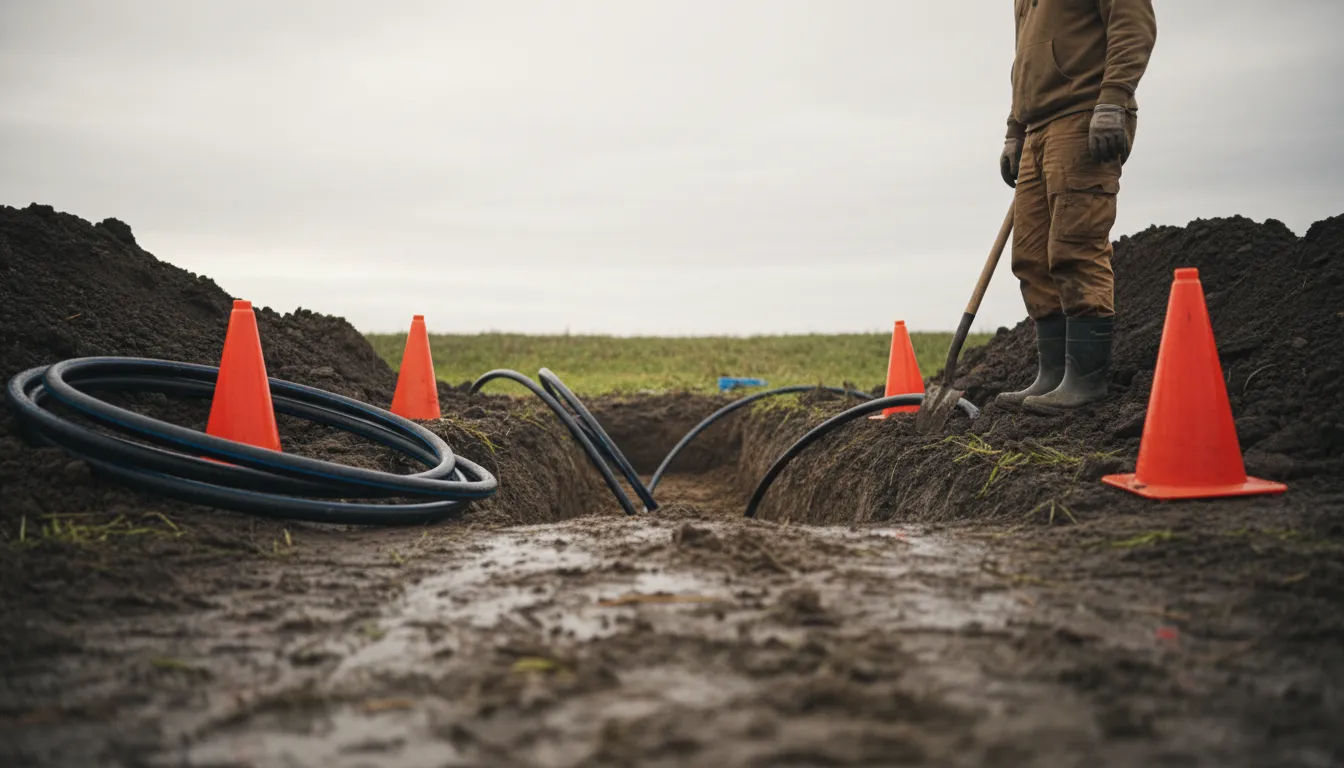
- Horizontal: Pipes are laid in trenches dug 4 to 8 feet deep. This requires a larger amount of usable land but is often less expensive than drilling if the space is available.
- Vertical: For homes with smaller lots, contractors drill boreholes typically 200 to 500 feet deep and insert U-shaped loops of pipe into each hole. This minimizes landscape disturbance and is ideal for properties with limited horizontal space.
- Pond/Lake: If you have a suitable body of water on your property, coils of pipe can be submerged at the bottom. This can be a cost-effective option, but it requires specific water depth and quality conditions 3 4.
Open-Loop Systems utilize groundwater directly. They pump water from a well or a pond, run it through the heat pump once to exchange heat, and then discharge it to a second well, a drainage ditch, or back to the pond 5. While potentially very efficient, these systems are less common due to the need for an adequate, consistent water supply and compliance with local codes regarding water discharge.
The Installation Process for Santa Clarita Homes
Installing a geothermal heating and cooling system is a significant project that requires careful planning and expert execution. The process typically follows these key steps:
- Site Assessment and Design: A qualified installer will evaluate your property, considering soil composition, lot size, landscaping, and accessibility. They will determine the optimal loop type (horizontal vs. vertical) and size the system correctly for your home's heating and cooling loads.
- Drilling or Trenching: This is the most visible phase. For a vertical system, a drilling rig will create the necessary boreholes. For a horizontal system, a backhoe will dig the long trenches. The soil conditions in your specific area of Santa Clarita can impact the time and cost of this step 6.
- Loop Installation: The HDPE piping is carefully placed into the boreholes or trenches. The pipes are connected into a continuous loop, pressure-tested for leaks, and then backfilled with a special grout (for vertical loops) or soil 7 8.
- Heat Pump and Ductwork Connection: The indoor heat pump unit is installed, typically in a garage, basement, or mechanical closet. The ground loop pipes are connected to this unit, which is also integrated with your home's existing or new ductwork 9.
- System Commissioning: Finally, the installer fills the loop with fluid, starts the system, and meticulously tests and balances it to ensure optimal performance, efficiency, and comfort 10.
Find the perfect geothermal heat pump contractors for your needs
Get personalized recommendations and expert advice
Key Considerations for Santa Clarita Property Owners
Several local factors influence the feasibility and design of a geothermal system.
- Property Size & Layout: The amount of available land is the primary driver in choosing between horizontal and vertical loops. A spacious, flat yard may accommodate a horizontal system, while a compact or sloped lot will likely require vertical drilling 11.
- Soil and Rock Conditions: The geology of your lot affects drilling speed and cost. Sandy soil is easier to trench through than dense clay or bedrock, which may require specialized drilling equipment 12.
- New Construction vs. Retrofit: Integrating a ground-source heat pump is most straightforward during the building of a new home or a major renovation, as the yard is already a worksite and ductwork can be planned accordingly. Retrofits into existing homes are absolutely possible but require careful planning to manage the landscaping impact 13.
- System Longevity and Value: One of the most compelling advantages is durability. The indoor heat pump unit often lasts 20 years or more, while the underground polyethylene piping can have a lifespan exceeding 50 years-essentially the life of the home. This longevity, combined with massive energy savings, can also add to your property's value.
Understanding Costs and Long-Term Savings
The upfront investment for a geothermal heat pump system is higher than that of a standard HVAC system, primarily due to the ground loop installation. However, this cost is offset by dramatic operational savings and incentives.
Homeowners can see reductions in their heating and cooling energy bills by up to 65% compared to conventional electric resistance heating and standard air conditioning 14 15. The payback period-the time it takes for energy savings to equal the initial investment-often falls in the range of 5 to 10 years, after which you enjoy significantly lower utility bills for decades 14 16. Furthermore, these systems are exceptionally quiet, provide excellent dehumidification in summer, and may qualify for federal tax credits and local utility rebates, which help improve the financial return.
Frequently asked questions
Sources
Footnotes
-
Geothermal Heat Pumps - EnergySmart CNY - https://www.energysmartcny.org/heat-pumps/geothermal/ ↩
-
How a Geothermal Heat Pump Works | This Old House - https://www.youtube.com/watch?v=d5Tbsx3R2T8 ↩
-
Geothermal Heat Pump and Ground Loop Technologies - https://efiling.energy.ca.gov/GetDocument.aspx?tn=73451 ↩
-
Geothermal heating & cooling, heat pumps, heat exchange ... - https://aztechgeo.com/residential-geothermal/how-it-works/ ↩
-
How to Compare Geothermal Heat Pumps - EnergySage - https://www.energysage.com/heat-pumps/compare-geothermal-heat-pumps/ ↩
-
How Geothermal Heating and Cooling Systems Work | Belle Air - https://www.belleairservices.com/how-geothermal-heating-and-cooling-systems-work/ ↩
-
All You Need to Know About Home Geothermal Heating & ... - https://dandelionenergy.com/all-you-need-to-know-about-home-geothermal-heating-cooling ↩
-
A Real Homeowner's Geothermal Installation Experience [2021] - https://radiantfamilyhome.com/geothermal-installation/ ↩
-
Geothermal Installer | San Jose, CA | Coldcraft Inc. - https://coldcraft.com/renewable-hvac/geothermal-residential/ ↩
-
Clean Energy 101: Geothermal Heat Pumps - RMI - https://rmi.org/clean-energy-101-geothermal-heat-pumps/ ↩
-
Ground Source Heat Pump Cost: How Much Will You Pay in 2025? - https://www.energysage.com/heat-pumps/costs-benefits-geothermal-heat-pumps/ ↩
-
Ground-Source Heat Pumps: Are They Green? - https://www.buildinggreen.com/feature/ground-source-heat-pumps-are-they-green ↩
-
The Complete Guide To Geothermal Heat Pump Installation - https://ultrageothermal.com/the-complete-guide-to-geothermal-heat-pump-installation/ ↩
-
5 Things You Should Know about Geothermal Heat Pumps - https://www.energy.gov/cmei/articles/5-things-you-should-know-about-geothermal-heat-pumps ↩ ↩2
-
Geothermal Heat Pumps - Department of Energy - https://www.energy.gov/energysaver/geothermal-heat-pumps ↩
-
Guide to Geothermal Heat Pumps - https://www.energy.gov/sites/prod/files/guide_to_geothermal_heat_pumps.pdf ↩