Find the Best Geothermal Heat Pump Contractors for Your Business
No obligation • Fast responses • Nationwide coverage

Why you can trust HVAC Firms
HVAC Firms is a leading United States resource for evaluating HVAC service providers. Our team researches companies, checks credentials, and reviews customer feedback to present clear, unbiased information. Listings and rankings are based on merit, and companies cannot pay to change our editorial content.
Search providers near you
Top Geothermal Heat Pump Contractors in Turlock, California Ranked
A geothermal heat pump, also known as a ground-source heat pump, is a highly efficient system for heating and cooling your Turlock home by exchanging heat with the stable temperature of the earth. This technology matters because it can dramatically reduce your energy bills and environmental footprint while providing exceptional comfort year-round. This guide will help you understand how these systems work, what installation involves, and how to connect with qualified local professionals who can assess your property.
How Geothermal Systems Work in Turlock's Climate
The principle behind a geothermal heating and cooling system is elegant in its simplicity. It leverages the fact that just a few feet below the surface, the earth in Turlock maintains a nearly constant, moderate temperature year-round, typically between 55°F and 70°F. This thermal stability is the system's powerhouse.
Here's the basic process:
- Heat Exchange: A loop of durable piping, buried in your yard, is filled with a water-based solution. This fluid circulates through the loop, absorbing heat from the warmer ground in the winter.
- Heat Pump Action: The warmed fluid returns to an indoor heat pump unit. The heat pump uses a refrigeration cycle-powered by a small amount of electricity-to concentrate this low-grade heat and transfer it to your home's air or water distribution system 1.
- Cooling Mode: In the summer, the process reverses. The system extracts heat from your home's air and transfers it into the cooler fluid in the ground loop, which then dissipates the heat into the earth.
This direct exchange with the earth's stable temperature is what makes geothermal technology vastly more efficient than conventional air-source heat pumps or furnaces that must work against extreme outdoor air temperatures.
Types of Ground Loop Systems
The buried pipe network, or ground loop, is the heart of the system. The right type for your Turlock property depends on your lot size, soil conditions, and budget. The three main configurations are:
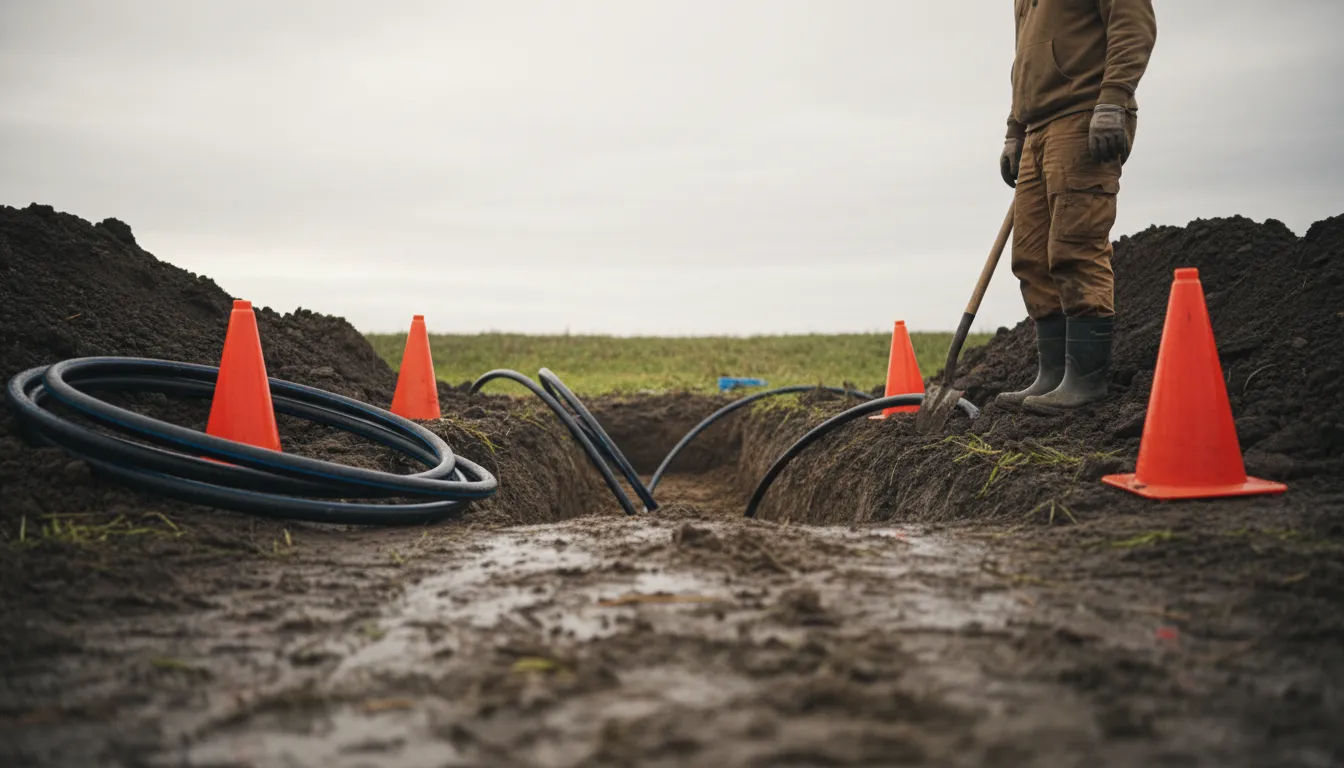
Horizontal Closed Loop This is often the most cost-effective option if space allows. Contractors excavate long trenches, typically 4 to 6 feet deep, and lay loops of pipe in them 2. This method requires a significant amount of open land, making it ideal for larger lots, new construction projects, or rural properties around Turlock.
Vertical Closed Loop For properties with limited yard space, such as many urban or suburban lots in Turlock, a vertical loop is the standard solution. Contractors use a drilling rig to bore holes 150 to 500 feet deep 3 4. U-shaped pipe loops are inserted into each borehole, which are then grouted. This method minimizes landscape disruption and is less dependent on surface area, though drilling costs can be higher 5.
Open Loop System An open-loop system uses groundwater from a well as the direct heat exchange fluid. After passing through the heat pump, the water is returned to a second well (recharge well) or discharged to a pond or stream, where permitted 6. This can be a highly efficient option, but it requires a sufficient supply of clean water and compliance with local codes regarding water use and discharge, which can be a consideration in California's Central Valley.
The Installation Process: What to Expect
Installing a geothermal system is a significant project that requires expert planning and execution. Here's a step-by-step overview of what a professional installation entails in Turlock:
-
Comprehensive Site Assessment: A qualified installer will begin with a thorough evaluation of your property. This includes assessing soil composition and thermal conductivity, determining the heating and cooling "load" of your home, identifying available space for a loop field, and locating all underground utilities. This assessment is critical for designing an efficient and properly sized system.
-
Loop Field Installation: This is the major earthwork phase. For a vertical system, a drill rig will create the necessary boreholes. For a horizontal system, a backhoe or trencher will excavate the designated area. The high-density polyethylene pipes are then laid, connected, and pressure-tested before the trenches or boreholes are carefully backfilled.
-
Indoor Unit Installation: The geothermal heat pump unit itself is typically installed indoors, similar to a furnace, often in a basement, garage, or utility closet. The installer will connect it to the ground loop piping and to your home's existing ductwork or hydronic (water-based) distribution system. Many advanced units, like the WaterFurnace Synergy3D, can also provide a significant portion of your home's domestic hot water as a bonus 7.
-
System Startup and Commissioning: Once everything is connected, the contractor will charge the system with fluid, power it up, and meticulously calibrate it. They will test all modes of operation, check refrigerant levels, and ensure the controls are properly set for optimal performance and efficiency 8.
Find the perfect geothermal heat pump contractors for your needs
Get personalized recommendations and expert advice
Benefits for Turlock Homeowners
Investing in a geothermal heat pump system offers a compelling array of advantages that go beyond simple temperature control.
Substantial Energy Savings This is the most significant benefit for most homeowners. By tapping into the earth's consistent temperature, geothermal systems operate with remarkable efficiency. They can reduce energy consumption for heating, cooling, and hot water by up to 70% compared to conventional systems like standard air conditioners and electric furnaces 9 10. While the upfront cost is higher, these savings often allow the system to pay for itself through lower utility bills in an estimated 5 to 10 years10 11.
Exceptional Durability and Low Maintenance The longevity of a geothermal system is outstanding. The underground polyethylene loop piping is renowned for its durability and often comes with warranties of 50 years or more 12. The indoor heat pump components, sheltered from the outdoor elements, also enjoy a longer service life-typically 20 to 25 years-compared to the 15-year average lifespan of an outdoor air conditioner condenser 12. Routine maintenance is similar to a standard HVAC system, involving filter changes and periodic check-ups by a technician.
Enhanced Comfort and Environmental Stewardship Geothermal systems provide consistent, even heating and cooling without the drafts and temperature swings associated with fossil fuel systems. They operate very quietly, with the noisiest component (the indoor fan) located inside your home. Furthermore, by drastically reducing electricity or natural gas consumption, you significantly lower your household's carbon footprint, making it one of the cleanest and most sustainable comfort solutions available 13.
Is a Geothermal System Right for Your Home?
Geothermal technology is versatile and can be adapted to many situations, but it's not a one-size-fits-all solution. It is an excellent long-term investment for homeowners in Turlock who:
- Plan to stay in their home long enough to realize the payback from energy savings.
- Are building a new home or significantly renovating, as this allows for easier integration of the ground loop.
- Have sufficient property for a horizontal loop or acceptable conditions for vertical drilling.
- Are motivated by long-term savings, increased home value, and environmental benefits.
- Are replacing an aging, inefficient HVAC system and want a comprehensive, future-proof upgrade.
A consultation with a experienced local installer is essential. They can provide a detailed analysis of your property's suitability, accurate cost estimates, and projections of your potential energy savings based on Turlock's specific climate and utility rates.
Frequently asked questions
Sources
Footnotes
-
How Geothermal Heat Pumps Work - https://www.youtube.com/watch?v=XxlTnBukweI&t=37 ↩
-
All You Need to Know About Home Geothermal Heating & ... - https://dandelionenergy.com/all-you-need-to-know-about-home-geothermal-heating-cooling ↩
-
How Does A Geothermal Heat Pump Work? Complete 2025 Guide - https://solartechonline.com/blog/how-does-geothermal-heat-pump-work/ ↩
-
Geothermal Installation Steps Explained - https://ultrageothermal.com/geothermal-installation-steps-explained/ ↩
-
Ground source heat pumps: horizontal collectors Vs. vertical boreholes - https://www.mesh-energy.com/insights/ground-source-heat-pumps-horizontal-collectors-vs-vertical-boreholes ↩
-
Geothermal Heat Pumps - EnergySmart CNY - https://www.energysmartcny.org/heat-pumps/geothermal/ ↩
-
Geothermal Heat Pumps | Install & Repair | Turlock, CA - https://drayhvac.com/residential/geothermal-heat-pumps/ ↩
-
Geothermal Heat Pump Installation: What To Expect For Your ... - https://jomory.com/geothermal-heat-pump-installation-what-to-expect-for-your-property/ ↩
-
Geothermal Heating And Cooling - https://flocksheating.com/geothermal/ ↩
-
Geothermal Heat Pumps - Department of Energy - https://www.energy.gov/energysaver/geothermal-heat-pumps ↩ ↩2
-
How Does a Geothermal System Work? - ClimateMaster - https://www.climatemaster.com/homeowner/side-links/how-it-works ↩
-
How Geothermal Heating and Cooling Systems Work | Belle Air - https://www.belleairservices.com/how-geothermal-heating-and-cooling-systems-work/ ↩ ↩2
-
The California Buyers Guide to Geothermal Heat Pump Systems - https://www.californiageo.org/wp-content/uploads/CA-Buyers-Guide-for-Geothermal-HP-revised-12-13-24.pdf ↩