Find the Best Geothermal Heat Pump Contractors for Your Business
No obligation • Fast responses • Nationwide coverage

Why you can trust HVAC Firms
HVAC Firms is a leading United States resource for evaluating HVAC service providers. Our team researches companies, checks credentials, and reviews customer feedback to present clear, unbiased information. Listings and rankings are based on merit, and companies cannot pay to change our editorial content.
Search providers near you
Top Geothermal Heat Pump Contractors in Thousand Oaks, California Ranked
A geothermal heat pump, also known as a ground-source heat pump, is a highly efficient heating and cooling system that leverages the stable temperature of the earth. For Thousand Oaks homeowners, this technology offers a path to dramatically lower energy bills, increased home comfort, and a reduced carbon footprint. This guide explains how these systems work, what installation entails, and how you can find qualified local professionals to evaluate your property for this sustainable upgrade.
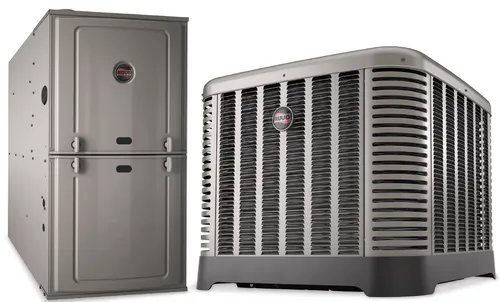
Just Rite Air Heating & Cooling Santa Clarita
25030 Avenue Stanford suite 70, Santa Clarita, CA 91355
Just Rite Air Heating & Cooling Santa Clarita provides comprehensive HVAC services in Santa Clarita, CA. They specialize in the installation, repair, and maintenance of heating and cooling systems including furnaces, air conditioners, heat pumps, boilers, ductless mini-splits, and geothermal heat pumps. Their services also cover indoor air quality solutions such as air purifiers, humidifiers, and duct cleaning. The company handles diagnostics and repairs for various HVAC components and offers system tune-ups to maintain efficiency. They serve the entire Santa Clarita Valley including Valencia, Saugus, Canyon Country, and Newhall.
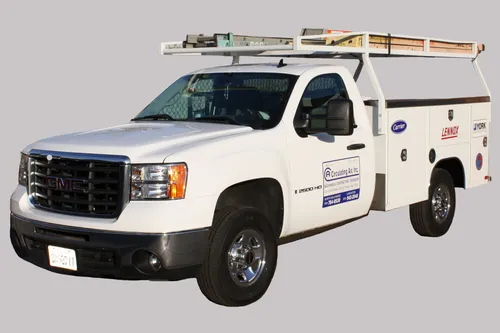
Circulating Air, Inc.
7337 Varna Ave, North Hollywood, CA 91605
Circulating Air, Inc. is an HVAC company based in Los Angeles, CA, providing a wide range of heating and cooling services. They handle air conditioning and furnace installation, repair, and maintenance, including ducted central systems, ductless mini splits, and geothermal heat pumps. The company also offers indoor air quality services to improve home comfort beyond temperature control. Circulating Air, Inc. serves residential, commercial, and industrial clients with experienced technicians equipped to manage complex HVAC systems. Their planned maintenance service helps ensure reliable operation of heating and cooling equipment when needed most.
How Geothermal Systems Work: Tapping into Earth's Constant Temperature
The core principle behind a geothermal heating and cooling system is remarkably simple: it uses the earth as a renewable energy source. Just a few feet below the surface in Thousand Oaks, the ground maintains a nearly constant temperature year-round, typically between 50°F and 70°F. This stable thermal mass acts as a natural heat source in the winter and a heat sink in the summer.
The process relies on a heat transfer loop. A water-based solution circulates through a network of pipes buried in your yard, called a ground loop. In the winter, this fluid absorbs the earth's stored heat and carries it to the heat pump unit inside your home. The unit then concentrates this low-grade heat and distributes warm air through your ductwork. In the summer, the system reverses, pulling heat from your home and transferring it into the cooler ground, effectively providing air conditioning 1. This efficient exchange is why geothermal systems can use up to 70% less energy than traditional HVAC systems.
Types of Ground Loop Systems for Thousand Oaks Properties
The underground pipe network is the heart of the system, and its design depends on your property's characteristics. There are three primary types of geothermal loops, each with distinct advantages.
-
Vertical Closed Loops: This is the most common choice for residential properties in Thousand Oaks, especially those with limited yard space. Contractors drill boreholes, typically 150 to 400 feet deep, and insert U-shaped pipes before backfilling them. While the drilling cost can be higher, vertical loops require minimal surface area and are less disruptive to existing landscaping.
-
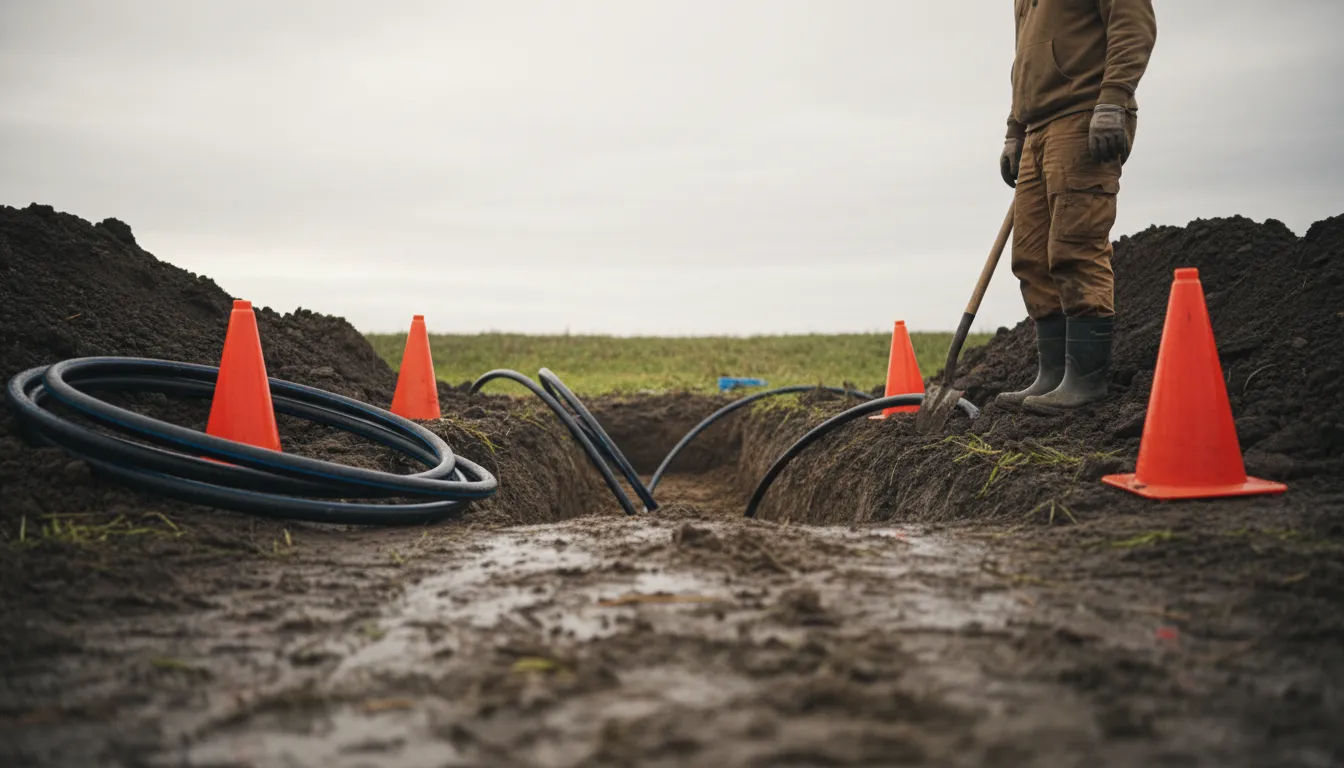
Horizontal Closed Loops: If you have ample, open land, a horizontal loop can be a more cost-effective option. Trenches are dug about six feet deep and several hundred feet long, and pipes are laid in a slinky-coil or straight-run configuration before being buried2 3. This method generally has a lower installation cost than drilling but requires a significant amount of usable land.
-
Open Loop Systems: This design uses groundwater from a well as the direct heat exchange fluid. After passing through the heat pump, the water is discharged back into a second well or a suitable surface body of water4 5. Open loop systems can be highly efficient and have lower installation costs, but they require an adequate supply of clean water and are subject to more stringent local permitting and environmental regulations.
The Geothermal Installation Process: From Assessment to Activation
Installing a ground-source heat pump is a significant project that requires careful planning and expert execution. Understanding the steps involved can help you prepare for a smooth process.
- Site Evaluation and Design: A qualified installer will first conduct a thorough assessment of your property. This includes evaluating soil composition, available land, and your home's heating and cooling loads. Based on this data, they design the optimal loop field and select the correctly sized heat pump unit.
- Permitting and Planning: Your contractor will handle securing the necessary permits from local authorities in Thousand Oaks and Ventura County. They will also create a detailed project plan and schedule.
- Ground Loop Installation: This is the major excavation phase. For a vertical system, a drilling rig will create the boreholes. For a horizontal system, a backhoe will dig the trenches. The high-density polyethylene pipes are then placed and connected into a continuous loop.
- Heat Pump and Indoor Unit Installation: The indoor heat pump unit, which is about the size of a traditional furnace, is installed in your garage, basement, or utility closet. It is connected to your home's existing ductwork or to a new duct system.
- System Connection and Commissioning: The ground loops are connected to the heat pump, and the system is filled with fluid. The installer will then power up the system, test all components for leaks and proper operation, and calibrate the controls. Finally, they will walk you through how to use your new geothermal heating and cooling system6 7.
Find the perfect geothermal heat pump contractors for your needs
Get personalized recommendations and expert advice
Understanding Costs and Long-Term Savings
The upfront investment for a geothermal system is higher than for a conventional air conditioner and furnace. For a typical Thousand Oaks home, a complete 3-ton geothermal heat pump system installation can range from $20,000 to over $40,000 8. This cost includes the ground loop, the heat pump unit, and all labor.
However, the operational savings are substantial. By leveraging the earth's stable temperature, these systems can reduce your heating and cooling energy consumption by 25% to 70%9 10. For a home using expensive propane or electric resistance heat, the monthly savings can be hundreds of dollars. The payback period-the time it takes for energy savings to equal the initial investment-typically falls between 5 and 10 years 10. This timeline can be shortened significantly by available financial incentives.
Incentives and Rebates for California Homeowners
Investing in a geothermal system in California is supported by powerful financial incentives that improve affordability.
- Federal Tax Credit: The federal Residential Clean Energy Credit provides a tax credit for 30% of the total installed cost of a qualifying geothermal heat pump system, with no upper limit11 12. This credit applies through 2034.
- Local Utility Rebates: It's essential to check with Southern California Edison (SCE) for any current rebate programs for high-efficiency heating and cooling equipment. While offerings change, utilities often provide incentives for technology that reduces peak electrical demand.
Combining these incentives can effectively reduce your net installed cost by a third or more, accelerating your return on investment and making geothermal a competitively priced option when viewed over its 20+ year lifespan.
Is a Geothermal Heat Pump Right for Your Home?
Geothermal systems are an excellent long-term investment for many Thousand Oaks residents, particularly those who:
- Plan to stay in their home long enough to realize the full payback from energy savings.
- Have high current heating costs (e.g., using propane, oil, or electric baseboards).
- Are building a new home or replacing an aging, inefficient HVAC system.
- Value consistent comfort, quiet operation, and reduced environmental impact.
- Have suitable property for a ground loop (even small lots can often accommodate vertical boreholes).
The mild winters and warm summers in Thousand Oaks are actually ideal for geothermal technology, allowing the system to operate at peak efficiency year-round. By providing both heating and cooling from one unified, fossil-fuel-free system, a ground-source heat pump offers a future-proof solution for home comfort.
Frequently asked questions
Sources
Footnotes
-
5 Things You Should Know about Geothermal Heat Pumps - https://www.energy.gov/cmei/articles/5-things-you-should-know-about-geothermal-heat-pumps ↩
-
All You Need to Know About Home Geothermal Heating & ... - https://dandelionenergy.com/all-you-need-to-know-about-home-geothermal-heating-cooling ↩
-
Geothermal Heat Pumps - EnergySmart CNY - https://www.energysmartcny.org/heat-pumps/geothermal/ ↩
-
Geothermal Systems - Wally Falke's Heating & Air Conditioning - https://wallyfalkes.com/geothermal-heat-pumps/ ↩
-
Geothermal Installation Steps Explained - https://ultrageothermal.com/geothermal-installation-steps-explained/ ↩
-
How It Works: The Geothermal Installation Process - https://www.awheatingandcooling.com/blog/geothermal-service/how-it-works-the-geothermal-installation-process/ ↩
-
Geothermal Loop Design 101 - https://precisioncomfort.com/geothermal-loop-design-101/ ↩
-
Geothermal Heat Pumps: Reputation vs. Reality - GreenBuildingAdvisor - https://www.greenbuildingadvisor.com/article/geothermal-heat-pumps-reputation-vs-reality ↩
-
Geothermal Heat Pumps - Department of Energy - https://www.energy.gov/energysaver/geothermal-heat-pumps ↩
-
How Does a Geothermal System Work? - ClimateMaster - https://www.climatemaster.com/homeowner/side-links/how-it-works ↩ ↩2
-
The California Buyers Guide to Geothermal Heat Pump Systems - https://www.californiageo.org/wp-content/uploads/CA-Buyers-Guide-for-Geothermal-HP-revised-12-13-24.pdf ↩
-
Geothermal Heat Pump Guide: Installation Costs, Types And Benefits - https://modernize.com/hvac/heating-repair-installation/heat-pump/geothermal ↩