Find the Best Geothermal Heat Pump Contractors for Your Business
No obligation • Fast responses • Nationwide coverage

Why you can trust HVAC Firms
HVAC Firms is a leading United States resource for evaluating HVAC service providers. Our team researches companies, checks credentials, and reviews customer feedback to present clear, unbiased information. Listings and rankings are based on merit, and companies cannot pay to change our editorial content.
Search providers near you
Top Geothermal Heat Pump Contractors in Temecula, California Ranked
A geothermal heat pump, or ground-source heat pump, is a highly efficient heating and cooling system that leverages the earth's stable underground temperature. For Temecula homeowners, this technology offers a powerful way to slash energy bills while maintaining year-round comfort. This guide explains how geothermal systems work, their benefits for our local climate, and how you can connect with qualified installers to explore this sustainable upgrade for your property.
How Geothermal Heating and Cooling Works in Temecula
Unlike traditional air-source systems that battle the fluctuating outdoor air temperatures, a geothermal system taps into the consistent thermal energy stored just below the earth's surface. In Temecula and across Southern California, the ground temperature remains a relatively stable 50-70°F year-round, making it an ideal energy source and sink.
The process centers on a network of buried pipes, called a ground loop, filled with a water-based fluid. In the winter, this fluid circulates through the loop, absorbing the earth's natural warmth. It then carries this heat to a heat pump unit inside your home, which concentrates it and distributes warm air through your existing ductwork. During our warm summers, the system simply reverses: the heat pump extracts heat from your indoor air and transfers it into the cooler ground loop, providing efficient air conditioning. This elegant exchange with the stable earth is why ground-source heat pumps are so remarkably efficient for both heating and cooling in our region.
Types of Ground Loop Systems
The design of the underground loop is a critical part of any geothermal installation. The right type for your Temecula property depends on factors like lot size, soil composition, and local geology. Professional installers conduct a thorough site assessment to determine the best option.
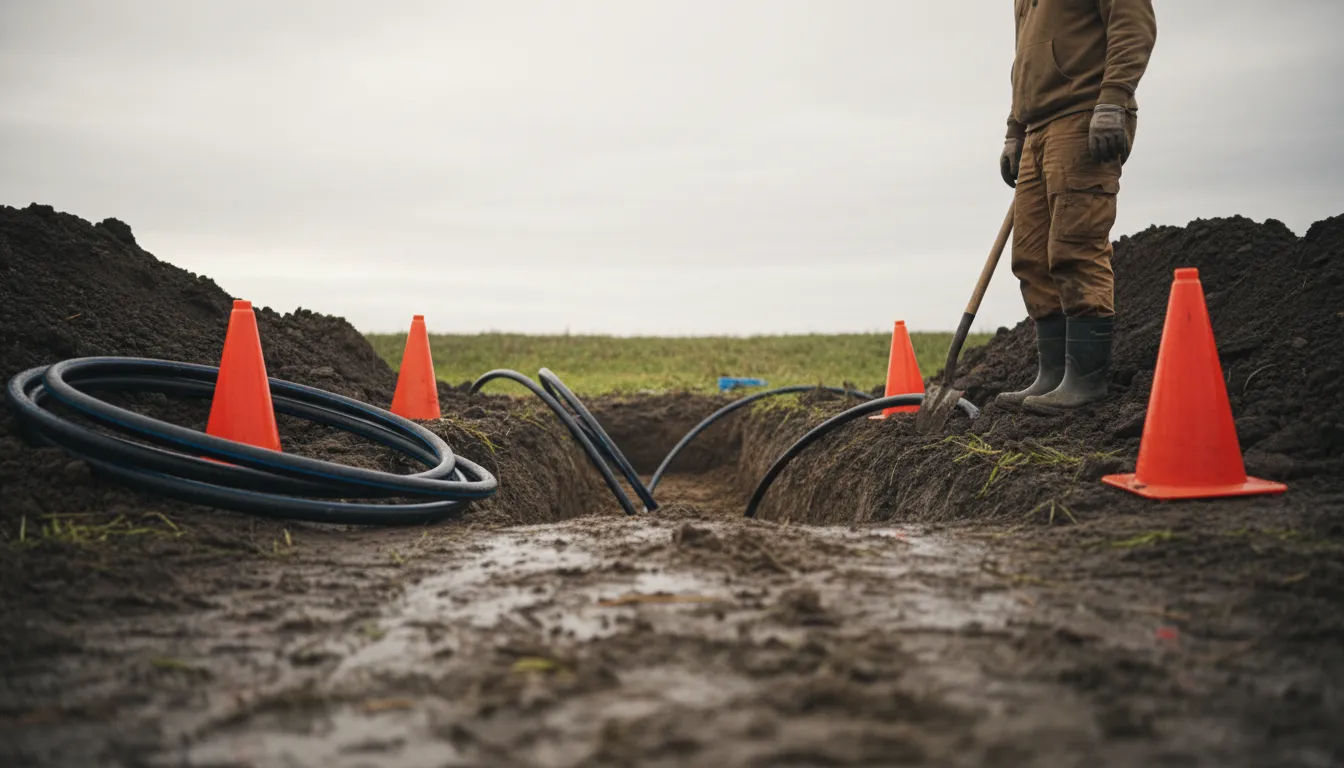
- Horizontal Loop: This is often the most cost-effective choice if space allows. Contractors dig trenches four to six feet deep and lay pipes in a series of loops. This configuration requires a larger, relatively clear area of land but involves less specialized drilling equipment 1 2.
- Vertical Loop: For properties with limited yard space, such as many in Temecula, a vertical loop is the standard solution. Installers drill boreholes, typically 150 to 400 feet deep, and insert U-shaped pipes into each one. This method minimizes surface disruption and is less dependent on available land area.
- Pond/Lake Loop: If your property has access to a suitable, sufficiently deep body of water, a closed loop can be submerged at the bottom. While an efficient option, it requires specific water conditions and is less common in our area.
The Installation Process for a Ground-Source Heat Pump
Understanding the installation steps can help you prepare for a geothermal project. Reputable local contractors will manage this multi-phase process from start to finish.
- Site Evaluation and Design: A certified installer will assess your property, evaluate soil and rock conditions, calculate your home's heating and cooling loads, and design the optimal loop field and system size.
- Loop Field Installation: For a vertical system, a drilling rig will create the necessary boreholes. For a horizontal system, a trencher will dig the required channels. The high-density polyethylene pipes are then placed, connected into a continuous loop, and pressure-tested for integrity 3 4.
- Indoor Unit Installation: The geothermal heat pump unit-which is about the size of a traditional furnace-is installed in your garage, basement, or utility closet. It connects to your existing air handler or ductwork to distribute conditioned air.
- Connection and Commissioning: The underground loop is connected to the indoor heat pump. The system is filled with its heat-transfer fluid, purged of air, and started. The contractor will test and balance the entire system to ensure optimal performance.
Find the perfect geothermal heat pump contractors for your needs
Get personalized recommendations and expert advice
Long-Term Value and Energy Savings
The most compelling reason Temecula residents consider a geothermal system is the dramatic reduction in energy costs. While the upfront investment is higher than a standard air conditioner and furnace, the long-term savings are substantial.
- Installation Cost: For a typical 2,000-square-foot home in Temecula, a complete geothermal heating and cooling system often ranges from $20,000 to $40,000 or more. The final price depends heavily on the loop type (vertical usually costs more than horizontal), the system's capacity, and the specific conditions of your property 5 6.
- Operational Savings: Homeowners can expect to reduce their energy use for heating and cooling by 30% to 65% compared to conventional systems 7 8. By leveraging the earth's constant temperature, a geothermal heat pump can deliver over four units of heating or cooling energy for every one unit of electricity it consumes. Over the 20- to 50-year life of the system, these savings can significantly offset the initial installation cost 9 10.
- Durability and Longevity: The indoor heat pump components typically last 20 years or more. The underground polyethylene loop system has an exceptionally long life expectancy of 25 to 50 years-often exceeding the lifespan of the home itself-with minimal maintenance required.
Why Temecula is Ideal for Geothermal Energy
Our local climate and geography make Temecula a prime location for ground-source heat pump technology. The region experiences both warm summers and cool winters, meaning the system works efficiently year-round. The stable subterranean temperatures provide a reliable "battery" for thermal energy, ensuring the heat pump doesn't have to work as hard as an air-source unit during a heatwave or a cold snap 11 12.
Furthermore, pairing a geothermal system with a residential solar panel array can create a near-net-zero home for energy use. The heat pump's high efficiency keeps electricity demands low, which can often be met entirely by a properly sized solar installation, leading to unparalleled energy independence and cost predictability.
Environmental Benefits
Choosing a geothermal system is also a choice for environmental stewardship. By drastically cutting electricity or natural gas consumption for home comfort, you directly reduce your household's carbon footprint. These systems have no on-site combustion, eliminating the risk of carbon monoxide and producing no direct emissions. They also use a refrigerant that is contained in a sealed, indoor unit, minimizing environmental impact. For the eco-conscious homeowner in Temecula, it's one of the most effective single upgrades for sustainable living 13.
Frequently asked questions
Sources
Footnotes
-
Geothermal Installation Steps Explained - https://ultrageothermal.com/geothermal-installation-steps-explained/ ↩
-
Geothermal Heat Pumps - Department of Energy - https://www.energy.gov/energysaver/geothermal-heat-pumps ↩
-
All You Need to Know About Home Geothermal Heating & Cooling - Dandelion Energy - https://dandelionenergy.com/all-you-need-to-know-about-home-geothermal-heating-cooling ↩
-
Geothermal Heat Pump Installation: What To Expect For Your Property - https://jomory.com/geothermal-heat-pump-installation-what-to-expect-for-your-property/ ↩
-
5 Things You Should Know about Geothermal Heat Pumps - https://www.energy.gov/cmei/articles/5-things-you-should-know-about-geothermal-heat-pumps ↩
-
Geothermal Heat Pump Guide: Installation Costs, Types And Benefits - https://modernize.com/hvac/heating-repair-installation/heat-pump/geothermal ↩
-
The California Buyers Guide to Geothermal Heat Pump Systems - https://www.californiageo.org/wp-content/uploads/CA-Buyers-Guide-for-Geothermal-HP-revised-12-13-24.pdf ↩
-
Geothermal Heating, Cooling, and Hot Water Systems - https://igshpa.org/wp-content/uploads/Homeowners-Guide-to-Geothermal.pdf ↩
-
Guide to Geothermal Heat Pumps - https://www.energy.gov/sites/prod/files/guide_to_geothermal_heat_pumps.pdf ↩
-
Geothermal Heating & Cooling - Department of Energy - https://www.energy.gov/eere/geothermal/geothermal-heating-cooling ↩
-
Geothermal Heat Pumps - EnergySmart CNY - https://www.energysmartcny.org/heat-pumps/geothermal/ ↩
-
Geothermal (Ground Source) Heat Pumps - NY.gov - https://cleanheat.ny.gov/geothermal-heat-pumps/ ↩
-
Clean Energy 101: Geothermal Heat Pumps - RMI - https://rmi.org/clean-energy-101-geothermal-heat-pumps/ ↩