
Find the Best Geothermal Heat Pump Contractors for Your Business
No obligation • Fast responses • Nationwide coverage

Why you can trust HVAC Firms
HVAC Firms is a leading United States resource for evaluating HVAC service providers. Our team researches companies, checks credentials, and reviews customer feedback to present clear, unbiased information. Listings and rankings are based on merit, and companies cannot pay to change our editorial content.
Search providers near you
Top Geothermal Heat Pump Contractors in San Jacinto, California Ranked
A geothermal heat pump is a highly efficient heating and cooling system that leverages the stable temperatures found underground. For homeowners in San Jacinto, this technology offers a reliable way to manage indoor climate year-round while significantly reducing energy consumption and utility bills. This guide explains how these systems work, their benefits, and how you can connect with qualified local professionals to explore this sustainable solution for your home.
How a Geothermal System Works: Tapping into the Earth's Energy
Unlike traditional air-source systems that exchange heat with the outside air, a ground-source heat pump uses the earth as a heat source in winter and a heat sink in summer. The ground a few feet below the surface maintains a relatively constant temperature year-round, typically between 50°F and 60°F in Southern California. This thermal stability is the key to the system's remarkable efficiency.
The process centers on a closed-loop of pipes, called the ground loop, buried on your property. A water-based fluid circulates through this loop. In the winter, this fluid absorbs the earth's natural warmth and carries it to the indoor heat pump unit. The unit then concentrates this heat and distributes it throughout your home via your ductwork. In the summer, the process reverses: the system extracts heat from your home's air, transfers it to the fluid in the loop, and disperses it into the cooler ground. This elegant exchange moves three to five units of energy for every one unit of electricity used to run the system 1.
Types of Ground Loops for San Jacinto Properties
The design of the underground loop system is critical and depends on your property's characteristics. Local installers will conduct a thorough site assessment to determine the best approach.
- Horizontal Closed Loops: This is often the most cost-effective option if sufficient land is available. Trenches are dug four to six feet deep, and pipes are laid in a series of parallel rows. This method requires a significant amount of open yard space-typically between a quarter to three-quarters of an acre 2 3 4.
- Vertical Closed Loops: For properties with limited space, like many urban or suburban lots in San Jacinto, vertical loops are the standard solution. Contractors use a drilling rig to bore holes 60 to 400 feet deep. U-shaped pipes are inserted into each borehole, which are then grouted. This method minimizes landscape disruption and is ideal for smaller yards or when bedrock is close to the surface.
- Open Loop Systems: If you have access to a sufficient supply of clean groundwater, an open loop system can be an option. It pumps water from a well, runs it through the heat pump to exchange heat, and then discharges it to a second well or a suitable surface body of water. This system requires careful evaluation of local water regulations and quality.
The Installation Process: What Homeowners Can Expect
Installing a geothermal heating and cooling system is a significant project that requires specialized expertise. Understanding the steps can help you prepare.
- Comprehensive Site Evaluation: A qualified installer will visit your property to evaluate soil conditions, lot size, landscaping, and access. This assessment determines the feasibility and optimal type of loop system (horizontal, vertical, or open) for your specific situation 5.
- System Design & Permitting: The contractor will design a system sized correctly for your home's heating and cooling loads. They will also handle pulling the necessary local permits, which are required for the drilling and electrical work involved.
- Loop Field Installation: This is the major exterior work. For a horizontal system, it involves trenching with excavators. For a vertical system, a drilling rig will be brought in to create the boreholes. While this stage temporarily disturbs your yard, the surface area is restored once the pipes are in place.
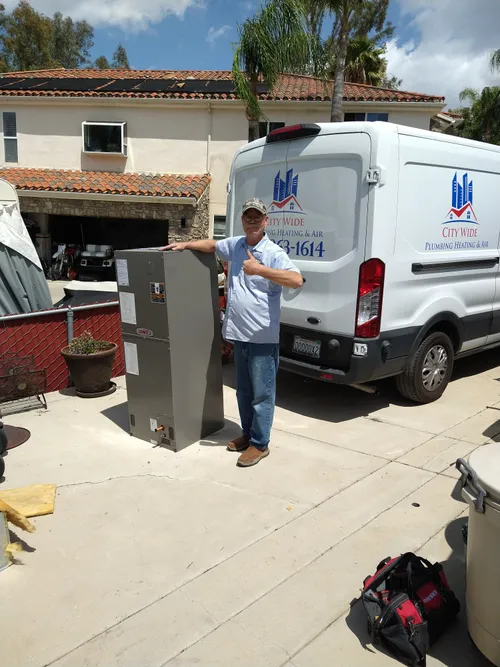
- Indoor Unit Installation: The ground-source heat pump unit itself is installed inside your home, typically in a basement, garage, or utility closet. It connects to your existing ductwork to distribute conditioned air. The system also includes a control thermostat 6.
- System Charging & Commissioning: The loop is filled and pressurized with its fluid, and the entire system is started, tested, and balanced to ensure optimal performance. The contractor will walk you through the system's operation 7.
Find the perfect geothermal heat pump contractors for your needs
Get personalized recommendations and expert advice
Financial and Environmental Benefits for San Jacinto Residents
The decision to install a geothermal system is a long-term investment in comfort, savings, and sustainability.
- Substantial Energy Savings: By leveraging the earth's consistent temperature, geothermal heat pumps operate with exceptional efficiency. Homeowners can see reductions of up to 65% on their heating and cooling bills compared to conventional systems 8. These savings help offset the higher initial investment over time.
- Long-Term Value & Payback: The upfront cost for a residential geothermal system in San Jacinto typically ranges from $15,000 to $35,000 or more, depending on the home's size and loop type 9 10. However, with dramatically lower operating costs, many systems achieve a payback period through utility savings in 5 to 10 years 9 11. Furthermore, these systems are renowned for their durability: the indoor heat pump unit often lasts 20 years or more, while the underground piping can have a lifespan exceeding 50 years with minimal maintenance 9 10.
- Eco-Friendly Comfort: Geothermal systems use renewable thermal energy from the ground, drastically reducing your home's reliance on fossil fuels and its associated carbon footprint. They also operate very quietly, with no noisy outdoor condenser unit 12.
Is a Geothermal System Right for Your Home?
Geothermal technology offers compelling advantages, but it's not a one-size-fits-all solution. It is often most cost-effective when planned during new construction or a major renovation, as the yard excavation can be coordinated with other site work. For existing homes, the feasibility depends heavily on your property's layout and access for drilling or trenching equipment.
Working with a local, experienced installer is crucial. They understand California's specific regulations, the regional geology, and can accurately assess your property's potential. They can also provide detailed information on available state and federal incentives, such as tax credits, which can significantly improve the financial outlook of your project 13.
Frequently asked questions
Sources
Footnotes
-
Geothermal Heat Pumps - EnergySmart CNY - https://www.energysmartcny.org/heat-pumps/geothermal/ ↩
-
Geothermal heat pumps: The ultimate guide to ground-source ... - https://termo-plus.com/blog/geothermal-ultimate-guide-to-ground-source-heat-pumps/ ↩
-
Ground Source Heat Pump Installation and Design Guideline - https://www.saltlakecounty.gov/globalassets/1-site-files/health/programs/construction--contractors/guidelines_gshp.pdf ↩
-
How Does A Geothermal Heat Pump Work? Complete 2025 Guide - https://solartechonline.com/blog/how-does-geothermal-heat-pump-work/ ↩
-
Geothermal Heat Pump Basics - Visalia, CA - https://jacksref.com/geothermal-heat-pump-basics/ ↩
-
How Does a Geothermal System Work? - ClimateMaster - https://www.climatemaster.com/homeowner/side-links/how-it-works ↩
-
Geothermal Heat Pump Installation: What To Expect For Your Property - https://jomory.com/geothermal-heat-pump-installation-what-to-expect-for-your-property/ ↩
-
5 Things You Should Know about Geothermal Heat Pumps - https://www.energy.gov/cmei/articles/5-things-you-should-know-about-geothermal-heat-pumps ↩
-
How Geothermal Heating and Cooling Systems Work | Belle Air - https://www.belleairservices.com/how-geothermal-heating-and-cooling-systems-work/ ↩ ↩2 ↩3
-
Geothermal Heat Pumps - Department of Energy - https://www.energy.gov/energysaver/geothermal-heat-pumps ↩ ↩2
-
Guide to Geothermal Heat Pumps - https://www.energy.gov/sites/prod/files/guide_to_geothermal_heat_pumps.pdf ↩
-
Geothermal (Ground Source) Heat Pumps - NY.gov - https://cleanheat.ny.gov/geothermal-heat-pumps/ ↩
-
The California Buyers Guide to Geothermal Heat Pump Systems - https://www.californiageo.org/wp-content/uploads/CA-Buyers-Guide-for-Geothermal-HP-revised-12-13-24.pdf ↩