Find the Best Geothermal Heat Pump Contractors for Your Business
No obligation • Fast responses • Nationwide coverage

Why you can trust HVAC Firms
HVAC Firms is a leading United States resource for evaluating HVAC service providers. Our team researches companies, checks credentials, and reviews customer feedback to present clear, unbiased information. Listings and rankings are based on merit, and companies cannot pay to change our editorial content.
Search providers near you
Top Geothermal Heat Pump Contractors in Perris, California Ranked
A geothermal heat pump, also known as a ground-source heat pump, is a highly efficient system that uses the earth's stable underground temperature to heat and cool your home. This technology matters because it can dramatically reduce your energy bills and environmental impact, offering a sustainable alternative to traditional fossil-fuel systems. For Perris residents, this guide will help you understand how these systems work, the types available, and how to connect with qualified local professionals for installation and service.
NexGen HVAC & Plumbing
10820 Mulberry Ave, Fontana, CA 92337
NexGen HVAC & Plumbing is a full-service contractor based in Riverside, CA, offering a wide range of heating, cooling, and plumbing services. They handle installation, repair, and maintenance of air conditioners, heat pumps, furnaces, ductless mini-splits, and geothermal systems. Their plumbing services include leak detection, drain cleaning, sewer repair, and gas line inspection. NexGen is equipped to service both residential and commercial properties and uses advanced technology such as high-tech camera inspections for plumbing diagnostics. They provide 24/7 emergency service to address urgent HVAC and plumbing issues promptly.
Thomas Brothers HVAC & Plumbing
12625 Frederick St, Moreno Valley, CA 92553
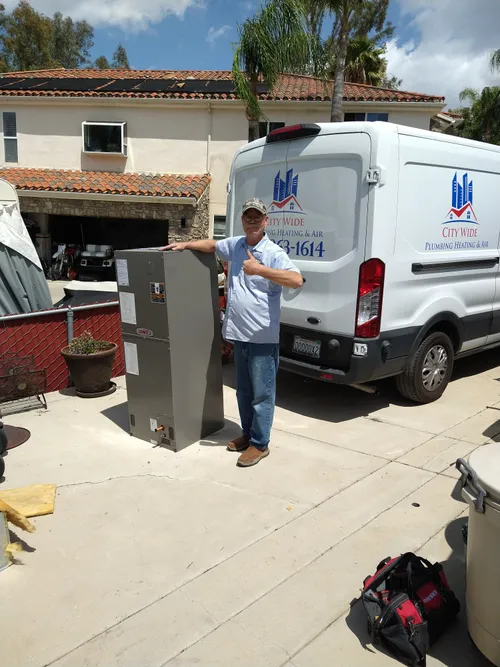
Thomas Brothers HVAC & Plumbing is a heating and cooling company located in Riverside, CA. They provide a range of services including installation and repair of air conditioners, furnaces, heat pumps, boilers, mini splits, and geothermal heat pumps. The company also offers HVAC tune-up services to maintain system efficiency. Thomas Brothers HVAC & Plumbing is bonded, insured, and licensed, ensuring compliance with industry standards.
How Geothermal Energy Works for Your Home
The core principle behind a geothermal system is remarkably simple: it leverages the earth's constant temperature. Just a few feet below the surface, the ground in Perris maintains a stable temperature between 50°F and 60°F year-round, regardless of the scorching summer heat or occasional chilly night 1. A geothermal heat pump capitalizes on this stability through a process of heat exchange.
In the winter, a fluid (often water mixed with antifreeze) circulates through a loop of pipes buried in your yard. This fluid absorbs the gentle warmth from the earth and carries it into your home. The heat pump then concentrates this warmth and distributes it through your ductwork or radiant floor system 2. In the summer, the process reverses: the system extracts heat from your indoor air and transfers it into the cooler ground loop, effectively providing air conditioning 3. Because the system is moving existing heat rather than creating it by burning fuel, it operates with exceptional efficiency.
Types of Ground Source Heat Pump Systems
Not all geothermal installations are the same. The right system for your Perris property depends heavily on your lot size, soil conditions, and budget. The main configurations are closed-loop and open-loop systems.
Closed-Loop Systems are the most common for residential use. They involve a continuous loop of pipe buried in the ground that circulates the heat-transfer fluid. There are two primary designs:
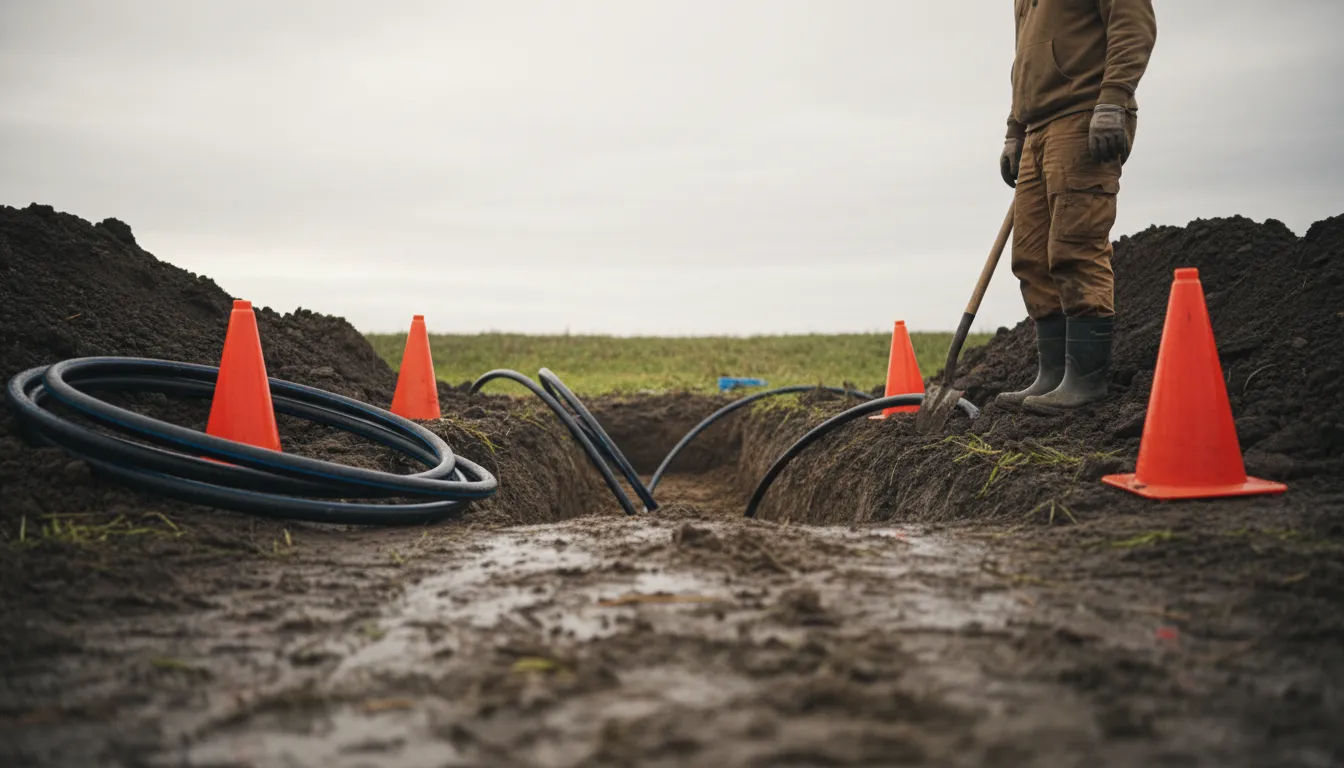
- Horizontal Loop: Pipes are laid in trenches 4 to 8 feet deep. This is often the most cost-effective installation method but requires a significant amount of land-typically between a quarter to three-quarters of an acre 4.
- Vertical Loop: Pipes are inserted into deep boreholes, usually 150 to 500 feet deep. This method is ideal for smaller lots common in many Perris neighborhoods, as it requires much less surface area. However, the need for specialized drilling equipment makes it more expensive per ton of capacity.
Open-Loop Systems use groundwater from a well as the heat exchange fluid. The water is pumped through the heat pump and then returned to the ground via a second well or a suitable discharge point. This can be the most efficient type of system, but it requires an adequate supply of clean water and compliance with local regulations regarding water use.
Hybrid Systems combine a geothermal ground loop with a supplemental air-source cooler (like a small cooling tower). This design is sometimes used for homes with exceptionally high cooling loads, optimizing performance and potentially reducing the required length of the ground loop 5.
The Installation Process: From Assessment to Operation
Installing a geothermal heating and cooling system is a significant project that requires careful planning and expert execution. The process typically follows these steps:
- Site Evaluation: A qualified installer will assess your property. They will evaluate soil composition, available land, the potential for drilling or trenching, and the condition of your home's existing ductwork or heating distribution system. For an open-loop system, they will also test water quality and flow rate.
- System Design & Loop Installation: Based on the evaluation, the installer designs the system. For a horizontal loop, excavation equipment digs the trenches, lays the piping, and backfills. For a vertical loop, a drilling rig bores the deep holes, U-shaped pipe loops are inserted, and the holes are grouted to ensure good thermal contact with the earth 6.
- Indoor Unit & Connection: The geothermal heat pump unit itself is installed inside your home, typically in a garage, basement, or utility closet. It is connected to the ground loop, your home's electrical system, and the ductwork or hydronic distribution system.
- Commissioning & Testing: Once everything is connected, the system is charged with refrigerant, powered on, and thoroughly tested to ensure it operates at peak efficiency and delivers the desired comfort throughout your home.
Find the perfect geothermal heat pump contractors for your needs
Get personalized recommendations and expert advice
Benefits and Financial Considerations for Perris Homeowners
The decision to invest in a geothermal system involves weighing higher upfront costs against long-term savings and benefits.
Substantial Energy Savings: This is the most compelling advantage. By using the earth's consistent temperature, geothermal heat pumps can achieve efficiencies 300-600% higher than the best conventional systems. Homeowners can expect to save 30% to 70% on their heating and cooling bills, with some reducing their related energy use by up to 65% 7 8. For a Perris home that might spend $200 a month on combined gas heating and electric cooling, switching to a geothermal system could slash that cost to around $50 for electricity to run the pump and fan.
High Initial Investment: The major barrier is the installation cost, which typically ranges from $20,000 to over $40,000 for a complete residential system. The ground loop excavation or drilling constitutes a large portion of this expense. This is significantly more than a standard air conditioner and furnace.
Strong Return on Investment & Added Value: While the initial outlay is high, the system pays for itself over time through utility savings. The payback period typically ranges from 4 to 15 years, depending on system design, local energy costs, and available incentives. Furthermore, a geothermal system is a permanent upgrade that increases your property's value and marketability. It also drastically reduces your home's carbon footprint by eliminating on-site fossil fuel combustion for heating 9 10.
A Perris Homeowner's Example
Consider a Perris resident with a typical suburban lot. Opting for a vertical loop system due to space constraints, their total installed cost comes to around $30,000. After installation, their old gas furnace and electric air conditioner are retired. Their new ground-source heat pump provides all their heating and cooling using only electricity to circulate fluid and compress refrigerant.
Their monthly energy bill for climate control drops from approximately $200 (for gas and electricity) to about $50 (for electricity only), completely eliminating their natural gas use for heating. At this rate, they recoup their investment in roughly 7 to 10 years. For the remaining 15-20+ years of the system's life, they enjoy drastically lower bills, superior comfort, and the knowledge that their home is operating with a much smaller environmental impact 11 12 13.
Maintaining Your Geothermal System
One of the appealing aspects of geothermal technology is its low maintenance requirements. The durable underground piping often carries warranties of 25 to 50 years and is designed to last for generations. The indoor heat pump unit requires similar maintenance to a standard HVAC system: regular filter changes and periodic check-ups by a technician to inspect components like the compressor, fan, and electrical connections. A well-maintained system can provide reliable, efficient service for over 20 years.
Frequently asked questions
Sources
Footnotes
-
How Geothermal Heat Pumps Work - https://www.youtube.com/watch?v=XxlTnBukweI&t=37 ↩
-
Ground Source Heating and Cooling - https://secondnature.org/solutions-center/geothermal-ground-source-heating-and-cooling/ ↩
-
Geothermal Heat Pumps Versus Geothermal Power Plants - https://dandelionenergy.com/geothermal-heat-pumps-versus-geothermal-power-plants ↩
-
All You Need to Know About Home Geothermal Heating & ... - https://dandelionenergy.com/all-you-need-to-know-about-home-geothermal-heating-cooling ↩
-
Geothermal Heat Pumps - Department of Energy - https://www.energy.gov/energysaver/geothermal-heat-pumps ↩
-
How Does A Geothermal Heat Pump Work? Complete 2025 Guide - https://solartechonline.com/blog/how-does-geothermal-heat-pump-work/ ↩
-
Geothermal Heating, Cooling, and Hot Water Systems - https://igshpa.org/wp-content/uploads/Homeowners-Guide-to-Geothermal.pdf ↩
-
5 Things You Should Know about Geothermal Heat Pumps - https://www.energy.gov/cmei/articles/5-things-you-should-know-about-geothermal-heat-pumps ↩
-
How it Works: Ground Source (Geothermal) Heat Pumps (GSHP) - https://www.youtube.com/watch?v=uhXUV2Xm5fQ ↩
-
Geothermal Ground Loop Design | Comfortworks, Inc. - https://comfort.works/ground-loop-design/ ↩
-
Everything You Need to Know About Geothermal Heat Pumps - https://www.familyhandyman.com/article/everything-you-need-to-know-about-geothermal-heat-pumps/ ↩
-
Geothermal Heat Pump Guide: Installation Costs, Types And Benefits - https://modernize.com/hvac/heating-repair-installation/heat-pump/geothermal ↩
-
The California Buyers Guide to Geothermal Heat Pump Systems - https://www.californiageo.org/wp-content/uploads/CA-Buyers-Guide-for-Geothermal-HP-revised-12-13-24.pdf ↩