Find the Best Geothermal Heat Pump Contractors for Your Business
No obligation • Fast responses • Nationwide coverage

Why you can trust HVAC Firms
HVAC Firms is a leading United States resource for evaluating HVAC service providers. Our team researches companies, checks credentials, and reviews customer feedback to present clear, unbiased information. Listings and rankings are based on merit, and companies cannot pay to change our editorial content.
Search providers near you
Top Geothermal Heat Pump Contractors in Cypress, California Ranked
A geothermal heat pump, also known as a ground-source heat pump, is a highly efficient heating and cooling system that leverages the earth's stable underground temperature. For Cypress homeowners, this technology offers a way to dramatically reduce energy bills while increasing home comfort and sustainability. This guide explains how these systems work, the installation options available locally, and how you can connect with qualified professionals to explore this upgrade for your property.
Moffett Plumbing & Air
13950 Milton Ave, Westminster, CA 92683
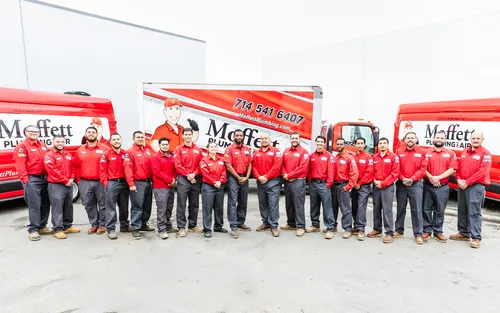
Moffett Plumbing & Air is a plumbing and HVAC company serving Long Beach, CA, and the surrounding Orange County area. They offer a wide range of services including air conditioning, furnace, heat pump, and boiler repair and installation, as well as duct cleaning, thermostat installation, indoor air quality services, and geothermal heat pump work. Established in 1969, Moffett Plumbing & Air has built a reputation for dependable service and community focus, treating customers with respect and care. Their team is known for professional workmanship and efficiency.
NexGen HVAC & Plumbing
23221 Peralta Dr Ste C, Laguna Hills, CA 92653
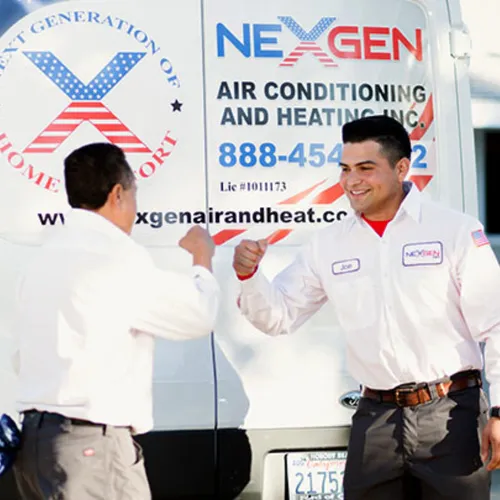
NexGen HVAC & Plumbing is a full-service heating and cooling company based in Irvine, CA. They provide installation, repair, and maintenance for a wide range of HVAC systems including traditional, electric, ductless, rooftop units, heat pumps, and geothermal systems. Their services also include air duct cleaning, thermostat installation, and HVAC tune-ups to improve system performance. NexGen HVAC & Plumbing offers insulation services for air ducts, walls, attics, and crawlspaces to enhance comfort and address issues such as mold and water leaks.
Nelson Air Heating & Air Conditioning
5062 Casa Oro Dr, Yorba Linda, CA 92886
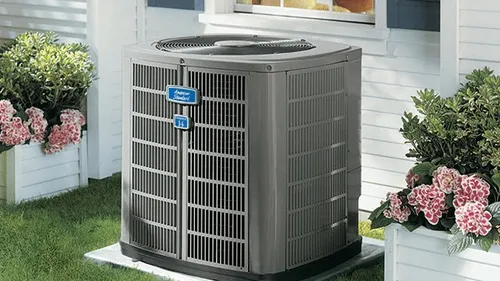
Nelson Air Heating & Air Conditioning provides HVAC installation services in Anaheim, CA. They handle installation for a variety of systems including air conditioners, furnaces, heat pumps, boilers, mini splits, and geothermal heat pumps for both residential and commercial clients. The company installs all major HVAC brands and emphasizes quality materials, efficiency, and workmanship.
Rancho Palos Verdes AC and Heating Pro
28120 Peacock Ridge Dr, Rancho Palos Verdes, CA 90275
Rancho Palos Verdes AC and Heating Pro provides heating and air conditioning services in Long Beach, CA. They offer repair, installation, and maintenance for furnaces, air conditioners, heat pumps, and geothermal systems. The company is equipped to handle HVAC tune-ups and replacements, tailoring systems to meet customer needs and budgets. Since 1997, they have served the area with a focus on quality workmanship and integrity. They also provide 24/7 emergency service with a manager available at all times for support.
Comfort Elite HVAC
1080 N Batavia St Ste N, Orange, CA 92867
Comfort Elite HVAC provides a wide range of heating, air conditioning, and indoor air quality services in Los Angeles, CA. With over 10 years of experience, they handle installation, repair, and maintenance for systems including heat pumps, furnaces, mini splits, and geothermal heating. Their services cover air duct cleaning, air purification, and refrigerant recharge, aiming to improve home comfort and air quality. Comfort Elite HVAC offers 24/7 emergency repair services and same-day responses to HVAC issues, ensuring timely assistance for heating and cooling needs.
How Geothermal Systems Work: Tapping into the Earth's Constant Temperature
The core principle behind a geothermal heating and cooling system is remarkably simple: just a few feet below the surface, the earth maintains a nearly constant temperature year-round. In Southern California, including Cypress, this ground temperature remains a stable 50-60°F regardless of the summer heat or occasional chilly night 1. A geothermal heat pump capitalizes on this consistency.
The system operates through a continuous loop of pipes, called a ground loop, buried in your yard. A water-based fluid circulates through this loop. In the winter, the fluid absorbs the earth's natural warmth and carries it to an indoor heat pump unit. The heat pump concentrates this thermal energy and distributes it as warm air through your home's ductwork or radiant floor system. The process reverses in summer; the system extracts heat from your home, transfers it to the fluid in the loop, and disperses it into the cooler ground 2 3. This efficient heat transfer process is what allows geothermal systems to achieve efficiencies of 300-500%, meaning they move multiple units of heat for every unit of electricity used 4.
Understanding Your Ground Loop Options
The buried loop system is the heart of any geothermal installation. The right configuration for your Cypress home depends on your property's size, soil conditions, and budget. There are two primary types of systems: closed-loop and open-loop.
Closed-Loop Systems This is the most common residential setup. A sealed loop of high-density polyethylene (HDPE) pipe is buried and filled with an environmentally friendly antifreeze solution. The fluid circulates continuously, exchanging heat with the ground without ever mixing with groundwater. Closed-loop systems are highly reliable and have minimal environmental impact, making them a popular choice.
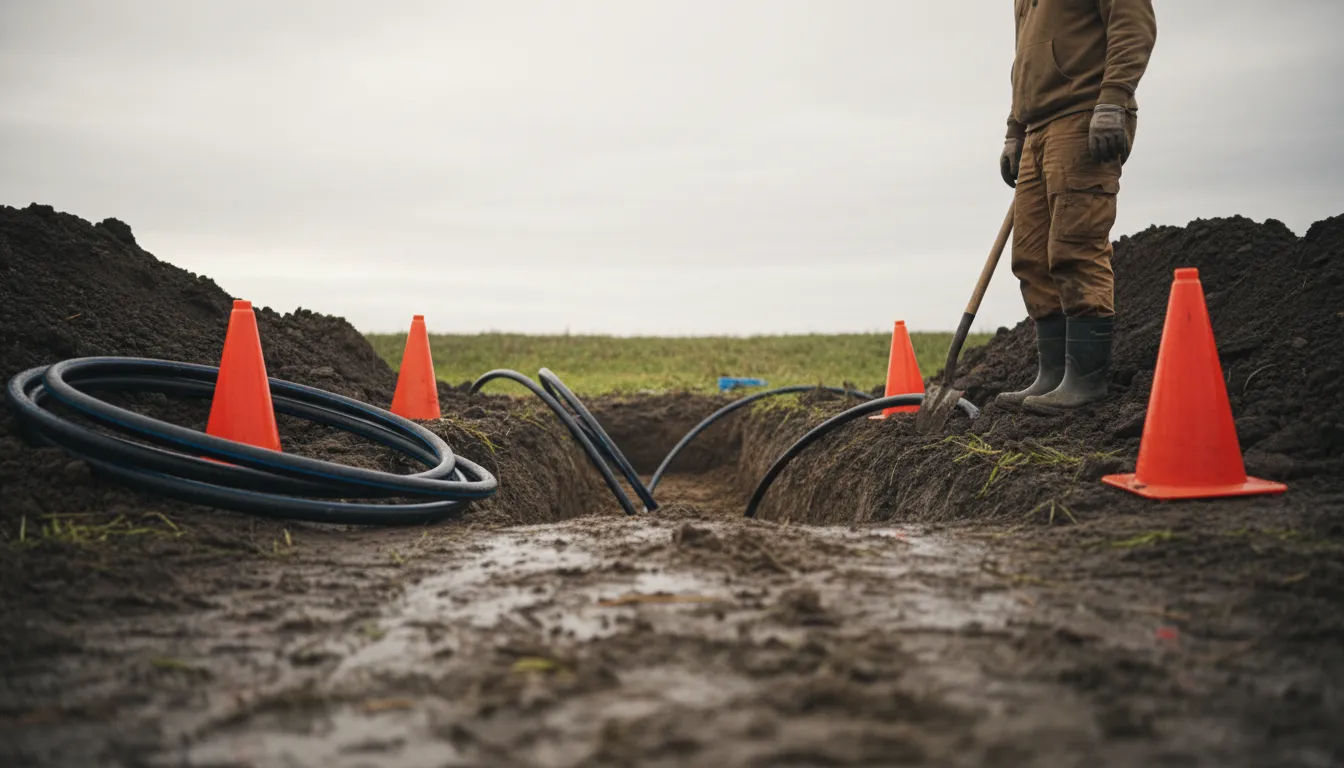
- Horizontal Closed Loops: Ideal for properties with ample yard space. Trenches are dug 4 to 6 feet deep and several hundred feet long in a series of parallel rows or slinky coils. This method is often less expensive than vertical drilling, especially for new construction where the yard is already being excavated 5.
- Vertical Closed Loops: The best solution for smaller urban lots common in parts of Cypress. Contractors use a drilling rig to bore holes 150 to 450 feet deep. U-shaped loops of pipe are inserted into each borehole, which are then grouted. Vertical loops require less land area and are less disruptive to existing landscaping after installation, though the drilling itself is a more specialized and costly process 6 7.
Open-Loop Systems An open-loop, or groundwater, system uses well water or water from a pond as the heat exchange fluid. It pumps water from the source, through the heat pump, and then discharges it. While potentially very efficient, these systems require a significant, consistent supply of clean water and are subject to more stringent local permitting regarding water use and discharge. They are less common in residential settings than closed-loop systems 8 9.
The Benefits of Geothermal for Cypress Homeowners
Investing in a ground-source heat pump offers a compelling array of advantages that go beyond simple temperature control.
- Substantial Energy Savings: This is the most significant benefit. By using the earth's free thermal energy, geothermal systems can reduce heating and cooling energy consumption by up to 65% compared to conventional systems like furnaces and standard air conditioners 10 11. For Cypress residents facing warm summers and mild winters, the savings on air conditioning can be particularly dramatic.
- Lower Operating Costs: High efficiency translates directly to lower monthly utility bills. The reduction in electricity or natural gas use for climate control can offset the system's higher upfront cost over time.
- Environmental Sustainability: Geothermal systems run on electricity and produce no on-site carbon emissions from burning fossil fuels. When paired with a renewable energy source like solar panels, your home's heating and cooling can become nearly carbon-neutral.
- Longevity and Reliability: The indoor heat pump components typically last 20-25 years, similar to high-end conventional systems. The buried ground loop, however, is incredibly durable and often comes with warranties of 50 years or more, with an expected lifespan exceeding 100 years. This means future homeowners will also benefit from the investment.
- Quiet and Consistent Comfort: With no noisy outdoor condenser unit (like a traditional AC has), operation is very quiet. The system also provides exceptionally even heating and cooling without the drafts or hot/cold spots associated with forced-air systems, and it often includes superior dehumidification in cooling mode.
Find the perfect geothermal heat pump contractors for your needs
Get personalized recommendations and expert advice
What to Expect During a Geothermal Installation
Installing a geothermal system is a significant project that requires careful planning and expert execution. The process typically follows these steps:
- Site Evaluation and Design: A qualified installer will assess your property, considering lot size, soil composition, accessibility, and your home's heating/cooling load. This assessment determines the optimal loop type and size. They will also handle necessary permits from local Cypress or Orange County authorities.
- Ground Loop Installation: For a horizontal system, this involves trenching with heavy equipment. For a vertical system, a drilling rig will be brought in to create the boreholes. This is the most disruptive phase of the project but is usually completed within a few days.
- Loop Connection and Pressure Test: The pipe sections are fused together, placed in the trenches or boreholes, and connected to a manifold. The entire loop is pressurized and tested for integrity before being backfilled.
- Indoor Unit Installation: The geothermal heat pump unit is installed inside your garage, basement, or utility closet. It connects to your existing ductwork or to a new radiant/hydronic distribution system.
- System Startup and Commissioning: The fluid is added to the loop, the system is charged, and all components are tested and balanced to ensure optimal performance.
Financial Considerations and Incentives
The initial investment for a complete geothermal heating and cooling system is higher than that of a traditional HVAC system. Costs can range significantly based on system size, loop type, and site conditions. However, this cost must be viewed in light of the long-term value.
- Long-Term Payback: The payback period-the time it takes for energy savings to equal the upfront cost-varies but is often between 5 to 15 years. With the system's long life, homeowners enjoy decades of virtually free heating and cooling after the payback period 12.
- Increased Property Value: Studies have shown that homes with geothermal systems often sell for a premium, as buyers recognize the value of low utility bills and modern, efficient infrastructure.
- Available Incentives: The federal government offers a tax credit for qualifying geothermal heat pump installations. It's crucial to consult with your installer and a tax professional about current federal and any potential state or local utility rebates that can substantially reduce the net cost 13.
Finding the Right Professional in Cypress
Choosing an experienced, certified installer is critical to a successful geothermal project. Look for contractors who are accredited by organizations like the International Ground Source Heat Pump Association (IGSHPA) and have specific experience with installations in the Southern California geology and climate. They should provide a detailed site assessment, a clear proposal outlining all costs, loop design, and equipment specifications, and a comprehensive warranty.
Frequently asked questions
Sources
Footnotes
-
How a Geothermal Heat Pump Works | This Old House - https://www.youtube.com/watch?v=d5Tbsx3R2T8 ↩
-
Geothermal heat pumps: The ultimate guide to ground-source ... - https://termo-plus.com/blog/geothermal-ultimate-guide-to-ground-source-heat-pumps/ ↩
-
How It Works: Geothermal Heat Pump 101 - GeoComfort Blog - https://geocomfort.com/blog/how-it-works-geothermal-heat-pump-101 ↩
-
All You Need to Know About Home Geothermal Heating & ... - https://dandelionenergy.com/all-you-need-to-know-about-home-geothermal-heating-cooling ↩
-
How Does a Geothermal System Work? - ClimateMaster - https://www.climatemaster.com/homeowner/side-links/how-it-works ↩
-
Geothermal heating & cooling, heat pumps, heat exchange ... - https://aztechgeo.com/residential-geothermal/how-it-works/ ↩
-
Geothermal Installation Steps Explained - https://ultrageothermal.com/geothermal-installation-steps-explained/ ↩
-
Geothermal Heat Pump and Ground Loop Technologies - https://efiling.energy.ca.gov/GetDocument.aspx?tn=73451 ↩
-
Geothermal Heat Pumps - EnergySmart CNY - https://www.energysmartcny.org/heat-pumps/geothermal/ ↩
-
How Does A Geothermal Heat Pump Work? Complete 2025 Guide - https://solartechonline.com/blog/how-does-geothermal-heat-pump-work/ ↩
-
5 Things You Should Know about Geothermal Heat Pumps - https://www.energy.gov/cmei/articles/5-things-you-should-know-about-geothermal-heat-pumps ↩
-
Everything You Need to Know About Geothermal Heat Pumps - https://www.familyhandyman.com/article/everything-you-need-to-know-about-geothermal-heat-pumps/ ↩
-
The California Buyers Guide to Geothermal Heat Pump Systems - https://www.californiageo.org/wp-content/uploads/CA-Buyers-Guide-for-Geothermal-HP-revised-12-13-24.pdf ↩