Find the Best Geothermal Heat Pump Contractors for Your Business
No obligation • Fast responses • Nationwide coverage

Why you can trust HVAC Firms
HVAC Firms is a leading United States resource for evaluating HVAC service providers. Our team researches companies, checks credentials, and reviews customer feedback to present clear, unbiased information. Listings and rankings are based on merit, and companies cannot pay to change our editorial content.
Search providers near you
Top Geothermal Heat Pump Contractors in Concord, California Ranked
A geothermal heat pump, also known as a ground-source heat pump, is a highly efficient heating and cooling system that leverages the Earth's stable underground temperature. For homeowners in Concord, this technology offers a path to dramatically lower energy bills and reduce environmental impact by using the ground as a renewable energy source. This guide explains how these systems work, what installation entails, and how you can find qualified local experts to evaluate your property for this long-term investment.
Fairview Heating & Air Conditioning Inc.
100 Brownstone Rd, Oakley, CA 94561
Fairview Heating & Air Conditioning Inc. is an HVAC contractor based in Oakland, CA, offering a range of services including air conditioning repair and installation, furnace and heat pump services, indoor air quality improvements, and ductless mini-split system installations. They provide solutions tailored to the local climate, including American-made equipment designed for East County conditions. With over 30 years of experience maintaining and installing HVAC systems, Fairview also addresses new energy efficiency standards affecting heating equipment in California. Their services include advanced capabilities such as air scrubbers and ultraviolet lights to enhance indoor air quality.
Big Air Heating & Air Conditioning
1000 Detroit Ave, Concord, CA 94518
Big Air Heating & Air Conditioning is an HVAC company serving Oakland, CA, with over 20 years of experience. They provide installation, repair, and tune-up services for air conditioning, furnaces, heat pumps, boilers, mini splits, and geothermal heat pumps. Their technicians are certified, drug screened, and background checked, ensuring professional and knowledgeable service. The company works with both commercial and residential clients, offering clear pricing by the job.
Clean Air HVAC INC
428 N Buchanan Cir #1, Pacheco, CA 94553
Clean Air HVAC INC is an HVAC contractor based in Oakland, CA, providing heating and cooling solutions for residential customers. The company offers a wide range of services including installation, repair, and maintenance of furnaces, air conditioners, heat pumps, mini-split systems, and geothermal heat pumps. They also provide indoor air quality services such as air filtration, humidifiers, and ventilation systems. Clean Air HVAC INC serves the East Bay area and is experienced in handling various HVAC systems, including Lennox Healthy Climate Solutions and zoning systems.
Harry Clark Plumbing and Heating Inc
3026 Broadway, Oakland, CA 94611
Harry Clark Plumbing and Heating Inc is an HVAC and plumbing service provider located in San Francisco, CA. The company offers a range of services including air conditioning, furnace, heat pump, boiler repair and installation, as well as mini split and geothermal heat pump installation. With a history dating back to the 1940s, the business has evolved through family ownership and continues to operate with a focus on local service. The company is known for maintaining a strong presence in the Oakland and Berkeley area, operating two separate entities for plumbing and heating/air conditioning services.
East Bay Hydronics
Oakland, CA
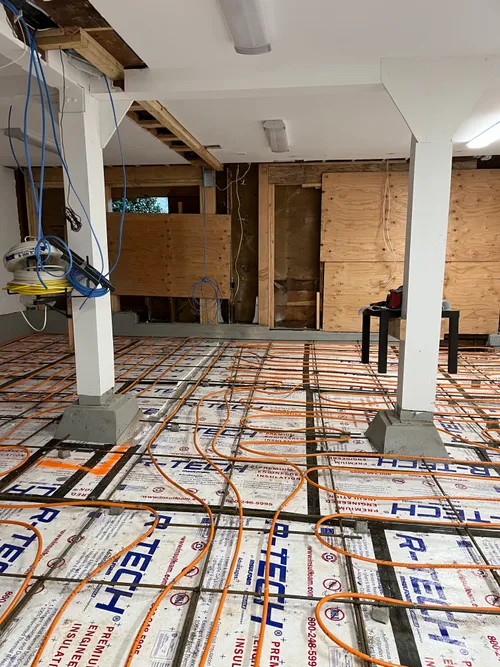
East Bay Hydronics is a heating and cooling contractor based in Oakland, CA, serving the Bay Area. They specialize in hydronic systems for both residential and commercial properties, including radiant heating and cooling, boilers, water heaters, solar thermal, and geothermal heat pumps. With over 17 years of experience, they support new construction and remodeling projects.
How Geothermal Systems Work: The Earth as a Thermal Battery
The core principle behind a geothermal system is remarkably simple: it uses the consistent temperature of the earth just below the surface as a source of heat in the winter and a place to dump heat in the summer. While Concord's outdoor air temperature swings from hot, humid summers to cool winters, the ground about 10 feet down remains a steady 55°F year-round 1. This stability is the key to the system's efficiency.
Here's the basic process:
- Heat Exchange: A mixture of water and antifreeze, called a heat transfer fluid, circulates through a loop of pipes buried in your yard.
- Winter Heating: The fluid, cooler than the ground, absorbs the Earth's natural heat as it travels through the buried loop. This warmed fluid is pumped to a heat pump unit inside your home, which concentrates the heat and distributes it through your ductwork or radiant floor system.
- Summer Cooling: The process reverses. The system extracts heat from your home's air and transfers it into the circulating fluid. The now-warmed fluid travels through the underground loop, where the cooler earth absorbs the heat, effectively "recharging" the ground.
This elegant exchange means a geothermal unit doesn't create heat by burning fuel; it simply moves existing heat from one place to another with exceptional efficiency, often reducing energy use for heating and cooling by 30% to 65%.
Types of Ground Loop Systems for Concord Properties
The buried pipe system, or "ground loop," is the heart of the installation. The right type for your Concord home depends on your lot size, soil composition, and access to groundwater. There are three primary configurations:
Closed-Loop Systems
These are the most common residential systems, where the heat transfer fluid is permanently sealed within a continuous loop of high-density polyethylene pipe.
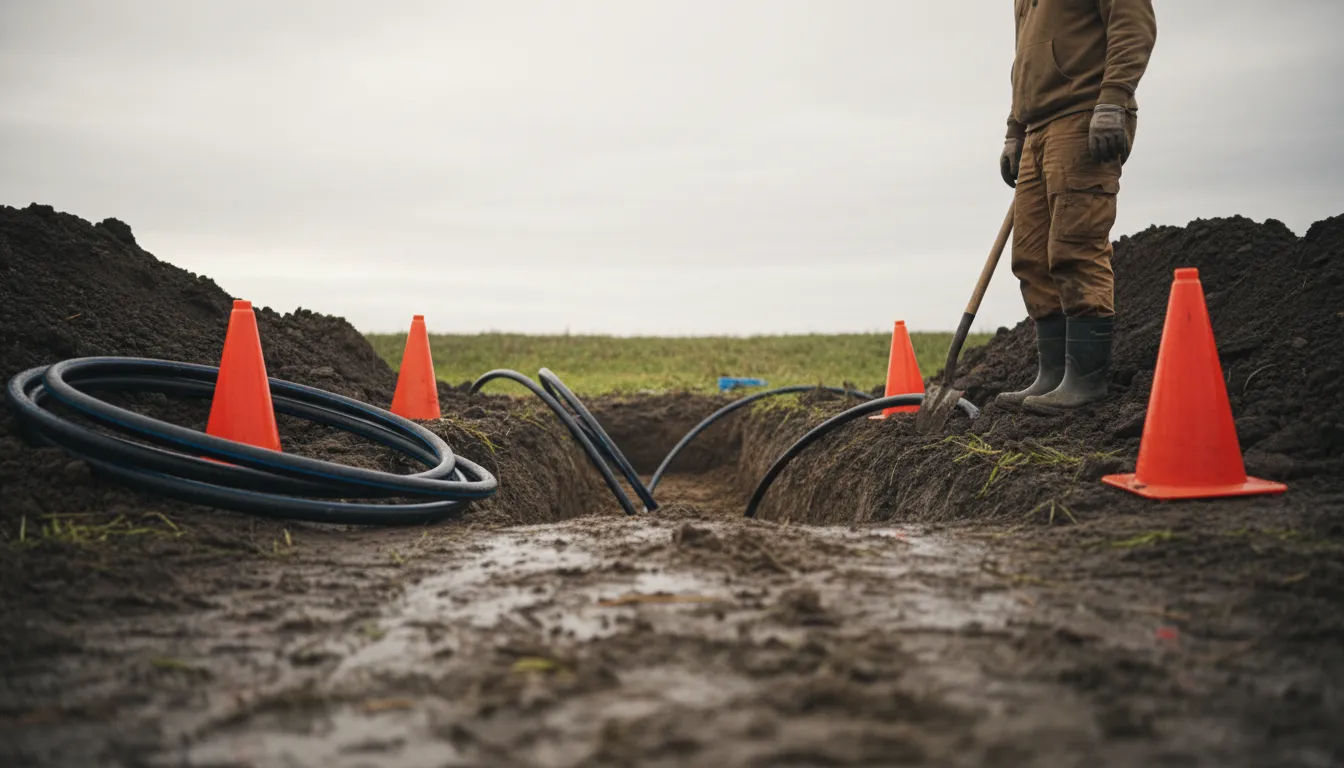
- Horizontal Closed-Loop: Ideal for properties with ample yard space. Trenches are dug about 4 to 6 feet deep, and pipes are laid in a series of parallel trenches or coiled in "slinky" formations. This method typically has a lower installation cost than vertical systems if the land is available2.
- Vertical Closed-Loop: The best solution for smaller urban or suburban lots in Concord. Contractors use a drilling rig to bore holes 150 to 450 feet deep. U-shaped loops of pipe are inserted into each borehole, which are then grouted. This method minimizes landscape disruption and is less dependent on soil type, though drilling can increase the upfront cost3 4.
Open-Loop Systems
This system uses groundwater from a well as the direct heat exchange fluid. It pumps water from an aquifer, runs it through the heat pump to exchange heat, and then discharges it to a second "return" well, pond, or stream. While potentially the most efficient, open-loop systems require an abundant, suitable water source and are subject to regulations from the North Carolina Department of Environmental Quality (NC DEQ).
The Installation Process: What Concord Homeowners Can Expect
Installing a geothermal system is a significant project that requires careful planning and skilled professionals. The process generally follows these key steps:
- Site Assessment & Design: A qualified installer will evaluate your property, considering soil conditions, lot layout, and your home's heating and cooling loads. This assessment determines the optimal loop type and size for maximum efficiency.
- Loop Installation: This is the major excavation phase.
- For horizontal loops, an excavator will dig the necessary trenches.
- For vertical loops, a drilling rig will be brought in to create the boreholes. The pipes are then placed, connected, and pressure-tested to ensure integrity before the trenches or boreholes are backfilled 5.
- Indoor Unit Installation: The geothermal heat pump unit, which is typically about the size of a traditional furnace, is installed in your basement, garage, or mechanical closet. It is connected to your home's existing ductwork or hydronic distribution system.
- Connection & Commissioning: The underground loops are connected to the indoor heat pump unit. The entire system is filled with fluid, purged of air, and started. A technician will test and calibrate the system to ensure it operates at peak performance6.
Find the perfect geothermal heat pump contractors for your needs
Get personalized recommendations and expert advice
Financial Considerations: Costs, Savings, and Incentives
The decision to install a geothermal system is a long-term financial calculation. The upfront cost is higher than a conventional HVAC system, primarily due to the excavation and loop installation. However, the operational savings and available incentives make it a compelling investment.
- Upfront Costs: Installation costs vary widely based on loop type, system size, and site conditions. The ground loop work represents a significant portion of the total project cost 7.
- Long-Term Savings: The dramatic increase in efficiency translates directly to lower monthly utility bills. Homeowners often see savings of 30% to 65% on their heating and cooling costs, which can offset the higher initial investment over time 8.
- Federal Tax Credit: The Inflation Reduction Act provides a major incentive. Through 2032, homeowners can claim a 30% federal tax credit on the total cost of purchasing and installing a qualifying geothermal heat pump system. This credit directly reduces the amount of income tax you owe, making the technology much more accessible9 10 11.
Is a Geothermal System Right for Your Home?
Geothermal heat pumps offer a reliable, quiet, and sustainable solution for home comfort. They have fewer mechanical parts exposed to the elements, which can lead to less maintenance and a longer lifespan for the indoor unit compared to traditional air conditioners and furnaces. For Concord residents with suitable properties, a ground-source heat pump represents a forward-thinking upgrade that increases home comfort, reduces carbon footprint, and provides decades of energy savings.
The key to a successful project is partnering with an experienced, certified installer who can conduct a thorough site evaluation and design a system tailored to your specific needs. By leveraging the Earth's constant temperature, you can achieve unparalleled efficiency and take a significant step toward energy independence.
Frequently asked questions
Sources
Footnotes
-
Geothermal Heat Pumps - EnergySmart CNY - https://www.energysmartcny.org/heat-pumps/geothermal/ ↩
-
Geothermal Heat Pumps - NC Sustainable Energy Association - https://www.energync.org/clean-energy-101/geothermal-heat-pumps/ ↩
-
Geothermal Heating and Cooling | NC DEQ - https://www.deq.nc.gov/about/divisions/water-resources/groundwater-resources/injection-wells-uic-program/geothermal-heating-and-cooling ↩
-
Ground source heat pumps: horizontal collectors Vs. vertical boreholes - https://www.mesh-energy.com/insights/ground-source-heat-pumps-horizontal-collectors-vs-vertical-boreholes ↩
-
Geothermal heating & cooling, heat pumps, heat exchange loops - How it works - https://aztechgeo.com/residential-geothermal/how-it-works/ ↩
-
Geothermal Installation Steps Explained - https://ultrageothermal.com/geothermal-installation-steps-explained/ ↩
-
Geothermal Heat Pumps - Carolina Country - https://www.carolinacountry.com/story/geothermal-heat-pumps-2 ↩
-
Unlocking Underground Energy: Ground Source Heat Pumps - https://www.ncsl.org/energy/unlocking-underground-energy-ground-source-heat-pumps ↩
-
5 Things You Should Know about Geothermal Heat Pumps - https://www.energy.gov/cmei/articles/5-things-you-should-know-about-geothermal-heat-pumps ↩
-
Everything You Need to Know About Geothermal Heat Pumps - https://www.familyhandyman.com/article/everything-you-need-to-know-about-geothermal-heat-pumps/ ↩
-
All You Need to Know About Home Geothermal Heating & ... - https://dandelionenergy.com/all-you-need-to-know-about-home-geothermal-heating-cooling ↩