Find the Best Geothermal Heat Pump Contractors for Your Business
No obligation • Fast responses • Nationwide coverage

Why you can trust HVAC Firms
HVAC Firms is a leading United States resource for evaluating HVAC service providers. Our team researches companies, checks credentials, and reviews customer feedback to present clear, unbiased information. Listings and rankings are based on merit, and companies cannot pay to change our editorial content.
Search providers near you
Top Geothermal Heat Pump Contractors in Clovis, California Ranked
A geothermal heat pump, also known as a ground-source heat pump, is a highly efficient heating and cooling system that leverages the Earth's stable underground temperature. For homeowners in Clovis, this technology offers a powerful way to achieve year-round comfort while significantly reducing energy bills and environmental impact. This guide explains how these systems work, what installation entails, and how you can find qualified local experts to assess your property for this sustainable upgrade.
Jack's Refrigeration
2539 Simpson St, Kingsburg, CA 93631
Jack's Refrigeration is an HVAC company serving Fresno, CA, and the surrounding Central Valley communities. They provide a range of services including air conditioning and furnace repair, installation of HVAC and geothermal heat pump systems, duct cleaning, and indoor air quality improvements. With over 60 years of experience, Jack's Refrigeration offers expertise in duct sealing using Aeroseal technology to enhance comfort and energy efficiency. They serve both residential and commercial customers and have a long history of supporting local homes and businesses.

Indoor Quality Services
340 W Fallbrook Ave #104, Fresno, CA 93711
Indoor Quality Services is an HVAC company based in Fresno, CA, serving the Central Valley and surrounding communities. Since 1998, they have provided a wide range of heating and cooling services including air conditioning and furnace installation and repair, duct cleaning, thermostat installation, and indoor air quality solutions. Their expertise includes installing energy-efficient systems such as ductless mini-splits and geothermal heat pumps, along with offering seasonal maintenance programs to support system longevity and performance.
Mitchell Aire
4281 W Shaw Ave, Fresno, CA 93722
Mitchell Aire is a family-operated HVAC company serving Fresno, CA, with over 80 years of experience since 1936. The company offers a wide range of services including repair and installation of air conditioning, furnaces, heat pumps, boilers, mini splits, and geothermal heat pumps. Their NATE Certified Technicians handle everything from minor repairs to major installations and regular maintenance, working with all types of models and makes. Mitchell Aire is known for quality workmanship and honest pricing, serving both residential and commercial customers in the Central Valley community.
How Geothermal Systems Work in Clovis
The core principle of a ground-source heat pump is elegantly simple: it uses the Earth as a giant, free battery for thermal energy. Unlike air temperatures that swing from hot summers to cool winters in the Central Valley, the temperature of the soil just a few feet below the surface in the Fresno/Clovis area remains remarkably constant, around 55°F year-round. This stable temperature acts as a consistent heat source in the winter and a reliable heat sink in the summer.
The system has three main components:
- The Ground Loop: This is a network of high-density polyethylene pipes buried in your yard. A water-based solution circulates through these sealed loops.
- The Heat Pump Unit: This indoor unit, similar in size to a traditional furnace, contains a compressor and heat exchanger.
- The Distribution System: This is your home's existing ductwork for forced air or a hydronic (water-based) system like radiant floor heating.
In the winter, the fluid in the ground loop absorbs the 55°F heat from the earth and carries it to the indoor heat pump. The heat pump then concentrates this low-grade heat and releases it as warm air or water into your home. In the summer, the process reverses: the system extracts heat from your home's air, transfers it to the fluid in the loop, and deposits it into the cooler ground 1 2 3. This exchange process is what makes geothermal technology so efficient, often performing 70% more efficiently than standard HVAC systems 4.
Types of Ground Loop Systems
The design of the underground piping, or loop field, is critical and depends on your property's characteristics. There are three primary configurations for residential ground-source heat pumps:
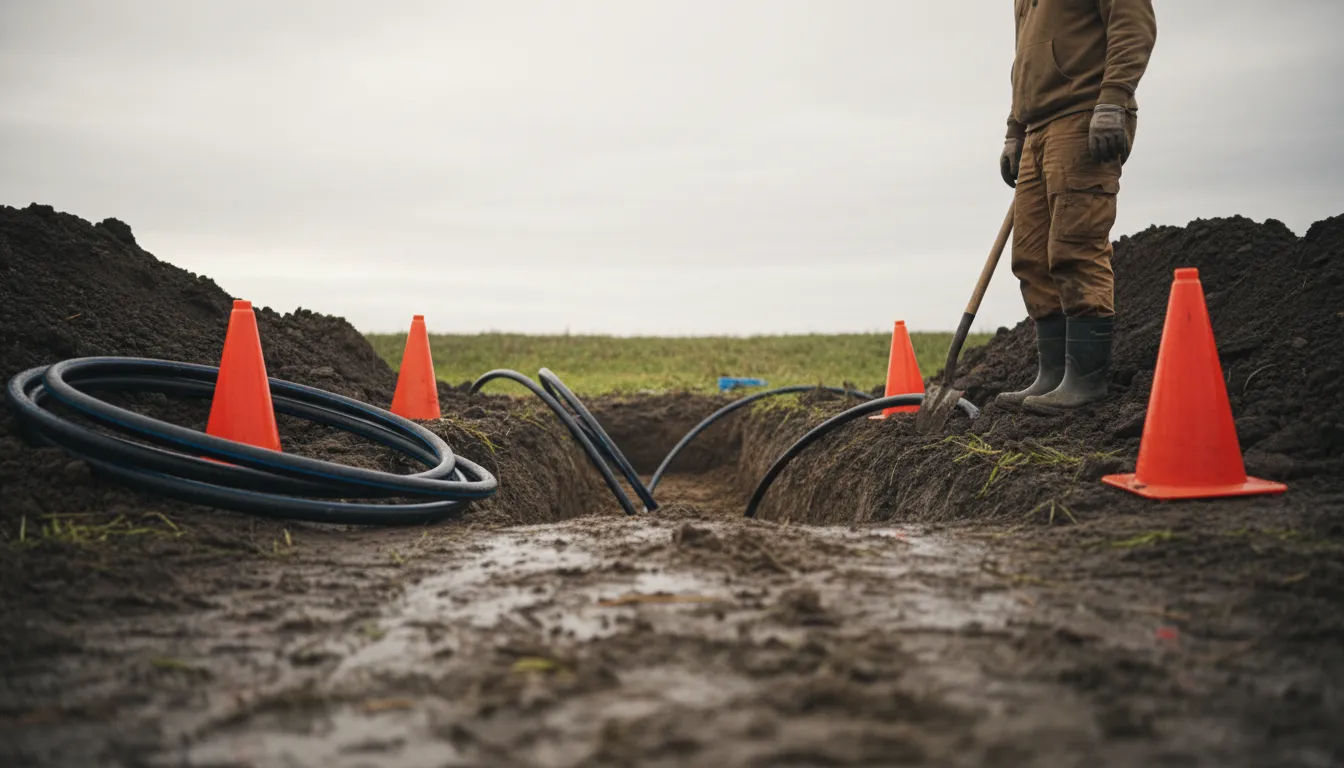
Horizontal Closed Loop This is often the most cost-effective option if space allows. Contractors dig trenches four to six feet deep across a large area of your yard-typically needing a plot of land several times the size of your home's footprint. The pipes are laid in these trenches in a slinky-coil or straight-run pattern before being backfilled 5 6 7. This method is less invasive than drilling but requires significant open land.
Vertical Closed Loop For properties with limited yard space, like many urban lots in Clovis, vertical loops are the ideal solution. Contractors use a drilling rig to bore holes 100 to 400 feet deep. U-shaped pipe loops are inserted into each borehole, which are then grouted. This method requires specialized equipment and can be more expensive per foot of loop, but it minimizes surface disruption and is excellent for rocky soil.
Open Loop System This system uses groundwater from a well as the direct heat exchange fluid. After passing through the heat pump, the water is returned to a second well (a "return" or "injection" well) or discharged to a pond or stream, where permitted. Open loop systems can be highly efficient but require an abundant, suitable water source and compliance with local groundwater regulations.
Find the perfect geothermal heat pump contractors for your needs
Get personalized recommendations and expert advice
The Geothermal Installation Process
Installing a geothermal heating and cooling system is a significant project that requires careful planning and expert execution. Understanding the steps can help you know what to expect when working with a local installer.
-
Site Assessment and Design: This first step is crucial. A qualified installer will evaluate your property's soil composition, lot size, landscaping, and accessibility. They will also perform a detailed load calculation for your home to determine its heating and cooling needs. This information dictates the optimal loop type (horizontal, vertical, or open) and the size of the loop field and heat pump unit.
-
Loop Field Installation: This is the major earthwork phase. For a horizontal system, excavators will dig the necessary trenches. For a vertical system, a drilling rig will be brought in to create the boreholes. High-quality HDPE pipe is then placed and connected into a continuous loop. The loop is pressure-tested to ensure there are no leaks before being backfilled or grouted.
-
Indoor Unit and Connection: The geothermal heat pump unit is installed in a utility closet, basement, garage, or attic. The unit is connected to the ground loop via entry pipes brought into the home. Finally, it is integrated with your home's existing distribution system-whether that's ductwork for forced air or piping for a hydronic system.
-
System Startup and Commissioning: Once everything is connected, the system is filled with fluid, purged of air, and started. The installer will calibrate the thermostat and controls, verify all components are operating correctly, and ensure the system is delivering the desired heating and cooling performance.
Benefits and Financial Considerations for Clovis Homeowners
Investing in a geothermal system in Clovis comes with compelling long-term advantages, though it requires a higher initial investment than a standard air-source heat pump or furnace/AC combo.
Substantial Energy Savings: The primary benefit is dramatically lower operating costs. By leveraging the Earth's constant temperature, these systems use far less electricity than conventional systems that fight against extreme outdoor air temperatures. Homeowners in the Central Valley can often see annual savings of $1,000 or more on their energy bills.
Reduced Environmental Impact: Geothermal systems are one of the cleanest and most efficient heating and cooling technologies available. They have no on-site emissions (like a gas furnace) and, because they use less electricity, they indirectly reduce the carbon footprint associated with your home's comfort 8.
Longevity and Reliability: The underground loop system is typically warranted for 50+ years and can last generations. The indoor heat pump unit also tends to have a longer lifespan (often 20-25 years) than conventional outdoor AC condensers because it is protected from the elements.
Upfront Costs and Payback: A complete residential geothermal system in Clovis typically ranges from $20,000 to $40,000 or more, depending on the loop type, home size, and site conditions 9. The good news is that the significant monthly utility savings lead to a payback period-the time it takes for savings to equal the upfront cost-typically estimated at 5 to 8 years in the Central Valley 10 11. Furthermore, federal tax credits are available to offset a percentage of the installation cost, improving the financial return 11.
Increased Home Value: A permanently installed, ultra-efficient climate control system is a valuable asset. Studies have shown that homes with geothermal systems often have higher resale values and can be more attractive to energy-conscious buyers.
Frequently asked questions
Sources
Footnotes
-
FAQs • What types of ground-source heat pumps and configurat - https://concordma.gov/FAQ.aspx?QID=484 ↩
-
How a Geothermal Heat Pump Works | This Old House - https://www.youtube.com/watch?v=d5Tbsx3R2T8 ↩
-
Geothermal Heat Pumps: How They Work | AHRI - https://www.ahrinet.org/scholarships-education/education/homeowners/how-things-work/geothermal-heat-pumps-how-they-work ↩
-
How Does A Geothermal Heat Pump Work? Complete 2025 ... - https://solartechonline.com/blog/how-does-geothermal-heat-pump-work/ ↩
-
Geothermal heat pumps: The ultimate guide to ground-source ... - https://termo-plus.com/blog/geothermal-ultimate-guide-to-ground-source-heat-pumps/ ↩
-
Geothermal Installation Steps Explained - https://ultrageothermal.com/geothermal-installation-steps-explained/ ↩
-
Ground-Source Heat Pumps | Building America Solution Center - https://basc.pnnl.gov/resource-guides/ground-source-heat-pumps ↩
-
Geothermal Heating & Cooling | City of Ann Arbor - A2gov.org - https://www.a2gov.org/sustainability-innovations-home/sustainability-me/for-families-individuals/geothermal-heating-cooling/ ↩
-
Geothermal Heat Pump Guide: Installation Costs, Types And Benefits - https://modernize.com/hvac/heating-repair-installation/heat-pump/geothermal ↩
-
Civil Engineering - https://engineering.fresnostate.edu/civil-geomatics/documents/Groundsource%20Heat%20Pumps%20in%20the%20Central%20Valley.pdf ↩
-
The California Buyers Guide to Geothermal Heat Pump Systems - https://www.californiageo.org/wp-content/uploads/CA-Buyers-Guide-for-Geothermal-HP-revised-12-13-24.pdf ↩ ↩2