Find the Best Geothermal Heat Pump Contractors for Your Business
No obligation • Fast responses • Nationwide coverage

Why you can trust HVAC Firms
HVAC Firms is a leading United States resource for evaluating HVAC service providers. Our team researches companies, checks credentials, and reviews customer feedback to present clear, unbiased information. Listings and rankings are based on merit, and companies cannot pay to change our editorial content.
Search providers near you
Top Geothermal Heat Pump Contractors in Azusa, California Ranked
Geothermal heat pumps, also known as ground-source heat pumps, are a highly efficient method for heating and cooling your home by leveraging the earth's stable underground temperature. For Azusa residents, this technology offers a path to significant energy savings and reduced environmental impact, especially given California's focus on clean energy. This guide explains how these systems work, what installation entails, and how you can find qualified local professionals to assess your property for a geothermal solution.
Moffett Plumbing & Air
13950 Milton Ave, Westminster, CA 92683
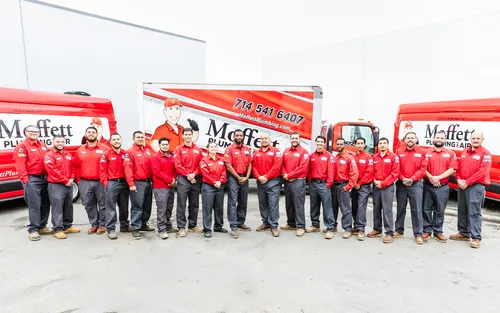
Moffett Plumbing & Air is a plumbing and HVAC company serving Long Beach, CA, and the surrounding Orange County area. They offer a wide range of services including air conditioning, furnace, heat pump, and boiler repair and installation, as well as duct cleaning, thermostat installation, indoor air quality services, and geothermal heat pump work. Established in 1969, Moffett Plumbing & Air has built a reputation for dependable service and community focus, treating customers with respect and care. Their team is known for professional workmanship and efficiency.
NexGen HVAC & Plumbing
10820 Mulberry Ave, Fontana, CA 92337
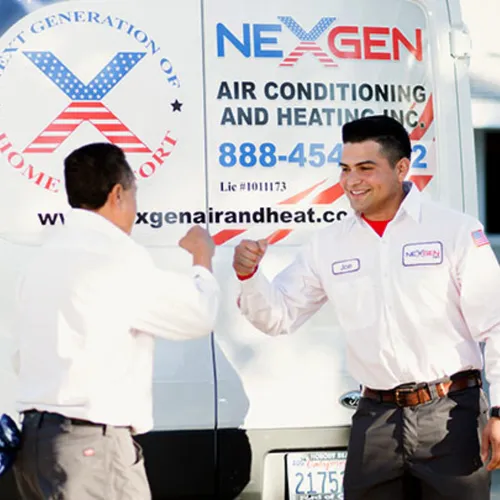
NexGen HVAC & Plumbing is a full-service contractor based in Riverside, CA, offering a wide range of heating, cooling, and plumbing services. They handle installation, repair, and maintenance of air conditioners, heat pumps, furnaces, ductless mini-splits, and geothermal systems. Their plumbing services include leak detection, drain cleaning, sewer repair, and gas line inspection. NexGen is equipped to service both residential and commercial properties and uses advanced technology such as high-tech camera inspections for plumbing diagnostics. They provide 24/7 emergency service to address urgent HVAC and plumbing issues promptly.
Nelson Air Heating & Air Conditioning
5062 Casa Oro Dr, Yorba Linda, CA 92886
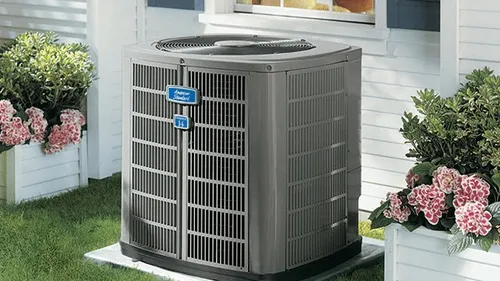
Nelson Air Heating & Air Conditioning provides HVAC installation services in Anaheim, CA. They handle installation for a variety of systems including air conditioners, furnaces, heat pumps, boilers, mini splits, and geothermal heat pumps for both residential and commercial clients. The company installs all major HVAC brands and emphasizes quality materials, efficiency, and workmanship.
Comfort Elite HVAC
1080 N Batavia St Ste N, Orange, CA 92867
Comfort Elite HVAC provides a wide range of heating, air conditioning, and indoor air quality services in Los Angeles, CA. With over 10 years of experience, they handle installation, repair, and maintenance for systems including heat pumps, furnaces, mini splits, and geothermal heating. Their services cover air duct cleaning, air purification, and refrigerant recharge, aiming to improve home comfort and air quality. Comfort Elite HVAC offers 24/7 emergency repair services and same-day responses to HVAC issues, ensuring timely assistance for heating and cooling needs.
How Geothermal Heating and Cooling Works
A geothermal system operates on a simple but brilliant principle: it uses the earth as a giant thermal battery. Just a few feet below the surface, the ground maintains a nearly constant temperature of 55-60°F year-round, regardless of the summer heat or winter chill in Azusa. A geothermal heat pump (GHP) taps into this stable resource to provide both heating and air conditioning for your home.
The process involves three key components:
- The Ground Loop: This is a network of pipes buried in your yard. A water-based fluid circulates through these sealed pipes, absorbing heat from the earth in the winter and depositing excess heat from your home into the earth in the summer.
- The Heat Pump Unit: Located inside your home, this unit concentrates the thermal energy collected by the ground loop. In heating mode, it extracts heat from the fluid and transfers it to your home's air. In cooling mode, it works in reverse, pulling heat from your indoor air and transferring it into the fluid to be dissipated underground.
- The Distribution System: Typically, the conditioned air is distributed throughout your home using existing ductwork, just like a conventional forced-air system.
The key to its efficiency is that the heat pump moves heat rather than creating it by burning fuel, making it one of the most energy-efficient HVAC technologies available.
Types of Geothermal Ground Loops
The design of the underground piping, or ground loop, is critical and depends on your property's characteristics. There are two primary closed-loop systems, and the right choice for your Azusa home will be determined by land availability and soil conditions.
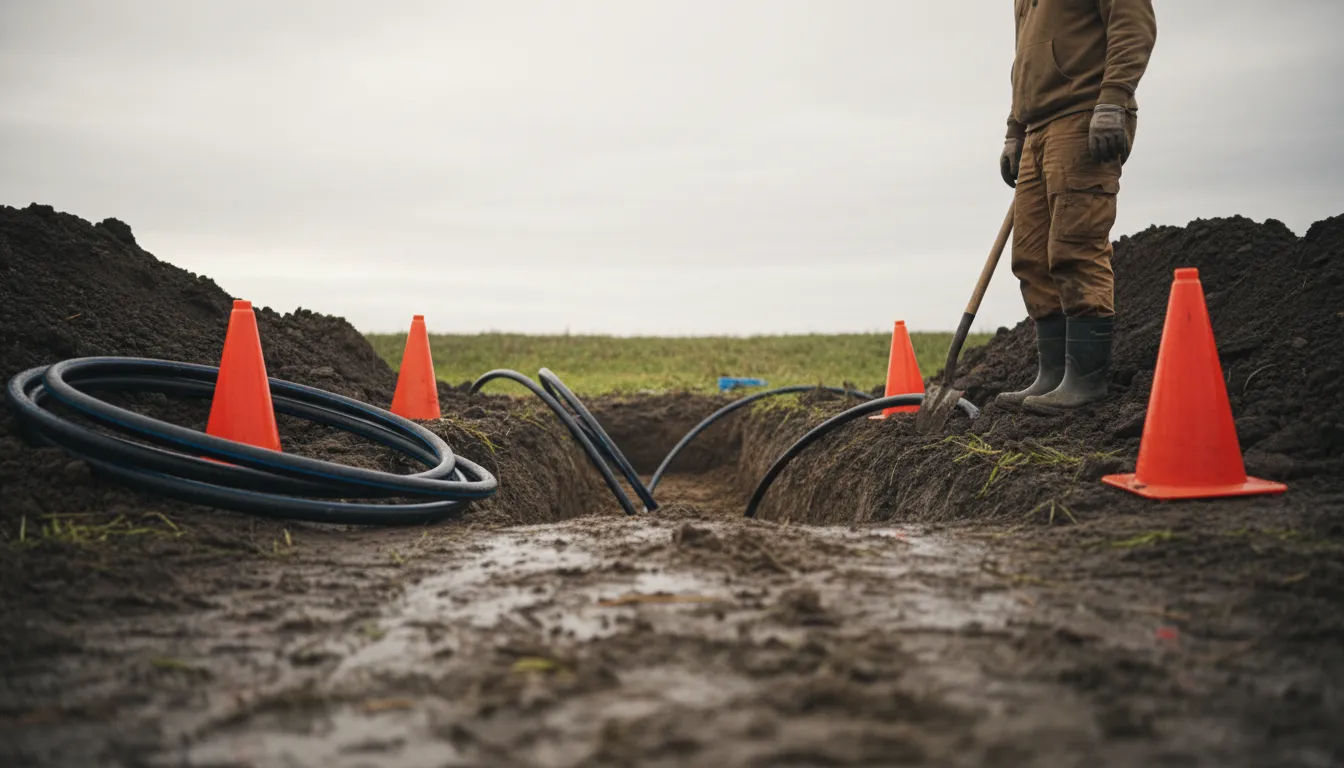
Horizontal Closed Loop This is often the most cost-effective option if space allows. Contractors excavate trenches about five to ten feet deep in your yard, laying pipes in a series of parallel runs or a slinky-coil configuration 1 2. This method requires a larger, open plot of land but generally involves lower excavation costs than drilling.
Vertical Closed Loop For homes in Azusa with smaller lots, a vertical loop is the standard solution. Contractors use a drilling rig to bore holes 150 to 400 feet deep 3. U-shaped pipes are inserted into each borehole, which are then grouted. This system has a smaller footprint and is less disruptive to existing landscaping, though drilling can be more expensive 4.
Open-Loop System A less common alternative, an open-loop system uses groundwater from a well or a nearby pond as the heat exchange fluid directly, which is then returned to a second well or the water body 5. This system is highly efficient but requires a sufficient, consistent water source and compliance with local water regulations.
The Installation Process for Azusa Homes
Installing a geothermal system is a significant project that requires professional expertise. Understanding the steps can help you prepare for the process.
- Site Assessment and Design: A qualified installer will evaluate your Azusa property, considering lot size, soil composition, and your home's heating and cooling loads. This assessment determines the optimal loop type and size for maximum efficiency.
- Excavation or Drilling: For a horizontal loop, trenching equipment will dig the necessary network in your yard. For a vertical system, a drilling rig will create the boreholes. This is the most disruptive phase but is typically completed in a few days.
- Loop Installation and Connection: The high-density polyethylene pipes are placed in the trenches or boreholes. All loop sections are fused together into a continuous circuit and connected to the manifold that leads into your home 6 7.
- System Hookup and Ductwork Integration: The indoor heat pump unit is installed and connected to the ground loop and your home's electrical system. It is integrated with your existing ductwork or air handler.
- Backfilling and Restoration: Once the loops are pressure-tested, the trenches are backfilled. The contractor will restore your landscaping as closely as possible to its original condition.
Find the perfect geothermal heat pump contractors for your needs
Get personalized recommendations and expert advice
Benefits and Financial Considerations
The decision to install a geothermal system is a long-term investment in comfort, savings, and sustainability.
Substantial Energy Savings The primary benefit is dramatically lower energy bills. Geothermal heat pumps are 50-70% more efficient at heating and 20-40% more efficient at cooling compared to conventional systems with standard air-source heat pumps 8. Homeowners can see savings of 30-70% on their energy costs, which can translate to $1,000-$2,000 or more annually in Azusa, depending on usage and local utility rates.
High Upfront Cost with Long-Term Payback The initial investment is higher than for traditional HVAC systems, typically ranging from $15,000 to $35,000 or more for a complete residential installation 9 10. This cost includes the ground loop excavation/drilling and the heat pump unit. However, the significant monthly savings lead to a payback period often estimated between 4 and 15 years 11 12. Furthermore, the system components are incredibly durable: the indoor heat pump may last 20+ years, while the underground piping often carries a warranty of 50 years or more 13.
Available Incentives and Rebates To offset the initial cost, geothermal systems are eligible for federal tax credits. It's essential to check the current credit rates with the IRS or your installer. Additionally, California utilities and state programs may offer further rebates or incentives for installing high-efficiency geothermal systems, improving the overall financial outlook 14.
Environmental Impact By using renewable thermal energy from the ground and electricity only to move heat, geothermal systems drastically reduce a home's carbon footprint. They produce no on-site emissions and, when paired with a renewable electricity source, can provide nearly carbon-free heating and cooling.
Is Geothermal Right for Your Property?
Geothermal is an excellent option for many, but not all, properties. It is ideal for homeowners who:
- Plan to stay in their home long enough to realize the savings payback.
- Have suitable land for a horizontal loop or the budget for vertical drilling.
- Are replacing an old, inefficient HVAC system or building a new home.
- Prioritize long-term energy savings and environmental sustainability.
The most critical step is to consult with a reputable, experienced geothermal installer in the Azusa area. They can provide a detailed site evaluation, accurate cost estimates, and a clear projection of your energy savings and potential incentives.
Frequently asked questions
Sources
Footnotes
-
Geothermal Ground Loop FAQs - Dandelion Energy - https://dandelionenergy.com/geothermal-ground-loop-frequently-asked-questions ↩
-
Geothermal Installation Steps Explained - https://ultrageothermal.com/geothermal-installation-steps-explained/ ↩
-
Geothermal Heat Pump and Ground Loop Technologies - https://efiling.energy.ca.gov/GetDocument.aspx?tn=73451 ↩
-
Geothermal heating & cooling, heat pumps, heat exchange loops - How it works - https://aztechgeo.com/residential-geothermal/how-it-works/ ↩
-
Geothermal Heat Pumps - EnergySmart CNY - https://www.energysmartcny.org/heat-pumps/geothermal/ ↩
-
Geothermal Heat Pumps | WBDG - https://www.wbdg.org/resources/geothermal-heat-pumps ↩
-
How Does a Geothermal System Work? - ClimateMaster - https://www.climatemaster.com/homeowner/side-links/how-it-works ↩
-
5 Things You Should Know about Geothermal Heat Pumps - https://www.energy.gov/cmei/articles/5-things-you-should-know-about-geothermal-heat-pumps ↩
-
Guide to Geothermal Heat Pumps - https://www.energy.gov/sites/prod/files/guide_to_geothermal_heat_pumps.pdf ↩
-
Everything You Need to Know About Geothermal Heat Pumps - https://www.familyhandyman.com/article/everything-you-need-to-know-about-geothermal-heat-pumps/ ↩
-
How Geothermal Heating and Cooling Systems Work | Belle Air - https://www.belleairservices.com/how-geothermal-heating-and-cooling-systems-work/ ↩
-
About Geothermal - https://igshpa.org/about-geothermal/ ↩
-
All You Need to Know About Home Geothermal Heating & ... - https://dandelionenergy.com/all-you-need-to-know-about-home-geothermal-heating-cooling ↩
-
The California Buyers Guide to Geothermal Heat Pump Systems - https://www.californiageo.org/wp-content/uploads/CA-Buyers-Guide-for-Geothermal-HP-revised-12-13-24.pdf ↩