Find the Best Mini-Split Installers for Your Business
No obligation • Fast responses • Nationwide coverage

Why you can trust HVAC Firms
HVAC Firms is a leading United States resource for evaluating HVAC service providers. Our team researches companies, checks credentials, and reviews customer feedback to present clear, unbiased information. Listings and rankings are based on merit, and companies cannot pay to change our editorial content.
Search providers near you
Top Mini-Split Installers in Delano, California Ranked
A ductless mini-split system is a versatile heating and cooling solution that provides zoned comfort for your home. These systems are ideal for room additions, older homes without existing ductwork, or for creating independent temperature zones throughout your entire house. This guide will help you understand the process, benefits, and considerations for installing a mini-split in Delano, so you can make an informed decision and connect with qualified local professionals.
Understanding Ductless Mini-Split Systems
Unlike traditional central HVAC that uses a network of ducts, a ductless mini-split system has two main components: an outdoor condenser unit and one or more indoor air-handling units. These are connected by a small conduit that houses refrigerant lines, power cables, and a condensate drain. This design eliminates the energy loss associated with ductwork, which can be as much as 30%. The primary advantage is zoned comfort; you can control the temperature in specific rooms or areas independently, cooling a sun-filled living room while keeping an unused bedroom warmer to save energy 1.
This makes ductless AC and heat pump systems a perfect fit for many Delano homes. They are a go-to solution for cooling a garage workshop, a new master suite addition, or providing efficient climate control for an entire home that lacks the space for ducts.
Common Applications for Delano Homes
Mini-splits are incredibly flexible. Here are the most typical applications homeowners in our area consider:
- Single Room Solutions: The most straightforward installation is for a single zone. This is perfect for a home office, bedroom, sunroom, or garage conversion. It addresses a hot or cold spot without needing to run new ducts.
- Whole-Home Comfort: For a complete house solution, a multi-zone system is installed. One powerful outdoor unit can connect to multiple indoor units (typically 2 to 5) placed in key living areas like the kitchen, living room, and bedrooms. This approach replaces or supplements central air without the ductwork.
- Additions and Historic Homes: Adding onto your home or cooling a historic property often presents ductwork challenges. A ductless system bypasses this issue entirely, providing efficient comfort where extending ducts is impractical or too expensive.
Zoning Options: Single-Zone vs. Multi-Zone
Your choice between a single-zone and multi-zone system will significantly impact your project's scope and budget.
- Single-Zone Systems: This configuration involves one outdoor condenser connected to one indoor unit. It's a cost-effective way to condition a specific space, like a living room or primary bedroom. It's simple, efficient, and a common starting point for many homeowners.
- Multi-Zone Systems: A single outdoor unit supports multiple indoor units (e.g., two, three, or four). This allows you to create customized comfort zones throughout your home. You can install different styles of indoor units (wall-mounted, ceiling cassette) in different rooms, all managed by individual remote controls or a central thermostat 2 3. This is the solution for whole-house comfort without ducts.
Planning Your Installation: Indoor Unit Placement
Where you place the indoor air handlers is crucial for performance, comfort, and aesthetics. Professional installers will help you determine the optimal location based on your room's layout and airflow needs.
- Wall-Mounted Units: This is the most common and economical style. The unit is mounted high on an interior wall, requiring a small hole (about 3 inches) to pass the conduit to the outside. Placement should be where conditioned air can flow freely across the room, away from direct sunlight or heat sources, and where the condensate drain can function properly.
- Floor-Mounted and Ceiling Cassettes: Other styles offer solutions for unique spaces. Floor-mounted units are excellent for rooms with large windows or sloped ceilings where wall space is limited 4. Ceiling cassette units are recessed into the ceiling, offering a very discreet look and four-way airflow, ideal for larger open areas.
- Key Consideration: Every indoor unit needs a clear, accessible path for the refrigerant lineset to connect to the outdoor unit. This affects the complexity of the installation.
Outdoor Unit Clearance and Location
The outdoor condenser requires careful placement for efficiency, longevity, and minimal disruption.
- Adequate Clearance: The unit needs sufficient space around it for proper airflow. Manufacturers specify minimum clearances (often 12-24 inches on the sides and much more on the front and back) to prevent overheating and ensure efficient operation 5 6. A good installer will ensure these clearances are met.
- Stable Mounting: The unit is typically placed on a dedicated concrete pad or composite mounting blocks to keep it level, stable, and above ground moisture. Wall-mounted brackets are also an option if ground space is limited.
- Noise and Aesthetics: Consider placing the condenser in a location where its operational noise won't disturb outdoor living areas or neighbors' bedrooms. Strategic screening with plants or fencing (while maintaining clearance) can help integrate it into your landscape.
Find the perfect mini-split installers for your needs
Get personalized recommendations and expert advice
Understanding Installation Costs in Delano
The cost of a ductless mini-split installation in California varies based on system capacity, efficiency, and complexity. Professional installation is highly recommended to handle refrigerant, electrical connections, and to preserve manufacturer warranties. Here's a general breakdown of what to expect:
- Single-Zone System: For cooling one room or area, installed costs in the Delano region typically range from $2,500 to $5,000 7 8. This includes a basic, efficient wall-mounted unit and standard installation.
- Multi-Zone System: For a whole-home solution with 2-3 zones, costs generally start around $5,500 and can reach $8,500 or more 9. A system with 4+ zones will be at the higher end of the spectrum.
- What Influences the Price?
- Equipment: Brand, cooling capacity (BTUs), and especially efficiency rating (SEER2). Higher SEER2 units cost more upfront but save on long-term energy bills.
- Labor: This can account for 50-60% of the total project cost and covers mounting units, running linesets, electrical work, vacuuming the system, and charging it with refrigerant 10.
- Installation Complexity: Longer refrigerant line runs between indoor and outdoor units, difficult wall penetrations (like stucco or brick), and the need for new electrical circuits or a sub-panel will add to the cost 11.
- Permits: Most localities, including Kern County, require permits for HVAC work, which adds a fee but ensures the installation is inspected for safety and code compliance.
The Professional Installation Process
A proper installation is a multi-step process that ensures optimal performance and system longevity. Here's what a professional team will do:
- Site Evaluation & Load Calculation: A technician will assess your home's insulation, layout, and size to recommend the correctly sized system.
- Planning & Permitting: They will finalize unit locations, line routing, and electrical needs, and pull any required permits.
- Mounting & Line Running: The indoor and outdoor units are securely mounted. A small hole is drilled for the lineset conduit, which is then run and insulated.
- Electrical Connection: A dedicated electrical circuit is run from your panel to the outdoor unit.
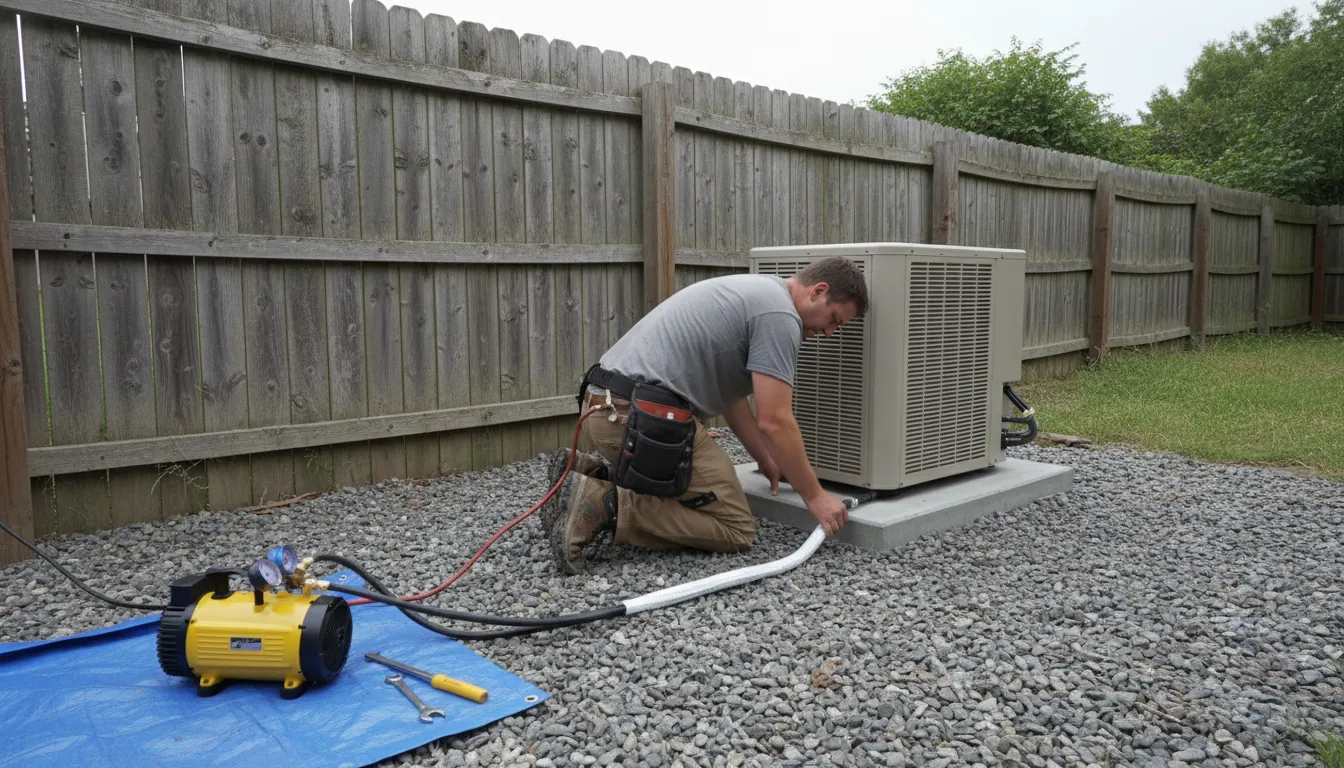
- System Evacuation & Charging: This critical step involves using a vacuum pump to remove all moisture and air from the refrigerant lines before charging the system with the precise amount of refrigerant 12.
- Testing & Commissioning: The system is started, tested for proper cooling/heating, airflow, and drainage, and the homeowner is instructed on how to use the controls.
Frequently asked questions
Sources
Footnotes
-
Ductless mini-split installation: Cool 2025 Guide - Southern Air - https://www.southern-air.com/blog/ductless-mini-split-installation ↩
-
Ductless Mini Split Installation Costs in 2026 - Carrier - https://www.carrier.com/residential/en/us/products/ductless-mini-splits/ductless-mini-split-installation-cost/ ↩
-
How Much Does It Cost to Install a Mini Split System? - https://elementairco.com/how-much-does-it-cost-to-install-a-mini-split-system/ ↩
-
How Much Does a Mini Split Installation Cost? (2026) - HomeGuide - https://homeguide.com/costs/ductless-mini-split-ac-cost ↩
-
How to Install a Mini Split - https://www.homedepot.com/c/ah/how-to-install-a-mini-split/9ba683603be9fa5395fab90c887a9dd ↩
-
Della Mini Split Installation: Optima, Econo, and TL (048-TL ... - https://www.youtube.com/watch?v=ANlXGE1rG04&t=36 ↩
-
Ductless Mini Split AC (Air Conditioners) - Budget, DIY-Friendly - https://dellahome.com/pages/mini-split-ac ↩
-
Mini-Split AC Installation in California - Bonney: Plumbing - https://www.bonney.com/blog/mini-split-ac-cost-california/ ↩
-
Cost to Install Mini Split AC System in 2025 - https://dellahome.com/blogs/della-blog/cost-to-install-mini-split-ac-system ↩
-
Ductless Mini-Split Installation Cost in 2025: Full Breakdown - https://osborneheatingncooling.com/ductless-mini-split-installation-cost/ ↩
-
Ductless Mini Split Installation: A Complete Guide - https://www.goairflow.com/blog/ductless-mini-split-installation/ ↩
-
Full Installation of Mini Split Ductless Unit, Step by Step! - https://www.youtube.com/watch?v=JQkth-AM5CE&t=156 ↩