Find the Best Geothermal Heat Pump Contractors for Your Business
No obligation • Fast responses • Nationwide coverage

Why you can trust HVAC Firms
HVAC Firms is a leading United States resource for evaluating HVAC service providers. Our team researches companies, checks credentials, and reviews customer feedback to present clear, unbiased information. Listings and rankings are based on merit, and companies cannot pay to change our editorial content.
Search providers near you
Top Geothermal Heat Pump Contractors in Texas City, Texas Ranked
Geothermal heat pumps, also known as ground-source heat pumps, offer a highly efficient method for heating and cooling your Texas City home by leveraging the Earth's stable underground temperature. This technology matters because it can dramatically reduce energy consumption and utility bills, providing comfort year-round regardless of the extreme outdoor temperatures common in our region. You can use this guide to understand how these systems work, evaluate their benefits, and connect with qualified local professionals for installation and service.
A-Team's A/C & Heating, LLC
3734 Magnolia Ridge, League City, TX 77573
A-Team's A/C & Heating, LLC is a licensed HVAC contractor serving Houston, TX, and surrounding counties including Galveston, Harris, and Brazoria. They provide residential and commercial heating and air conditioning services, including installation, repair, and maintenance of air conditioners, furnaces, heat pumps, boilers, mini split systems, and geothermal heat pumps. The company also offers indoor air quality services such as duct cleaning, air duct sealing, and installation of air cleaners and humidifiers. As an American-Standard® dealer, they supply a wide range of comfort equipment and specialize in system customization. With 24/7 emergency service availability, A-Team's A/C & Heating supports customers with trained technicians and extended service agreements to maintain system performance.
TEXAS UNITED MECHANICAL, LLC
1118 N Main St #2G, Pearland, TX 77581
Texas United Mechanical, LLC is an HVAC company serving Houston, TX, and surrounding communities including Baytown, Brenham, Galveston, and Conroe. They provide a wide range of services such as air conditioner, furnace, and heat pump repair and installation, duct cleaning, thermostat installation, indoor air quality solutions, and geothermal system services. As a Carrier Factory Authorized Dealer, their technicians are factory-trained in both conventional and geothermal HVAC systems. With over 70 years of combined experience, the team offers 24/7 availability for emergency repairs and maintenance.
How Geothermal Systems Work in Texas City
Instead of exchanging heat with the outside air like a conventional air-source heat pump, a geothermal system uses the ground as a heat source in winter and a heat sink in summer. The principle is simple: just a few feet below the surface, the Earth maintains a relatively constant temperature of around 60 to 70 degrees Fahrenheit year-round 1. A geothermal heat pump capitalizes on this stability.
During our hot Texas summers, the system pulls heat from your home's air and transfers it into the cooler ground via a fluid circulating in underground pipes. In the winter, even when the air is chilly, the system extracts the abundant heat stored in the ground and moves it inside to warm your home. This process is far more efficient than generating heat or fighting 100-degree air, as it simply moves existing heat from one place to another.
The Core Components: Ground Loops
The defining feature of a geothermal installation is the ground loop system. This is a network of pipes buried in your yard that circulates a water-based solution to exchange heat with the earth. The type of loop system installed depends on your property's characteristics, soil conditions, and budget. There are three primary configurations:
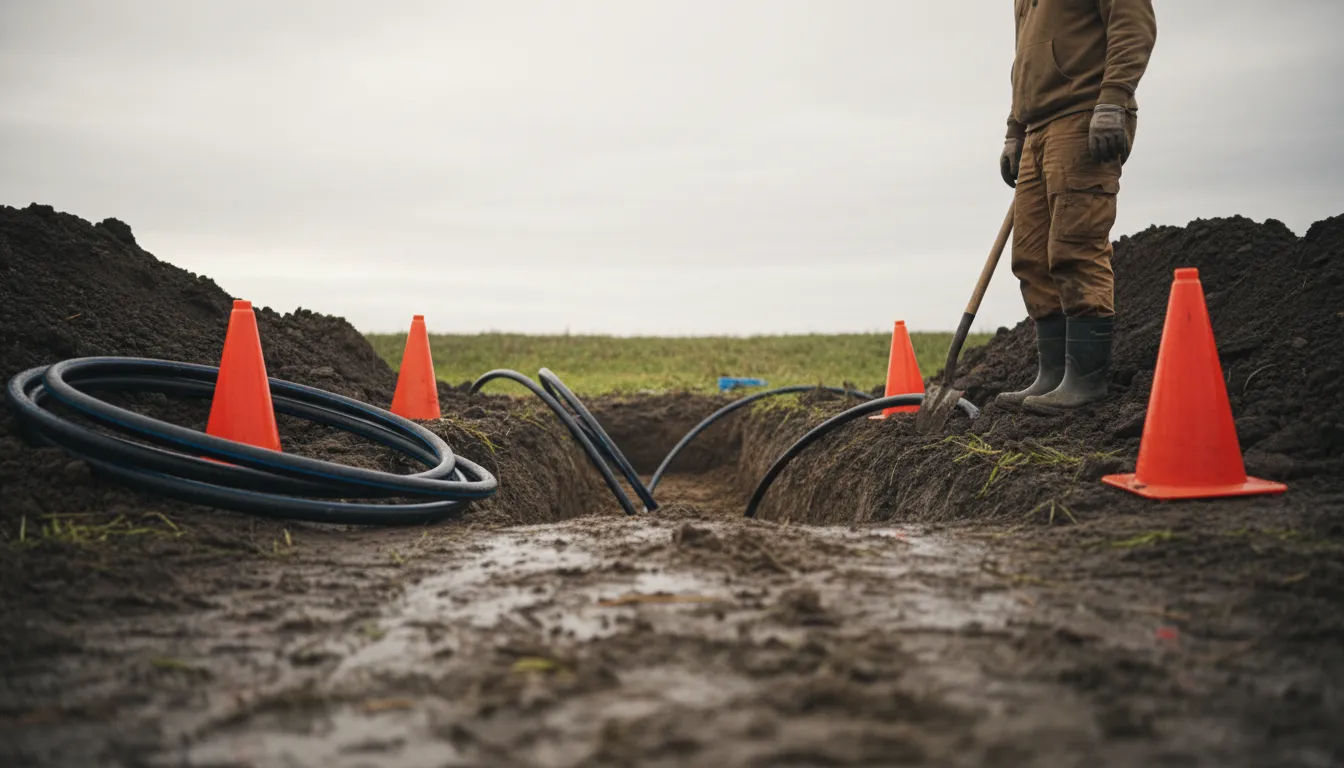
Horizontal Closed Loops This is often the most cost-effective option for properties with sufficient land. Contractors dig trenches four to ten feet deep and lay pipes in a series of loops 2. Horizontal trenching is frequently used in new construction where the yard is already being excavated, as it minimizes disruption and cost.
Vertical Closed Loops For homes with smaller lots, like many in established Texas City neighborhoods, vertical loops are the standard solution. Installers use drilling rigs to bore holes 100 to 400 feet deep, into which U-shaped pipe loops are inserted 3. While the drilling process is more expensive than trenching, it requires much less surface area and is less disruptive to existing landscaping.
Open Loop Systems Less common in residential settings, an open loop system uses groundwater from a well as the direct heat exchange fluid. After passing through the heat pump, the water is discharged back into a well, pond, or stream 4. This system can be highly efficient but depends on having an adequate supply of clean water and often involves more complex permitting and environmental considerations.
Benefits for Texas City Homeowners
The advantages of installing a ground-source heat pump in our climate are substantial and multifaceted.
Major Energy Savings This is the most compelling benefit. By using the Earth's consistent temperature, geothermal heat pumps operate with remarkable efficiency. Homeowners can typically expect a 40% to 70% reduction in their heating and cooling energy consumption compared to conventional systems like standard air conditioners and furnaces 5. For a Texas City household, this can translate to cutting a $200-$300 monthly summer cooling bill down significantly, leading to thousands of dollars in savings over the system's lifespan.
Lower Operating Costs The high efficiency directly results in lower utility bills. While electricity is still needed to run the compressor and pumps, the amount of energy moved is three to five times greater than the energy consumed 6. This coefficient of performance (COP) makes geothermal one of the most cost-effective ways to condition a home over the long term, providing a strong buffer against rising energy prices.
Enhanced Comfort and Quiet Operation Geothermal systems provide exceptionally consistent temperatures without the hot or cold blasts common with fossil fuel furnaces and standard air conditioners. They also maintain better humidity control. Furthermore, since there's no loud outdoor condenser unit fighting the summer heat, the system runs very quietly. The noisiest components are located indoors, and the ground loop itself is completely silent.
Durability and Low Maintenance The underground piping, often made of high-density polyethylene, is designed to last for 50 years or more 7. The indoor heat pump unit also tends to have a longer life expectancy (often 20-25 years) than conventional outdoor AC condensers because it is protected from the weather. Maintenance is straightforward, typically involving annual checks of the indoor components and monitoring the loop pressure.
Environmental Friendliness By slashing fossil fuel consumption or reducing the strain on the electrical grid during peak cooling periods, a geothermal system significantly lowers your home's carbon footprint. It uses a renewable resource-the Earth's heat-and emits no on-site greenhouse gases.
Find the perfect geothermal heat pump contractors for your needs
Get personalized recommendations and expert advice
Understanding Costs and Financial Considerations
The primary hurdle for most homeowners is the initial investment. A complete geothermal heating and cooling system in Texas City typically ranges from $20,000 to over $50,000, with the national average falling between $24,000 and $44,000 for a full installation 8 9. The wide range depends heavily on your home's size, the chosen loop type (vertical drilling is more expensive than horizontal trenching), soil conditions, and the system's capacity.
It's crucial to view this cost in context. The price includes the ground loop installation, which is the most significant expense, and the indoor heat pump unit. While this upfront cost is substantially higher than installing a new high-efficiency air-source system, the operational savings begin immediately.
Financing the Investment Many homeowners finance their geothermal system. The long-term energy savings can often cover a significant portion of the monthly loan payment, making the net monthly cost comparable to or even less than your old utility bills plus a traditional system payment. Additionally, you may be eligible for:
- Federal Tax Credits: The federal government offers a significant tax credit for qualifying geothermal heat pump installations. Always consult with a tax professional for the most current information.
- Local Utility Rebates: Check with your Texas City electricity provider for any available rebates or special rates for geothermal customers.
The return on investment (ROI) is a key calculation. With potential utility savings of 40-70%, the payback period can often be estimated between 5 to 15 years, after which you enjoy dramatically lower energy costs for the decades-long life of the system 10 11.
The Installation Process: What to Expect
A proper installation is critical for system performance and longevity. Here's a general overview of the process:
- Site Assessment & Design: A qualified installer will evaluate your property, considering lot size, soil composition, and accessibility. They will perform a Manual J load calculation to determine your home's exact heating and cooling needs and design the appropriate loop field and select the correct heat pump unit.
- Loop Field Installation: For a vertical system, a drilling rig will create the boreholes. For a horizontal system, a backhoe will dig the trenches. The pipes are then laid, connected, and pressure-tested to ensure there are no leaks before being buried.
- Indoor Unit Installation: The geothermal heat pump unit (which contains the compressor, heat exchanger, and fan) is installed in your garage, basement, or utility closet. It's connected to your existing ductwork or to a new duct system.
- Connection & Commissioning: The ground loops are connected to the heat pump, the system is filled with fluid, and all electrical connections are made. The installer will then start the system, check its operation, and balance the airflow.
Choosing the Right Installer This is the most important decision you'll make. Look for a contractor with specific, proven experience in geothermal installations. They should be licensed, insured, and ideally certified by organizations like the International Ground Source Heat Pump Association (IGSHPA). Ask for local references and detailed quotes that break down all costs for equipment, labor, and loop installation.
Is Geothermal Right for Your Home?
Geothermal heat pumps are an excellent long-term investment for many Texas City residents, but they are not a one-size-fits-all solution. They are particularly well-suited for:
- Homeowners planning to stay in their home for 10+ years to realize the full financial payback.
- Those building a new home, where the loop field can be integrated into the site work efficiently.
- Properties with adequate land for horizontal loops or suitable soil/access for vertical drilling.
- Owners of larger homes with high cooling bills, where the percentage savings will be greatest.
The technology represents a forward-thinking approach to home comfort, turning your property into a source of efficient, renewable energy. By understanding the systems, benefits, and process outlined here, you are well-equipped to make an informed decision about whether a ground-source heat pump is the right choice for your Texas City home.
Frequently asked questions
Sources
Footnotes
-
Geothermal Heating and Cooling Systems - MN Dept. of Health - https://www.health.state.mn.us/communities/environment/water/wells/geothermal.html ↩
-
Geothermal Heat Pumps - EnergySmart CNY - https://www.energysmartcny.org/heat-pumps/geothermal/ ↩
-
What Texans needs to know about heat pumps - https://environmentamerica.org/texas/center/articles/what-texans-needs-to-know-about-heat-pumps/ ↩
-
Ground source heat pump - Wikipedia - https://en.wikipedia.org/wiki/Ground_source_heat_pump ↩
-
5 Things You Should Know about Geothermal Heat Pumps - https://www.energy.gov/cmei/articles/5-things-you-should-know-about-geothermal-heat-pumps ↩
-
Geothermal Heat Pumps - Department of Energy - https://www.energy.gov/energysaver/geothermal-heat-pumps ↩
-
Geothermal Ground Loop FAQs - Dandelion Energy - https://dandelionenergy.com/geothermal-ground-loop-frequently-asked-questions ↩
-
Read Heat Pump Installation Cost Guide In Fort Worth Tx - https://r10heatandair.com/heat-pump-installation-cost/ ↩
-
Geothermal Heat Pump Guide: Installation Costs, Types And Benefits - https://modernize.com/hvac/heating-repair-installation/heat-pump/geothermal ↩
-
Geothermal HVAC: Feasibility & ROI - https://jupitairhvac.com/blog/geothermal-hvac-systems-feasibility-north-texas/ ↩
-
About Geothermal Heat Pumps and Geothermal Cooling - Houston TX - http://earthpowerac.com/about-geo-in-texas/ ↩