Find the Best Geothermal Heat Pump Contractors for Your Business
No obligation • Fast responses • Nationwide coverage

Why you can trust HVAC Firms
HVAC Firms is a leading United States resource for evaluating HVAC service providers. Our team researches companies, checks credentials, and reviews customer feedback to present clear, unbiased information. Listings and rankings are based on merit, and companies cannot pay to change our editorial content.
Search providers near you
Top Geothermal Heat Pump Contractors in Houston, Texas Ranked
A geothermal heat pump, also known as a ground-source heat pump, is a highly efficient heating and cooling system that leverages the earth's stable underground temperature. For Houston homeowners, this technology offers a powerful solution to combat extreme summer heat and mild winter chills while dramatically reducing energy consumption. This guide explains how these systems work, their benefits for our local climate, and how you can connect with qualified professionals to explore this sustainable home upgrade.

Easco Air Conditioning and Heating
2001 Timberloch Pl #500, The Woodlands, TX 77380
Easco Air Conditioning and Heating is a full-service HVAC company serving Houston, TX, and the surrounding Conroe area. They offer installation, repair, and maintenance for air conditioners, furnaces, heat pumps, mini splits, and geothermal heat pump systems. As a certified Lennox and Armstrong Pro Dealer, they handle all makes and models, including WaterFurnace geothermal systems. Established in 1982, Easco has over 40 years of experience in residential, commercial, and industrial HVAC services. They provide 24/7 emergency service to address urgent heating and cooling needs.
A-Team's A/C & Heating, LLC
3734 Magnolia Ridge, League City, TX 77573
A-Team's A/C & Heating, LLC is a licensed HVAC contractor serving Houston, TX, and surrounding counties including Galveston, Harris, and Brazoria. They provide residential and commercial heating and air conditioning services, including installation, repair, and maintenance of air conditioners, furnaces, heat pumps, boilers, mini split systems, and geothermal heat pumps. The company also offers indoor air quality services such as duct cleaning, air duct sealing, and installation of air cleaners and humidifiers. As an American-Standard® dealer, they supply a wide range of comfort equipment and specialize in system customization. With 24/7 emergency service availability, A-Team's A/C & Heating supports customers with trained technicians and extended service agreements to maintain system performance.
Thermacon Service Company, Inc
255 I-10, Beaumont, TX 77702
Thermacon Service Company, Inc is an HVAC contractor serving Houston, TX, and the surrounding Golden Triangle area including Beaumont and Port Arthur. They provide a range of services including air conditioning and furnace installation, repair, planned maintenance, and geothermal heat pump services for residential, commercial, industrial, and marine customers. The company is a Lennox dealer and employs factory-trained technicians to meet manufacturer standards. They offer 24-hour emergency HVAC repair and service, ensuring availability for urgent needs.
Easco Air Conditioning and Heating
16809 TX-75, Willis, TX 77378
Easco Air Conditioning and Heating is a full-service HVAC company serving Houston, TX. They provide installation, repair, and maintenance for air conditioning, furnaces, heat pumps, mini splits, and geothermal heat pump systems. As a certified Lennox and Armstrong Pro Dealer, they handle all makes and models, including WaterFurnace geothermal systems. With over 30 years of experience since 1982, Easco offers 24/7 emergency service to address heating and cooling needs any time of day or night.
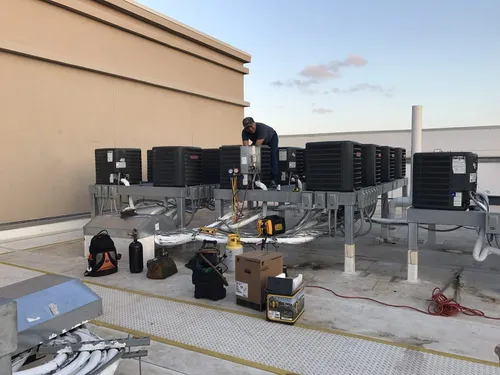
TCH Mechanical
Houston, TX
TCH Mechanical is an HVAC company based in Houston, TX, offering a wide range of services including air conditioning, furnace, heat pump, and mini split installation and repair. They serve residential, commercial, and multi-family buildings, handling systems from small to large capacities. Their capabilities include duct cleaning, thermostat installation, air purification with UV lights, and blown insulation to improve indoor air quality. The company provides maintenance, repairs, and replacements, with flexible financing options to support customers. They also offer a Comfort Club Membership for regular system maintenance and upgrades. TCH Mechanical serves Houston and surrounding Texas areas, focusing on keeping homes comfortable year-round.
How Geothermal Systems Work in Houston's Climate
Unlike traditional air-source heat pumps that exchange heat with the outside air, a geothermal system uses a network of buried pipes, called a ground loop, to exchange heat with the earth. Just a few feet below the surface, the ground maintains a nearly constant temperature between 60-70°F year-round, regardless of Houston's sweltering summer air or occasional winter chill.
This consistent temperature is the key to the system's remarkable efficiency:
- Heating in Winter: The fluid circulating in the ground loop absorbs the earth's natural warmth. The geothermal heat pump unit inside your home then concentrates this low-grade heat and distributes warm air through your existing ductwork.
- Cooling in Summer: The process reverses. The system extracts heat and humidity from your home's air, transfers it to the fluid in the loop, and deposits it into the cooler earth. This is exceptionally effective in Houston, where the ground is significantly cooler than the peak summer air.
By using the earth as a heat source in winter and a heat sink in summer, these ground-source systems require far less electricity to maintain comfortable indoor temperatures compared to conventional HVAC equipment.
Types of Ground Loop Systems
The installation of the underground loop field is the most distinctive aspect of a geothermal system. The right type for your Houston property depends on available land, soil conditions, and budget. Local geothermal contractors will perform a detailed site assessment to determine the best configuration.
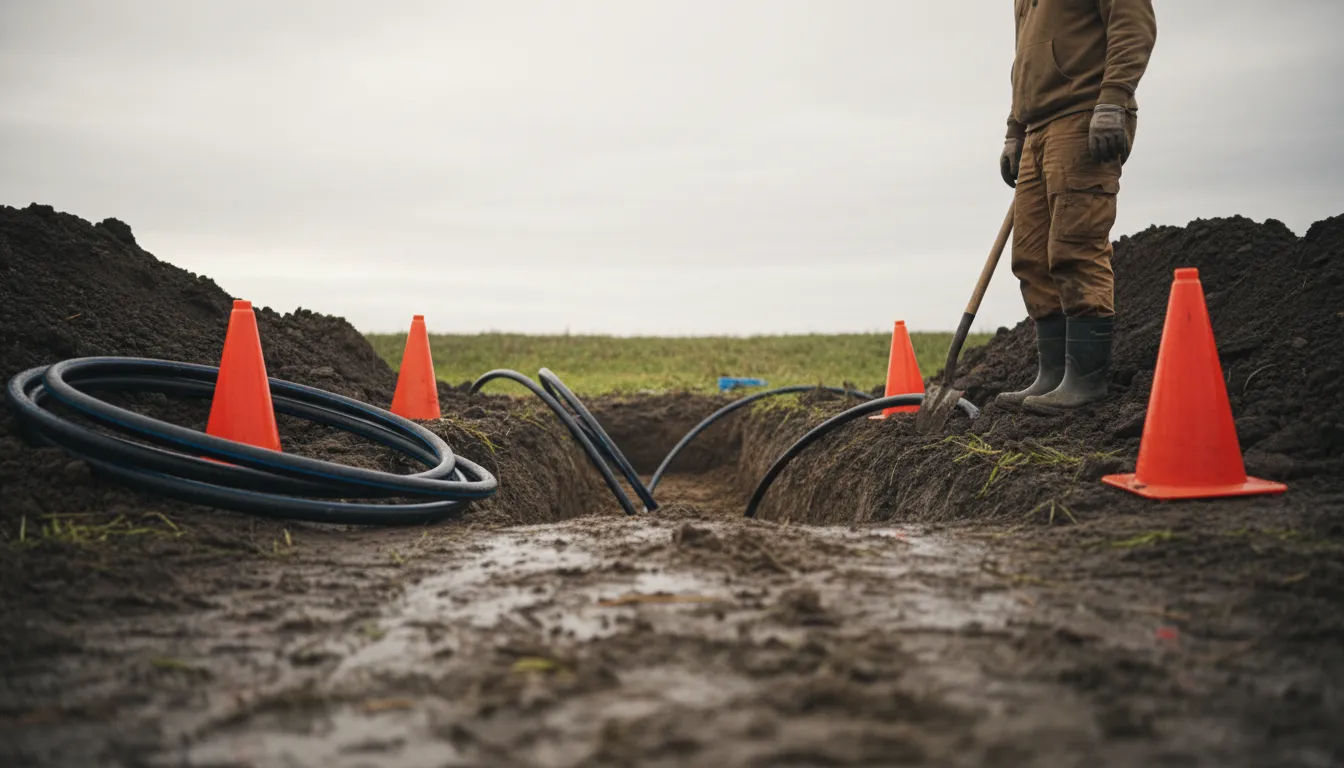
- Horizontal Ground Loops: This is often the most cost-effective option for properties with ample yard space. Polyethylene pipes are laid in trenches dug 4 to 6 feet deep. This method is commonly used in new construction where land is readily accessible for excavation.
- Vertical Ground Loops: For homes with smaller lots, which are common in many Houston neighborhoods, vertical loops are the ideal solution. Contractors drill boreholes 60 to 140 meters deep and insert U-shaped loop pipes. This method minimizes surface disruption and is less dependent on large tracts of land.
- Pond/Lake Loops: If your property has a suitable pond or lake, coils of pipe can be submerged at the bottom. This can be a very efficient and lower-cost installation option, but it requires an adequate, permanent body of water 1 2.
- Open Loop Systems: This system uses groundwater from a well as the direct heat exchange fluid. After circulating through the heat pump, the water is returned to the ground via a second well or approved discharge point. This option depends heavily on local water quality and regulations 3.
The Installation Process for Houston Homes
Installing a geothermal heating and cooling system is a significant project that requires specialized expertise. Understanding the process can help you know what to expect when working with a local installer.
- Comprehensive Site Evaluation: A qualified geothermal professional will assess your property's soil composition, available space, and your home's heating and cooling loads. This evaluation is critical for correctly sizing the system and choosing the optimal loop type.
- Ground Loop Installation: This is the major excavation phase. For horizontal loops, trenches are dug. For vertical loops, a drilling rig creates the necessary boreholes. High-density polyethylene (HDPE) pipe is then installed and connected into a continuous loop.
- Indoor Unit Setup: The geothermal heat pump unit, which is typically about the size of a traditional furnace, is installed inside your home (often in a garage or basement). It is connected to the underground loop and to your home's existing ductwork or hydronic distribution system 4 5.
- System Charging and Testing: The loop is thoroughly flushed, pressure-tested, and filled with a water-based antifreeze solution. The entire system is then started and fine-tuned to ensure it operates at peak efficiency and delivers the promised comfort 6 7.
Key Considerations for Houston Homeowners
Before investing in a geothermal heat pump, it's important to weigh several local factors that influence the system's design, cost, and payoff.
- Soil and Geology: Houston's clay-heavy soil can affect heat transfer rates and may influence loop length and drilling requirements. An experienced installer will account for this in their design 8.
- Space Availability: Your lot size will directly determine whether a horizontal or vertical loop system is feasible. Vertical loops are a common solution for the urban and suburban lots found throughout the Houston area.
- Upfront Investment vs. Long-Term Savings: The initial installation cost for a complete geothermal system in Houston can range from $20,000 to over $50,000, with the ground loop work being a major portion 9. However, this is balanced against substantial long-term savings on monthly energy bills-often between 30% and 70% compared to conventional systems-and an exceptionally long lifespan for the underground components, which can last 50 years or more 10 9.
Find the perfect geothermal heat pump contractors for your needs
Get personalized recommendations and expert advice
Understanding Costs and Energy Savings
The financial case for a geothermal system is built on long-term value. While the upfront cost is higher than a standard HVAC system, the operational savings are profound. Houston homeowners can expect a significant reduction in their utility bills, as these systems are 300-600% efficient, meaning they move three to six units of heat for every one unit of electricity used 11 12.
The payback period-the time it takes for energy savings to equal the initial investment-typically ranges from 4 to 15 years in Houston 13. This timeline depends on your specific installation costs, the system's efficiency, local electricity rates, and the type of system you are replacing. Furthermore, the ground loop has a lifespan of multiple decades, meaning you may only ever need to replace the indoor heat pump unit, which also has a long service life.
Environmental and Comfort Benefits
Beyond the financial savings, geothermal heat pumps offer exceptional environmental and comfort advantages perfect for our community:
- Reduced Carbon Footprint: By using renewable thermal energy from the ground and consuming less electricity, these systems drastically lower your home's greenhouse gas emissions.
- Enhanced Comfort: Geothermal systems provide exceptionally even heating and cooling, eliminate outdoor condenser noise, and often include superior dehumidification capabilities-a major benefit for Houston's humid climate 14 15.
- Quiet Operation: With no loud outdoor fan unit, the system operates very quietly. The main mechanical components are located indoors.
- Reliability: With fewer mechanical parts exposed to the elements and stable underground temperatures, geothermal systems are known for their durability and consistent performance year after year.
Frequently asked questions
Sources
Footnotes
-
Geothermal Heat Pumps - Department of Energy - https://www.energy.gov/energysaver/geothermal-heat-pumps ↩
-
How it Works - https://www.climatemaster.com/homeowner/side-links/how-it-works ↩
-
Geothermal heating & cooling, heat pumps, heat exchange ... - https://aztechgeo.com/residential-geothermal/how-it-works/ ↩
-
All You Need to Know About Home Geothermal Heating & Cooling - Dandelion Energy - https://dandelionenergy.com/all-you-need-to-know-about-home-geothermal-heating-cooling ↩
-
Ground Source Heat Pumps: Distribution System Types and ... - https://goclean.masscec.com/article/gshp-distribution-system-types-and-configurations/ ↩
-
Geothermal Heat Pumps, Explained - Bosch Home Comfort - https://www.bosch-homecomfort.com/us/en/residential/connect/blog/geothermal-heat-pumps-go-green-save-green/ ↩
-
About Geothermal Heat Pumps and Geothermal Cooling - Houston TX - http://earthpowerac.com/about-geo-in-texas/ ↩
-
Geothermal heat pumps: The ultimate guide to ground-source ... - https://termo-plus.com/blog/geothermal-ultimate-guide-to-ground-source-heat-pumps/ ↩
-
Geothermal Heat Pump Guide: Installation Costs, Types And Benefits - https://modernize.com/hvac/heating-repair-installation/heat-pump/geothermal ↩ ↩2
-
Everything You Need to Know About Geothermal Heat Pumps - https://www.familyhandyman.com/article/everything-you-need-to-know-about-geothermal-heat-pumps/ ↩
-
5 Things You Should Know about Geothermal Heat Pumps - https://www.energy.gov/cmei/articles/5-things-you-should-know-about-geothermal-heat-pumps ↩
-
Geothermal Systems - https://pellergy.com/heat-pump-systems/geothermal/ ↩
-
Geothermal Heat Pump - https://gencorphomes.com/geothermal-heat-pump/ ↩
-
How Do Geothermal Systems Work for Residential Homes? - https://www.davisheat.com/blog/how-do-geothermal-systems-work-for-residential-homes/ ↩
-
Geothermal - https://precisioncomfort.com/geothermal/ ↩