
Find the Best Geothermal Heat Pump Contractors for Your Business
No obligation • Fast responses • Nationwide coverage

Why you can trust HVAC Firms
HVAC Firms is a leading United States resource for evaluating HVAC service providers. Our team researches companies, checks credentials, and reviews customer feedback to present clear, unbiased information. Listings and rankings are based on merit, and companies cannot pay to change our editorial content.
Search providers near you
Top Geothermal Heat Pump Contractors in Missouri City, Texas Ranked
A geothermal heat pump, also known as a ground-source heat pump, is a highly efficient system for heating and cooling your home by leveraging the earth's stable underground temperature. For Missouri City residents, this technology offers a powerful way to manage the region's hot summers and mild winters while significantly reducing energy consumption. This guide explains how these systems work, the installation process, and how you can find qualified local experts to evaluate your property for this sustainable upgrade.
A-Team's A/C & Heating, LLC
3734 Magnolia Ridge, League City, TX 77573
A-Team's A/C & Heating, LLC is a licensed HVAC contractor serving Houston, TX, and surrounding counties including Galveston, Harris, and Brazoria. They provide residential and commercial heating and air conditioning services, including installation, repair, and maintenance of air conditioners, furnaces, heat pumps, boilers, mini split systems, and geothermal heat pumps. The company also offers indoor air quality services such as duct cleaning, air duct sealing, and installation of air cleaners and humidifiers. As an American-Standard® dealer, they supply a wide range of comfort equipment and specialize in system customization. With 24/7 emergency service availability, A-Team's A/C & Heating supports customers with trained technicians and extended service agreements to maintain system performance.
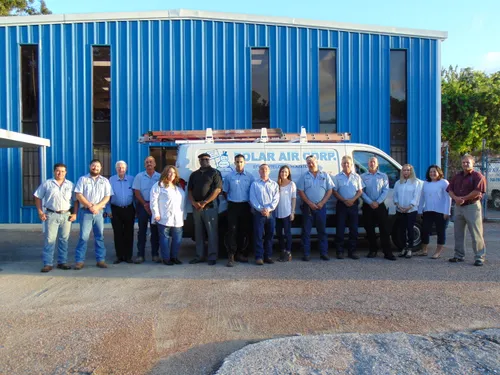
Polar Air Corp
8718 Antelope Dr, Houston, TX 77063
Polar Air Corp is a family-owned HVAC installation contractor serving Houston, TX, and the surrounding communities. They specialize in installing air conditioning systems, furnaces, heat pumps, boilers, mini splits, and geothermal heat pumps. With experience dating back to 1967, Polar Air Corp has a long history of providing tailored heating and cooling solutions for homes and businesses in the area.
TEXAS UNITED MECHANICAL, LLC
1118 N Main St #2G, Pearland, TX 77581
Texas United Mechanical, LLC is an HVAC company serving Houston, TX, and surrounding communities including Baytown, Brenham, Galveston, and Conroe. They provide a wide range of services such as air conditioner, furnace, and heat pump repair and installation, duct cleaning, thermostat installation, indoor air quality solutions, and geothermal system services. As a Carrier Factory Authorized Dealer, their technicians are factory-trained in both conventional and geothermal HVAC systems. With over 70 years of combined experience, the team offers 24/7 availability for emergency repairs and maintenance.
How Geothermal Systems Work: Harnessing the Earth's Energy
Unlike traditional air-source heat pumps that exchange heat with the outdoor air, a geothermal system uses a network of underground pipes, called a ground loop, to exchange heat with the earth. Just a few feet below the surface, the ground maintains a nearly constant temperature of 70-72°F year-round, regardless of the weather above 1. This stable thermal resource is the key to the system's remarkable efficiency.
During a sweltering Missouri City summer, the system acts as a highly efficient air conditioner. The heat pump inside your home extracts warm air from your living spaces. This heat is transferred to a fluid circulating within the buried ground loop. Because the earth is cooler than the summer air, it readily absorbs this excess heat, cooling the fluid before it returns to repeat the cycle 2 3. In the winter, the process simply reverses. The fluid in the loop absorbs the gentle heat from the earth and carries it to the indoor unit. The heat pump then concentrates this energy and distributes warm air throughout your home via the ductwork 4 5. This process is so efficient that for every unit of electricity used to run the system, it can deliver up to four units of heating or cooling energy to your home.
Types of Ground Loop Systems
Selecting the right ground loop configuration is a critical decision that depends on your property's characteristics, including soil composition, land area, and the presence of a water source. A qualified installer will conduct a thorough site assessment to recommend the best option.
Horizontal Closed-Loop Systems This is often the most cost-effective choice for residential properties, particularly new construction sites with ample yard space. Trenches are dug 4 to 6 feet deep using a backhoe or trencher, and high-density polyethylene (HDPE) pipes are laid in them 6. To reduce the required land area, the "slinky" method-laying coiled loops of pipe in the trench-is frequently used 7.
Vertical Closed-Loop Systems For homes with smaller lots or rocky soil, a vertical system is ideal. A drilling rig creates boreholes typically 100 to 400 feet deep. U-shaped HDPE pipes are inserted into each hole, which is then filled with a special grout to improve heat transfer and protect groundwater 8 9. While the drilling increases upfront costs, this system minimizes landscape disruption.
Pond/Lake Closed-Loop Systems If you have a sufficiently large and deep pond or lake on your property, this can be an excellent low-cost option. Coils of pipe are submerged at least 8 feet below the surface to utilize the water's stable temperature 10 11. The water body must meet specific volume and quality requirements for this system to be viable.
Open-Loop Systems This configuration uses groundwater directly from a well as the heat exchange fluid. The water is pumped through the heat pump and then returned to the aquifer via a second "return" well or discharged on the surface, subject to local regulations. This option requires an abundant, clean water source and is less common than closed-loop designs.
The Geothermal Installation Process
Installing a ground-source heat pump is a specialized project that requires expertise in HVAC, plumbing, and earthwork. The process is meticulous to ensure long-term performance and reliability.
- Comprehensive Site Evaluation: A certified contractor will assess your property's soil thermal conductivity, available space, and your home's heating and cooling load calculations. This step determines the optimal loop type and size 12.
- Ground Loop Installation: For horizontal systems, trenching equipment excavates the designated area. For vertical systems, a drilling rig arrives to create the boreholes. The HDPE pipe is then laid or inserted, and all loop sections are connected using thermal fusion welding, creating a seamless, leak-proof circuit 13 14. The entire loop is rigorously pressure-tested before being buried or grouted.
- Indoor Unit Integration: The ground loops are connected to the geothermal heat pump unit inside your home, typically located where a traditional furnace would be. The unit is integrated with your existing ductwork and electrical system.
- System Commissioning: Once installed, the contractor will charge the system, calibrate the controls, and test all modes of operation to ensure everything is working at peak efficiency.
Find the perfect geothermal heat pump contractors for your needs
Get personalized recommendations and expert advice
Energy Savings and Financial Incentives
The primary appeal of a geothermal heating and cooling system is its dramatic reduction in energy use. Homeowners can typically expect to lower their energy bills for heating and cooling by 30% to over 60% compared to conventional systems 15 16. In Texas, where air conditioning runs for much of the year, these savings can be substantial, making a geothermal system a wise long-term investment.
To help offset the initial installation cost, significant financial incentives are available:
- Federal Tax Credit: The federal Energy Efficient Home Improvement Tax Credit provides a credit worth 30% of the total installation cost for qualified geothermal heat pump systems, with no upper limit through 2032 17. This can translate to thousands of dollars back on your federal income taxes.
- State of Texas Rebates: The State Energy Conservation Office (SECO) is developing an income-dependent rebate program for home energy upgrades. While the start date is pending, this program could provide rebates of up to $14,000 for eligible low- and moderate-income households installing efficient systems like geothermal 18 19.
Long-Term Benefits and Considerations
Beyond monthly savings, geothermal systems offer exceptional durability. The indoor heat pump unit often lasts 20-25 years, while the underground ground loop can have a lifespan of 50 years or more 20. These systems are also remarkably quiet, with no noisy outdoor condenser unit, and they provide excellent dehumidification during the cooling season.
It's important to work with an experienced, certified installer. Proper design and installation are non-negotiable for achieving the promised efficiency and reliability. Look for contractors with specific training and credentials in geothermal technology, and always ask for references from local installations they have completed.
Frequently asked questions
Sources
Footnotes
-
Guide to Geothermal Heat Pumps - https://www.energy.gov/sites/prod/files/guide_to_geothermal_heat_pumps.pdf ↩
-
Geothermal Air Conditioning Spring | Earth Power AC and Heat - https://earthpowerac.com/geothermal-air-conditioning-spring/ ↩
-
Trane Geothermal Heat Pump Systems - https://www.lexairconditioning.com/systems/geothermal-systems/ ↩
-
Geothermal Heat Pump Wells - PUB2899 - https://dnr.mo.gov/document-search/geothermal-heat-pump-wells-pub2899/pub2899 ↩
-
Benefits of Geothermal Heating and Cooling Systems - https://residential.sunsetair.com/blog/benefits-of-geothermal-heating-and-cooling-systems/ ↩
-
Southeast Missouri Geothermal Heating System Services - https://www.dutchenterprises.com/heating/geothermal-systems/ ↩
-
Common Geothermal Configurations - https://www.achrnews.com/articles/96439-common-geothermal-configurations ↩
-
Geothermal Heating and Cooling by GeothermalXperts, Inc. - http://www.geothermalxperts.com/geothermal-system-types.htm ↩
-
Drilling geothermal wells: 2025 Ultimate Guide - https://www.eatondrillingandpumpservice.com/drilling-geothermal-wells/ ↩
-
Geothermal Heat Pumps, Explained - Bosch Home Comfort - https://www.bosch-homecomfort.com/us/en/residential/connect/blog/geothermal-heat-pumps-go-green-save-green/ ↩
-
Choosing Between Geothermal Systems in St. Louis | Scott-Lee - https://scottleeheating.com/which-of-the-four-geothermal-systems-is-best-for-you/ ↩
-
Geothermal HVAC: Feasibility & ROI - https://jupitairhvac.com/blog/geothermal-hvac-systems-feasibility-north-texas/ ↩
-
Geothermal Heat Pumps - Department of Energy - https://www.energy.gov/energysaver/geothermal-heat-pumps ↩
-
The Complete Guide To Geothermal Heat Pump Installation - https://ultrageothermal.com/the-complete-guide-to-geothermal-heat-pump-installation/ ↩
-
5 Things You Should Know about Geothermal Heat Pumps - https://www.energy.gov/cmei/articles/5-things-you-should-know-about-geothermal-heat-pumps ↩
-
ground-source heat pump case studies - UNT Digital Library - https://digital.library.unt.edu/ark:/67531/metadc622024/m2/1/high_res_d/105884.pdf ↩
-
Available Tax Credits For Geothermal Heat Pumps In 2025 | TX - https://glennairecompany.com/available-tax-credits-for-geothermal-heat-pumps-in-2025/ ↩
-
2025 Texas HVAC Rebates | Air Authority LLC - https://airauthorityllc.com/texas-hvac-rebates-tax-incentives-to-take-advantage-of/ ↩
-
Trane Geothermal Systems: Hage Energy Houston Service - https://hagenrg.com/products/trane/trane-geothermal-systems/ ↩
-
Geothermal Heat Pumps - Department of Energy - https://www.energy.gov/energysaver/geothermal-heat-pumps ↩