Find the Best Geothermal Heat Pump Contractors for Your Business
No obligation • Fast responses • Nationwide coverage

Why you can trust HVAC Firms
HVAC Firms is a leading United States resource for evaluating HVAC service providers. Our team researches companies, checks credentials, and reviews customer feedback to present clear, unbiased information. Listings and rankings are based on merit, and companies cannot pay to change our editorial content.
Search providers near you
Top Geothermal Heat Pump Contractors in League City, Texas Ranked
Geothermal heat pumps are a highly efficient method for heating and cooling your home by leveraging the stable temperatures found underground. For homeowners in League City, this technology offers a path to significant energy savings and long-term comfort, making it a compelling alternative to traditional air-source systems. This guide explains how ground-source heat pump systems work, their benefits, and what you need to know to explore local installation options for your property.
A-Team's A/C & Heating, LLC
3734 Magnolia Ridge, League City, TX 77573
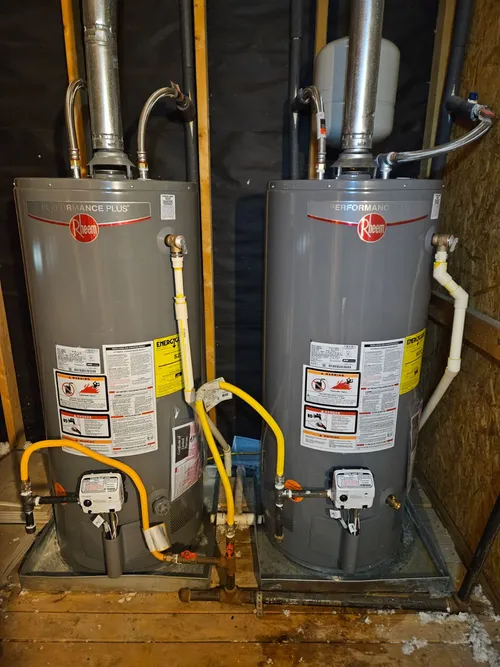
A-Team's A/C & Heating, LLC is a licensed HVAC contractor serving Houston, TX, and surrounding counties including Galveston, Harris, and Brazoria. They provide residential and commercial heating and air conditioning services, including installation, repair, and maintenance of air conditioners, furnaces, heat pumps, boilers, mini split systems, and geothermal heat pumps. The company also offers indoor air quality services such as duct cleaning, air duct sealing, and installation of air cleaners and humidifiers. As an American-Standard® dealer, they supply a wide range of comfort equipment and specialize in system customization. With 24/7 emergency service availability, A-Team's A/C & Heating supports customers with trained technicians and extended service agreements to maintain system performance.
Polar Air Corp
8718 Antelope Dr, Houston, TX 77063
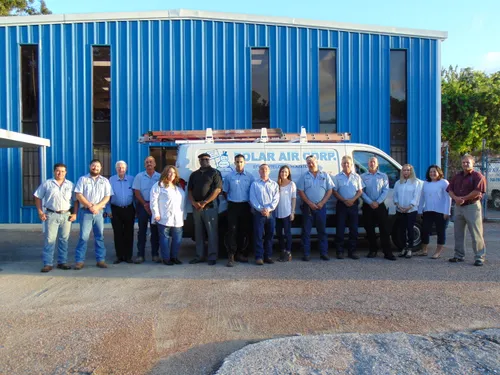
Polar Air Corp is a family-owned HVAC installation contractor serving Houston, TX, and the surrounding communities. They specialize in installing air conditioning systems, furnaces, heat pumps, boilers, mini splits, and geothermal heat pumps. With experience dating back to 1967, Polar Air Corp has a long history of providing tailored heating and cooling solutions for homes and businesses in the area.
TEXAS UNITED MECHANICAL, LLC
1118 N Main St #2G, Pearland, TX 77581
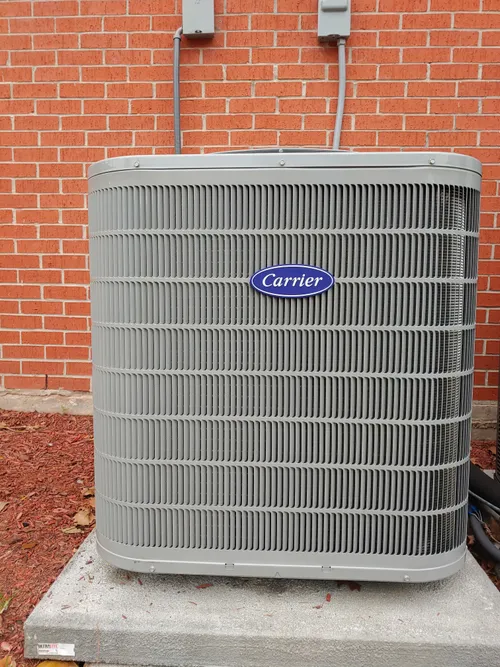
Texas United Mechanical, LLC is an HVAC company serving Houston, TX, and surrounding communities including Baytown, Brenham, Galveston, and Conroe. They provide a wide range of services such as air conditioner, furnace, and heat pump repair and installation, duct cleaning, thermostat installation, indoor air quality solutions, and geothermal system services. As a Carrier Factory Authorized Dealer, their technicians are factory-trained in both conventional and geothermal HVAC systems. With over 70 years of combined experience, the team offers 24/7 availability for emergency repairs and maintenance.
How Geothermal Systems Work: The Basics
A geothermal system, often called a ground-source heat pump, doesn't create heat by burning fuel. Instead, it transfers heat. In the winter, it extracts heat from the earth and moves it into your home. In the summer, the process reverses, pulling heat from your home and depositing it into the cooler ground 1. This is possible because just a few feet below the surface, the earth maintains a remarkably stable temperature of around 60-70°F year-round, regardless of the sweltering summer heat or occasional chilly night in League City 2 3.
The system has three main components:
- The Ground Loop: A network of pipes buried in your yard or drilled deep into the ground. A water-based solution circulates through these pipes to exchange heat with the earth.
- The Heat Pump Unit: Located inside your home, this unit concentrates the thermal energy gathered from the loop. In heating mode, it amplifies the warmth for distribution; in cooling mode, it acts like an air conditioner, expelling heat.
- The Distribution System: This is typically your existing ductwork, which delivers the conditioned air throughout your house. Some systems can also work with in-floor radiant heating.
The core efficiency advantage comes from exchanging heat with the stable ground temperature rather than the highly variable outdoor air, which allows the system to work much less hard than a conventional air-source heat pump or AC unit 4.
Types of Ground Loops for League City Properties
The design of the underground loop field is critical and depends heavily on your specific lot. There are three primary configurations, each with pros and cons for the local soil and space constraints.
Vertical Closed Loops This is the most common installation type for homes in developed areas like League City. Contractors drill boreholes between 150 and 450 feet deep and insert U-shaped loop pipes into each one. The main advantage is a small surface footprint, making vertical loops ideal for smaller residential lots where trenching isn't feasible. While the drilling process can be more expensive upfront, it is often the only practical choice for retrofitting a system onto an existing home with a modest yard.
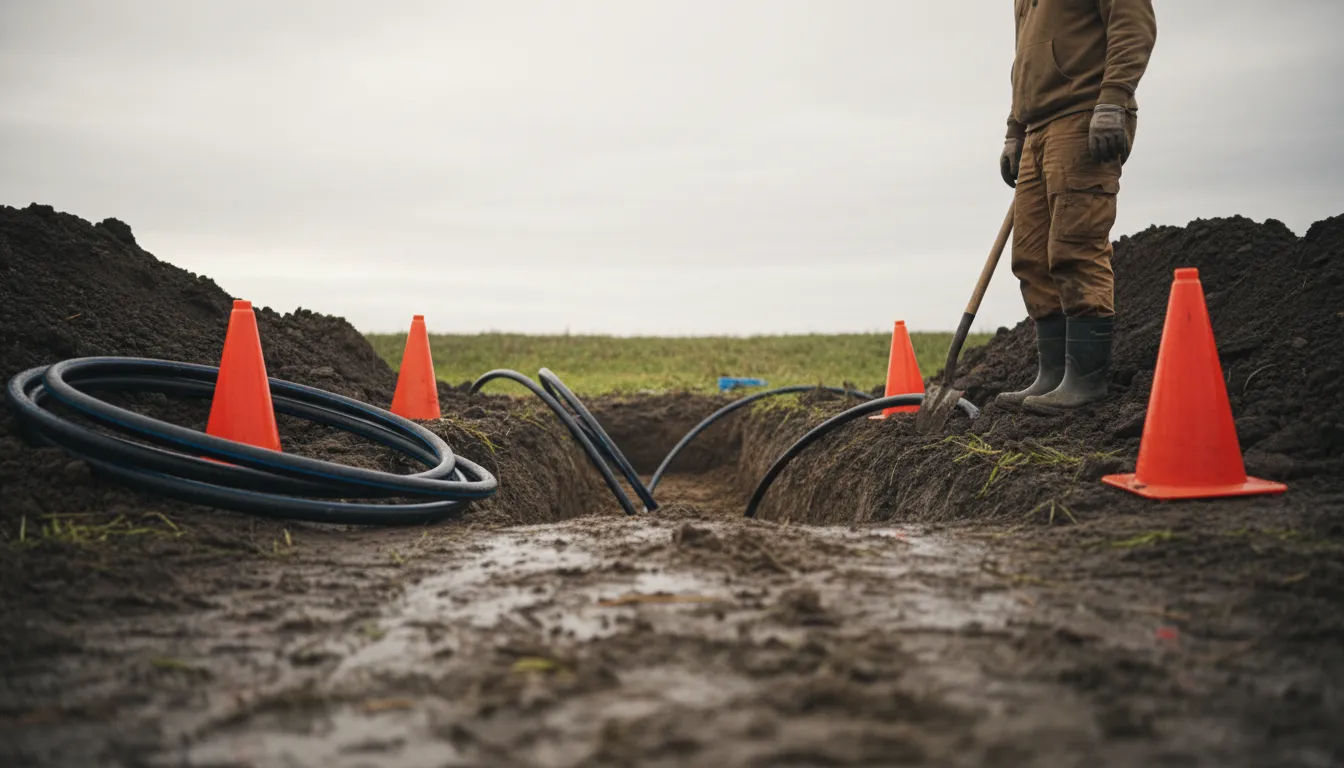
Horizontal Closed Loops For properties with ample land, a horizontal loop may be an option. Contractors dig trenches 4 to 6 feet deep in a grid or series of parallel lines, laying out the piping before backfilling 5 6. This method generally has a lower installation cost than vertical drilling because it uses standard trenching equipment. However, it requires a significant amount of unobstructed land, which can be a limiting factor in many suburban neighborhoods.
Pond/Lake Loops (Open or Closed) If you have a sufficiently large and deep pond or lake on your property, it can serve as a heat exchange source. Coils of pipe are submerged at the bottom of the water body 7. This can be one of the most cost-effective loop installations if the conditions are right, but it is entirely dependent on having a suitable, accessible body of water nearby.
Find the perfect geothermal heat pump contractors for your needs
Get personalized recommendations and expert advice
Key Considerations for Installation in League City
Choosing and installing a geothermal system is a major home investment that requires careful local planning. Several factors specific to the Gulf Coast region will influence your project's design and cost.
Soil Composition and Thermal Conductivity The soil in League City affects how well heat transfers between the ground and the loop pipes. Sandy, clay-heavy, or moist soils all have different thermal properties 8. A qualified installer will assess your soil conditions to correctly size the loop field. Proper sizing is non-negotiable-an undersized loop will lead to an inefficient system, while an oversized one adds unnecessary cost.
Space and Drilling vs. Trenching As mentioned, the available space on your lot is the primary determinant for loop type. Vertical drilling is frequently the go-to solution due to lot size constraints, but it involves specialized drilling rigs 9. Horizontal trenching needs more yard space but may be simpler. Your installer will evaluate your property layout, including setbacks, utilities, and landscaping, to recommend the best approach.
System Sizing and Home Compatibility A geothermal heat pump must be correctly sized for your home's heating and cooling load, which is calculated based on square footage, insulation levels, window quality, and other factors. An oversized or undersized unit will compromise efficiency and comfort. Furthermore, these systems work most efficiently when paired with a well-designed, leak-free ductwork system. An installer will evaluate your current ducts to see if they need sealing, modification, or replacement.
The Financial Picture: Costs, Savings, and Incentives
The decision to install a geothermal system is often driven by its long-term financial benefits, though it requires understanding the upfront investment.
Upfront Installation Costs The initial cost for a geothermal heat pump system in League City is significant, primarily due to the ground loop excavation or drilling. For a typical 2,000-square-foot home, total installed costs can range from $20,000 to over $40,000. The wide range depends on the loop type (vertical drilling is more expensive than horizontal trenching), the soil conditions, the system's capacity, and any necessary upgrades to your home's electrical service or ductwork.
Long-Term Energy Savings and ROI This is where geothermal systems shine. By leveraging the earth's constant temperature, they operate with exceptional efficiency, often cutting heating, cooling, and even hot water costs by 40% to 70% compared to conventional HVAC systems 10 11. These dramatic savings on your monthly utility bills from providers like CenterPoint Energy allow the system to pay for itself over time. The return on investment (ROI) or "payback period" typically falls between 4 and 15 years, after which you enjoy drastically reduced operating costs for the decades-long lifespan of the system 12 13.
Rebates and Tax Credits To help offset the high initial cost, federal incentives are available. The federal residential energy efficiency tax credit can cover a substantial percentage of the total cost of a qualifying geothermal heat pump installation, including labor. It's crucial to discuss current federal, state, and even local utility rebates with your installer, as these programs can change and significantly improve the project's economics.
Maintenance and Longevity
One of the standout features of a geothermal system is its durability and low maintenance requirements. The indoor heat pump unit requires about the same level of care as a standard furnace or air handler: regular filter changes and periodic check-ups by a professional. The groundbreaking, however, is famously long-lasting. The polyethylene pipes used are designed to last for 50 years or more, and because the system is sealed and protected underground, it is largely immune to weather damage. This longevity contributes to the excellent life-cycle value of the investment.
Frequently asked questions
Sources
Footnotes
-
Geothermal Heat Pumps - Department of Energy - https://www.energy.gov/energysaver/geothermal-heat-pumps ↩
-
5 Things You Should Know about Geothermal Heat Pumps - https://www.energy.gov/cmei/articles/5-things-you-should-know-about-geothermal-heat-pumps ↩
-
How Do Geothermal Systems Work for Residential Homes? - https://www.davisheat.com/blog/how-do-geothermal-systems-work-for-residential-homes/ ↩
-
Geothermal Heat Pumps | WBDG - https://www.wbdg.org/resources/geothermal-heat-pumps ↩
-
Geothermal heat pumps: The ultimate guide to ground-source ... - https://termo-plus.com/blog/geothermal-ultimate-guide-to-ground-source-heat-pumps/ ↩
-
Geothermal Heating, Cooling, and Hot Water Systems - https://igshpa.org/wp-content/uploads/Homeowners-Guide-to-Geothermal.pdf ↩
-
Geothermal heating & cooling, heat pumps, heat exchange loops - How it works - https://aztechgeo.com/residential-geothermal/how-it-works/ ↩
-
Geothermal Conditioning : Critical Sources for Sustainability - https://link.springer.com/rwe/10.1007/978-1-4614-5828-9_422 ↩
-
All You Need to Know About Home Geothermal Heating & ... - https://dandelionenergy.com/all-you-need-to-know-about-home-geothermal-heating-cooling ↩
-
Geothermal HVAC: Feasibility & ROI - https://jupitairhvac.com/blog/geothermal-hvac-systems-feasibility-north-texas/ ↩
-
How Does a Geothermal System Work? - ClimateMaster - https://www.climatemaster.com/homeowner/side-links/how-it-works ↩
-
Everything You Need to Know About Geothermal Heat Pumps - https://www.familyhandyman.com/article/everything-you-need-to-know-about-geothermal-heat-pumps/ ↩
-
Geothermal Heat Pump Guide: Installation Costs, Types And Benefits - https://modernize.com/hvac/heating-repair-installation/heat-pump/geothermal ↩