Find the Best Geothermal Heat Pump Contractors for Your Business
No obligation • Fast responses • Nationwide coverage

Why you can trust HVAC Firms
HVAC Firms is a leading United States resource for evaluating HVAC service providers. Our team researches companies, checks credentials, and reviews customer feedback to present clear, unbiased information. Listings and rankings are based on merit, and companies cannot pay to change our editorial content.
Search providers near you
Top Geothermal Heat Pump Contractors in Conroe, Texas Ranked
A geothermal heat pump, also known as a ground-source heat pump, is a highly efficient system that uses the earth's stable temperature to heat and cool your home. For Conroe residents, this technology offers a powerful way to combat both the intense summer heat and the occasional winter chill while significantly reducing energy bills. This guide explains how these systems work, what installation in Conroe involves, and how you can find qualified local experts to assess your property for this long-term investment.
Easco Air Conditioning and Heating
2001 Timberloch Pl #500, The Woodlands, TX 77380
Easco Air Conditioning and Heating is a full-service HVAC company serving Houston, TX, and the surrounding Conroe area. They offer installation, repair, and maintenance for air conditioners, furnaces, heat pumps, mini splits, and geothermal heat pump systems. As a certified Lennox and Armstrong Pro Dealer, they handle all makes and models, including WaterFurnace geothermal systems. Established in 1982, Easco has over 40 years of experience in residential, commercial, and industrial HVAC services. They provide 24/7 emergency service to address urgent heating and cooling needs.
Easco Air Conditioning and Heating
16809 TX-75, Willis, TX 77378
Easco Air Conditioning and Heating is a full-service HVAC company serving Houston, TX. They provide installation, repair, and maintenance for air conditioning, furnaces, heat pumps, mini splits, and geothermal heat pump systems. As a certified Lennox and Armstrong Pro Dealer, they handle all makes and models, including WaterFurnace geothermal systems. With over 30 years of experience since 1982, Easco offers 24/7 emergency service to address heating and cooling needs any time of day or night.
Century Air Solutions, Llc
11709 Boudreaux Rd Ste. 630, Tomball, TX 77375
Century Air Solutions, LLC is an HVAC contractor serving Houston, TX, and surrounding areas including Tomball, Spring, and Cypress. They provide a range of services such as air conditioning repair and maintenance, heating system installation and replacement, geothermal HVAC solutions, and indoor air quality improvements. The company offers 24/7 emergency HVAC services and works with both residential and commercial clients. Their certified technicians focus on energy-efficient installations and repairs, helping customers qualify for federal tax credits and local utility rebates.
How a Geothermal System Works: Harnessing the Earth's Constant Temperature
The core principle behind a geothermal heating and cooling system is remarkably simple: it exchanges heat with the ground, which maintains a nearly constant temperature year-round just a few feet below the surface. In Conroe, this ground temperature is a stable resource, typically between 50-70°F 1 2.
The process involves two main components:
- The Ground Loop: A network of pipes buried in your yard circulates a water-based fluid. In the winter, this fluid absorbs the earth's natural warmth and carries it indoors.
- The Heat Pump Unit: Located inside your home, this unit concentrates the low-grade heat from the fluid and transfers it to warm the air circulated through your ducts. In the summer, the process reverses: the system extracts heat from your indoor air and deposits it into the cooler ground 3.
This efficient heat exchange is why geothermal systems, or earth-coupled heat pumps, can be up to 65% more efficient than conventional HVAC systems for heating and up to 50% more efficient for cooling.
Types of Ground Loops: Choosing the Right System for Your Conroe Property
The buried pipe system, or ground loop, is the heart of the installation. The right type for your home depends on your lot size, soil conditions, and local geology. There are three primary configurations:
Closed-Loop Systems This is the most common type installed in residential settings. A sealed loop of high-density polyethylene pipe circulates an environmentally safe antifreeze/water mixture. There are two main installation styles:
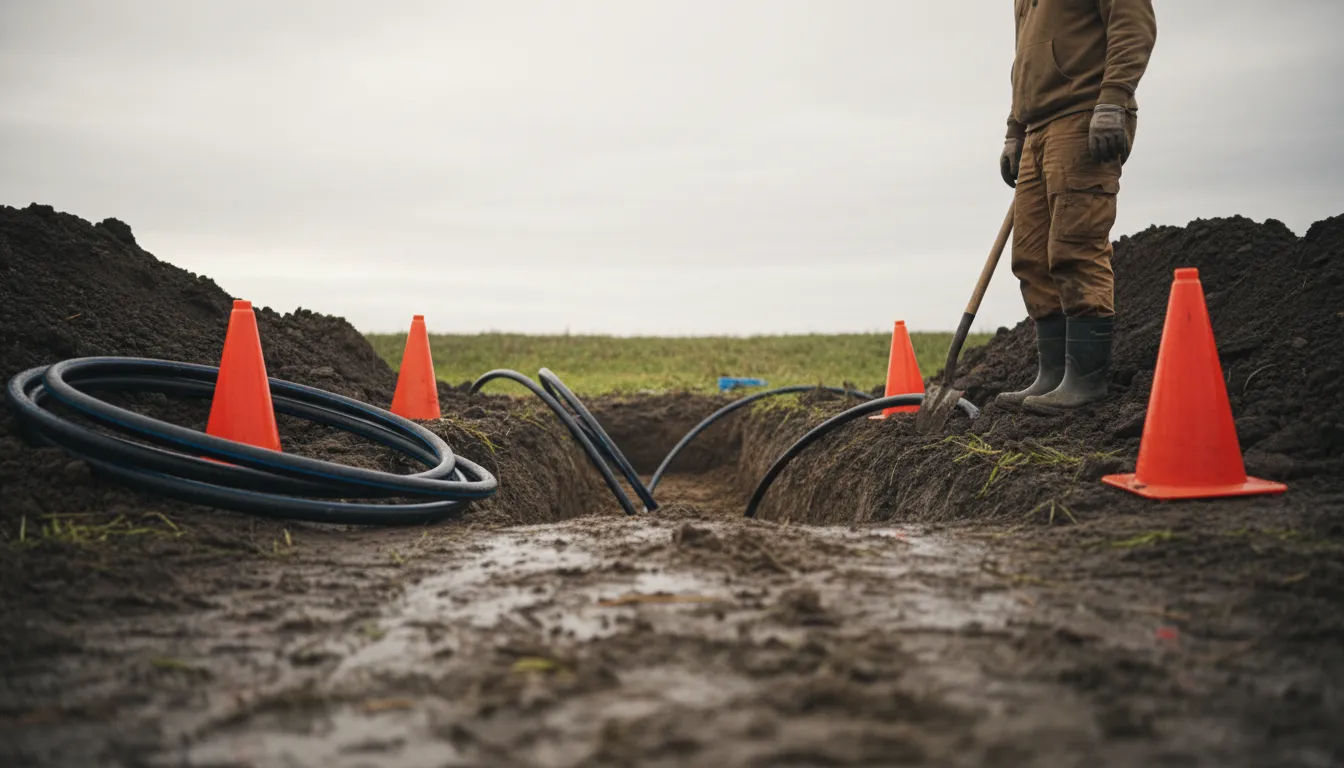
- Horizontal Loops: Pipes are laid in trenches dug 4 to 6 feet deep. This requires a significant amount of open land but is generally less expensive than vertical drilling if space is available.
- Vertical Loops: For homes with smaller yards, like many in Conroe, vertical loops are often the ideal solution. Holes are bored 150 to 450 feet deep, and U-shaped loops of pipe are inserted into each borehole. This minimizes landscape disruption and is excellent for high heating and cooling loads.
Open-Loop Systems This system uses groundwater from a well as the heat exchange fluid. After circulating through the heat pump, the water is discharged back into a second well, a pond, or a stream. This option is highly efficient but is entirely dependent on having a sufficient supply of suitable quality water available on your property 4.
Pond/Lake Loops If you have access to a large, deep pond or lake, a coil of pipe can be submerged at the bottom. This can be a very cost-effective loop option, as it avoids extensive trenching or drilling 5 6.
Find the perfect geothermal heat pump contractors for your needs
Get personalized recommendations and expert advice
The Installation Process in Conroe: From Assessment to Activation
Installing a geothermal heat pump is a significant project that requires careful planning and expert execution. The process typically follows these steps:
- Site Evaluation: A qualified installer will first conduct a thorough assessment of your property. They will evaluate soil composition, rock content, available space, and water table levels. This evaluation is critical for determining the best loop type and sizing the system correctly for your home's specific needs.
- Loop Field Installation: This is the most invasive phase. For a horizontal system, a backhoe will dig long trenches. For a vertical system, a drilling rig will be brought in to create the boreholes. The pipes are then placed, connected, and pressure-tested to ensure there are no leaks 7 8.
- Indoor Unit Installation: The geothermal heat pump unit, which is about the size of a small refrigerator, is installed indoors-typically in a basement, utility room, or garage. It is connected to your home's existing ductwork or to a new duct system.
- Connection & Commissioning: The indoor unit is connected to the underground loop, and the system is filled with fluid. The installer will then start the system, check all components, and calibrate it for optimal performance.
Because of the excavation or drilling required, installation is often easiest during new home construction or a major renovation. However, retrofits are entirely possible and common.
Costs, Savings, and Long-Term Value
The decision to install a geothermal system is a long-term financial investment. Understanding the upfront costs versus the operational savings is key.
Upfront Investment The initial cost for a geothermal heat pump system in Conroe is higher than for a traditional air-source system. For a typical 2,000-square-foot home, total installed costs often range from $20,000 to $40,000 or more 9. This price includes the ground loop excavation/drilling, the heat pump unit, and all labor. The largest variable cost is the loop field installation, which depends on the type and size required.
Long-Term Energy Savings This is where geothermal systems shine. By leveraging the earth's free thermal energy, they drastically reduce the amount of electricity needed for heating and cooling. Homeowners can save up to 65% on their heating and cooling energy bills compared to conventional systems 10 11 12. In Conroe's hot climate, the savings on summer cooling can be particularly substantial, helping to offset the higher initial cost over time.
Durability and Lifespan Geothermal systems are renowned for their longevity. The underground polyethylene piping often comes with warranties of 25 to 50 years and can last for generations 13. The indoor heat pump unit typically has a lifespan of 20 years or more, which is significantly longer than the 15-year average for a standard air conditioner 14 13.
Incentives and Rebates Federal tax credits are available for qualifying geothermal heat pump installations, which can significantly reduce the net cost. It's important to consult with your installer about current federal, state, or local utility incentives.
Is a Geothermal System Right for Your Conroe Home?
A typical Conroe home with a modest-sized yard might be an excellent candidate for a closed-loop system with vertical boreholes. This configuration minimizes surface disruption while providing the capacity to handle our long cooling season efficiently. The system would provide quiet, consistent comfort year-round, cutting cooling costs significantly during our hot summers while also providing efficient heat during cooler winter nights 15 16.
The ideal candidate for geothermal is a homeowner planning to stay in their home long enough to recoup the initial investment through utility savings, someone interested in reducing their carbon footprint with a renewable technology, or someone building a new home where the loop field can be integrated seamlessly into the site plan.
Frequently asked questions
Sources
Footnotes
-
Geothermal Heat Pumps - EnergySmart CNY - https://www.energysmartcny.org/heat-pumps/geothermal/ ↩
-
How a Geothermal Heat Pump Works | This Old House - https://www.youtube.com/watch?v=d5Tbsx3R2T8 ↩
-
Geothermal Heating & Cooling - Department of Energy - https://www.energy.gov/eere/geothermal/geothermal-heating-cooling ↩
-
Geothermal heating & cooling, heat pumps, heat exchange ... - https://aztechgeo.com/residential-geothermal/how-it-works/ ↩
-
Geothermal Heat Pumps - Department of Energy - https://www.energy.gov/energysaver/geothermal-heat-pumps ↩
-
Geothermal Heating, Cooling, and Hot Water Systems - https://igshpa.org/wp-content/uploads/Homeowners-Guide-to-Geothermal.pdf ↩
-
Ground source heat pumps: horizontal collectors Vs. vertical boreholes - https://www.mesh-energy.com/insights/ground-source-heat-pumps-horizontal-collectors-vs-vertical-boreholes ↩
-
Difference Between Horizontal and Vertical Geothermal Ground Loops - https://envirotechgeo.com/horizontal-and-vertical-geothermal-ground-loops/ ↩
-
Geothermal Heat Pump Guide: Installation Costs, Types And Benefits - https://modernize.com/hvac/heating-repair-installation/heat-pump/geothermal ↩
-
5 Things You Should Know about Geothermal Heat Pumps - https://www.energy.gov/cmei/articles/5-things-you-should-know-about-geothermal-heat-pumps ↩
-
Guide to Geothermal Heat Pumps - https://www.energy.gov/sites/prod/files/guide_to_geothermal_heat_pumps.pdf ↩
-
Ground Source Heat Pumps - https://www.membersfirst.coop/ground-source-heat-pumps ↩
-
Guide to Geothermal Heat Pumps - https://www.energy.gov/sites/prod/files/guide_to_geothermal_heat_pumps.pdf ↩ ↩2
-
How Geothermal Heating and Cooling Systems Work | Belle Air - https://www.belleairservices.com/how-geothermal-heating-and-cooling-systems-work/ ↩
-
Understanding Geothermal Heating & Cooling Systems - https://www.tchvac.net/news/geothermal-heating-and-cooling-explained ↩
-
Conroe Geothermal Heating System Installation Services - https://www.eascoair.com/conroe-heating/geothermal-heating-systems/ ↩