
Find the Best Geothermal Heat Pump Contractors for Your Business
No obligation • Fast responses • Nationwide coverage

Why you can trust HVAC Firms
HVAC Firms is a leading United States resource for evaluating HVAC service providers. Our team researches companies, checks credentials, and reviews customer feedback to present clear, unbiased information. Listings and rankings are based on merit, and companies cannot pay to change our editorial content.
Search providers near you
Top Geothermal Heat Pump Contractors in Burleson, Texas Ranked
For Burleson homeowners seeking a long-term solution for home comfort and energy savings, geothermal heat pumps represent a sophisticated and highly efficient technology. These systems, also known as ground-source heat pumps or geoexchange systems, leverage the earth's constant underground temperature to provide both heating and cooling for your home. This guide explains how geothermal works, what installation in Burleson entails, and how you can connect with qualified local experts to explore this sustainable HVAC option for your property.
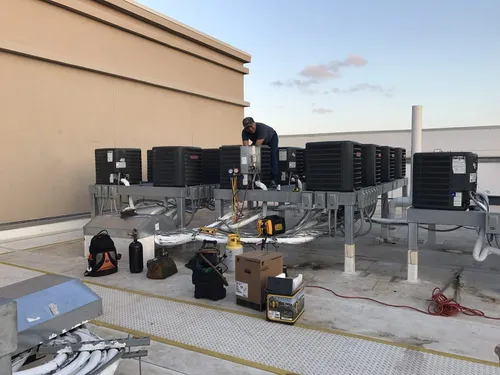
How a Geothermal System Works: Harnessing the Earth's Energy
Unlike conventional air conditioners and furnaces that create heat or fight the outside air temperature, a geothermal heat pump simply transfers heat. The key is the earth's stable thermal mass. Just a few feet below the surface, the ground in North Texas maintains a relatively constant temperature of approximately 60-70°F year-round. A geothermal system uses this as a renewable energy source and a heat sink.
The process centers on a closed-loop of pipes, called a ground loop, buried in your yard. A water-based fluid circulates through this loop. In the winter, the fluid absorbs the earth's warmth and carries it to the heat pump unit inside your home. The heat pump concentrates this low-grade heat and distributes warm air through your ductwork 1 2. In the summer, the system reverses: it extracts heat and humidity from your indoor air and transfers it into the cooler fluid, which then dumps that heat into the ground 1 3. This heat exchange process is what makes geothermal systems remarkably efficient, as moving heat requires significantly less energy than generating it.
Types of Ground Loops for Burleson Properties
The ground loop is the most site-specific part of a geothermal installation. The right type for your home depends on your lot size, soil composition, and local geology. There are three primary configurations:
-
Horizontal Closed Loop: This is often the most cost-effective option if space allows. Contractors dig trenches 5 to 8 feet deep in your yard and lay extensive coils of pipe 4 5. This approach typically requires a fair amount of land, often half an acre or more, making it a good fit for many Burleson properties with larger lots.
-
Vertical Closed Loop: For homes with smaller yards, vertical loops are the standard solution. Contractors use a drilling rig to bore holes 150 to 250 feet deep. U-shaped pipes are inserted into each borehole, which is then sealed with a special grout. While drilling can be more expensive than trenching, it minimizes landscape disturbance and is effective in most soil and rock types found in the area.
-
Pond/Lake Loop: If you have a sufficient body of water on your property, this can be an excellent option. Coils of pipe are submerged at the bottom of the pond or lake, where the water temperature remains stable 6 7. This method usually has the lowest installation cost if the water source is suitable and accessible.
Key Considerations for Burleson Homeowners
Before investing in a geothermal heating and cooling system, several local factors will influence your project's design, feasibility, and cost.
- Soil and Geology: The composition of the soil and rock in North Texas directly impacts heat transfer efficiency and drilling difficulty. A qualified installer will assess your specific site conditions to design the most effective loop field.
- Available Space: Your lot size and layout are the primary determinants for choosing between a horizontal or vertical loop system. A professional site evaluation is essential.
- New Construction vs. Retrofit: Integrating a geothermal system into a new home build is generally more straightforward and cost-effective, as the loop field can be installed before landscaping and the interior unit can be planned alongside ductwork. Retrofitting an existing home is absolutely possible but may involve more complex ductwork modifications and careful landscape planning 8.
- Home Heating and Cooling Load: The size and efficiency of your home dictate the required capacity of the geothermal heat pump and the length of the ground loop. An accurate load calculation is a critical first step.
Understanding Costs, Savings, and Return on Investment
The most significant consideration for most homeowners is the financial aspect. Geothermal systems have a higher upfront cost but offer substantial operational savings.
- Installation Cost: For a typical residential system in Burleson, total installed costs generally range from $20,000 to $40,000 or more. This wide range accounts for the type of loop system, the size of your home, the equipment quality, and site-specific challenges. This initial investment is notably higher than that of a standard high-efficiency air-source heat pump or AC/furnace combo.
- Energy Savings: This is where geothermal shines. By leveraging the earth's stable temperature, these systems operate with exceptional efficiency. Homeowners can typically expect to reduce their energy bills for heating and cooling by 50% to 70% compared to conventional systems 9 10. This dramatic reduction provides a buffer against rising electricity and natural gas prices.
- Return on Investment (ROI): The payback period-the time it takes for energy savings to recoup the installation premium-varies widely, often cited between 4 and 15 years 11. Factors include your installation cost, local utility rates, system usage, and available incentives. Over the system's lifespan of 20-25 years for the heat pump and 50+ years for the ground loop, the lifetime savings are substantial 11.
Find the perfect geothermal heat pump contractors for your needs
Get personalized recommendations and expert advice
The Importance of Expert Design and Installation
Geothermal technology is not a DIY project. Its performance and longevity are heavily dependent on precise design and flawless installation. A properly sized and installed system will deliver decades of quiet, reliable, and efficient service. Conversely, an undersized loop field or an incorrectly installed heat pump can lead to poor performance, high operating costs, and premature failure.
This underscores the value of working with experienced, certified geothermal contractors. They perform the crucial site surveys, load calculations, and system designs specific to Burleson's climate and soil conditions. They also understand the permitting process and can ensure the loop installation meets all codes and best practices.
Long-Term Benefits Beyond Savings
While the financial payback is a major draw, the benefits of a ground-source heat pump extend further:
- Durability: The protected underground piping often carries warranties of 50 years and can last generations. The indoor heat pump components also tend to have longer lifespans than conventional outdoor AC units.
- Comfort: Geothermal systems provide exceptionally even heating and cooling without the drafts and temperature swings associated with fossil fuel furnaces. They also excel at dehumidification in the summer.
- Quiet Operation: With no loud outdoor condenser unit, the system runs very quietly. The only sound is the indoor air handler.
- Safety and Cleanliness: There is no combustion, so there are no risks of carbon monoxide poisoning, gas leaks, or flammable fuel storage. The system produces no flames or exhaust.
- Environmental Impact: By using renewable thermal energy from the ground and electricity, a geothermal system drastically reduces your home's carbon footprint associated with heating and cooling.
Navigating Incentives and Financing
The federal government, and sometimes state or local utilities, offer incentives to offset the initial cost of geothermal systems. As of this writing, a federal tax credit is available for qualified geothermal heat pump installations. It is essential to consult with your installer and a tax professional to understand the current incentives for which you may qualify. Some HVAC contractors also partner with financing companies to offer loan options that make the upfront cost more manageable, allowing your monthly energy savings to help cover the payment.
Frequently asked questions
Sources
Footnotes
-
Geothermal Heating & Cooling - Department of Energy - https://www.energy.gov/eere/geothermal/geothermal-heating-cooling ↩ ↩2
-
Geothermal Heat Pumps | WBDG - https://www.wbdg.org/resources/geothermal-heat-pumps ↩
-
How a Geothermal Heat Pump Works | This Old House - https://www.youtube.com/watch?v=d5Tbsx3R2T8 ↩
-
Geothermal Heat Pumps, Explained - Bosch Home Comfort - https://www.bosch-homecomfort.com/us/en/residential/connect/blog/geothermal-heat-pumps-go-green-save-green/ ↩
-
Geothermal Heating, Cooling, and Hot Water Systems - https://igshpa.org/wp-content/uploads/Homeowners-Guide-to-Geothermal.pdf ↩
-
Geothermal Heat Pumps - Department of Energy - https://www.energy.gov/energysaver/geothermal-heat-pumps ↩
-
Geothermal heating & cooling, heat pumps, heat exchange ... - https://aztechgeo.com/residential-geothermal/how-it-works/ ↩
-
How Do Geothermal Systems Work for Residential Homes? - https://www.davisheat.com/blog/how-do-geothermal-systems-work-for-residential-homes/ ↩
-
Geothermal HVAC: Feasibility & ROI - https://jupitairhvac.com/blog/geothermal-hvac-systems-feasibility-north-texas/ ↩
-
Geothermal Heat Pump Guide: Installation Costs, Types And Benefits - https://modernize.com/hvac/heating-repair-installation/heat-pump/geothermal ↩
-
Everything You Need to Know About Geothermal Heat Pumps - https://www.familyhandyman.com/article/everything-you-need-to-know-about-geothermal-heat-pumps/ ↩ ↩2