Find the Best Geothermal Heat Pump Contractors for Your Business
No obligation • Fast responses • Nationwide coverage

Why you can trust HVAC Firms
HVAC Firms is a leading United States resource for evaluating HVAC service providers. Our team researches companies, checks credentials, and reviews customer feedback to present clear, unbiased information. Listings and rankings are based on merit, and companies cannot pay to change our editorial content.
Search providers near you
Top Geothermal Heat Pump Contractors in Beaumont, Texas Ranked
A geothermal heat pump, or ground-source heat pump, is a highly efficient heating and cooling system that uses the Earth's stable underground temperature to regulate your home's climate. For Beaumont residents, this technology offers a powerful way to combat both the intense summer heat and occasional winter chills while significantly reducing energy consumption. This guide explains how these systems work, what installation entails, and how you can find qualified local experts to evaluate your property for this sustainable upgrade.
How Geothermal Systems Work in Southeast Texas
The core principle behind a geothermal system is remarkably simple: it exchanges heat with the ground, which maintains a nearly constant temperature of 60-70°F year-round just a few feet below the surface 1. This is far more stable than Beaumont's fluctuating air temperatures, making ground-source heat pumps exceptionally efficient.
- Heating Mode: During winter, a fluid circulating through pipes buried in the ground absorbs the Earth's natural warmth. The heat pump then concentrates this thermal energy and distributes it as warm air through your home's existing ductwork 2.
- Cooling Mode: In summer, the process reverses. The system extracts heat and humidity from your indoor air and transfers it into the cooler fluid in the ground loops, which then deposits the heat into the Earth, leaving your home comfortably cooled 3.
This efficient heat exchange process is why geothermal systems can achieve energy savings of 25% to 70% on heating and cooling bills compared to conventional systems. While the savings percentage in Beaumont's hot-humid climate may trend toward the lower end of that range compared to colder regions, the absolute dollar savings on air conditioning can still be substantial.
Types of Geothermal Loop Systems
The underground portion of the system, called the ground loop, is the most critical component. There are several configurations, and the right choice depends heavily on your property's characteristics-soil composition, land area, and access to water.
Closed-Loop Systems
This is the most common residential installation. A sealed loop of high-density polyethylene (HDPE) pipe is buried and filled with a water and antifreeze solution that circulates continuously.
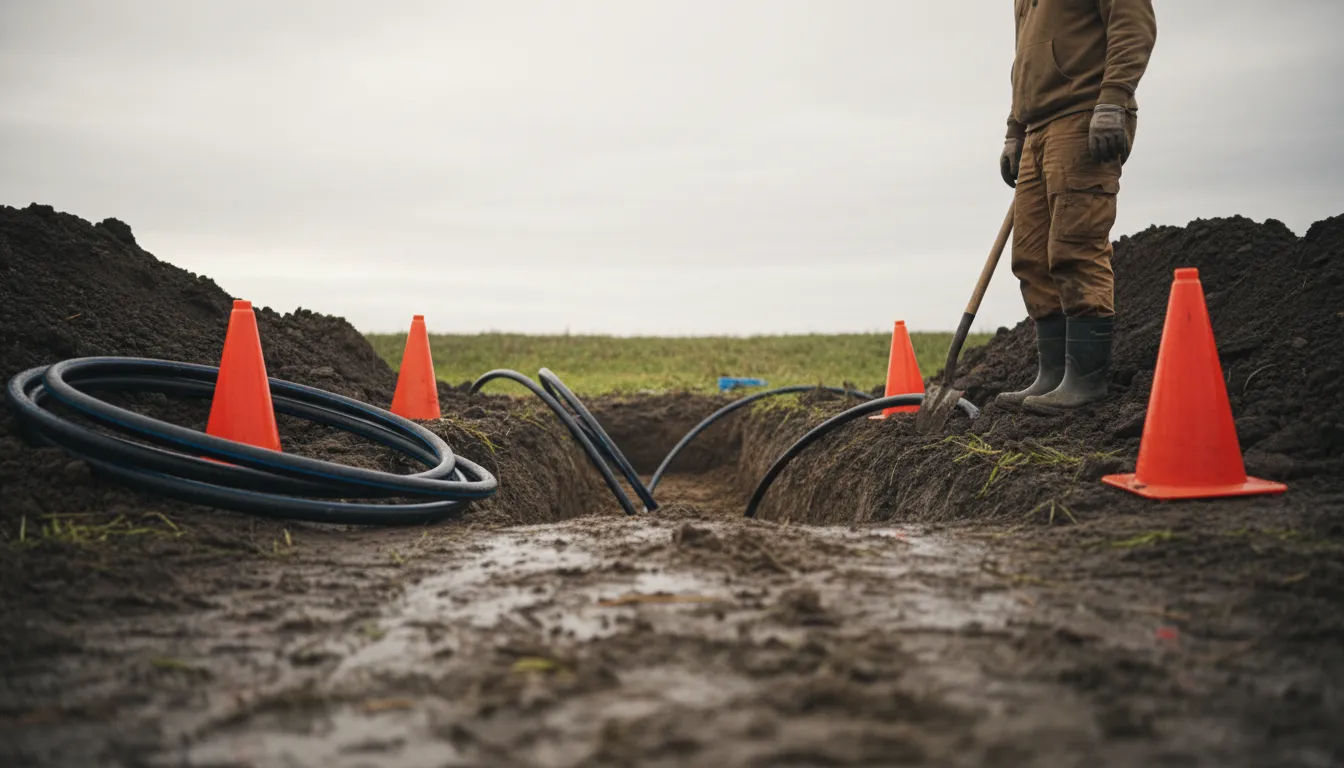
- Horizontal Closed-Loop: Ideal for properties with ample yard space. Trenches are dug 4 to 6 feet deep and hundreds of feet long to lay the pipe loops4 5. This is often the most cost-effective method if land is available.
- Vertical Closed-Loop: The best solution for smaller lots common in many Beaumont neighborhoods. Contractors drill boreholes 60 to 140 meters deep and insert U-shaped loops of pipe into each hole6 7. Vertical loops are more common in areas with rocky soil or limited space and typically have a higher installation cost due to the drilling equipment required.
Open-Loop Systems
This configuration uses groundwater from a well or a pond as the direct heat exchange fluid. After passing through the heat pump, the water is returned to a second well or discharged on the surface. While potentially very efficient, open-loop systems require an abundant, consistent water source with suitable quality and are subject to more local regulations regarding water use8.
The Installation Process for Beaumont Homes
Installing a residential geothermal system is a significant project that requires specialized expertise. Understanding the steps can help you know what to expect when working with a local installer.
- Site Assessment and Design: A qualified installer will evaluate your property, considering soil and rock types (which affect heat transfer), available space, and your home's heating and cooling loads. This assessment determines the optimal loop type and size.
- Permitting: Your contractor will handle obtaining necessary local permits for drilling, trenching, and the HVAC work, ensuring all Beaumont and Jefferson County regulations are met.
- Loop Installation: For a vertical system, a drilling rig will create the boreholes. For a horizontal system, a trenching machine will dig the long trenches. The HDPE pipe is then laid, connected, and pressure-tested before being buried.
- Heat Pump and Ductwork Connection: The indoor geothermal heat pump unit is installed (often in place of your old furnace or air handler) and connected to the ground loop and your home's ductwork. Electrical and refrigerant lines are finalized.
- System Charging and Startup: The loop is filled with the heat transfer fluid, the system is purged of air, and the heat pump is started and tested for proper operation9.
Find the perfect geothermal heat pump contractors for your needs
Get personalized recommendations and expert advice
Understanding Costs and Financials
The primary consideration for most homeowners is the upfront investment, which is higher than for a traditional air-source HVAC system.
- Installation Cost: For a typical Beaumont home, a complete geothermal heating and cooling system often ranges from $20,000 to $40,000 or more. The final price depends on the loop type (vertical drilling is more expensive than horizontal trenching), your home's size, the existing ductwork, and the specific equipment chosen.
- Operating Cost & Savings: The high efficiency translates to lower monthly utility bills. For example, a 2,000-square-foot home might save $1,000 to $2,000 or more annually on energy costs compared to a standard system, though this varies widely with personal usage and local electricity rates10 11.
- Payback and Incentives: The "payback period"-the time it takes for energy savings to equal the initial cost-can be shortened by available incentives. The federal residential energy tax credit can significantly offset the installed cost12 13. When combined with long-term savings and the system's durability, many homeowners find the investment financially sound over time.
Longevity and Environmental Benefits
One of the most compelling advantages of geothermal technology is its lifespan. The indoor heat pump components typically last 20 to 25 years, which is comparable to high-quality conventional systems. The real standout is the underground loop system, which has a proven lifespan of 50 years or more with minimal maintenance, as the durable HDPE pipe is protected from the elements. This longevity means the ground loop may last for the lifetime of the home.
Environmentally, ground-source heat pumps have a much smaller carbon footprint. They use electricity only to move heat, not to create it, and can be paired with renewable energy sources like solar panels for a near-zero-emissions home comfort solution14 15. They also operate very quietly, with no noisy outdoor condenser unit.
Finding the Right Local Expertise
Given the complexity and site-specific nature of geothermal installations, choosing an experienced, certified contractor is paramount. Look for professionals with specific training in geothermal system design and installation, such as certification from the International Ground Source Heat Pump Association (IGSHPA). They should conduct a detailed Manual J load calculation for your home and provide a comprehensive proposal that includes loop design, equipment specifications, and a clear breakdown of costs and projected savings.
Frequently asked questions
Sources
Footnotes
-
How Do Geothermal Systems Work for Residential Homes? - https://www.davisheat.com/blog/how-do-geothermal-systems-work-for-residential-homes/ ↩
-
Geothermal Heat Pumps - EnergySmart CNY - https://www.energysmartcny.org/heat-pumps/geothermal/ ↩
-
Geothermal (Ground Source) Heat Pumps - NY.gov - https://cleanheat.ny.gov/geothermal-heat-pumps/ ↩
-
Geothermal heat pumps: The ultimate guide to ground-source ... - https://termo-plus.com/blog/geothermal-ultimate-guide-to-ground-source-heat-pumps/ ↩
-
Geothermal Heat Pumps - Department of Energy - https://www.energy.gov/energysaver/geothermal-heat-pumps ↩
-
FAQs • What types of ground-source heat pumps and configurat - https://concordma.gov/FAQ.aspx?QID=484 ↩
-
Understanding the Geothermal Loop: Open vs. Closed Systems - https://sperrydrillinginc.com/understanding-the-geothermal-loop-open-vs-closed-systems/ ↩
-
Geothermal Heating, Cooling, and Hot Water Systems - https://igshpa.org/wp-content/uploads/Homeowners-Guide-to-Geothermal.pdf ↩
-
How to Install a Residential Geothermal System: A Step-by-Step Guide - https://www.envirotechgeo.com/how-to-install-a-residential-geothermal-system/ ↩
-
Geothermal HVAC: Feasibility & ROI - https://jupitairhvac.com/blog/geothermal-hvac-systems-feasibility-north-texas/ ↩
-
Geothermal Heat Pump Guide: Installation Costs, Types And Benefits - https://modernize.com/hvac/heating-repair-installation/heat-pump/geothermal ↩
-
About Geothermal - https://igshpa.org/about-geothermal/ ↩
-
Guide to Geothermal Heat Pumps - https://www.energy.gov/sites/prod/files/guide_to_geothermal_heat_pumps.pdf ↩
-
Geothermal Heating & Cooling - Department of Energy - https://www.energy.gov/eere/geothermal/geothermal-heating-cooling ↩
-
5 Things You Should Know about Geothermal Heat Pumps - https://www.energy.gov/cmei/articles/5-things-you-should-know-about-geothermal-heat-pumps ↩