Find the Best Geothermal Heat Pump Contractors for Your Business
No obligation • Fast responses • Nationwide coverage

Why you can trust HVAC Firms
HVAC Firms is a leading United States resource for evaluating HVAC service providers. Our team researches companies, checks credentials, and reviews customer feedback to present clear, unbiased information. Listings and rankings are based on merit, and companies cannot pay to change our editorial content.
Search providers near you
Top Geothermal Heat Pump Contractors in Toledo, Ohio Ranked
Geothermal heat pumps, also known as ground-source heat pumps, provide an exceptionally efficient method for heating and cooling your home by leveraging the earth's stable underground temperature. For Toledo homeowners, this technology offers a path to significant energy savings and reduced environmental impact. This guide explains how these systems work, what installation entails, and how you can connect with qualified local professionals to explore this sustainable home comfort solution.

Ultra Inc
Toledo, OH 43612
Ultra Inc is a family owned and operated HVAC company serving Toledo, OH. Since 1989, they have provided heating and cooling solutions for both residential and commercial customers. Their services include installation, repair, and maintenance of furnaces, air conditioners, boilers, geothermal heat pumps, and indoor air quality products. Ultra Inc is an Elite Dealer for Day & Night Heating & Cooling Products and offers 24-hour emergency service to address urgent needs.

T & M Heating & Air
478 Dearborn Ave, Toledo, OH 43605
T & M Heating & Air is a heating and cooling company based in Toledo, OH, serving residential and light commercial customers. They provide a full range of HVAC services including air conditioner and furnace repair, installation, tune-ups, and indoor air quality solutions. The company also specializes in geothermal heat pump installations, offering eco-friendly options to improve energy savings. With over 30 years of experience in the Toledo area, T & M Heating & Air offers 24/7 emergency service and same-day appointments to address urgent heating and cooling needs.
How Geothermal Heating and Cooling Works
Unlike conventional furnaces and air conditioners, a geothermal system doesn't create heat by burning fuel. Instead, it moves existing heat between your home and the ground. The earth beneath Toledo maintains a relatively constant temperature between 40°F and 70°F year-round, regardless of the weather above. A geothermal heat pump uses this stable thermal resource as its exchange medium.
In the winter, the system circulates a water-based solution through a loop of pipes buried in the ground. This fluid absorbs the earth's natural warmth. The heat pump then concentrates this low-grade heat and transfers it to your home's air or water distribution system 1.
In the summer, the process reverses. The system extracts heat from your indoor air and transfers it into the cooler ground loop. This provides air conditioning by depositing your home's unwanted heat into the earth. Because it relies on the consistent ground temperature rather than fluctuating outside air, a ground-source heat pump operates with much higher efficiency than standard air-source heat pumps or traditional HVAC equipment 2.
Types of Geothermal Loop Systems
The heart of a geothermal system is its ground loop. The type of loop installed depends on your Toledo property's characteristics, including land availability, soil composition, and access to water. There are two main categories: closed-loop and open-loop systems.
Closed-Loop Systems
This is the most common configuration for residential properties. A sealed loop of high-density polyethylene (HDPE) pipe is buried underground and filled with an environmentally friendly antifreeze and water solution. This fluid continuously circulates, exchanging heat with the earth without ever mixing with groundwater. There are three primary closed-loop designs:
- Vertical Loops: Ideal for properties with limited yard space, which is common in many Toledo neighborhoods. Contractors drill several boreholes, typically 150 to 400 feet deep, and insert U-shaped loops of pipe into each hole. This design minimizes surface disruption but often involves higher drilling costs.
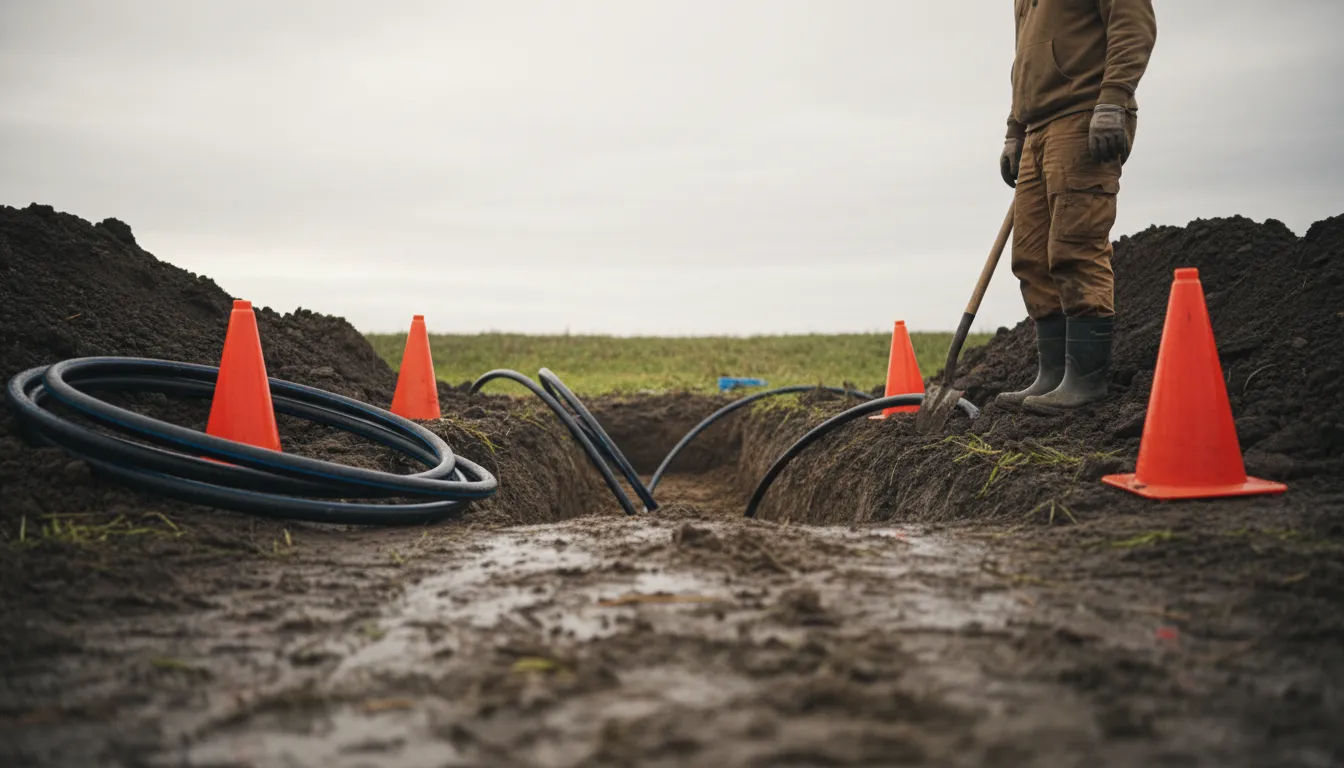
- Horizontal Loops: This method requires more land area. Contractors dig trenches about four to six feet deep in long, parallel rows and lay loops of pipe horizontally 3 4 5. It is generally more cost-effective than vertical drilling if sufficient open land is available.
- Pond/Lake Loops: If your property has access to a suitable pond or lake, coils of pipe can be submerged at the bottom. This can be a very efficient and lower-cost option, provided the body of water meets depth, volume, and quality requirements 6.
Open-Loop Systems
An open-loop system uses groundwater from a well as the direct heat exchange fluid. It pumps water from the aquifer, runs it through the heat pump to exchange heat, and then discharges it to a pond, stream, or recharge well 7. While potentially very efficient, this system is less common because it requires an abundant supply of clean water and compliance with local codes regarding water discharge.
The Installation Process for Toledo Homes
Installing a geothermal system is a significant project that requires professional expertise. Understanding the steps can help you prepare.
- Site Assessment and Design: A certified geothermal contractor will evaluate your property. They assess soil and rock conditions, available land, and access for drilling equipment. They also perform a detailed load calculation for your home to properly size the heat pump and loop field.
- Loop Field Installation: This is the major excavation phase. For a vertical system, a drilling rig will create the boreholes, and the U-bend pipes will be inserted and grouted. For a horizontal system, a backhoe will dig the trenches, and the piping will be laid and backfilled.
- Trenching to the House: A trench is dug from the loop field to the home's foundation to bring the underground pipes into the basement or mechanical room 8.
- Indoor Unit Installation: The geothermal heat pump unit-which is about the size of a small furnace-is installed indoors, typically in a basement, utility room, or garage. It is connected to the ground loop piping and to your home's existing ductwork for air distribution or to a hydronic system for radiant floor heat 9.
- System Startup and Commissioning: The contractor fills the loops, purges air from the system, and tests all components. They will balance the airflow and ensure the system is operating at peak efficiency before handing it over to you 10.
Find the perfect geothermal heat pump contractors for your needs
Get personalized recommendations and expert advice
Key Considerations for Your Property
Before moving forward with a geothermal system, several local factors specific to your Toledo home will influence the design and cost:
- Available Space: Vertical loops are the standard for smaller urban and suburban lots. If you have ample acreage, a horizontal loop may be more economical.
- Soil and Rock Composition: The type of soil and bedrock in your area affects drilling speed and cost. Clay and moist soil offer good heat transfer, while solid rock requires specialized drilling equipment 11 12.
- Existing Ductwork: Most geothermal heat pumps use forced air for distribution. Your existing ductwork may be compatible, but it must be properly sealed and sized for optimal performance. The indoor unit can also be configured for ductless applications or to work with in-floor radiant systems.
- Local Permits and Regulations: Reputable installers will handle obtaining the necessary permits from local authorities and ensuring the system meets all building codes and environmental guidelines in Lucas County.
Benefits, Savings, and Longevity
The upfront investment in a geothermal system is offset by substantial long-term benefits that make it an attractive option for many Toledo residents.
- Energy Bill Savings: Homeowners typically see a 25% to 50% reduction in heating and cooling costs compared to conventional systems. In some cases, savings can reach up to 65% 13 14. While electricity is needed to run the compressor and pumps, the energy drawn from the ground is free and renewable.
- Low Operating Costs: The high efficiency of geothermal heat pumps translates directly to lower monthly utility bills. Their efficiency is measured in Coefficient of Performance (COP) for heating and Energy Efficiency Ratio (EER) for cooling, with geothermal systems often achieving COPs of 3.0 to 5.0, meaning they deliver 3 to 5 units of heat for every unit of electricity consumed 15.
- Exceptional Lifespan: The indoor heat pump components have a life expectancy of 20 to 25 years, which is comparable to high-end conventional systems. The buried ground loop, however, is incredibly durable and often comes with warranties of 50 years or more, with an expected functional life that can exceed half a century.
- Comfort and Quiet: Geothermal systems provide consistent, even heating and cooling without the cold blasts or hot streaks associated with fossil fuel furnaces. The indoor units operate very quietly, and there is no noisy outdoor condenser like those found with air-source heat pumps or central AC.
- Environmental Impact: By drastically reducing fossil fuel consumption or the load on the electrical grid, a geothermal system significantly lowers your home's carbon footprint. It's a clean, renewable technology that uses the earth's natural energy.
Frequently asked questions
Sources
Footnotes
-
How Does Geothermal Energy Work? - https://www.kkellyinc.com/geothermal-concepts.html ↩
-
Geothermal Heating & Cooling - Department of Energy - https://www.energy.gov/eere/geothermal/geothermal-heating-cooling ↩
-
Geothermal Heat Pump Installation: What To Expect For Your ... - https://jomory.com/geothermal-heat-pump-installation-what-to-expect-for-your-property/ ↩
-
Geothermal Heat Pumps, Explained - Bosch Home Comfort - https://www.bosch-homecomfort.com/us/en/residential/connect/blog/geothermal-heat-pumps-go-green-save-green/ ↩
-
Geothermal heating & cooling, heat pumps, heat exchange ... - https://aztechgeo.com/residential-geothermal/how-it-works/ ↩
-
Recommendations for Geothermal Heating and ... - Ohio.gov - https://dam.assets.ohio.gov/image/upload/epa.ohio.gov/Portals/28/documents/sccgw/GHCS.pdf ↩
-
Geothermal Heat Pumps - Department of Energy - https://www.energy.gov/energysaver/geothermal-heat-pumps ↩
-
Ground Source Heat Pump Installation - Process & Costs - https://iheat.co.uk/heat-pump-help/ground-source-heat-pump-installation ↩
-
Geothermal | Green Home Technology Center - https://greenhome.osu.edu/renewables/geothermal ↩
-
How It Works: The Geothermal Installation Process - https://www.awheatingandcooling.com/blog/geothermal-service/how-it-works-the-geothermal-installation-process/ ↩
-
Geothermal Heating And Cooling System, Toledo, Ohio - Services - https://www.tandmheatingandair.com/geothermal-heating-cooling/ ↩
-
Geothermal Heating, Cooling, and Hot Water Systems - https://igshpa.org/wp-content/uploads/Homeowners-Guide-to-Geothermal.pdf ↩
-
5 Things You Should Know about Geothermal Heat Pumps - https://www.energy.gov/cmei/articles/5-things-you-should-know-about-geothermal-heat-pumps ↩
-
How Do Geothermal Systems Work for Residential Homes? - https://www.davisheat.com/blog/how-do-geothermal-systems-work-for-residential-homes/ ↩
-
Geothermal Heat Pump - DSO Electric Cooperative - https://dsoelectric.com/geothermal-heat-pump ↩