Find the Best Geothermal Heat Pump Contractors for Your Business
No obligation • Fast responses • Nationwide coverage

Why you can trust HVAC Firms
HVAC Firms is a leading United States resource for evaluating HVAC service providers. Our team researches companies, checks credentials, and reviews customer feedback to present clear, unbiased information. Listings and rankings are based on merit, and companies cannot pay to change our editorial content.
Search providers near you
Top Geothermal Heat Pump Contractors in Dayton, Ohio Ranked
A geothermal heat pump, also known as a ground-source heat pump, is a highly efficient heating and cooling system that uses the Earth's stable underground temperature to regulate your home's climate. This technology matters because it can dramatically cut energy bills, reduce your home's carbon footprint, and provide reliable comfort for decades. For Dayton homeowners, finding a qualified local installer is the first step to accessing these benefits, and this guide will help you understand the process and what to look for in a provider.
How Geothermal Systems Work in Dayton
The principle behind a ground-source heat pump is elegant in its simplicity. It leverages the fact that just a few feet below the surface, the Earth maintains a nearly constant temperature between 40-70°F year-round, regardless of Ohio's seasonal extremes. A geothermal system uses this stable thermal resource as a heat source in winter and a heat sink in summer.
The core component is the ground loop, a network of pipes buried in your yard or submerged in a pond. A water-based fluid circulates through this sealed loop. In the winter, the fluid absorbs heat from the relatively warm ground and carries it to the heat pump unit inside your home. The heat pump concentrates this low-grade heat and distributes it through your ductwork. In the summer, the process reverses: the system extracts heat from your home, transfers it to the fluid, and rejects it into the cooler earth. This exchange with the consistent ground temperature is what makes geothermal systems far more efficient than conventional air-source heat pumps, which must work harder as outdoor air temperatures become very hot or very cold.
Types of Ground Loop Systems
Choosing the right loop configuration is a critical decision based on your property's characteristics. The most common types installed in the Dayton area are closed-loop systems.
- Vertical Closed-Loop: This is often the best choice for residential lots with limited space. A drilling rig bores holes 150 to 450 feet deep, and U-shaped loops of high-density polyethylene (HDPE) pipe are inserted into each borehole. The holes are then grouted to ensure good thermal contact with the earth. This method minimizes landscape disturbance but requires specialized drilling equipment.
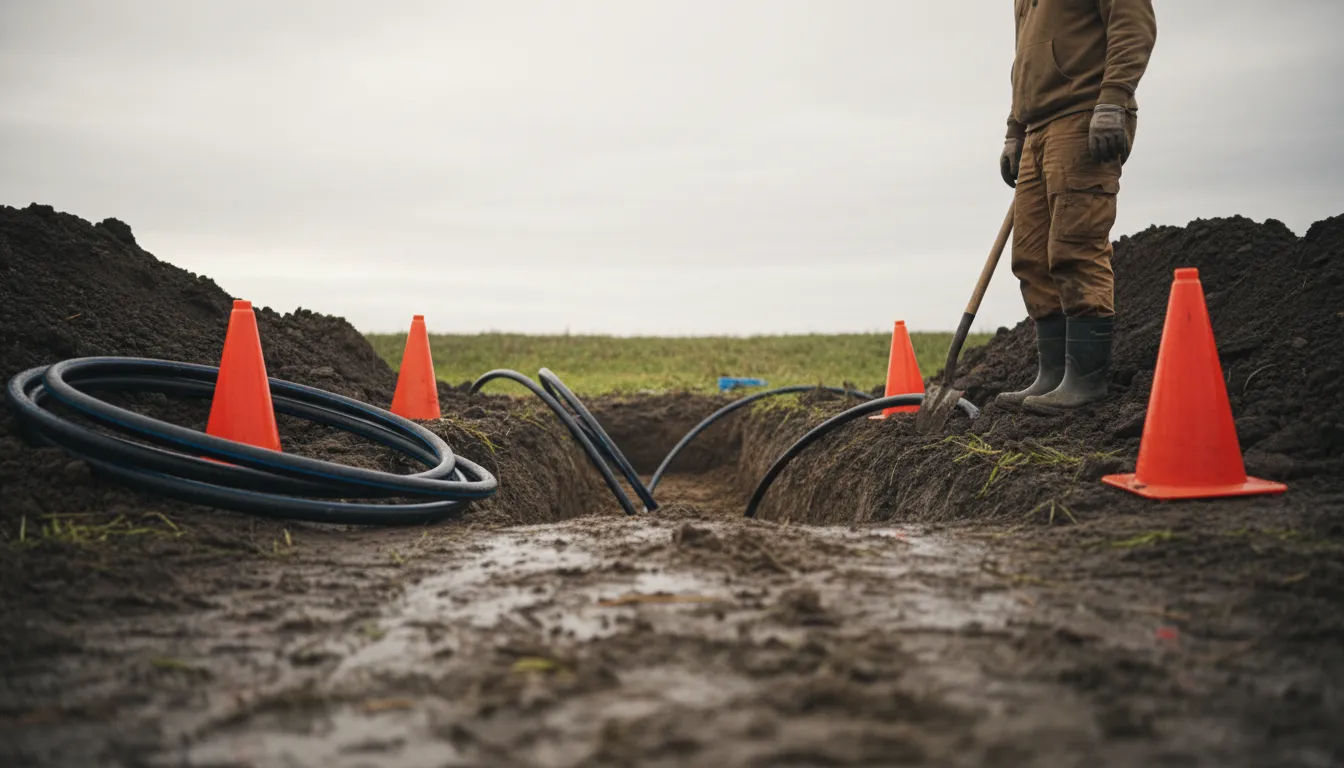
- Horizontal Closed-Loop: If you have ample yard space, a horizontal loop may be more cost-effective. Trenches are excavated about four to six feet deep, and pipes are laid in a series of parallel runs or slinky coils. This approach requires more land area but typically involves lower excavation costs than deep drilling 1 2.
- Pond/Lake Loop: If you have a suitable body of water on your property, this can be an excellent option. Coils of pipe are submerged at a depth that won't freeze. The water acts as an excellent heat exchange medium, often making this one of the most efficient and lower-cost loop options to install 3 4.
- Open-Loop System: This system uses groundwater from a well directly as the heat exchange fluid. After passing through the heat pump, the water is discharged to a second well, a pond, or a stream, depending on local codes. This system is highly efficient but requires an adequate supply of clean water and compliance with local regulations regarding water discharge 5.
The Installation Process: What Dayton Homeowners Can Expect
A professional geothermal installation is a significant project that follows a clear sequence.
- Site Assessment and Design: A qualified installer will evaluate your property, considering soil composition, lot size, landscaping, and access. They will also perform a detailed heating and cooling load calculation for your home to properly size the system. This stage determines the optimal loop type and configuration.
- Loop Field Installation: For a vertical system, a drilling rig will arrive to create the boreholes. For a horizontal system, an excavator will dig the necessary trenches. The HDPE pipe is then laid, connected, and pressure-tested to ensure there are no leaks before being placed in the ground 6.
- Heat Pump and Indoor Connection: The indoor heat pump unit, which is typically about the size of a traditional furnace, is installed. It is connected to your home's existing ductwork or to a new duct system. The ground loop pipes are brought into the home and connected to the heat pump 7.
- System Commissioning: Once everything is connected, the trenches or boreholes are carefully backfilled. The installer will charge the system with fluid, start it up, and test all components to ensure everything is operating at peak efficiency and capacity.
Find the perfect geothermal heat pump contractors for your needs
Get personalized recommendations and expert advice
Energy Savings, Costs, and Payback in Ohio
The upfront investment for a geothermal heating and cooling system is higher than for a conventional system. For a typical Dayton home, you can expect a whole-home geothermal system to cost between $20,000 and $40,000 or more, with the loop field accounting for a significant portion of the expense 8 9.
However, the operational savings are substantial. By harnessing the Earth's free and consistent energy, geothermal heat pumps can reduce your heating and cooling energy consumption by 25% to 50% compared to conventional systems 10 11. For many homeowners, these monthly savings accumulate to the point where they pay back the initial installation cost within several years. With a system life expectancy of over 20 years for the heat pump and 50+ years for the underground loops, the long-term financial and comfort benefits are compelling 12 13.
Furthermore, these savings can be accelerated by financial incentives. The federal government offers a tax credit for the installation of qualified geothermal heat pump systems. It's also worth checking with local utilities like DSO Electric Cooperative for any additional rebates or special rates for geothermal customers.
Why Dayton is Well-Suited for Geothermal Technology
Ohio's climate and geology are particularly favorable for ground-source heat pumps. The state experiences wide temperature swings, but the ground below the frost line remains a stable, moderate temperature year-round. This provides a perfect "battery" for efficient heat exchange 14. Dayton's varied soil types, from clay to more sandy compositions, are all suitable for geothermal loops, though they affect the thermal conductivity and thus the required loop length.
Working with a local installer who understands Ohio's specific geology, climate, and regulatory environment is crucial. They will be familiar with local permitting requirements, utility interconnection processes, and the best practices for ensuring a durable and efficient system in our region.
Maintenance and Longevity
One of the standout advantages of a geothermal system is its durability and low maintenance needs. The indoor heat pump components are housed in a protected environment and typically require only the standard maintenance of any forced-air system, such as periodic filter changes and routine check-ups. The underground loop system has no moving parts and is designed to last for generations with no routine maintenance required. This reliability, combined with quiet operation (since there's no noisy outdoor condenser unit), makes geothermal a hassle-free comfort solution for the long haul.
Frequently asked questions
Sources
Footnotes
-
Geothermal heat pumps: The ultimate guide to ground-source ... - https://termo-plus.com/blog/geothermal-ultimate-guide-to-ground-source-heat-pumps/ ↩
-
Geothermal Heating, Cooling, and Hot Water Systems - https://igshpa.org/wp-content/uploads/Homeowners-Guide-to-Geothermal.pdf ↩
-
Geothermal heating & cooling, heat pumps, heat exchange ... - https://aztechgeo.com/residential-geothermal/how-it-works/ ↩
-
Geothermal Heat Pumps - Department of Energy - https://www.energy.gov/energysaver/geothermal-heat-pumps ↩
-
Recommendations for Geothermal Heating and ... - Ohio.gov - https://dam.assets.ohio.gov/image/upload/epa.ohio.gov/Portals/28/documents/sccgw/GHCS.pdf ↩
-
All You Need to Know About Home Geothermal Heating & Cooling - https://dandelionenergy.com/all-you-need-to-know-about-home-geothermal-heating-cooling ↩
-
Geothermal Heating And Cooling System, Toledo, Ohio - Services - https://www.tandmheatingandair.com/geothermal-heating-cooling/ ↩
-
Guide to Geothermal Heat Pumps - https://www.energy.gov/sites/prod/files/guide_to_geothermal_heat_pumps.pdf ↩
-
Geothermal Heat Pump Guide: Installation Costs, Types And Benefits - https://modernize.com/hvac/heating-repair-installation/heat-pump/geothermal ↩
-
Geothermal Heat Pump - DSO Electric Cooperative - https://dsoelectric.com/geothermal-heat-pump ↩
-
Geothermal Systems: Stack's Energy Efficiency in Ohio - https://stackheating.com/energy-savings-2/geothermal-systems-energy-efficiency-secret-weapon/ ↩
-
5 Things You Should Know about Geothermal Heat Pumps - https://www.energy.gov/cmei/articles/5-things-you-should-know-about-geothermal-heat-pumps ↩
-
Geothermal Heating & Cooling - Department of Energy - https://www.energy.gov/eere/geothermal/geothermal-heating-cooling ↩
-
Geothermal | Green Home Technology Center - https://greenhome.osu.edu/renewables/geothermal ↩