Find the Best Geothermal Heat Pump Contractors for Your Business
No obligation • Fast responses • Nationwide coverage

Why you can trust HVAC Firms
HVAC Firms is a leading United States resource for evaluating HVAC service providers. Our team researches companies, checks credentials, and reviews customer feedback to present clear, unbiased information. Listings and rankings are based on merit, and companies cannot pay to change our editorial content.
Search providers near you
Top Geothermal Heat Pump Contractors in Beavercreek, Ohio Ranked
For Beavercreek homeowners seeking a long-term, energy-efficient solution for year-round comfort, geothermal heat pumps represent a powerful investment. These systems, also known as ground-source heat pumps, leverage the earth's stable underground temperature to provide exceptionally efficient heating and cooling. This guide explains how this technology works, what installation entails, and how you can find qualified local experts to evaluate if a geothermal system is right for your property.
Gruter Heating & Air Conditioning Co., Inc.
164 Wyndham Dr, Maineville, OH 45039
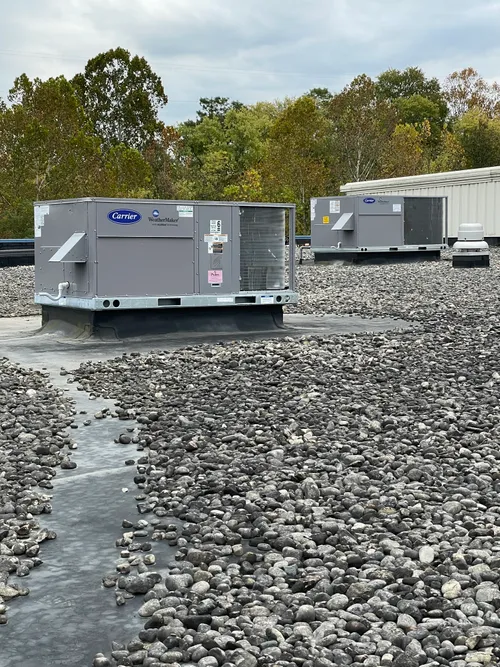
Gruter Heating & Air Conditioning Co., Inc. is an HVAC contractor serving Cincinnati, OH, and the surrounding areas. They provide installation, repair, and maintenance services for air conditioners, furnaces, heat pumps, boilers, mini splits, and geothermal heat pumps for both residential and commercial clients. The company works with well-known brands and uses advanced diagnostic tools and genuine manufacturer parts to ensure efficient and eco-friendly solutions. With nearly 40 years of experience, Gruter Heating & Air Conditioning offers flexible scheduling and competitive pricing to meet customer needs.
Arrowhead Heating and Cooling LLC
208 S Columbus St, Blanchester, OH 45107
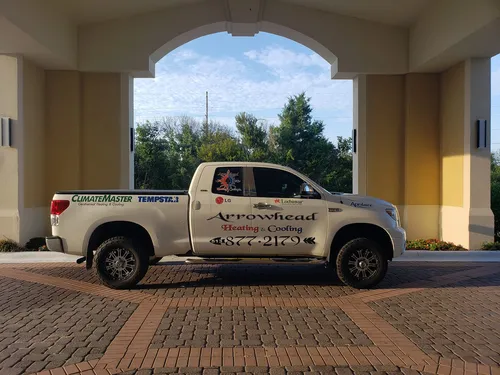
Arrowhead Heating and Cooling LLC is an HVAC company based in Cincinnati, OH, serving Southwest Ohio with a range of heating and cooling services. They handle installation, repair, and maintenance of furnaces, air conditioners, heat pumps, geothermal systems, boilers, water heaters, and thermostats. The company is authorized to sell and install products from brands like Tempstar, Climate Master, LG, and Lochinvar. Arrowhead Heating and Cooling offers 24-hour service and focuses on providing affordable solutions for both residential and light commercial customers.
How Geothermal Systems Work: Harnessing the Earth's Constant Temperature
The core principle behind a geothermal or ground-source heat pump is simple: it uses the earth as a heat source in winter and a heat sink in summer. Unlike air temperatures that swing wildly with the seasons, the ground just a few feet below the surface maintains a relatively constant temperature of approximately 50°F year-round in Ohio.
In the winter, a fluid mixture of water and antifreeze circulates through a loop of pipes buried in your yard. This fluid absorbs the earth's gentle warmth. The geothermal heat pump unit inside your home then concentrates this low-grade heat and transfers it to warm the air circulated through your ductwork. During the summer, the process reverses. The system extracts heat and humidity from your indoor air and transfers it into the cooler fluid in the underground loop, where it is dissipated into the earth, effectively cooling your home. This elegant exchange of heat with the ground is what makes these systems so remarkably efficient compared to conventional air-source heat pumps or furnaces.
Types of Ground Loops: Horizontal vs. Vertical Systems
The underground pipe network, called the ground loop, is the heart of the system. The two primary types installed in Beavercreek are chosen based on your property's characteristics.
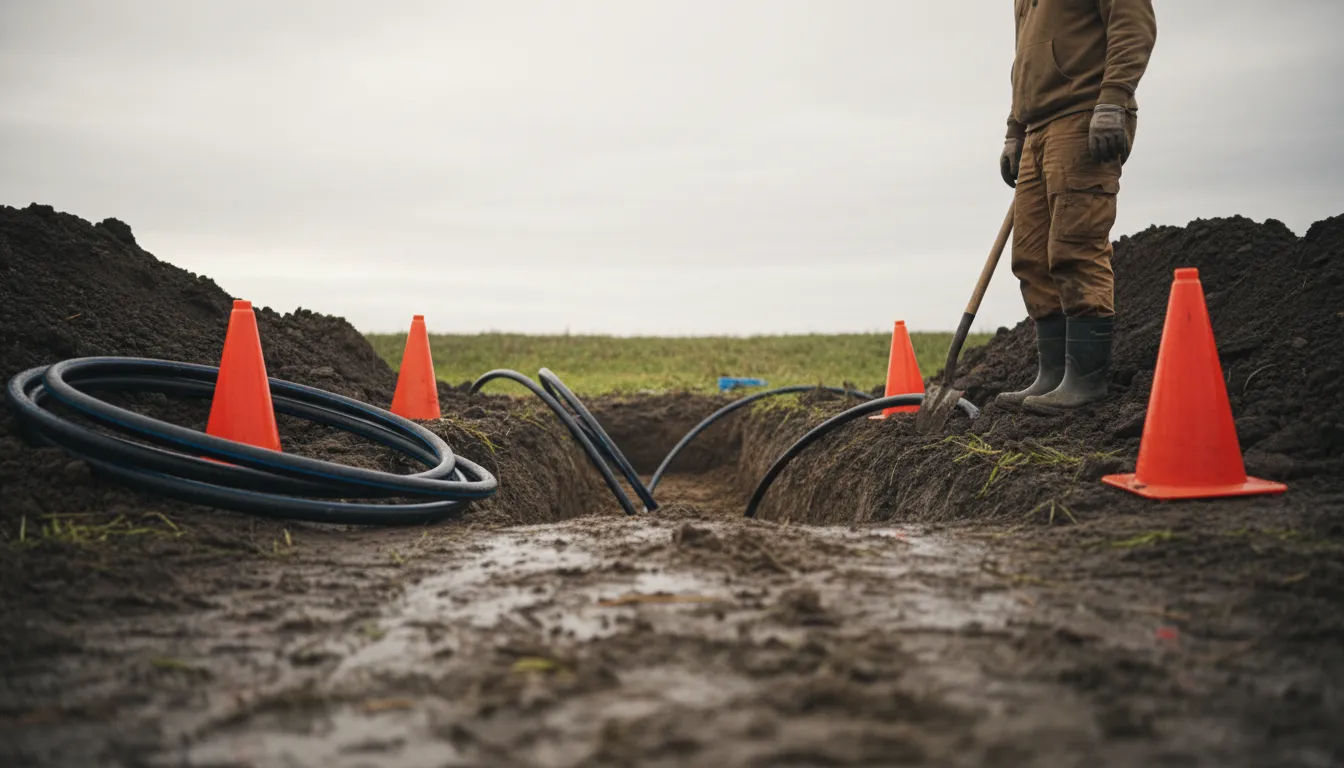
Horizontal Ground-Coupled Loops: This is often the most cost-effective option if you have sufficient land. Trenches are dug about five to eight feet deep across your yard, and pipes are laid in a series of loops before being backfilled 1 2. A typical horizontal system for a residential home may require between 1,500 to 3,000 square feet of open land, making it suitable for properties of a half-acre or more.
Vertical Loops: For properties with limited yard space, such as many suburban lots in Beavercreek, vertical loops are the ideal solution. Boreholes are drilled straight down, typically 150 to 400 feet deep, and U-shaped pipe loops are inserted into each hole. While the drilling process is more specialized, it disturbs much less of your lawn and landscaping. Multiple boreholes are spaced about 15-20 feet apart to meet the heating and cooling demands of your home.
A professional installer will conduct a detailed site assessment of your property's soil composition, rock content, and available space to recommend the optimal loop configuration for efficiency, cost, and minimal disruption.
The Installation Process: What Beavercreek Homeowners Can Expect
Installing a geothermal heating and cooling system is a significant project that requires careful planning and skilled execution. Understanding the steps can help you prepare.
- Site Evaluation and Design: A certified contractor will perform a load calculation for your home and assess your property to design the loop field. This includes soil testing, evaluating space, and determining the best loop type and size.
- Loop Field Installation: For a horizontal system, this involves trenching equipment to dig the long, deep trenches over one to three days. For a vertical system, a drilling rig will be brought in to create the boreholes, which can take three to five days for a standard home 3. The high-density polyethylene pipes are then placed and connected into a continuous loop.
- Indoor Unit Installation: The geothermal heat pump unit-which is typically about the size of a small refrigerator-is installed in your basement, garage, or utility closet. It is connected to your home's existing ductwork and the newly installed ground loop 4.
- System Charging, Testing, and Restoration: The loop is pressurized and filled with the fluid mixture. The entire system is tested for leaks and performance. Finally, the excavation sites are backfilled, and your yard is restored as closely as possible to its original condition 5.
Find the perfect geothermal heat pump contractors for your needs
Get personalized recommendations and expert advice
Financial and Efficiency Benefits: Understanding the Investment
The most significant consideration for any Beavercreek resident is the cost-benefit analysis. Geothermal systems have a higher upfront cost than traditional HVAC systems, primarily due to the ground loop excavation or drilling 6. However, this initial investment is counterbalanced by substantial long-term savings and benefits.
- Exceptional Energy Savings: Geothermal heat pumps are 300-600% efficient, meaning they move three to six units of heat for every one unit of electricity used. This can translate to reductions of 30% to 70% on your heating and cooling bills 7 8 9.
- Fast Return on Investment (ROI): Thanks to dramatic utility savings, most homeowners see a payback period on their investment within 5 to 10 years 10. This timeline can be accelerated with available federal tax credits and potential local utility rebates, which you should inquire about with your installer.
- Long System Lifespan: The underground piping is incredibly durable, with a lifespan often exceeding 50 years. The indoor heat pump unit typically lasts 20 to 25 years-significantly longer than the 15-year average of a standard air conditioner or furnace.
- Quiet Operation and Low Maintenance: With no noisy outdoor condenser unit, geothermal systems operate very quietly. They also have fewer mechanical components exposed to the elements, which generally means lower maintenance requirements and costs over time 11.
Is a Geothermal System Right for Your Home?
Geothermal technology offers a sustainable, highly efficient path to home comfort that aligns with both environmental and economic goals. For Beavercreek properties with suitable land or lot size, it provides a quiet, reliable, and long-term solution that drastically cuts energy consumption. While the installation process is more involved than replacing a traditional system, the disruption is temporary, and the long-term rewards in comfort, savings, and property value are substantial.
To move forward, the essential step is to consult with experienced, certified geothermal contractors in the Beavercreek area. They can provide a precise assessment, detailed cost estimates, and explain the latest available incentives to help you make an informed decision for your home.
Frequently asked questions
Sources
Footnotes
-
Geothermal Heat Pump Installation: What To Expect For Your ... - https://jomory.com/geothermal-heat-pump-installation-what-to-expect-for-your-property/ ↩
-
Geothermal heat pumps: The ultimate guide to ground-source ... - https://termo-plus.com/blog/geothermal-ultimate-guide-to-ground-source-heat-pumps/ ↩
-
Geothermal Heating And Cooling System, Toledo, Ohio - Services - https://www.tandmheatingandair.com/geothermal-heating-cooling/ ↩
-
How a Geothermal Heat Pump Works | This Old House - https://www.youtube.com/watch?v=d5Tbsx3R2T8 ↩
-
How Geothermal Heat Pumps Work - https://www.youtube.com/watch?v=XxlTnBukweI&t=37 ↩
-
Geothermal Heat Pumps - Department of Energy - https://www.energy.gov/energysaver/geothermal-heat-pumps ↩
-
How to Choose the Right System for Your Home - Morrison Inc. - https://morrisongeothermal.com/how-to-choose-the-right-system-for-your-home/ ↩
-
Geothermal Systems: Stack's Energy Efficiency in Ohio - https://stackheating.com/energy-savings-2/geothermal-systems-energy-efficiency-secret-weapon/ ↩
-
Guide to Geothermal Heat Pumps - https://www.energy.gov/sites/prod/files/guide_to_geothermal_heat_pumps.pdf ↩
-
Geothermal Heating, Cooling, and Hot Water Systems - https://igshpa.org/wp-content/uploads/Homeowners-Guide-to-Geothermal.pdf ↩
-
Geothermal Heating: How It Works - Aire Serv - https://www.aireserv.com/about/blog/2020/march/what-is-geothermal-heating-and-how-does-it-work-/ ↩