Find the Best Geothermal Heat Pump Contractors for Your Business
No obligation • Fast responses • Nationwide coverage

Why you can trust HVAC Firms
HVAC Firms is a leading United States resource for evaluating HVAC service providers. Our team researches companies, checks credentials, and reviews customer feedback to present clear, unbiased information. Listings and rankings are based on merit, and companies cannot pay to change our editorial content.
Search providers near you
Top Geothermal Heat Pump Contractors in Winston Salem, North Carolina Ranked
A geothermal heat pump is a highly efficient heating and cooling system that leverages the earth's stable underground temperature to regulate your home's climate. For Winston-Salem residents, this technology offers a path to dramatically lower energy bills and a reduced environmental footprint, all while providing exceptional comfort year-round. This guide explains how these systems work, the installation process, and how you can find qualified local experts to evaluate your property for a ground-source heat pump.
Cool Breeze 1250 Heating & Cooling
305 Pineview Dr, Kernersville, NC 27284
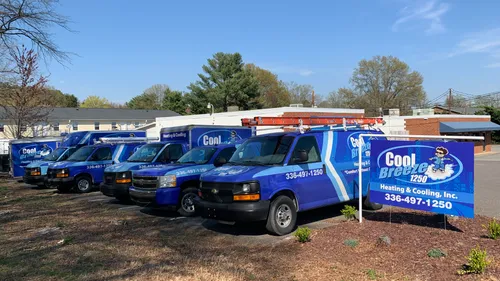
Cool Breeze 1250 Heating & Cooling is an HVAC company based in Kernersville, North Carolina, serving Greensboro and nearby areas including Summerfield, Winston Salem, High Point, and Deep River. They provide repair, maintenance, and installation services for air conditioners, furnaces, heat pumps, ductless mini-splits, and geothermal systems. Their technicians work with a wide range of brands such as Daikin, Fujitsu, Carrier, Trane, Lennox, and more. The company offers 24/7 availability for heating and cooling needs.

Triple A Heating & Cooling
Greensboro, NC
Triple A Heating & Cooling provides heating and cooling services in Greensboro, NC. They offer installation and repair for air conditioners, furnaces, heat pumps, boilers, mini splits, and geothermal heat pumps. Their services also include HVAC tune-ups to maintain system efficiency.
How Geothermal Systems Work
Often called ground-source heat pumps, these systems operate on a simple, elegant principle: they exchange heat with the earth, which maintains a nearly constant temperature of about 55°F just a few feet below the surface in North Carolina 1. This consistency is the key to their remarkable efficiency.
The core of the system is a ground loop-a network of pipes buried in your yard or submerged in a water source. A water-based fluid circulates through this loop, absorbing the earth's warmth in the winter and its relative coolness in the summer 2.
- Winter Heating: The fluid, chilled by releasing its heat inside your home, travels through the underground loop where it is warmed by the earth. This warmer fluid returns to the geothermal unit inside your house. The heat pump concentrates this low-grade heat and distributes warm air through your existing ductwork.
- Summer Cooling: The process reverses. The heat pump extracts heat and humidity from your indoor air. This heat is transferred to the fluid in the loop, which then travels underground to dissipate the heat into the cooler earth. The now-chilled fluid returns to cool your home 3.
This closed-loop exchange is far more efficient than generating heat through combustion or fighting the extreme outdoor air temperatures with a standard air conditioner.
Types of Ground Loops for Winston-Salem Properties
The design of the underground portion of the system is critical and depends entirely on your property's characteristics. There are several common configurations, each with its own advantages.
Closed-Loop Systems
These are the most common types, where a sealed loop of pipe circulates a water and antifreeze mixture.
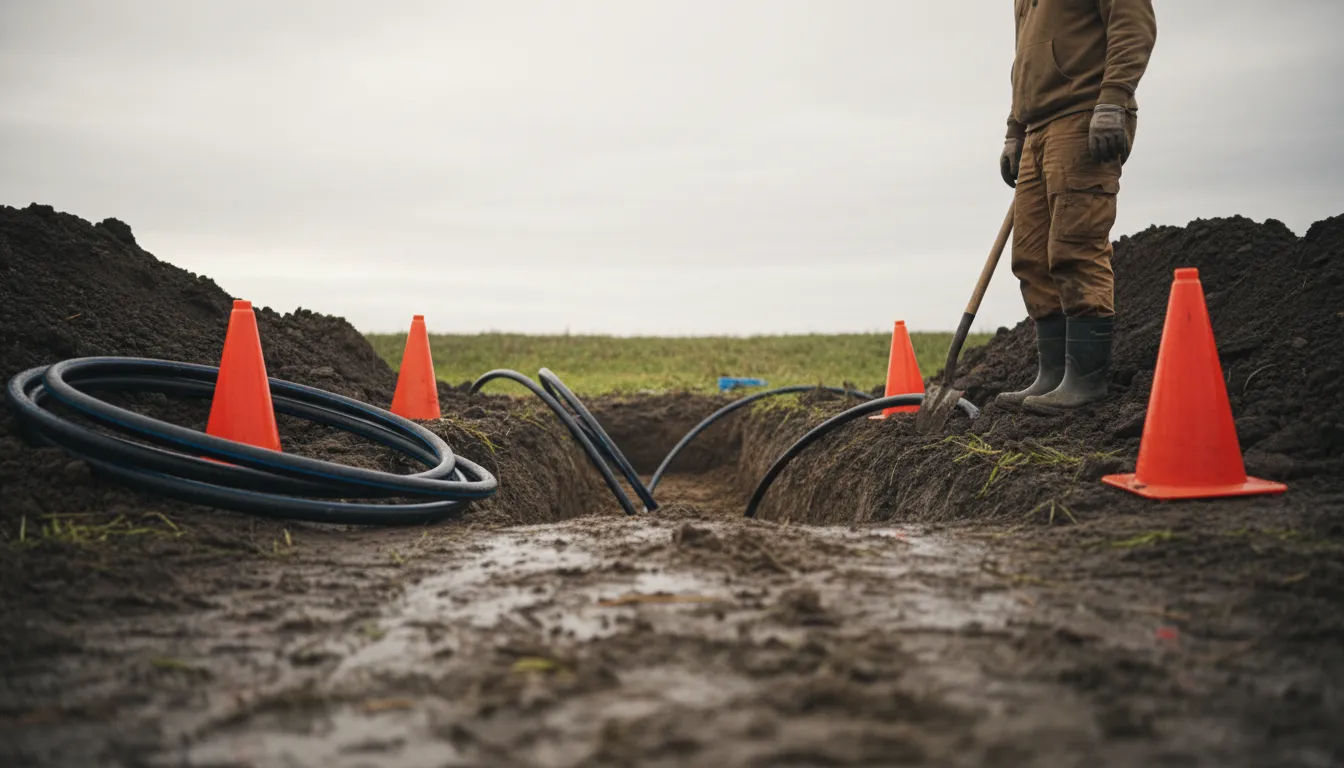
- Horizontal Closed Loop: This is often the most cost-effective option for properties with ample land. Pipes are laid in trenches typically 6 feet deep. While it requires more linear footage of trenching, it avoids the cost of deep drilling and is frequently chosen for new construction where the yard is already being excavated 4 5 6.
- Vertical Closed Loop: Ideal for smaller residential lots common in many Winston-Salem neighborhoods, this system uses boreholes drilled 150 to 400 feet deep. U-shaped pipes are inserted into these holes. Vertical loops have a smaller surface footprint, causing minimal disruption to lawns and landscaping, though the specialized drilling equipment makes this option more expensive upfront than horizontal trenching.
Open-Loop Systems
This configuration uses groundwater from a well as the direct heat exchange fluid. The water is pumped through the heat pump unit and then discharged, typically back into a second "return" well or a suitable surface body of water. Open-loop systems can be extremely efficient but require an adequate supply of clean water and are subject to more stringent permitting from the North Carolina Department of Environmental Quality (NCDEQ) to protect groundwater resources.
Pond/Lake Loop
If you have a sufficiently deep pond or lake on your property, a coil of pipe can be submerged at the bottom. This can be a very economical loop option, as it avoids both trenching and drilling, utilizing the consistent temperature of the water body instead 7.
The Installation Process: What to Expect
Installing a geothermal heating and cooling system is a significant project that requires careful planning and professional expertise. Here's a general overview of the steps involved.
- Site Assessment and Design: A qualified installer will evaluate your property, considering soil composition, available land, and access to water. This assessment determines the most feasible and efficient loop type (horizontal, vertical, or open) and sizes the entire system to meet your home's specific heating and cooling loads.
- Permitting: In North Carolina, geothermal installations are regulated, particularly open-loop systems. Your contractor will handle obtaining the necessary permits from local authorities and the NCDEQ to ensure the system complies with all environmental and building codes.
- Loop Installation: This is the major exterior work. For a horizontal system, an excavator will dig the trenches. For a vertical system, a drilling rig will create the boreholes. While this phase involves heavy equipment, a professional crew will work to minimize disruption and properly restore your landscaping.
- Indoor Unit Installation: The geothermal heat pump unit, which is typically about the size of a traditional furnace, is installed in your basement, crawlspace, or utility room. It is connected to your home's ductwork and the underground loop piping 8.
- System Charging and Startup: The loop is filled and pressurized with fluid, the electrical connections are made, and the entire system is tested and balanced to ensure optimal performance.
Find the perfect geothermal heat pump contractors for your needs
Get personalized recommendations and expert advice
Benefits and Considerations for Homeowners
Understanding the long-term value proposition of a ground-source heat pump is key to making an informed decision.
Key Advantages
- Exceptional Energy Efficiency: Geothermal systems are the most efficient heating and cooling technology available for homes. They can reduce energy consumption for heating and cooling by 44% to 72% compared to conventional systems, translating into significant savings on your monthly utility bills.
- Long System Lifespan: The underground loop components are incredibly durable, often carrying warranties of 50 years and potentially lasting much longer. The indoor heat pump unit typically has a lifespan of 20 to 25 years, which is longer than most standard air conditioners and furnaces.
- Year-Round Comfort: These systems provide consistent, even heating in the winter and quiet, dehumidifying cooling in the summer. Many models can also be equipped to provide a portion of your home's hot water, increasing overall efficiency 9.
- Low Environmental Impact: By using the renewable thermal energy of the earth, geothermal systems have a very low carbon footprint. They use electricity only to run the compressor, pump, and fan, not to create heat through resistance or combustion.
Important Considerations
- High Upfront Cost: The initial investment is the primary barrier. A complete geothermal system for an average Winston-Salem home can range from $20,000 to over $40,000, with vertical loop systems generally at the higher end of this spectrum due to drilling costs 10 11 12.
- Site Suitability: Not every property is ideal. A horizontal loop requires sufficient open land, while a vertical loop needs soil and rock conditions suitable for drilling. A professional assessment is non-negotiable.
- Long-Term Payback: The financial benefit comes from reduced operating costs over time. The payback period depends on your current energy costs, the system installed, and available incentives. The combination of high efficiency and long equipment life makes geothermal a sound long-term investment for many homeowners 13.
Finding the Right Professional in Winston-Salem
Selecting an experienced, certified installer is the most critical step in your geothermal project. Look for contractors who are accredited by organizations like the International Ground Source Heat Pump Association (IGSHPA). They should conduct a detailed Manual J load calculation for your home and provide a comprehensive proposal that includes system design, loop type, equipment specifications, and a clear breakdown of costs. Be sure to check references and review examples of their previous geothermal installations.
Frequently asked questions
Sources
Footnotes
-
Geothermal Heating and Cooling Systems - MN Dept. of Health - https://www.health.state.mn.us/communities/environment/water/wells/geothermal.html ↩
-
Geothermal (Ground Source) Heat Pumps - NY.gov - https://cleanheat.ny.gov/geothermal-heat-pumps/ ↩
-
How Geothermal Heat Pumps Work - https://www.youtube.com/watch?v=XxlTnBukweI&t=37 ↩
-
Geothermal Heating and Cooling | NC DEQ - https://www.deq.nc.gov/about/divisions/water-resources/groundwater-resources/injection-wells-uic-program/geothermal-heating-and-cooling ↩
-
Geothermal Heat Pumps - EnergySmart CNY - https://www.energysmartcny.org/heat-pumps/geothermal/ ↩
-
Geothermal Heat Pump Installation: What To Expect For Your Property - https://jomory.com/geothermal-heat-pump-installation-what-to-expect-for-your-property/ ↩
-
Geothermal Heat Pumps - Department of Energy - https://www.energy.gov/energysaver/geothermal-heat-pumps ↩
-
Geothermal Heat Pumps - NC Sustainable Energy Association - https://www.energync.org/clean-energy-101/geothermal-heat-pumps/ ↩
-
How Does A Geothermal Heat Pump Work? Complete 2025 Guide - https://solartechonline.com/blog/how-does-geothermal-heat-pump-work/ ↩
-
5 Things You Should Know about Geothermal Heat Pumps - https://www.energy.gov/cmei/articles/5-things-you-should-know-about-geothermal-heat-pumps ↩
-
Geothermal Heat Pump Guide: Installation Costs, Types And Benefits - https://modernize.com/hvac/heating-repair-installation/heat-pump/geothermal ↩
-
How Do Geothermal Systems Work for Residential Homes? - https://www.davisheat.com/blog/how-do-geothermal-systems-work-for-residential-homes/ ↩
-
Geothermal Heat Pumps - Carolina Country - https://www.carolinacountry.com/story/geothermal-heat-pumps-2 ↩