
Find the Best Geothermal Heat Pump Contractors for Your Business
No obligation • Fast responses • Nationwide coverage

Why you can trust HVAC Firms
HVAC Firms is a leading United States resource for evaluating HVAC service providers. Our team researches companies, checks credentials, and reviews customer feedback to present clear, unbiased information. Listings and rankings are based on merit, and companies cannot pay to change our editorial content.
Search providers near you
Top Geothermal Heat Pump Contractors in Greensboro, North Carolina Ranked
A geothermal heat pump, often called a ground-source heat pump, is a highly efficient system that uses the earth's stable temperature to heat and cool your home. For Greensboro residents, this technology offers a reliable way to slash energy bills and reduce environmental impact by tapping into the consistent thermal energy just below our yards. This guide explains how geothermal systems work locally, the installation process, and how you can find qualified professionals to evaluate your property for this long-term investment.
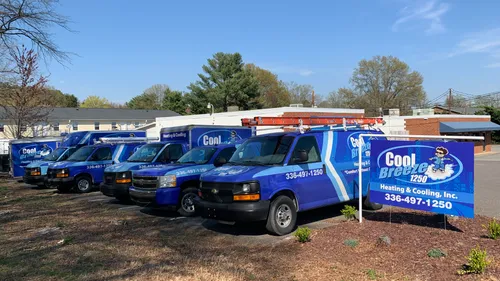
Cool Breeze 1250 Heating & Cooling
305 Pineview Dr, Kernersville, NC 27284
Cool Breeze 1250 Heating & Cooling is an HVAC company based in Kernersville, North Carolina, serving Greensboro and nearby areas including Summerfield, Winston Salem, High Point, and Deep River. They provide repair, maintenance, and installation services for air conditioners, furnaces, heat pumps, ductless mini-splits, and geothermal systems. Their technicians work with a wide range of brands such as Daikin, Fujitsu, Carrier, Trane, Lennox, and more. The company offers 24/7 availability for heating and cooling needs.

Triple A Heating & Cooling
Greensboro, NC
Triple A Heating & Cooling provides heating and cooling services in Greensboro, NC. They offer installation and repair for air conditioners, furnaces, heat pumps, boilers, mini splits, and geothermal heat pumps. Their services also include HVAC tune-ups to maintain system efficiency.
How Geothermal Systems Work in Greensboro
The core principle behind a geothermal or ground-source heat pump is remarkably simple: it uses the earth as a giant thermal battery. Unlike the air temperature, which swings wildly with the seasons, the ground just a few feet below the surface in North Carolina maintains a nearly constant temperature of 50 to 60 degrees Fahrenheit year-round. This stable temperature is the system's secret weapon.
Here's the basic process:
- Heat Exchange: A loop of pipes, called a ground loop, is buried in the earth. A water-based solution (often mixed with antifreeze) circulates through these pipes.
- Winter Heating: In the heating mode, the fluid absorbs the earth's warmth. This slightly warmed fluid is pumped back to the heat pump unit inside your home, where the system concentrates that heat and distributes it through your ductwork.
- Summer Cooling: In the cooling mode, the process reverses. The system extracts heat from your home's air and transfers it into the cooler fluid in the ground loop, which then deposits that heat into the earth.
This method of heat exchange is far more efficient than traditional air-source systems that must work harder as outside air temperatures become extreme 1. It's a proven, closed-loop technology regulated in North Carolina to protect groundwater resources.
Common Types of Geothermal Systems
Choosing the right type of ground loop is a critical first step, and it depends heavily on your Greensboro property's characteristics. The two primary categories are closed-loop and open-loop systems.
Closed-Loop Systems
This is the most common and widely used type. The pipes form a continuous, sealed loop underground, and the fluid inside never touches the ground or groundwater. There are two main configurations:
- Vertical Closed-Loop: This is often the best choice for residential lots in Greensboro with limited space. Contractors use a drilling rig to bore vertical holes typically 150 to 400 feet deep. U-shaped pipes are inserted into each borehole, which are then grouted. This design has minimal impact on your lawn after installation but involves specialized drilling equipment.
- Horizontal Closed-Loop: If you have ample yard space, a horizontal loop can be more cost-effective to install. Trenches are dug about 4 to 6 feet deep, requiring a significant land area-often 1,500 to 2,500 square feet for an average home 2 3. Coiled or straight pipes are laid in the trenches before they are backfilled.
Open-Loop Systems
Also known as "pump and dump" systems, these utilize groundwater directly from a well or a pond. The water is pumped through the heat pump unit, where heat is exchanged, and then the water is discharged to a second well, a pond, or a stream (in compliance with regulations). While they can be very efficient, they require an adequate supply of suitable water and are subject to specific permitting from the NC Department of Environmental Quality (DEQ).
The Installation Process: What to Expect
Installing a geothermal heating and cooling system is a significant project that requires careful planning and expert execution. Here's a typical step-by-step overview for a Greensboro home.
- Site Assessment and Design: A qualified installer will evaluate your property. They'll assess soil conditions, rock content, available land, and water table to determine the most feasible and efficient loop type (vertical, horizontal, or pond). This stage includes calculating your home's heating and cooling loads to properly size the system 4.
- Ground Loop Installation: This is the major outdoor work.
- For vertical systems, a drilling rig will be brought in to create the boreholes. This is a precise operation but causes less surface disruption.
- For horizontal systems, excavation equipment will dig long trenches across your yard. This work is faster but temporarily impacts a larger area of your landscape 5.
- Heat Pump and Indoor Unit Installation: The indoor heat pump unit, which is typically compact and quiet, is installed and connected to the ground loop piping and your home's existing ductwork or hydronic distribution system.
- Permitting and Regulations: In North Carolina, geothermal installations, especially open-loop systems, are regulated by the DEQ's Underground Injection Control (UIC) program to prevent groundwater contamination 6. Your installer should handle securing all necessary local and state permits before work begins.
- System Charging and Startup: Once the loop is pressure-tested and connected, the system is charged with fluid, and the electrical connections are made. The installer will then commission the system, ensuring all components are working in harmony for optimal efficiency.
Find the perfect geothermal heat pump contractors for your needs
Get personalized recommendations and expert advice
Key Considerations for Greensboro Homeowners
Before moving forward with a geothermal heat pump, it's important to weigh several local factors.
- Property Characteristics: Your available land is the biggest determinant. A horizontal loop requires significant open space, while a vertical loop is ideal for smaller lots. Soil composition and the presence of bedrock can also affect drilling difficulty and cost.
- Upfront Cost vs. Long-Term Savings: The initial investment for a geothermal system is higher than for a conventional HVAC system, primarily due to the ground loop installation. However, the operational savings are substantial. Homeowners can expect to reduce their heating and cooling energy consumption by 25% to 65% 7. This often translates to enough annual savings on utility bills to result in a payback period of 5 to 10 years 8.
- Durability and Lifespan: One of the most compelling advantages is longevity. The indoor heat pump unit typically lasts 20 years or more, while the underground piping for a closed-loop system often carries warranties of 50 years and can last for generations with minimal maintenance 9 10.
- Comfort and Environmental Impact: Geothermal systems provide exceptionally consistent temperatures and dehumidify effectively in summer. They also have a very low carbon footprint, as they use electricity only to move heat, not to create it by burning fuel.
Energy Savings and Financial Payback Analysis
The financial case for a ground-source heat pump is built on dramatically lower operating costs. Because they are 300-600% efficient at transferring energy, they use significantly less electricity than standard systems 11 12.
- Calculating Savings: Your actual savings depend on what you're replacing (e.g., an old electric furnace or a propane system) and local utility rates. For example, replacing an older electric resistance heating system with a geothermal system could cut your heating costs by more than half.
- Understanding Payback: The payback period is the time it takes for your energy savings to equal the net cost of the system (after any incentives). With federal tax credits and potential local rebates improving the economics, many homeowners see a full return on investment within a decade. For a system costing $20,000 or more after incentives, annual savings of $1,500 to $2,000 are common, leading to a payback in well under 10 years 13.
- Added Home Value: Studies have shown that geothermal systems can increase a home's resale value, as buyers recognize the benefit of low utility bills and modern, efficient infrastructure.
Frequently asked questions
Sources
Footnotes
-
Air Source vs Ground Source Heat Pump: Which Is Best? - https://harmonmechanical.com/air-source-vs-ground-source-heat-pump/ ↩
-
Geothermal Heat Pump Installation: What To Expect For Your ... - https://jomory.com/geothermal-heat-pump-installation-what-to-expect-for-your-property/ ↩
-
Geothermal Heat Pumps, Explained - Bosch Home Comfort - https://www.bosch-homecomfort.com/us/en/residential/connect/blog/geothermal-heat-pumps-go-green-save-green/ ↩
-
In Geothermal Designs, Don't Succumb to Rules of Thumb - https://www.achrnews.com/articles/131767-in-geothermal-designs-dont-succumb-to-rules-of-thumb ↩
-
Geothermal Heat Pump Vs Heat Pump - https://www.mrcool.com/blog/geothermal-heat-pump-vs-heat-pump ↩
-
Geothermal Heating and Cooling | NC DEQ - https://www.deq.nc.gov/about/divisions/water-resources/groundwater-resources/injection-wells-uic-program/geothermal-heating-and-cooling ↩
-
5 Things You Should Know about Geothermal Heat Pumps - https://www.energy.gov/cmei/articles/5-things-you-should-know-about-geothermal-heat-pumps ↩
-
Geothermal Heat Pumps - EnergySmart CNY - https://www.energysmartcny.org/heat-pumps/geothermal/ ↩
-
Geothermal Heat Pumps - NC Sustainable Energy Association - https://www.energync.org/clean-energy-101/geothermal-heat-pumps/ ↩
-
About Geothermal - https://igshpa.org/about-geothermal/ ↩
-
Geothermal Heat Pumps - Department of Energy - https://www.energy.gov/energysaver/geothermal-heat-pumps ↩
-
Guide to Geothermal Heat Pumps - https://www.energy.gov/sites/prod/files/guide_to_geothermal_heat_pumps.pdf ↩
-
Geothermal Heat Pump Guide: Installation Costs, Types And Benefits - https://modernize.com/hvac/heating-repair-installation/heat-pump/geothermal ↩