Find the Best Geothermal Heat Pump Contractors for Your Business
No obligation • Fast responses • Nationwide coverage

Why you can trust HVAC Firms
HVAC Firms is a leading United States resource for evaluating HVAC service providers. Our team researches companies, checks credentials, and reviews customer feedback to present clear, unbiased information. Listings and rankings are based on merit, and companies cannot pay to change our editorial content.
Search providers near you
Top Geothermal Heat Pump Contractors in Durham, North Carolina Ranked
Geothermal heat pumps, also known as ground-source heat pumps, are a highly efficient way to heat and cool your home by leveraging the Earth's stable underground temperature. This technology can significantly reduce your energy bills and environmental footprint. For Durham residents exploring this sustainable option, this guide explains how these systems work, the local installation process, and how to connect with qualified professionals in the area to assess your property.
Maynor Service Company
1000 Goodworth Dr, Apex, NC 27539
Maynor Service Company is a heating, air conditioning, plumbing, and electrical service provider based in Raleigh, NC. Serving the Triangle Area, they offer repair, installation, design, and high-efficiency system upgrades including geothermal, ductless mini-split, and variable speed heating and cooling systems. With over 25 years of experience, Maynor Service Company operates 24/7 to meet customer needs and emphasizes energy-efficient and sustainable equipment options.
Bowman Heating & Cooling
1544 Mechanical Blvd, Garner, NC 27529
Bowman Heating & Cooling is a full-service HVAC company based in Raleigh, NC, serving the Triangle area including Garner. They provide a wide range of heating and cooling services such as repair, maintenance, and installation of gas furnaces, heat pumps, air conditioners, and geothermal heat pumps. Bowman Heating & Cooling specializes in geothermal systems, having installed and maintained hundreds in the region. Their offerings also include humidifiers, filtration systems, and zone control systems.
Warren-Hay Mechanical
Durham, NC
Warren-Hay Mechanical is a family-owned HVAC company serving Durham, NC, and surrounding areas including Hillsborough, Chapel Hill, and Myrtle Beach, SC. They offer a wide range of heating and cooling services such as air conditioning repair, furnace repair, heat pump installation, and indoor air quality inspections. The company is recognized as a Trane Comfort Specialist and holds certifications including NATE and IGSHPA for geothermal heat pump expertise. With over 30 years of experience since 1993, Warren-Hay Mechanical provides commercial and residential HVAC solutions and offers 24/7 emergency services for urgent needs.
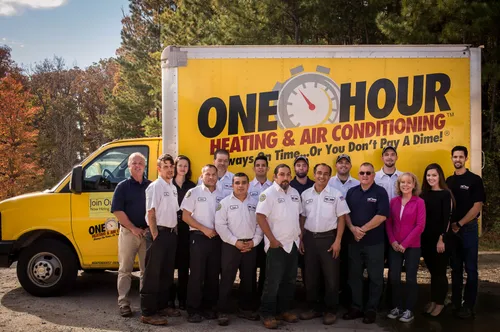
Green Horizon One Hour Heating & Air Conditioning
4628 Industry Ln Suite C, Durham, NC 27713
Green Horizon One Hour Heating & Air Conditioning provides HVAC repair, installation, and maintenance services in Raleigh, NC. They specialize in air conditioning, furnace, heat pump, mini split, and geothermal heat pump systems. The company offers 24/7 emergency service and backs their work with a two-year satisfaction guarantee. As an independently owned business within the One Hour Heating & Air Conditioning network, Green Horizon emphasizes punctuality and clear communication with customers.
Raleigh Heating and Air
2730 Rowland Rd, Raleigh, NC 27615
Raleigh Heating and Air is a full-service HVAC and plumbing company based in Raleigh, NC. Serving Wake County and surrounding areas, they provide repair, installation, and maintenance for heating and cooling systems including central air conditioners, ductless mini-splits, geothermal heat pumps, and furnaces. The company has over 30 years of experience and offers 24-hour emergency HVAC repair services to ensure homes remain safe and comfortable year-round. They also provide indoor air quality solutions to address harmful contaminants in the home environment.
How Geothermal Heating and Cooling Works
A geothermal system operates on a simple principle of heat exchange. Unlike air-source heat pumps that pull heat from the outside air, a ground-source heat pump uses the consistent temperature of the earth, which remains around 55°F year-round in North Carolina. This constant temperature acts as a reliable heat source in winter and a heat sink in summer.
The system has three main components:
- Ground Loops: A network of pipes, called a ground loop, is buried underground. These pipes circulate a water or antifreeze solution.
- The Heat Pump Unit: This indoor unit contains a compressor and heat exchanger. It concentrates the thermal energy from the fluid in the loops.
- Distribution System: The conditioned air is delivered through your home's existing ductwork or a hydronic (water-based) system like radiant floors.
In heating mode, the fluid in the underground pipes absorbs the Earth's warmth. This warm fluid is pumped to the heat pump, which extracts the heat, concentrates it, and transfers it to your home. In cooling mode, the process reverses: the system removes heat from your home and transfers it into the cooler ground via the fluid in the loops 1.
Types of Ground Loop Systems
The type of ground loop installed on your property is the most critical site-specific decision. The main options are:
Closed-Loop Systems
This is the most common type of geothermal installation. The fluid circulates through a sealed, continuous loop of high-density polyethylene pipe.
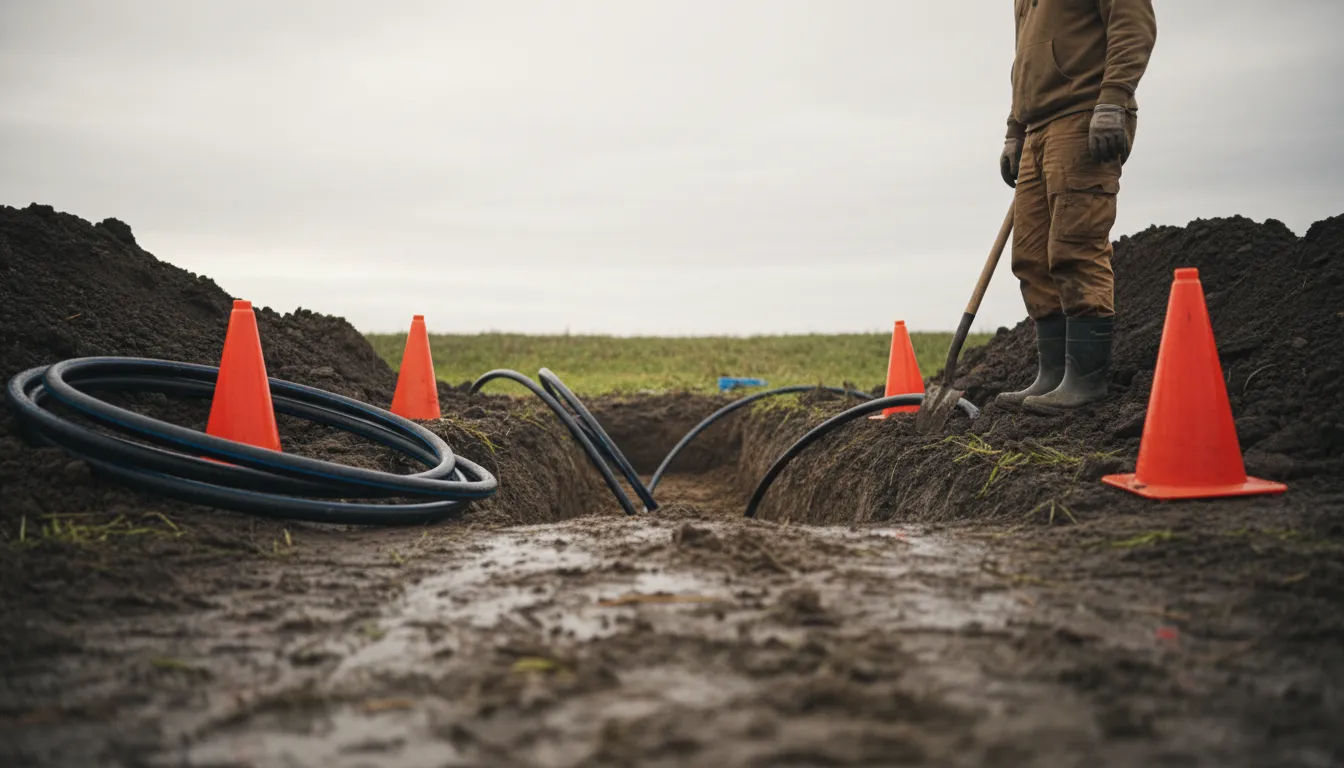
- Horizontal Loops: Pipes are laid in trenches about six feet deep. This method requires a significant amount of land but is often less expensive than drilling if the soil conditions are suitable and space is available.
- Vertical Loops: Pipes are installed in deep boreholes, typically 200 to 500 feet deep. This is the ideal solution for homes with smaller lots, like many in Durham's established neighborhoods. While the drilling process is more involved, it minimizes landscape disturbance.
Open-Loop Systems
This system uses groundwater from a well as the heat exchange fluid. After passing through the heat pump, the water is discharged back into the ground via a second well or a suitable surface discharge point. While potentially very efficient, open-loop systems require an adequate supply of clean water and are subject to specific regulations and permitting from the North Carolina Department of Environmental Quality (NC DEQ).
Pond/Lake Loops
If a sufficient body of water is available on your property, coils of pipe can be submerged at an adequate depth. This can be a cost-effective loop option, but it depends entirely on water access, depth, and quality 2.
The Geothermal Installation Process in Durham
Installing a geothermal system is a significant project that requires careful planning and expert execution. Here's what you can expect:
- Site Assessment and Design: A qualified installer will evaluate your property, considering soil composition, lot size, landscaping, and your home's heating and cooling load. This assessment determines the best loop type (horizontal, vertical, or open) and calculates the necessary pipe length for optimal efficiency 3.
- Loop Field Installation: This is the major excavation phase.
- For horizontal loops, a backhoe digs long trenches.
- For vertical loops, a drilling rig creates the necessary boreholes. All drilling in North Carolina is regulated to protect groundwater resources.
- Indoor Unit Installation: The geothermal heat pump unit is installed inside your home, typically in a basement, utility room, or garage. It is connected to your home's ductwork or hydronic system.
- Connection and Commissioning: The underground loops are connected to the heat pump, forming a sealed system. The entire system is filled, pressurized, tested, and started up to ensure everything operates correctly 4.
Find the perfect geothermal heat pump contractors for your needs
Get personalized recommendations and expert advice
Key Considerations for Durham Homeowners
Before investing in a geothermal system, consider these local factors:
- Land Availability: Horizontal loops require more land, making vertical boreholes a common choice for standard residential lots in Durham. Your installer's site survey will determine feasibility 5 6.
- Soil and Rock Conditions: The composition of your soil affects heat transfer and the ease of drilling or trenching. Clay soils, common in the area, have good thermal properties but can be challenging to drill through.
- Regulations and Permits: All geothermal drilling activities are overseen by the NC DEQ to prevent groundwater contamination. Your installer should handle obtaining the necessary permits for closed-loop vertical systems or the more complex permits required for open-loop systems 7.
- Upfront Cost vs. Long-Term Savings: The initial investment for a geothermal system is higher than for a conventional HVAC system, largely due to the ground loop installation. For a typical 2,000-square-foot home in Durham, costs might range from $20,000 to $40,000 before incentives. However, the dramatic reduction in energy use-up to 65% according to the U.S. Department of Energy-leads to significant monthly savings on utility bills 8.
Financial Incentives and Efficiency
The long-term value proposition of a geothermal heat pump is compelling, especially with current incentives:
- Energy Savings: By using the stable ground temperature, geothermal systems operate with exceptional efficiency, often delivering 3 to 5 units of heating or cooling for every 1 unit of electricity used. This can translate to savings of up to 65% on your heating and cooling bills compared to traditional systems 9 10 11.
- Federal Tax Credit: The Inflation Reduction Act provides a 30% federal tax credit for the total cost of purchasing and installing a qualified geothermal heat pump system. This credit is available through 2032, making now an excellent time to consider the upgrade 12 13.
- Increased Home Value: These systems are durable, with ground loops often warrantied for 50 years and the indoor heat pump unit lasting 20+ years. The combination of low operating costs, modern comfort, and sustainability is an attractive feature for potential home buyers.
Frequently asked questions
Sources
Footnotes
-
Geothermal Heating & Cooling - Department of Energy - https://www.energy.gov/eere/geothermal/geothermal-heating-cooling ↩
-
All You Need to Know About Home Geothermal Heating & Cooling - https://dandelionenergy.com/all-you-need-to-know-about-home-geothermal-heating-cooling ↩
-
Ground source heat pumps: horizontal collectors Vs. vertical boreholes - https://www.mesh-energy.com/insights/ground-source-heat-pumps-horizontal-collectors-vs-vertical-boreholes ↩
-
Geothermal Heat Pumps | WBDG - https://www.wbdg.org/resources/geothermal-heat-pumps ↩
-
Geothermal Heat Pumps - NC Sustainable Energy Association - https://www.energync.org/clean-energy-101/geothermal-heat-pumps/ ↩
-
Geothermal Heat Pumps - https://www.energysmartcny.org/heat-pumps/geothermal/ ↩
-
Geothermal Heating and Cooling | NC DEQ - https://www.deq.nc.gov/about/divisions/water-resources/groundwater-resources/injection-wells-uic-program/geothermal-heating-and-cooling ↩
-
Geothermal Heat Pump Guide: Installation Costs, Types And Benefits - https://modernize.com/hvac/heating-repair-installation/heat-pump/geothermal ↩
-
Geothermal Heat Pumps - EnergySmart CNY - https://www.energysmartcny.org/heat-pumps/geothermal/ ↩
-
5 Things You Should Know about Geothermal Heat Pumps - https://www.energy.gov/cmei/articles/5-things-you-should-know-about-geothermal-heat-pumps ↩
-
Geothermal Heat Pumps - Carolina Country - https://www.carolinacountry.com/story/geothermal-heat-pumps-2 ↩
-
Everything You Need to Know About Geothermal Heat Pumps - https://www.familyhandyman.com/article/everything-you-need-to-know-about-geothermal-heat-pumps/ ↩
-
Guide to Geothermal Heat Pumps - https://www.energy.gov/sites/prod/files/guide_to_geothermal_heat_pumps.pdf ↩