Find the Best Geothermal Heat Pump Contractors for Your Business
No obligation • Fast responses • Nationwide coverage

Why you can trust HVAC Firms
HVAC Firms is a leading United States resource for evaluating HVAC service providers. Our team researches companies, checks credentials, and reviews customer feedback to present clear, unbiased information. Listings and rankings are based on merit, and companies cannot pay to change our editorial content.
Search providers near you
Top Geothermal Heat Pump Contractors in Suffolk, Virginia Ranked
A geothermal heat pump, or ground-source system, is a highly efficient method for heating and cooling your home by leveraging the Earth's stable underground temperature. This technology matters because it can dramatically reduce your energy bills and environmental footprint while providing reliable, year-round comfort. For Suffolk residents, finding the right local specialist is key to a successful installation, as they can assess your specific property, navigate local regulations, and design a system that maximizes your long-term savings and comfort.
Galactic Air Incorporated
420 Investors Pl #107, Virginia Beach, VA 23452
Galactic Air Incorporated is a locally owned HVAC company serving Virginia Beach, VA, and the surrounding South Hampton Roads area. They provide a wide range of services including repair and installation of air conditioners, heat pumps, gas furnaces, geothermal heat pumps, ductless mini split systems, and water heaters. Their technicians are nationally certified and trained on the latest HVAC technologies, with a focus on systems like Trane. Galactic Air also offers indoor air quality services and ductwork repair or replacement. The company emphasizes attention to detail and professional service in both residential and commercial settings.
Quick Heating and Air Conditioning
207 Hollywood Blvd, Yorktown, VA 23692
Quick Heating and Air Conditioning is an HVAC company serving Virginia Beach, VA, and the surrounding Hampton Roads area. They provide repair and installation services for furnaces, heat pumps, air conditioning units, boilers, mini splits, geothermal heat pumps, and related systems. The company works with various brands and handles both residential and commercial projects. Quick Heating and Air Conditioning emphasizes honest and cost-effective solutions tailored to customer needs.
Atlantic Shores Heating and Cooling
3500 Robs Dr, Suffolk, VA 23434
Atlantic Shores Heating and Cooling is a family-owned HVAC company serving Chesapeake, VA, and surrounding areas. They provide a full range of heating and cooling services including air conditioner, furnace, heat pump, mini split, and geothermal heat pump repair, installation, and maintenance. The company also offers indoor air quality solutions and duct cleaning to help improve home environments. Founded in 1995, Atlantic Shores Heating and Cooling has over 20 years of experience and provides 24/7 emergency services to address urgent HVAC needs.

Puffin Mechanical
Virginia Beach, VA
Puffin Mechanical is a family-owned HVAC company serving Virginia Beach, VA, and the broader Hampton Roads area. With over 23 years of experience, they provide heating and cooling repair, replacement, and maintenance for heat pumps, air conditioners, furnaces, mini-splits, geothermal systems, and rooftop units. Their services include comprehensive HVAC tune-ups, home performance testing with blower door and infrared thermography, as well as air sealing and attic insulation to improve energy efficiency and indoor air quality. Puffin Mechanical focuses on reducing energy consumption to benefit both customers and the environment.
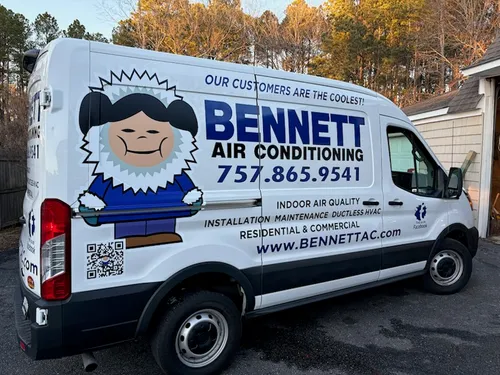
Bennett Air Conditioning
2311 60th St, Hampton, VA 23661
Bennett Air Conditioning is a family-owned HVAC contractor serving Virginia Beach, VA, and nearby areas including Hampton, Newport News, and Yorktown. Since 1999, they have provided a range of heating and cooling services such as air conditioning repair and installation, furnace and heat pump services, geothermal system installation, and indoor air quality solutions. Their expertise also extends to commercial HVAC, refrigeration, and sheet metal fabrication. Bennett Air Conditioning offers ductless HVAC options and generator evaluations to support reliable home and business comfort throughout the year.
How Geothermal Systems Work in Suffolk
Unlike traditional air-source heat pumps that battle Suffolk's variable outdoor air temperatures, a ground-source heat pump taps into the consistent thermal energy stored just below the surface. A few feet underground, the Earth maintains a steady temperature of approximately 50-60°F year-round, regardless of summer heat or winter chill. This constant temperature is the system's powerhouse.
Here's the basic process:
- Heating Mode: A fluid (typically water mixed with antifreeze) circulates through a loop of pipes buried in your yard. This fluid absorbs the Earth's gentle heat. The geothermal unit then concentrates this low-grade heat and transfers it to your home's air or hydronic distribution system 1.
- Cooling Mode: The cycle reverses. The system extracts heat from your home's indoor air and transfers it into the cooler fluid in the ground loops. The now-cooled air is circulated back into your home, while the absorbed heat is dissipated into the Earth.
This elegant exchange with the ground, rather than the outside air, is what makes geothermal HVAC so remarkably efficient, often leading to energy savings of 40-80% on heating and cooling costs compared to conventional systems.
Types of Ground Loop Systems for Suffolk Properties
The buried pipe network, or "ground loop," is the heart of the system. The right type for your Suffolk home depends on your land, soil composition, and access to water. Local installers are experts at conducting the necessary site assessment to determine the best option.
Closed-Loop Systems
These systems continuously circulate the same fluid through a sealed, high-density polyethylene (HDPE) pipe loop.
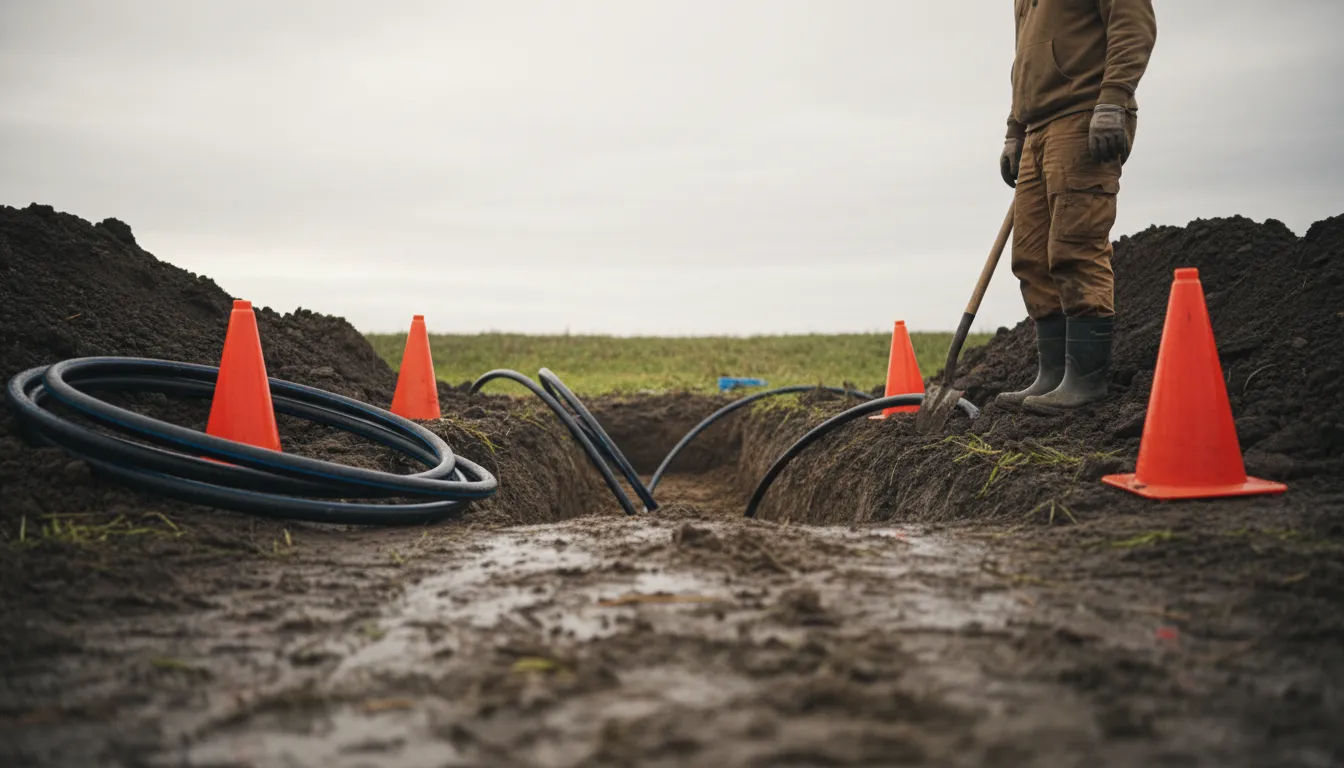
- Horizontal Closed Loop: This is often the most cost-effective option if you have sufficient land. Contractors dig trenches 4 to 6 feet deep and lay pipes in a coiled "slinky" pattern or straight lines. It requires a larger, clear area of land but typically avoids the need for deep drilling 2 3.
- Vertical Closed Loop: Ideal for properties with limited space, like many residential lots in Suffolk. Drillers bore holes 200 to 500 feet deep and insert U-shaped loops of pipe into each hole. While the drilling process is more specialized and can have a higher upfront cost, vertical loops often deliver excellent performance and minimize landscape disruption 4 5.
- Pond/Lake Loop: If you have a suitable, deep body of water on your property, coils of pipe can be submerged at the bottom. This can be a very efficient and lower-cost installation method, as it avoids extensive digging or drilling 6.
Open-Loop System
This system uses groundwater directly from a well as the heat exchange fluid. After circulating through the heat pump, the water is discharged back into a second well, a pond, or a stream, following local codes. This option requires an abundant, clean water source and is subject to specific environmental regulations.
The Installation Process: What Suffolk Homeowners Can Expect
A professional geothermal installation is a multi-stage project managed by experienced contractors. Understanding the steps can help you prepare.
- Site Evaluation & Design: A specialist will visit your property to assess soil conditions, land availability, and access. They will recommend the optimal loop type (horizontal vs. vertical) and design a system sized perfectly for your home's heating and cooling loads.
- Excavation or Drilling: For a horizontal system, a backhoe or trencher will dig the necessary trenches. For a vertical system, a drilling rig will create the deep boreholes. This is a significant but temporary phase of the project 7.
- Loop Placement & Connection: The durable HDPE piping is laid in the trenches or inserted into the boreholes. All loop sections are carefully fused together to create a continuous, leak-proof circuit, which is then pressure-tested.
- Heat Pump Installation: The indoor geothermal unit, which is compact and quiet, is installed in your basement, garage, or utility closet. It is connected to the ground loop and to your home's existing ductwork or radiant heating system.
- System Charging & Startup: The loop is filled with fluid, and the entire system is charged and tested. The contractor will ensure everything is operating correctly and explain the basic controls to you.
- Backfilling & Restoration: The trenches are carefully backfilled, or the boreholes are grouted. The contractor will restore your landscape as closely as possible to its original condition.
Find the perfect geothermal heat pump contractors for your needs
Get personalized recommendations and expert advice
Benefits of Choosing Geothermal in Suffolk
Investing in a ground-source heating and cooling system offers compelling advantages for local homeowners:
- Substantial Energy Savings: By using the Earth's free, stable thermal energy, these systems operate with exceptional efficiency. Homeowners commonly see reductions of 40% to 80% on their heating and cooling bills, a significant financial benefit over the system's long lifespan 8 9.
- Long-Term Reliability & Low Maintenance: With few mechanical parts exposed to the elements and a protected underground loop, geothermal systems are known for their durability. The ground loops often carry warranties of 50 years or more, and the indoor heat pump units can last 20-25 years.
- Enhanced Comfort: These systems provide consistent, even heating and cooling without the drafts or temperature swings associated with fossil fuel furnaces or standard air conditioners. They also excel at dehumidifying during Suffolk's humid summers 10.
- Quiet Operation & Safety: The main unit operates quietly indoors, and there is no noisy outdoor condenser. With no combustion or flammable fuel involved, the system is very safe 11.
- Environmental Stewardship: Geothermal systems have a minimal carbon footprint, reducing your home's reliance on fossil fuels. They use electricity primarily to move heat, not create it, making them a clean choice for sustainable living.
Understanding Costs and Financial Payback
The upfront investment for a residential geothermal system is higher than that of a conventional HVAC system. In Suffolk, a complete installation for a typical single-family home can range from $12,000 to over $45,000, with the final cost heavily influenced by the loop type (vertical drilling is generally more expensive than horizontal trenching), property characteristics, and home size 12 13.
However, this cost must be viewed as a long-term investment. The dramatic reduction in monthly utility bills means the system often pays for itself over time. The payback period-the time it takes for energy savings to equal the initial investment-typically falls between 4 and 15 years 14. After that, you enjoy drastically lower operating costs for decades. Furthermore, a geothermal system can increase your property value and may qualify for local incentives or federal tax credits, improving the overall financial picture.
Frequently asked questions
Sources
Footnotes
-
How Geothermal Heat Pumps Work - https://www.youtube.com/watch?v=XxlTnBukweI&t=37 ↩
-
Geothermal heat pumps: The ultimate guide to ground-source ... - https://termo-plus.com/blog/geothermal-ultimate-guide-to-ground-source-heat-pumps/ ↩
-
Geothermal Heating, Cooling, and Hot Water Systems - https://igshpa.org/wp-content/uploads/Homeowners-Guide-to-Geothermal.pdf ↩
-
Geothermal Heat Pumps, Explained - Bosch Home Comfort - https://www.bosch-homecomfort.com/us/en/residential/connect/blog/geothermal-heat-pumps-go-green-save-green/ ↩
-
How Does a Geothermal System Work? - ClimateMaster - https://www.climatemaster.com/homeowner/side-links/how-it-works ↩
-
All You Need to Know About Home Geothermal Heating & Cooling - https://dandelionenergy.com/all-you-need-to-know-about-home-geothermal-heating-cooling ↩
-
How a Geothermal Heat Pump Works | This Old House - https://www.youtube.com/watch?v=d5Tbsx3R2T8 ↩
-
Geothermal HVAC Systems: Harnessing the Earth for ... - https://www.iccsafe.org/building-safety-journal/bsj-technical/geothermal-hvac-systems-harnessing-the-earth-for-sustainable-comfort/ ↩
-
Everything You Need to Know About Geothermal Heat Pumps - https://www.familyhandyman.com/article/everything-you-need-to-know-about-geothermal-heat-pumps/ ↩
-
Cold Climate Ground Source Heat Pumps: Ultimate Guide - https://igshpa.org/igshpa-blog/cold-climate-ground-source-heat-pumps-ultimate-guide/ ↩
-
How Do Geothermal Systems Work for Residential Homes? - https://www.davisheat.com/blog/how-do-geothermal-systems-work-for-residential-homes/ ↩
-
How Does A Geothermal Heat Pump Work? Complete 2025 Guide - https://solartechonline.com/blog/how-does-geothermal-heat-pump-work/ ↩
-
Geothermal Heat Pump Guide: Installation Costs, Types And Benefits - https://modernize.com/hvac/heating-repair-installation/heat-pump/geothermal ↩
-
Geothermal Heat Pumps | Falls Church, VA - Official Website - https://www.fallschurchva.gov/2282/Geothermal-Heat-Pumps ↩