Find the Best Geothermal Heat Pump Contractors for Your Business
No obligation • Fast responses • Nationwide coverage

Why you can trust HVAC Firms
HVAC Firms is a leading United States resource for evaluating HVAC service providers. Our team researches companies, checks credentials, and reviews customer feedback to present clear, unbiased information. Listings and rankings are based on merit, and companies cannot pay to change our editorial content.
Search providers near you
Top Geothermal Heat Pump Contractors in Chesapeake, Virginia Ranked
A geothermal heat pump, also known as a ground-source heat pump, is a highly efficient heating and cooling system that leverages the Earth's stable underground temperature. For Chesapeake homeowners, this technology offers a path to significant energy savings and enhanced home comfort by exchanging heat with the ground rather than the outside air. This guide explains how these systems work, what installation entails, and how you can find qualified local experts to evaluate your property for this sustainable upgrade.
Conner Services Inc
1359 Virginia Beach Blvd, Virginia Beach, VA 23454
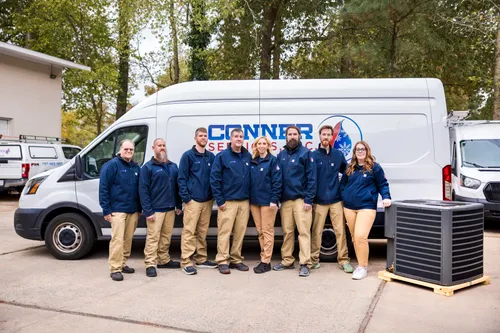
Conner Services Inc provides a wide range of heating, ventilation, and air conditioning services in Virginia Beach, VA. Their skilled technicians handle HVAC installation, repair, and maintenance for systems including furnaces, heat pumps, mini-splits, geothermal units, and ductwork. They also offer indoor air quality solutions such as filtration and UV lights, as well as smart home HVAC accessories. The company emphasizes energy-efficient options and comprehensive seasonal tune-ups to maintain system performance. Conner Services Inc holds multiple professional licenses and offers a one-year labor warranty on all services.
Galactic Air Incorporated
420 Investors Pl #107, Virginia Beach, VA 23452
Galactic Air Incorporated is a locally owned HVAC company serving Virginia Beach, VA, and the surrounding South Hampton Roads area. They provide a wide range of services including repair and installation of air conditioners, heat pumps, gas furnaces, geothermal heat pumps, ductless mini split systems, and water heaters. Their technicians are nationally certified and trained on the latest HVAC technologies, with a focus on systems like Trane. Galactic Air also offers indoor air quality services and ductwork repair or replacement. The company emphasizes attention to detail and professional service in both residential and commercial settings.
Owens Heating & Air Conditioning, Inc.
1542 Penniman Rd A, Williamsburg, VA 23185
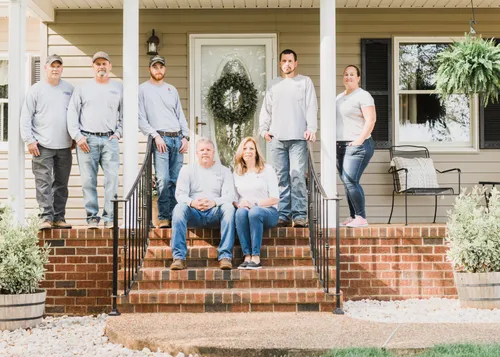
Owens Heating & Air Conditioning, Inc. is a family-owned HVAC company serving Chesapeake, VA, and the surrounding Hampton Roads area. With over 40 years of experience, they provide a full range of heating and cooling services including installation, repair, and maintenance of air conditioners, furnaces, heat pumps, boilers, and geothermal systems. They also offer indoor air quality solutions, gas line services, thermostat installation, and water heating services. Owens Heating & Air Conditioning is an authorized dealer for major HVAC brands and provides 24-hour emergency service to address urgent HVAC needs.
Atlantic Shores Heating and Cooling
3500 Robs Dr, Suffolk, VA 23434
Atlantic Shores Heating and Cooling is a family-owned HVAC company serving Chesapeake, VA, and surrounding areas. They provide a full range of heating and cooling services including air conditioner, furnace, heat pump, mini split, and geothermal heat pump repair, installation, and maintenance. The company also offers indoor air quality solutions and duct cleaning to help improve home environments. Founded in 1995, Atlantic Shores Heating and Cooling has over 20 years of experience and provides 24/7 emergency services to address urgent HVAC needs.

Puffin Mechanical
Virginia Beach, VA
Puffin Mechanical is a family-owned HVAC company serving Virginia Beach, VA, and the broader Hampton Roads area. With over 23 years of experience, they provide heating and cooling repair, replacement, and maintenance for heat pumps, air conditioners, furnaces, mini-splits, geothermal systems, and rooftop units. Their services include comprehensive HVAC tune-ups, home performance testing with blower door and infrared thermography, as well as air sealing and attic insulation to improve energy efficiency and indoor air quality. Puffin Mechanical focuses on reducing energy consumption to benefit both customers and the environment.
How Geothermal Systems Work
Unlike conventional air conditioners and furnaces that battle the extremes of Virginia's summer heat and winter chill, a geothermal heating and cooling system uses the consistent temperature of the earth just below the surface. A few feet underground, the temperature remains a relatively stable 50 to 70 degrees Fahrenheit year-round. A geothermal unit taps into this constant energy source through a series of buried pipes called a ground loop.
In the winter, a water-based solution circulating through the loop absorbs the Earth's natural warmth1. This heat is concentrated by the geothermal heat pump inside your home and distributed through your existing ductwork or radiant heating system2. The process reverses for cooling: the system extracts heat from your home's air and transfers it into the cooler ground loop, leaving behind chilled air to circulate indoors. This elegant exchange of thermal energy with the ground is what makes geothermal technology remarkably efficient.
Types of Ground Loop Systems
The ground loop is the heart of the system, and its configuration depends on your property's characteristics. There are three primary types of loops used in residential geothermal installations.
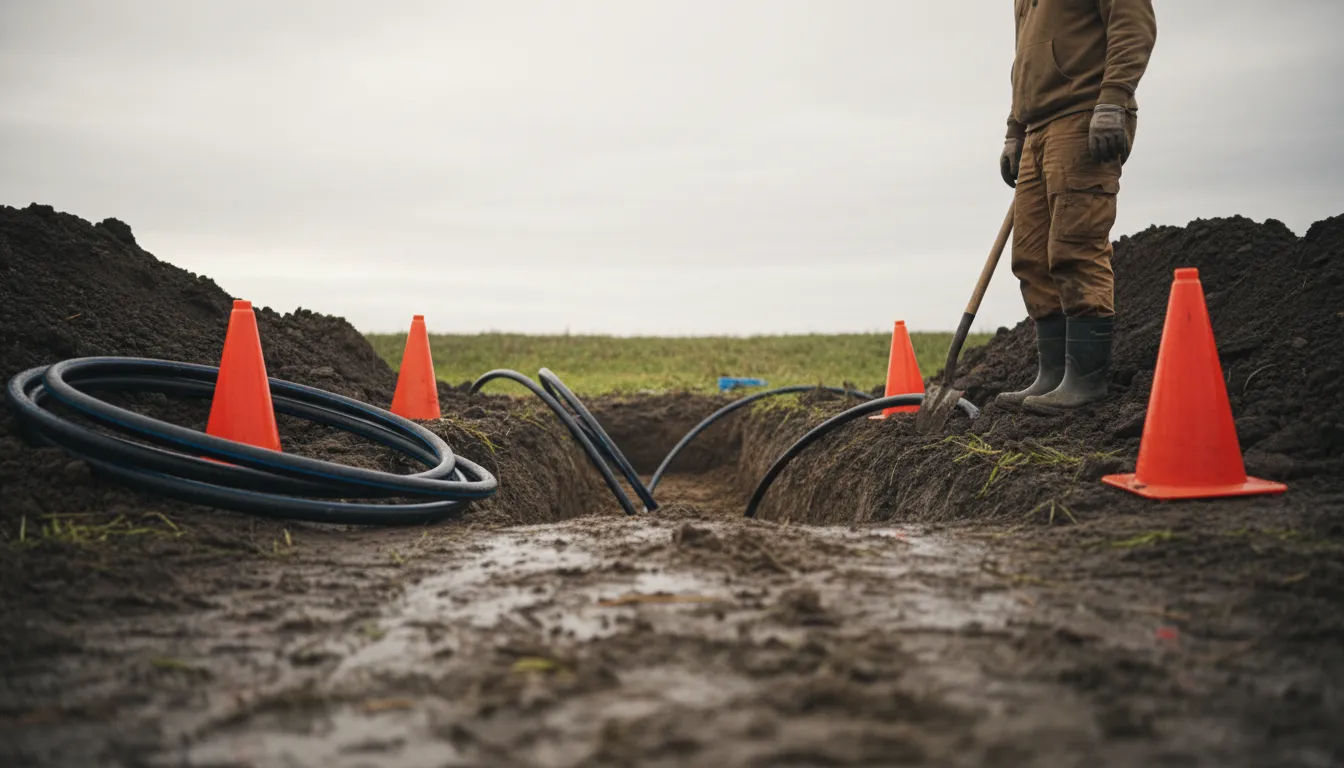
Horizontal Ground Loops: This is often the most cost-effective option if sufficient land is available. Contractors excavate long, shallow trenches-typically four to six feet deep-and lay pipes in a series of parallel runs or slinky coils3 4. This method requires a larger, clear plot of land but generally involves less specialized drilling equipment.
Vertical Ground Loops: For homes in Chesapeake with smaller yards, vertical loops are the preferred solution. Installers drill boreholes approximately 150 to 400 feet deep and insert U-shaped pipe loops into each hole. While drilling is more expensive than trenching, vertical loops minimize landscape disruption and are excellent for transferring heat due to the deep ground's stable temperature.
Pond/Lake Loops: If your property has a suitable, deep-bodied pond or lake, this can be an efficient loop source. Coils of pipe are submerged at a depth where water temperatures remain stable. This option often has the lowest installation cost if the water source is already present and meets specific volume and quality requirements5.
The Installation Process in Chesapeake
Installing a geothermal system is a significant project that requires careful planning and expert execution. Understanding the steps can help you prepare.
- Site Evaluation and Design: A qualified installer will assess your property, considering soil composition, available space, and your home's heating and cooling loads. Virginia's geology generally supports efficient heat transfer, but local soil types can influence the final loop design and length6. This stage determines the optimal loop type and system size.
- Loop Field Installation: For a vertical system, a drilling rig will create the boreholes. For a horizontal system, a backhoe will dig the trenches. The high-density polyethylene pipes are then placed, connected into a continuous loop, and pressure-tested to ensure integrity before the earth is backfilled.
- Indoor Unit Installation: The geothermal heat pump unit itself is typically installed indoors, similar to a traditional furnace, in a basement, utility closet, or garage. It is connected to the ground loop and to your home's existing ductwork or hydronic distribution system7.
- System Startup and Commissioning: The loop is filled with fluid, the system is charged, and all components are tested. The installer will ensure the system is operating at peak efficiency and explain its controls to you.
Find the perfect geothermal heat pump contractors for your needs
Get personalized recommendations and expert advice
Benefits for Chesapeake Homeowners
The decision to install a geothermal system is an investment that pays dividends in multiple ways over the long term.
- Substantial Energy Savings: Geothermal heat pumps are 40% to 80% more efficient than conventional systems8 9. By using the Earth's free thermal energy, they drastically reduce the electricity or gas needed for climate control. A typical household can save $1,000 or more annually on utility bills10 11.
- Long-Term Financial Payback: While the upfront cost is higher than a standard HVAC system, the dramatic reduction in monthly operating costs leads to a payback period. Many homeowners see a return on their investment through energy savings in about 5 to 10 years. Furthermore, the system adds to your home's value.
- Exceptional Durability and Low Maintenance: The indoor components of a geothermal system have a long lifespan, often around 25 years. The underground loop system is even more durable, frequently carrying warranties of 50 years or more and potentially lasting for generations with virtually no maintenance.
- Environmental Stewardship: By slashing energy consumption, a ground-source heat pump significantly reduces your household's carbon footprint. It also operates quietly and eliminates the need for an outdoor condenser unit, freeing up yard space and reducing noise.
Key Considerations Before You Install
A successful geothermal installation hinges on a few local and property-specific factors.
- Soil and Geology: The thermal conductivity of your soil affects loop design. A professional evaluation will determine if your land has the right properties for efficient heat exchange12 13.
- Available Space: The size and layout of your yard directly dictate which loop type is feasible. Vertical loops are ideal for tight spaces, while horizontal loops require more acreage 14.
- Home Readiness: The efficiency gains are greatest in a well-insulated, sealed home. Ensuring your attic, walls, and windows are properly insulated will allow your geothermal system to perform at its best.
- Choosing the Right Installer: This is a specialized field. Look for experienced, certified professionals who conduct thorough load calculations and site surveys, not just equipment salespeople.
Frequently asked questions
Sources
Footnotes
-
Geothermal (Ground Source) Heat Pumps - NY.gov - https://cleanheat.ny.gov/geothermal-heat-pumps/ ↩
-
How a Geothermal Heat Pump Works | This Old House - https://www.youtube.com/watch?v=d5Tbsx3R2T8 ↩
-
Geothermal Heat Pump Installation: What To Expect For Your ... - https://jomory.com/geothermal-heat-pump-installation-what-to-expect-for-your-property/ ↩
-
Ground source heat pumps: horizontal collectors Vs. vertical boreholes - https://www.mesh-energy.com/insights/ground-source-heat-pumps-horizontal-collectors-vs-vertical-boreholes ↩
-
FAQs • What types of ground-source heat pumps and configurat - https://concordma.gov/FAQ.aspx?QID=484 ↩
-
Virginia Energy - Geology and Mineral Resources - Geothermal - https://energy.virginia.gov/geology/Geothermal.shtml ↩
-
Geothermal Heat Pumps - Department of Energy - https://www.energy.gov/energysaver/geothermal-heat-pumps ↩
-
Geothermal Heat Pumps | Falls Church, VA - Official Website - https://www.fallschurchva.gov/2282/Geothermal-Heat-Pumps ↩
-
5 Things You Should Know about Geothermal Heat Pumps - https://www.energy.gov/cmei/articles/5-things-you-should-know-about-geothermal-heat-pumps ↩
-
How Does A Geothermal Heat Pump Work? Complete 2025 Guide - https://solartechonline.com/blog/how-does-geothermal-heat-pump-work/ ↩
-
Geothermal Heating, Cooling, and Hot Water Systems - https://igshpa.org/wp-content/uploads/Homeowners-Guide-to-Geothermal.pdf ↩
-
The Science Behind Geothermal HVAC in Chesapeake, VA - https://www.climatemakers.com/blog/2020/december/the-science-behind-geothermal-hvac-in-chesapeake/ ↩
-
Best Geothermal Systems for Georgia Homes - https://toptechmech.com/best-geothermal-systems/ ↩
-
Geothermal Installation Steps Explained - https://ultrageothermal.com/geothermal-installation-steps-explained/ ↩