Find the Best Geothermal Heat Pump Contractors for Your Business
No obligation • Fast responses • Nationwide coverage

Why you can trust HVAC Firms
HVAC Firms is a leading United States resource for evaluating HVAC service providers. Our team researches companies, checks credentials, and reviews customer feedback to present clear, unbiased information. Listings and rankings are based on merit, and companies cannot pay to change our editorial content.
Search providers near you
Top Geothermal Heat Pump Contractors in Colorado Springs, Colorado Ranked
A geothermal heat pump, or ground-source heat pump, is a highly efficient heating and cooling system that leverages the earth's stable underground temperature. For Colorado Springs homeowners, this technology offers a powerful way to slash energy bills while ensuring year-round comfort, regardless of the season's extremes. This guide explains how these systems work, their benefits, and how you can find qualified local experts to assess your property for a potential installation.
How Geothermal Systems Work in Our Climate
The principle behind a geothermal heating and cooling system is elegantly simple. Just a few feet below the surface, the ground in Colorado maintains a remarkably stable temperature of approximately 48 to 55 degrees Fahrenheit year-round 1. A geothermal system uses this constant temperature as a free energy source.
Here's the basic process:
- Heat Exchange: A mixture of water and antifreeze circulates through a loop of high-density polyethylene (HDPE) pipes buried in your yard.
- Winter Heating: In heating mode, the fluid absorbs the earth's warmth as it travels through the underground loop. This warmed fluid is brought back to an indoor heat pump unit, which concentrates the thermal energy and distributes it as warm air through your home's ductwork or as hot water through radiant floor systems.
- Summer Cooling: In cooling mode, the process reverses. The system extracts heat from your home's air, transfers it to the fluid in the loop, and then dumps that heat into the cooler ground.
This direct exchange with the stable earth, rather than the wildly fluctuating outside air, is what makes ground-source heat pumps so extraordinarily efficient.
Types of Ground Loops for Colorado Springs Properties
The buried pipe system, known as the "ground loop," is the heart of the installation. The right type for your home depends on your lot size, soil composition, and budget. The three main configurations are:
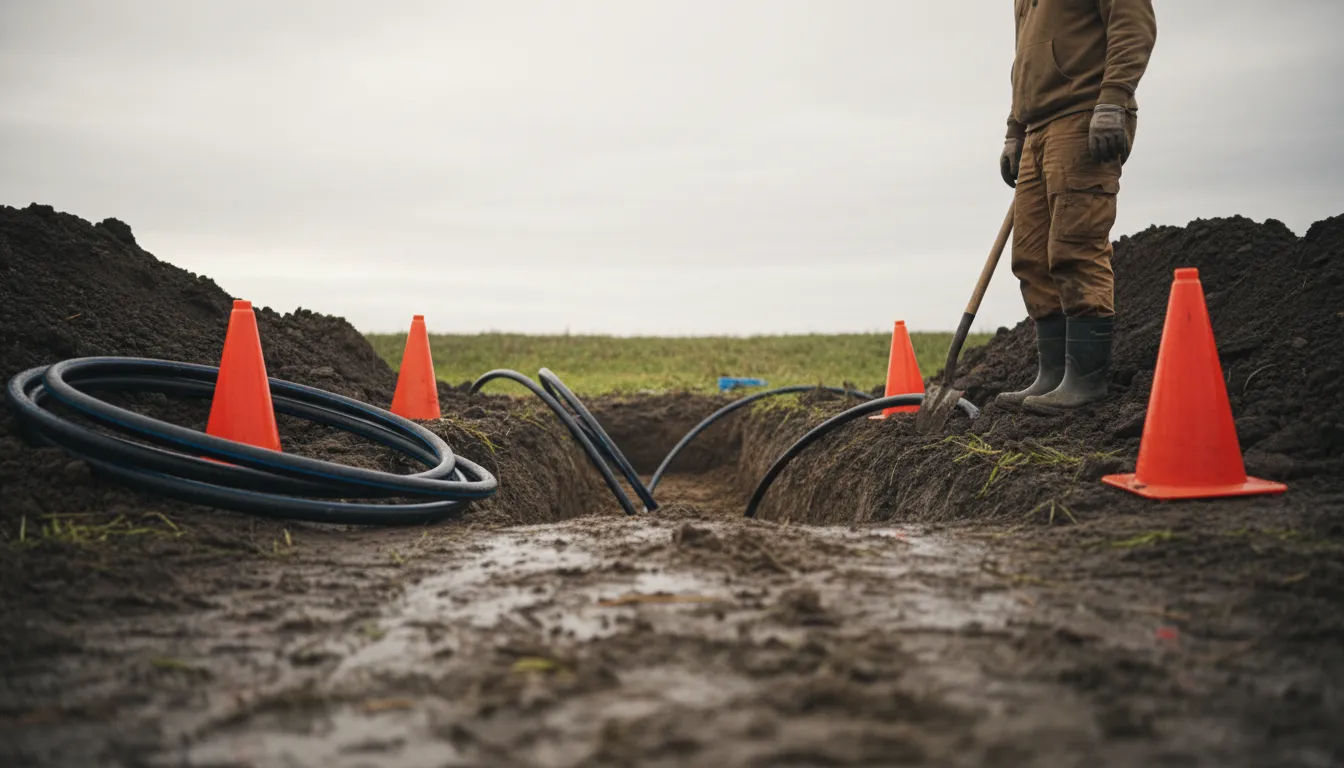
Horizontal Closed Loop This is often the most cost-effective option if you have sufficient land. Trenches are dug 4 to 6 feet deep, typically requiring about a quarter of an acre of usable land for a 2,000-square-foot home. Pipes are laid in these trenches in a series of parallel runs. This method is less expensive than drilling but is best suited for new construction or properties with ample, clear space.
Vertical Closed Loop For homes in Colorado Springs with smaller yards, rocky soil, or limited open space, vertical loops are the ideal solution. Contractors drill boreholes 200 to 500 feet deep and insert U-shaped loops of pipe into each one 2 3. While the drilling process is more specialized and can have a higher upfront cost, it requires minimal surface area and is very effective in a variety of soil and rock conditions common to the region 4.
Open Loop System This configuration uses groundwater from a well as the direct heat exchange fluid. After passing through the heat pump, the water is returned to the ground via a second well or a suitable discharge point. Open loop systems can be highly efficient but are entirely dependent on having an adequate supply of clean water and complying with local groundwater regulations.
The Installation Process: What to Expect
Installing a residential geothermal system is a significant project that requires careful planning and expert execution. Understanding the steps can help you prepare.
- Site Assessment & Design: A qualified installer will evaluate your property, considering soil conditions, lot size, and your home's heating and cooling load. This assessment determines the optimal loop type (vertical or horizontal) and the required size of the system.
- Loop Installation: This is the major excavation phase. For a horizontal system, a trencher will dig the necessary network. For a vertical system, a drilling rig will create the boreholes. This work is typically completed in one to three days.
- Pipe Fusion & Placement: Sections of HDPE pipe are thermally fused together to create continuous, leak-proof loops. These loops are then carefully placed in the trenches or inserted into the boreholes.
- Manifolding & Connection: All the underground loops are gathered and connected to a manifold, which is then piped into your home's mechanical room. The trenches are backfilled, and the boreholes are grouted with a special thermally enhanced material to ensure good heat transfer.
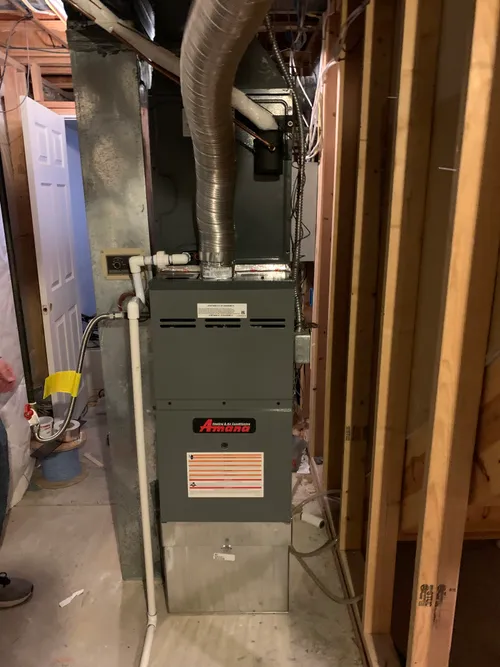
- Heat Pump Integration: The indoor geothermal heat pump unit is installed and connected to the ground loop manifold, your home's electrical system, and your existing ductwork or hydronic distribution system 5.
Find the perfect geothermal heat pump contractors for your needs
Get personalized recommendations and expert advice
Understanding Costs and Remarkable Savings
The upfront investment for a geothermal heating and cooling system is higher than that of a conventional furnace and air conditioner, primarily due to the ground loop installation. However, the operational savings are dramatic and make it a compelling long-term investment.
- Energy Savings: Homeowners in Colorado Springs can expect to reduce their heating and cooling energy consumption by 50% to 70% 6. For example, a household previously paying $200-$300 per month for combined heating and cooling might see that bill drop to between $60 and $100 per month.
- Payback Period: With these substantial utility savings, the system typically pays for itself through lower bills in an estimated 8 to 12 years.
- Long-Term Value: After the payback period, you enjoy decades of drastically reduced energy costs. The underground piping has a lifespan of 50 years or more, and the indoor heat pump unit often lasts 20 years or longer 7. Over a 20-year period, total savings can range from $30,000 to $50,000, effectively paying for the system multiple times over 8.
Efficiency and Environmental Benefits
The efficiency of geothermal heat pumps is measured by their Coefficient of Performance (COP) for heating and Energy Efficiency Ratio (EER) for cooling. While even the best air-source heat pumps struggle in freezing temperatures, a ground-source system maintains its high efficiency year-round. It's common for these systems to achieve heating COPs of 4.0 or higher, meaning they deliver four units of heat energy for every one unit of electrical energy consumed-an efficiency of 400% 9 10.
This incredible efficiency translates directly into environmental benefits. By using less electricity, often sourced from the grid, your home's carbon footprint for heating and cooling can be reduced by a similar 50-70%. For environmentally conscious residents of Colorado Springs, a geothermal system is one of the most impactful single upgrades you can make to your home.
Is Geothermal Right for Your Home?
Geothermal technology is versatile and can be integrated into many homes, but it's not a one-size-fits-all solution. It is an excellent fit for:
- Homeowners planning to stay in their current home long enough to realize the long-term savings.
- Properties undergoing major renovation or new construction, where loop installation can be more seamlessly coordinated.
- Those with high current heating costs, especially from propane, heating oil, or electric resistance heat.
- Environmentally minded individuals seeking the most efficient, low-emission comfort solution available.
The key first step is a professional site evaluation by an experienced local installer. They can provide a realistic assessment of costs, savings, and the best technical approach for your specific situation.
Frequently asked questions
Sources
Footnotes
-
How Does the Performance of Geothermal Heat Pumps Compare in Various Climates? - https://www.miamihp.com/how-does-the-performance-of-geothermal-heat-pumps-compare-in-various-climates/ ↩
-
How Does A Geothermal Heat Pump Work? Complete 2025 ... - https://solartechonline.com/blog/how-does-geothermal-heat-pump-work/ ↩
-
All You Need to Know About Home Geothermal Heating & Cooling - https://dandelionenergy.com/all-you-need-to-know-about-home-geothermal-heating-cooling ↩
-
Geothermal Heat Pumps - Department of Energy - https://www.energy.gov/energysaver/geothermal-heat-pumps ↩
-
The Geothermal Process | Colorado Geothermal Drilling - https://www.cogeothermal.com/services/our-process/ ↩
-
5 Things You Should Know about Geothermal Heat Pumps - https://www.energy.gov/cmei/articles/5-things-you-should-know-about-geothermal-heat-pumps ↩
-
Guide to Geothermal Heat Pumps - https://www.energy.gov/sites/prod/files/guide_to_geothermal_heat_pumps.pdf ↩
-
Geothermal Heating and Cooling Systems for Colorado ... - https://accurateaircontrolcolorado.com/geothermal-heating-and-cooling-systems-for-colorado-springs-homes/ ↩
-
Green Heat - Colorado Geothermal Drilling - https://www.cogeothermal.com/green-heat/ ↩
-
Geothermal Heating and Cooling | Colorado Energy Office ... - https://geothermal.colorado.gov/geothermal-heating-and-cooling ↩