Find the Best Mini-Split Installers for Your Business
No obligation • Fast responses • Nationwide coverage

Why you can trust HVAC Firms
HVAC Firms is a leading United States resource for evaluating HVAC service providers. Our team researches companies, checks credentials, and reviews customer feedback to present clear, unbiased information. Listings and rankings are based on merit, and companies cannot pay to change our editorial content.
Search providers near you
Top Mini-Split Installers in Burnsville, Minnesota Ranked
A ductless mini-split system is a versatile heating and cooling solution that provides targeted comfort without the need for extensive ductwork. These systems are particularly valuable for managing Minnesota's distinct seasons, offering efficient zoned climate control for specific areas of your home. This guide explains what mini-split installation involves, why it's a smart choice for many Burnsville residences, and how you can evaluate local options to find a qualified provider for your project.
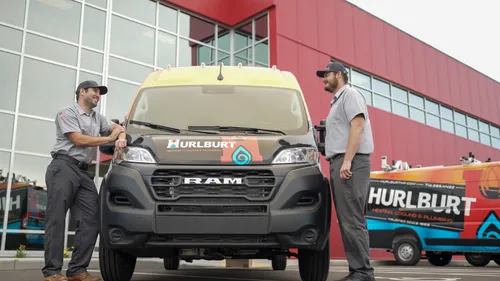
Hurlburt Heating & Plumbing
1000 County Rd E Suite 115, Shoreview, MN 55126
Hurlburt Heating & Plumbing is a family-owned home services provider serving Minneapolis, MN, and surrounding areas. Since 1959, they have offered a wide range of services including HVAC installation and repair, plumbing, and electrical work. Their HVAC services cover air conditioner and furnace repair, heat pump and mini split installation, indoor air quality solutions, and HVAC tune-ups. Hurlburt also provides whole-home air scrubbers, purifiers, humidifiers, and dehumidifiers to improve indoor air quality. With over six decades of experience, they combine modern technology with personalized service to address customer needs.

Nice Heating & Air
24 Onville Rd suite 101-9, Stafford, VA 22556
Nice Heating & Air is an HVAC company serving Minneapolis, MN, specializing in air conditioning, heating, and indoor air quality services. They provide installation, repair, and maintenance for systems including ductless mini splits, heat pumps, furnaces, and water heaters. The company has many years of experience and focuses on delivering high-quality products and services with a commitment to customer satisfaction. Their capabilities include HVAC tune-ups and indoor air quality improvements such as air purifier installation and ventilation services.

Furnace Doctors
102 County Rd C West, Little Canada, MN 55117
Furnace Doctors is an HVAC company based in Minneapolis, MN, offering a range of heating and cooling services. Their expertise includes furnace repair and replacement, air conditioner repair and installation, ductless system installation, and indoor air quality solutions such as air filtration and humidity control systems. The company emphasizes maximizing HVAC system performance and has installers with over 25 years of experience. Furnace Doctors also provides annual maintenance plans to help keep systems running efficiently.

Pronto Heating and Air Conditioning - Minneapolis
7415 Cahill Rd, Minneapolis, MN 55439
Pronto Heating and Air Conditioning - Minneapolis is an HVAC company serving Minneapolis, MN, and nearby communities. They provide installation, repair, and maintenance for heating and cooling systems including furnaces, air conditioners, boilers, heat pumps, and ductless mini splits. The company is a Bryant Factory Authorized Dealer with expertise in indoor air quality solutions such as air purification and advanced thermostats. Pronto Heating and Air Conditioning offers emergency service with a commitment to respond within 24 hours and has a history of recognized performance as a multiple Bryant Dealer of the Year finalist and winner.
Stafford Home Service
6225 Cambridge St, Minneapolis, MN 55416
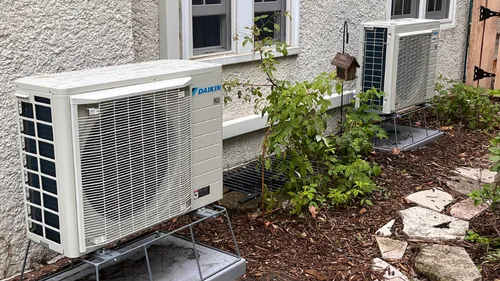
Stafford Home Service is a family-operated company based in Minneapolis, MN, offering residential HVAC and electrical services. They provide repairs, installations, and maintenance for heating and cooling systems including furnaces, heat pumps, boilers, mini-split systems, and air conditioning units. The company features licensed technicians with over 70 years of combined experience and emphasizes transparent pricing and customer satisfaction. Stafford Home Service also offers advanced HVAC solutions with Daikin products, known for energy efficiency and zoning capabilities. Since 2007, the company has continued a legacy of quality workmanship under current ownership. They serve Minneapolis and surrounding communities with a range of home comfort services.
Why Consider a Ductless System in Burnsville?
Burnsville homeowners often seek flexible heating and cooling solutions that adapt to their home's unique layout and their family's comfort needs. Traditional central forced-air systems can struggle with temperature inconsistencies, especially in older homes, additions, or rooms with lots of windows. A ductless mini-split, or simply a ductless AC and heat pump, solves this by creating independent comfort zones. This is ideal for finishing a basement, cooling a sunroom addition, or providing efficient heat to a garage workshop without the cost and disruption of installing new ducts 1 2. For historic homes where preserving architecture is key, or for any room lacking existing ductwork, a mini-split installation offers a modern, efficient alternative 3.
Common Applications for Mini-Splits
Understanding where a ductless system shines can help you decide if it's the right fit for your property.
- Home Additions & Renovations: Adding a family room, converting an attic, or building a sunroom? Extending existing ductwork can be complex and expensive. A mini-split provides a dedicated, efficient climate control system for the new space without overburdening your old HVAC 4.
- Targeted Zoning: Do you have a home office that gets too warm in the afternoon or a bedroom that's always colder than the rest of the house? Ductless technology allows you to set different temperatures in different zones, eliminating hot and cold spots and potentially reducing overall energy use by conditioning only occupied spaces.
- Older & Historic Homes: Many charming older homes in the area were built without central air conditioning or have inefficient, difficult-to-modify duct systems. Installing a ductless mini-split avoids the invasive construction required for ductwork, preserving your home's character while adding modern comfort.
- Supplemental Heating and Cooling: A mini-split can serve as a highly efficient primary system or as a supplement. It can take the load off your furnace during mild fall and spring days or provide cooling to a second floor that your central AC struggles to reach.
Types of Ductless Mini-Split Systems
The first major decision in planning your installation is choosing between a single-zone or multi-zone configuration.
- Single-Zone Systems: This setup consists of one outdoor condenser unit connected to one indoor air handler. It's the most straightforward and cost-effective option, perfect for conditioning a single room, such as a master bedroom suite, a basement rec room, or a garage. It provides independent control for that specific space.
- Multi-Zone Systems: A single, more powerful outdoor unit can be connected to multiple indoor units (typically 2 to 5+). This allows you to control the temperature independently in several rooms-like the kitchen, living room, and a home office-all from one outdoor compressor. While the upfront cost is higher than a single-zone, it can be more efficient and less obtrusive than installing multiple separate systems.
Indoor Unit Styles and Placement
The indoor air handler comes in several styles to suit different room aesthetics and layout needs. Proper placement is critical for performance, comfort, and efficient drainage.
- Wall-Mounted: This is the most common and generally most affordable type. The unit is mounted high on an interior wall, allowing for excellent air distribution across an open space. Installation is relatively straightforward.
- Ceiling Cassette: These units are recessed into the ceiling, offering a very sleek, low-profile look. They distribute air in four directions for even coverage but require sufficient ceiling cavity depth for installation, which can increase complexity and cost 5 6.
- Floor-Mounted: Designed to be installed low on a wall, similar to a traditional radiator. This style is an excellent solution for rooms with sloped ceilings, knee walls, or large window walls where high wall mounting isn't feasible. It provides upward airflow that can help combat cold drafts from windows 7.
- Placement Considerations: A certified installer will assess the best location for optimal airflow, ensuring the unit can effectively draw in room air and discharge conditioned air. They must also plan for a slight downward pitch in the condensate drain line to allow moisture from dehumidification to exit the home properly.
Find the perfect mini-split installers for your needs
Get personalized recommendations and expert advice
The Installation Process: What to Expect
A professional ductless mini-split installation is a precise job that typically follows these key steps:
- Site Evaluation & Planning: A technician will visit your Burnsville home to assess the best locations for the indoor and outdoor units, check electrical service capacity, and plan the refrigerant line routing.
- Mounting the Units: The indoor air handler bracket is securely mounted to the wall, ceiling, or floor. Outside, a sturdy mounting bracket or concrete pad is installed for the condenser, ensuring it has adequate clearance (usually 12-24 inches) on all sides for airflow and service access.
- Drilling the Line Set Hole: A small, clean hole (typically 2-3 inches) is drilled through the exterior wall to connect the indoor and outdoor units. This hole will carry the insulated copper refrigerant lines, condensate drain tubing, and electrical wiring.
- Making Connections: The refrigerant lines are carefully flared, connected, and sealed. The condensate line is routed to an appropriate drain. Electrical connections are made, which often involves running a new dedicated 240-volt circuit from your main electrical panel to the outdoor unit 8.
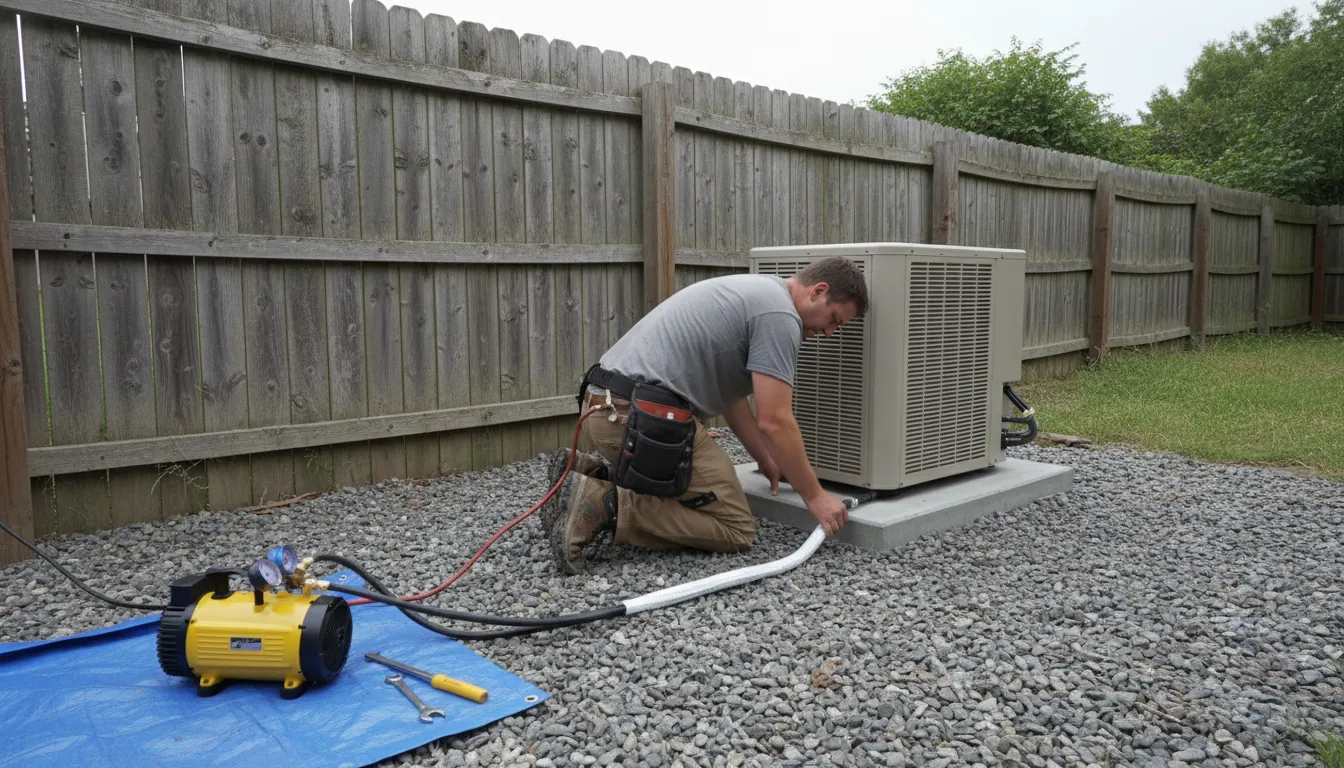
- System Evacuation & Testing: The installer will use a vacuum pump to remove all air and moisture from the refrigerant lines-a critical step for system longevity and efficiency. The system is then charged with refrigerant, activated, and tested for proper heating, cooling, and drainage 9.
Understanding Installation Costs in Burnsville
The cost of a ductless mini-split installation in Burnsville varies based on system complexity, capacity, and your home's specific requirements.
- Single-Zone System: For a standard wall-mounted unit installation, homeowners can expect a total cost range between $3,000 and $8,000 10. The final price depends on the unit's heating/cooling capacity (measured in BTUs) and efficiency (SEER2 rating), brand, and any necessary electrical upgrades.
- Multi-Zone System: Installing a system with 2-3 indoor zones typically ranges from $5,500 to $15,000 or more11 12. Each additional indoor zone generally adds $1,500 to $3,000 to the project cost 13 14.
- Key Cost Factors:
- Number of Zones & Unit Type: More indoor units and specialized types (like ceiling cassettes) increase material and labor costs.
- System Efficiency: Higher SEER2-rated units are more expensive upfront but offer lower long-term operating costs.
- Electrical Work: Installing a new dedicated circuit or upgrading an electrical panel adds to the project cost.
- Installation Complexity: Long refrigerant line runs, difficult wall constructions, or complex mounting situations can increase labor time.
Frequently asked questions
Sources
Footnotes
-
Ductless mini-split installation: Cool 2025 Guide - Southern Air - https://www.southern-air.com/blog/ductless-mini-split-installation ↩
-
How Much Does a Mini-Split Cost in 2025? - EnergySage - https://www.energysage.com/heat-pumps/how-much-does-a-mini-split-cost/ ↩
-
Tag: ductless ac - https://completecomfort.us/tag/ductless-ac/ ↩
-
How Ducted and Ductless Mini Split Systems Work - https://www.sumzeroenergysystems.com/blog/how-mixed-ducted-and-ductless-mini-splits-work-in-one-system ↩
-
How Much Does a Mini Split Installation Cost? (2026) - HomeGuide - https://homeguide.com/costs/ductless-mini-split-ac-cost ↩
-
How Much Does a Mini-Split Installation Cost? - Taskrabbit Blog - https://www.taskrabbit.com/blog/mini-split-installation-cost/ ↩
-
Ductless Mini-Splits: A Comprehensive Cost Breakdown - https://www.myfivestarhomeservices.com/ductless-mini-splits-a-comprehensive-cost-breakdown/ ↩
-
How to Install a Mini Split System - https://www.youtube.com/watch?v=J2nkLRbhfPY&t=99 ↩
-
Ductless Mini Split Setup: An Ultimate Guide - Airflow Heating & Air - https://www.goairflow.com/blog/ductless-mini-split-installation/ ↩
-
Mini Split System Average Cost in Minnesota (2025 Update) - https://genzryan.com/blog/mini-split-system-cost/ ↩
-
Ductless Mini-Split Installation Costs in Minnesota - AIR COMFORT HEATING & AIR - https://www.aircomfortmn.com/blog/ductless-mini-split-installation-costs-in-minnesota ↩
-
Ductless Mini-Split Installation Cost in 2025: Full Breakdown - https://osborneheatingncooling.com/ductless-mini-split-installation-cost/ ↩
-
Ductless Mini Split Installation Costs in 2026 - Carrier - https://www.carrier.com/residential/en/ca/products/ductless-mini-splits/ductless-mini-split-installation-cost/ ↩
-
Understanding mini split installation costs: A quick guide - Homeaglow - https://www.homeaglow.com/hub/content/mini-split-installation-cost ↩