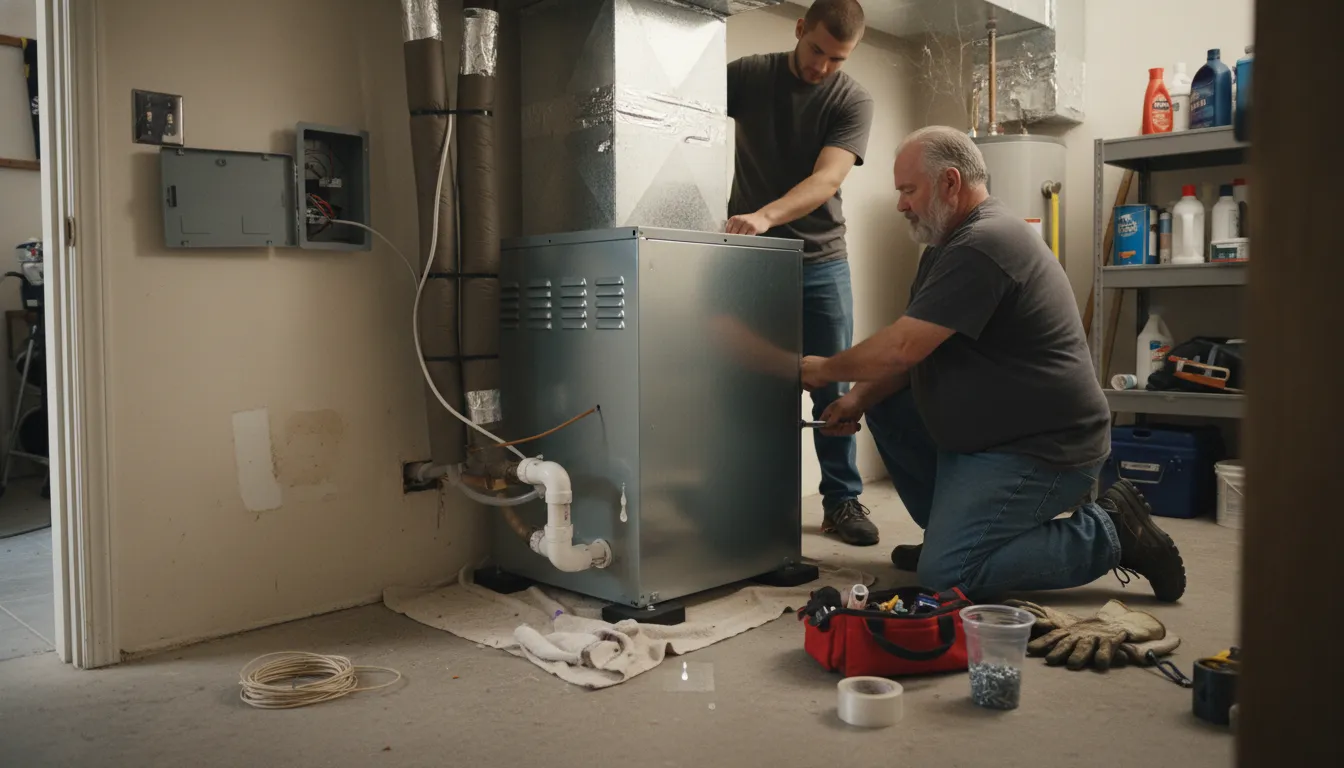
Find the Best HVAC Installers for Your Business
No obligation • Fast responses • Nationwide coverage

Why you can trust HVAC Firms
HVAC Firms is a leading United States resource for evaluating HVAC service providers. Our team researches companies, checks credentials, and reviews customer feedback to present clear, unbiased information. Listings and rankings are based on merit, and companies cannot pay to change our editorial content.
Search providers near you
Top HVAC Installers in Georgetown, Texas Ranked
Installing a new heating, ventilation, and air conditioning system is a significant investment in your home's comfort, efficiency, and value. In Georgetown's unique climate, with hot summers and variable winters, a properly sized and professionally installed HVAC system is essential for maintaining a healthy indoor environment and managing energy costs. This guide will help you understand the process, options, and key considerations for a successful HVAC system installation or replacement in your home.
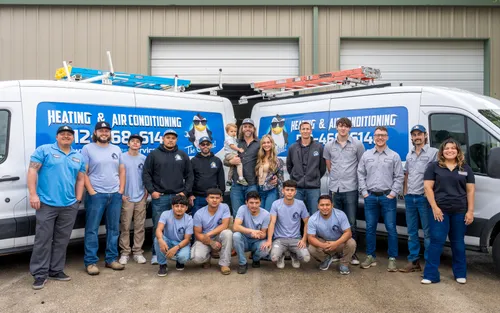
The Coolest LLC
4505 Terry-O Ln, Austin, TX 78745
The Coolest LLC is an HVAC company based in Austin, TX, specializing in air conditioning installation, repair, and indoor air quality services. They focus on installing energy-efficient HVAC systems that help reduce electricity consumption while improving air quality by filtering dust and pollution. Their services include AC installation, HVAC tune-ups, and maintenance tailored to meet customer needs, aiming to lower overall HVAC-related expenses through efficient and durable equipment. The company emphasizes transparency in pricing and offers options for exchanging older units with newer models to enhance efficiency.

Cool Kids AC, Heat & Plumbing
907 Fieldstone Pl, Round Rock, TX 78664
Cool Kids AC, Heat & Plumbing is a family-owned HVAC company serving Austin, TX, and the surrounding areas. They provide a range of services including air conditioning and furnace repair, installation, and tune-ups, as well as indoor air quality solutions. Their team offers same-to-next-day HVAC system replacements and emphasizes homeowner education on maintenance to prevent future issues. They recommend bi-annual maintenance to keep systems efficient and extend their lifespan. Cool Kids AC, Heat & Plumbing is available for service calls during days, nights, and weekends.
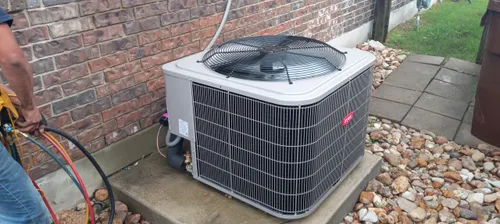
Atomic AC & Heating
520 Co Rd 108 Unit 46, Hutto, TX 78634
Atomic AC & Heating is an HVAC company serving Austin, TX, specializing in air conditioning and heating services for both residential and commercial properties. With over 20 years of experience, they provide installation and repair for AC units and furnaces, ensuring comfort throughout the year. Their licensed and insured technicians focus on delivering quality service with a commitment to community support.
Airsheen Services LLC
11817 Buckner Rd, Austin, TX 78726
Airsheen Services LLC offers a range of heating and cooling solutions in Austin, TX. Their services include air conditioning repair, furnace installation and repair, HVAC tune-ups, and indoor air quality improvements such as air purifiers and ventilation systems. They also specialize in ductless mini-split installations to provide efficient heating and cooling without ductwork. Airsheen Services LLC focuses on maintaining comfortable and energy-efficient homes throughout the year.

All About TEXAS Cooling and Heating
2125 Downing Ln, Leander, TX 78641
All About TEXAS Cooling and Heating is an HVAC company based in Austin, TX, offering a wide range of services including air conditioning, furnace, heat pump, and mini-split installation and repair. They also provide HVAC tune-ups and indoor air quality solutions. With over 34 years of experience, they specialize in advanced systems such as zoning, two-stage, and fully modulating inverter technology. The company emphasizes local values and respectful service practices.
Understanding Your Georgetown Home's Needs
Every home is different, and a one-size-fits-all approach to HVAC installation can lead to discomfort and high utility bills. The first and most critical step in any new installation is a professional assessment. This involves more than just measuring square footage; it requires a detailed load calculation known as a Manual J assessment. This calculation considers your home's insulation, window types, orientation, and even Georgetown's specific microclimate to determine the exact heating and cooling capacity (measured in BTUs) your system needs. An oversized system will short-cycle, turning on and off frequently, leading to uneven temperatures and excess wear. An undersized system will run constantly, struggling to keep up on the hottest or coldest days.
A comprehensive evaluation should also include a thorough inspection of your existing ductwork. Leaky, poorly insulated, or incorrectly sized ducts can waste 30% or more of your system's energy output. Your technician will check for leaks, proper routing, and adequate return air pathways. In many older Georgetown homes, addressing ductwork issues is a necessary part of a new installation to ensure the new equipment performs as designed.
Types of HVAC Systems for Central Texas
Choosing the right type of system is a balance of upfront cost, long-term efficiency, and your home's specific layout. Here are the most common options for Georgetown residences:
Air-Source Heat Pumps: This is an increasingly popular choice for our climate. A heat pump provides both efficient cooling in the summer and heating in the winter by moving heat rather than generating it. Modern models are effective even in Texas winters and can offer significant energy savings compared to a standard air conditioner and gas furnace combination.
Central Air Conditioner & Furnace: This traditional split system pairs a high-efficiency air conditioner with a gas or electric furnace. The efficiency of an air conditioner is measured by its SEER (Seasonal Energy Efficiency Ratio) rating. In Texas, a minimum of 14 SEER is standard, but systems up to 26 SEER are available for maximum savings. The furnace's efficiency is measured by AFUE (Annual Fuel Utilization Efficiency).
Ductless Mini-Split Systems: Ideal for homes without existing ductwork, room additions, or for creating independent temperature zones. These systems consist of an outdoor compressor/condenser and one or more indoor air-handling units. They offer flexible installation and high efficiency.
Geothermal Heat Pumps: This is the most energy-efficient option available, using the stable temperature of the earth to heat and cool your home. While it has the highest upfront installation cost, it offers the greatest long-term savings on energy bills and may qualify for substantial federal tax credits.
Find the perfect hvac installers for your needs
Get personalized recommendations and expert advice
The Professional Installation Process Explained
A quality installation is just as important as the equipment you choose. A proper HVAC installation in Georgetown is a multi-step process that typically unfolds over one to several days.
- Final Assessment & Planning: The installer will confirm the Manual J load calculation and finalize equipment selection. They will also plan the routing for new refrigerant lines, electrical connections, and any ductwork modifications.
- Preparation & Removal: The old system is safely decommissioned and removed. The work area is protected, and the installer will prepare the site for the new equipment, which may include pouring a new concrete pad for the outdoor unit.
- Equipment Placement & Connections: The new outdoor condenser and indoor air handler or furnace are set in place. Refrigerant lines are carefully installed, brazed, and pressure-tested to ensure there are no leaks. New electrical wiring and high-voltage disconnects are installed to code1.
- Ductwork Modifications & Sealing: If needed, new ductwork is installed, or existing ducts are modified, re-sized, and sealed with mastic to prevent energy loss.
- System Startup & Testing: This is a critical phase. The installer will evacuate moisture and air from the refrigerant lines, charge the system with the precise amount of refrigerant, and test all components. They will calibrate the thermostat, test the heat and cool cycles, and verify system pressures and airflow2.
- Customer Walkthrough: A reputable installer will walk you through the operation of your new system, explain your thermostat, and review maintenance requirements.
Cost Considerations for Installation & Replacement
The cost of a new HVAC system in Georgetown varies widely based on system type, efficiency, home size, and the complexity of the installation. For a full system replacement in a typical 1,500-2,500 square foot home, homeowners can expect a range.
- Basic System Replacement: Installing a standard-efficiency AC unit and furnace can start in the range of $5,000 to $8,000.
- High-Efficiency System Replacement: Upgrading to a high-SEER air conditioner (16+ SEER) and a high-AFUE furnace will typically range from $8,000 to $15,000 or more for the equipment and installation.
- Heat Pump Installation: A quality air-source heat pump system generally falls between $4,500 and $10,000 installed3 4.
- Additional Necessary Costs: These figures often assume existing ductwork and electrical are adequate. Ductwork replacement or major modification can add $1,000 to $5,000+5. Necessary electrical panel upgrades can add hundreds to over a thousand dollars. Local permits also add to the cost6.
It's vital to view this investment through the lens of total cost of ownership. A higher upfront cost for a more efficient system can be offset by lower monthly energy bills. For example, the long-term savings on energy from a high-efficiency system can amount to thousands of dollars over a 15-year lifespan compared to a basic model.
Timeline for a Typical Residential Installation
How long you can expect your home to be in the installation phase depends on the job's scope.
- Straightforward AC or Furnace Swap: If replacing a single component with a similar model and no other work is needed, a professional crew can often complete the job in 4 to 8 hours or within a single day.
- Full System Replacement (AC & Furnace): Installing a new matched system typically takes 1 to 2 full days.
- Heat Pump or Complex Installations: Jobs involving a heat pump or significant ductwork modifications usually require 2 to 3 days.
- Geothermal Systems: These are major projects involving ground-loop excavation and can take 3 to 5 days or more for the HVAC installation portion7.
The Importance of Proper Ductwork
Your new HVAC system can only be as effective as the ducts that distribute the air. In Georgetown, where attics can reach extreme temperatures, poorly performing ductwork is a major source of energy waste. During your installation consultation, ask specifically about duct testing. Professional ductwork installation or sealing ensures that the conditioned air your new, efficient system produces actually reaches your living spaces. This step maximizes comfort, improves indoor air quality by preventing dust intrusion from attics or crawl spaces, and protects your investment by allowing the equipment to operate as designed.
Frequently asked questions
Sources
Footnotes
-
AC Installation Georgetown & Leander, TX | DTC Air Conditioning - https://www.dtctexas.com/air-conditioning-installation/ ↩
-
Georgetown, TX - Intelligent Air Services - https://www.iairservices.com/service-area/georgetown-tx/ ↩
-
HVAC Replacement Cost Tips to Avoid Extra Expenses - Green Attics - https://greenatticstx.com/hvac-replacement-cost/ ↩
-
AC Replacement & HVAC Installation in Georgetown, TX - https://texasbree.com/ac-installation-replacement-georgetown/ ↩
-
Professional Ductwork Installation in Georgetown, TX - https://www.georgetownac.com/duct-work-installation/ ↩
-
The Texas AC Replacement Guide 2025 - Costs & Pro Guidance - https://ctrairandheat.com/blog/texas-ac-replacement-costs-guide-2025/ ↩
-
How Long Does a Typical HVAC Installation Take in a Residential ... - https://www.mybelugaair.com/blogs/6976/how-long-does-a-typical-hvac-installation-take-in-a-residential-home ↩