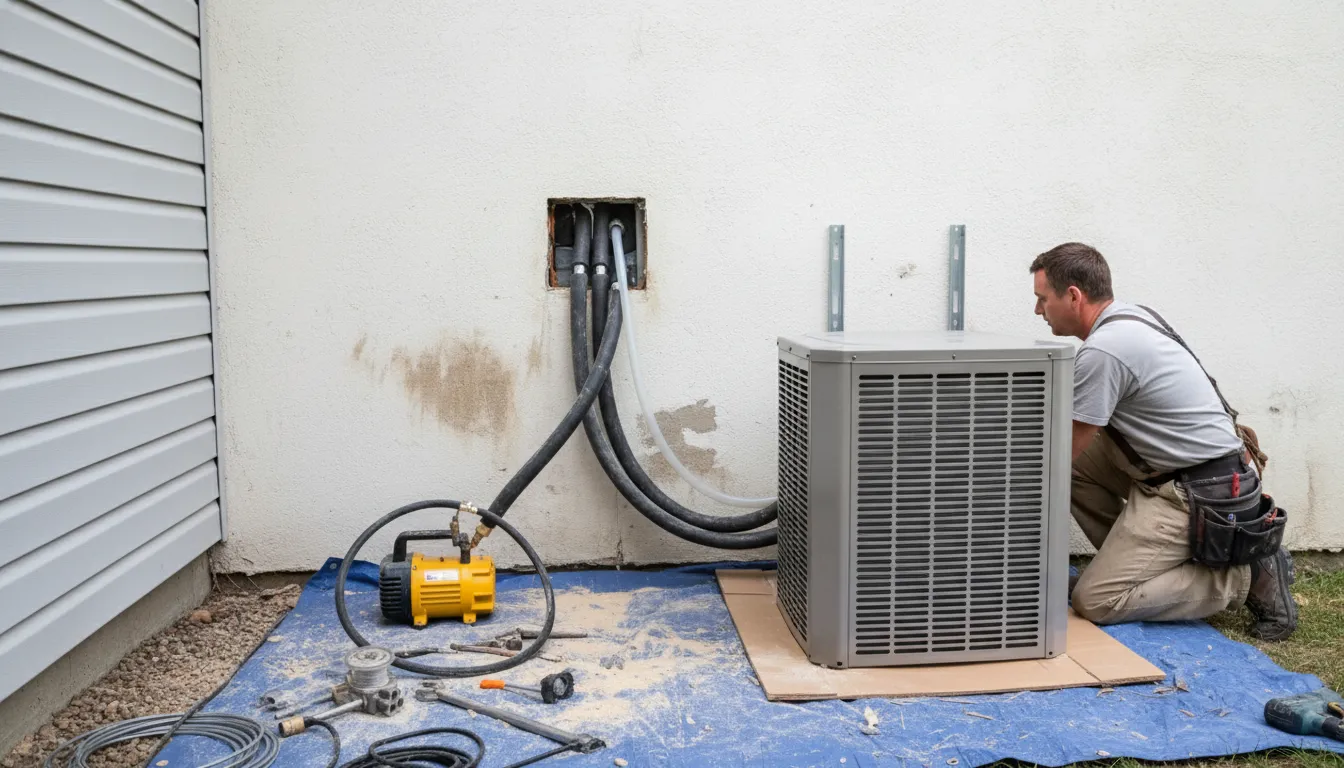
Find the Best Heat Pump Installation & Replacement Contractors for Your Business
No obligation • Fast responses • Nationwide coverage

Why you can trust HVAC Firms
HVAC Firms is a leading United States resource for evaluating HVAC service providers. Our team researches companies, checks credentials, and reviews customer feedback to present clear, unbiased information. Listings and rankings are based on merit, and companies cannot pay to change our editorial content.
Search providers near you
Top Heat Pump Installation & Replacement Contractors in Norfolk, Virginia Ranked
Upgrading your home's heating and cooling system with a heat pump is a smart move for Norfolk residents. This efficient technology provides both heating and cooling from a single unit, offering year-round comfort and significant energy savings compared to traditional systems like furnaces and air conditioners. For homeowners in Norfolk, understanding the types of systems available, their suitability for our local climate, and the investment involved is key to making an informed decision. This guide will help you navigate the process of selecting and installing a heat pump, connecting you with the information needed to find qualified local professionals for your project.
Absolute Comfort Heating and Cooling
524 Central Dr #101, Virginia Beach, VA 23454
Absolute Comfort Heating and Cooling is a family-owned HVAC company serving Virginia Beach, VA, and nearby areas since 2003. They provide a wide range of services including air conditioning, heat pump, furnace, and boiler repair and installation, as well as indoor air quality solutions and ductless system services. Their NATE-certified technicians handle both residential and light commercial HVAC needs, offering expertise in system diagnostics, maintenance, and installations. The company also offers 24/7 emergency service for urgent HVAC issues.
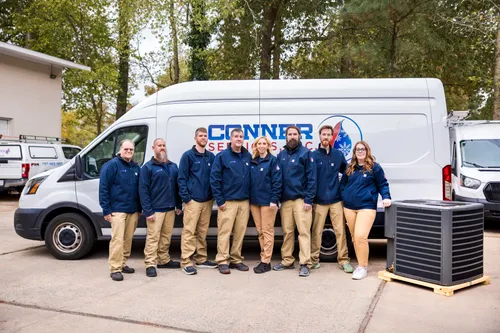
Conner Services Inc
1359 Virginia Beach Blvd, Virginia Beach, VA 23454
Conner Services Inc provides a wide range of heating, ventilation, and air conditioning services in Virginia Beach, VA. Their skilled technicians handle HVAC installation, repair, and maintenance for systems including furnaces, heat pumps, mini-splits, geothermal units, and ductwork. They also offer indoor air quality solutions such as filtration and UV lights, as well as smart home HVAC accessories. The company emphasizes energy-efficient options and comprehensive seasonal tune-ups to maintain system performance. Conner Services Inc holds multiple professional licenses and offers a one-year labor warranty on all services.

Aire Serv of Southside
4740 W Norfolk Rd, Portsmouth, VA 23703
Aire Serv of Southside is an HVAC company serving Virginia Beach, VA, and nearby areas including Chesapeake, Norfolk, and Portsmouth. They provide a range of heating and cooling services such as air conditioner repair and installation, furnace and heat pump maintenance, boiler services, and indoor air quality improvements. The company offers specialized capabilities like ductless mini split AC system installation and comprehensive HVAC tune-ups to enhance system efficiency. Aire Serv of Southside is locally owned and operated and is affiliated with a national network, providing access to extensive resources and continuing education. They also offer 24/7 availability for heating and air conditioning repairs to ensure customer comfort year-round.
Galactic Air Incorporated
420 Investors Pl #107, Virginia Beach, VA 23452
Galactic Air Incorporated is a locally owned HVAC company serving Virginia Beach, VA, and the surrounding South Hampton Roads area. They provide a wide range of services including repair and installation of air conditioners, heat pumps, gas furnaces, geothermal heat pumps, ductless mini split systems, and water heaters. Their technicians are nationally certified and trained on the latest HVAC technologies, with a focus on systems like Trane. Galactic Air also offers indoor air quality services and ductwork repair or replacement. The company emphasizes attention to detail and professional service in both residential and commercial settings.

Mechollage, Inc.
4904 Rutherford Rd #102, Virginia Beach, VA 23455
Mechollage, Inc. is a veteran-owned HVAC company serving Virginia Beach, VA, and nearby communities since 2009. They provide a range of services including installation, repair, and maintenance of air conditioners, furnaces, heat pumps, mini splits, and thermostats. Specializing in Daikin Fit systems, Mechollage offers energy-efficient and quiet HVAC solutions with extended warranties. The company also provides 24/7 emergency repair services to address urgent heating and cooling needs promptly.
Understanding Heat Pump Technology
A heat pump doesn't generate heat by burning fuel; instead, it moves existing heat from one place to another. In the summer, it acts like an air conditioner, extracting heat from inside your home and releasing it outdoors. In the winter, the process reverses-it extracts heat from the outside air (even when it's cold) and transfers it indoors. This method of heat transfer is inherently more efficient than generating heat, which is why modern heat pumps can provide substantial savings on utility bills.
The core components are an outdoor unit (similar to an AC condenser) and an indoor air handler. They are connected by refrigerant lines that circulate a special fluid to facilitate the heat exchange. Advancements in compressor technology, such as variable-speed and two-stage systems, allow today's units to adjust their output precisely to your home's needs, maintaining consistent temperatures and improving efficiency.
Types of Heat Pump Systems for Norfolk Homes
There are several configurations to consider, each with its own advantages depending on your home's layout and existing infrastructure.
Central Air-Source Heat Pumps: This is the most common type for homes with existing ductwork. It uses a single outdoor unit connected to a central indoor air handler that distributes conditioned air through ducts. It's an ideal, straightforward replacement for an old central air conditioner and furnace combo 1.
Ductless Mini-Split Heat Pumps: These systems are perfect for homes without ducts, for room additions, or for creating independent temperature zones. One outdoor compressor can connect to multiple indoor air-handling units mounted on walls or ceilings in different rooms. They offer excellent flexibility and efficiency, as you only condition the spaces you're using.
Geothermal (Ground-Source) Heat Pumps: This is the most efficient type of heat pump system available. Instead of exchanging heat with the outside air, it uses a loop of pipes buried in the ground to exchange heat with the earth, which maintains a more stable temperature year-round. While the installation cost is significantly higher due to the ground loop excavation, the operating costs are the lowest, leading to long-term savings.
Efficiency Ratings: SEER2, HSPF2, and What They Mean
When comparing heat pumps, you'll encounter key efficiency metrics mandated by the U.S. Department of Energy.
- SEER2 (Seasonal Energy Efficiency Ratio 2): Measures cooling efficiency. The higher the number, the more efficient the unit is at cooling. Current standards start at 14-16 SEER2 for new systems 2.
- HSPF2 (Heating Seasonal Performance Factor 2): Measures heating efficiency. A higher HSPF2 indicates a more efficient heater. Modern units typically have an HSPF2 of around 8.5 or higher 3.
For maximum savings, look for high-efficiency models rated at 17+ SEER2 and 9+ HSPF2. These often feature advanced compressors and fans that use less electricity to maintain comfort. Investing in a higher-efficiency unit can pay off through lower monthly bills, especially in Norfolk's climate where the system runs frequently 4.
Is Norfolk's Climate Suitable for a Heat Pump?
Absolutely. Norfolk's humid subtropical climate, with its hot summers and generally mild winters, is well-suited for air-source heat pump operation 5. Average winter lows in the 30s°F are within the effective range of standard models.
However, for the best performance and efficiency during our occasional colder snaps, consider a cold-climate heat pump. These models are specifically engineered to provide efficient heating at much lower outdoor temperatures (some down to -15°F) without relying heavily on less-efficient backup electric resistance heat 6 7. This ensures you stay comfortable and efficient throughout the entire winter.
Find the perfect heat pump installation & replacement contractors for your needs
Get personalized recommendations and expert advice
Cost Factors for Heat Pump Installation
The total cost of a new heat pump system in Norfolk varies widely based on the system type, size, efficiency, and installation complexity. Here's a general breakdown:
- Standard Central Air-Source System: For a full system replacement, homeowners can expect costs ranging from $8,000 to $18,000 or more. This range accounts for the unit itself, labor, standard electrical connections, and integrating with existing ductwork 8 9 10.
- Ductless Mini-Split System: Installing a single-zone system (one outdoor unit, one indoor head) typically costs between $3,500 and $10,000. Multi-zone systems for cooling and heating several rooms will be at the higher end of this range or above.
- Geothermal System: Due to the ground loop excavation or drilling, these systems have a high upfront cost, generally between $15,000 and $40,000+. The long-term energy savings can be substantial, making it a worthwhile investment for many 11 12.
These prices are influenced by several key factors:
- System Size & Capacity: An undersized or oversized unit will perform poorly. A proper Manual J load calculation performed by your contractor is essential.
- Existing Infrastructure: Modifications to ductwork, upgrading electrical service, or installing new refrigerant lines will add to the project cost.
- Brand and Features: Premium brands and models with advanced features (like variable-speed compressors) command a higher price.
- Labor & Contractor Expertise: Always choose a licensed, insured, and preferably NATE-certified technician. Quality installation is critical for performance, efficiency, and longevity.
Incentives and Rebates to Lower Your Cost
The net cost of your new heat pump can be significantly reduced through available financial incentives.
- Federal Tax Credits: The Inflation Reduction Act (IRA) offers a tax credit of up to 30% of the project cost (with annual limits) for qualifying high-efficiency heat pump installations 13. This credit is applied directly to your federal income tax liability.
- Local Utility Rebates: Dominion Energy and other local utilities often offer rebates for installing high-efficiency HVAC equipment. These are typically point-of-sale discounts or check rebates after installation.
- Potential State Programs: Check for any current Virginia state incentives or financing programs aimed at energy efficiency upgrades.
A qualified local installer will be familiar with the latest incentives and can help you identify which ones you qualify for, effectively lowering your out-of-pocket expense.
The Importance of Professional Sizing and Installation
A heat pump is a significant investment, and its performance hinges entirely on proper sizing and installation. An oversized unit will short-cycle (turn on and off frequently), leading to uneven temperatures, higher humidity in summer, and increased wear. An undersized unit will struggle to keep your home comfortable on the most extreme days.
A professional contractor will perform a detailed load calculation (Manual J) that considers your home's square footage, insulation levels, window types, air leakage, and local climate data. They will also ensure the refrigerant charge is precise, the electrical connections are safe and to code, and the ductwork (if used) is properly sealed and sized. Never base your system size solely on the square footage of your home; a professional assessment is non-negotiable for optimal results.
Maintaining Your New Heat Pump System
To protect your investment and ensure it operates at peak efficiency for its full lifespan (typically 15+ years), regular maintenance is essential. Homeowners should:
- Change or clean the system's air filters every 1-3 months.
- Keep the outdoor unit clear of leaves, grass clippings, and debris.
- Ensure indoor vents are not blocked by furniture or curtains.
Additionally, scheduling a bi-annual professional tune-up (once in spring for cooling and once in fall for heating) is highly recommended. A technician will check refrigerant levels, clean coils, inspect electrical components, and ensure all parts are functioning correctly, helping to prevent costly breakdowns and maintain high efficiency.
Frequently asked questions
Sources
Footnotes
-
8 Benefits of Installing a Heat Pump in Your Virginia Home | Appleton Campbell - https://appletoncampbell.com/blog/8-benefits-of-installing-a-heat-pump-in-your-virginia-home/ ↩
-
Essential Guide to Replacing Your Central Air System in 2025 - https://www.tcmemt.com/post/central-air-conditioning-system-replacement-essential-guide-for-spring-2025-upgrades ↩
-
Heat Pump Price Guides - Heat Pump Prices and Replacement Costs - https://heatpumppriceguides.com/ ↩
-
Heat Pump Replacement Cost Guide by The Otter Guys - https://calltheotterguys.com/heat-pump-replacement-cost/ ↩
-
SoCal Climate Control & Mechanical, Inc. | How to Pick the Best HVAC System for Your Climate - https://socalclimatecontrol.com/best-hvac-system-for-your-climate/ ↩
-
Heat Pumps 101: A Guide for 2025 - Zero Homes - https://www.zerohomes.io/the-latest/heat-pump-guide ↩
-
Heat Pump 101: Efficient Heating And Cooling Complete Guide - R&R Heating and Cooling - https://rrmechanicalsvs.com/heating/heat-pump-101-efficient-heating-and-cooling-complete-guide/ ↩
-
Heat Pump Install in Norfolk, VA | Micheal & Son - https://michaelandson.com/norfolk/heating/heat-pump-installation ↩
-
How Much Does a New HVAC Cost in Virginia in 2024? - United Air Temp - https://www.unitedairtemp.com/dc-metro-area/blog/how-much-dpes-a-new-hvac-cost-in-virginia/ ↩
-
How much does it cost for a heat pump - Comfort Temp - https://comforttemp.com/how-much-does-it-cost-for-a-heat-pump/ ↩
-
How Much Does a Heat Pump Cost in 2025? - EnergySage - https://www.energysage.com/heat-pumps/costs-and-benefits-air-source-heat-pumps/ ↩
-
Heat Pump Cost & Replacement Cost Guide - Rahn Industries - https://rahnindustries.com/2023/08/08/heat-pump-replacement-cost-guide/ ↩
-
2026 Heat Pump Cost Guide: Purchase, Installation & Repair - https://www.carrier.com/residential/en/us/products/heat-pumps/how-much-does-a-heat-pump-cost/ ↩