Find the Best Geothermal Heat Pump Contractors for Your Business
No obligation • Fast responses • Nationwide coverage

Why you can trust HVAC Firms
HVAC Firms is a leading United States resource for evaluating HVAC service providers. Our team researches companies, checks credentials, and reviews customer feedback to present clear, unbiased information. Listings and rankings are based on merit, and companies cannot pay to change our editorial content.
Search providers near you
Top Geothermal Heat Pump Contractors in Sammamish, Washington Ranked
A geothermal heat pump, or ground-source heat pump, is a highly efficient heating and cooling system that leverages the earth's stable underground temperature. For Sammamish homeowners, this technology offers a reliable way to manage indoor climate year-round while significantly reducing energy consumption and utility bills. This guide explains how these systems work locally, the installation process, and how you can find qualified specialists to assess your property for this sustainable upgrade.
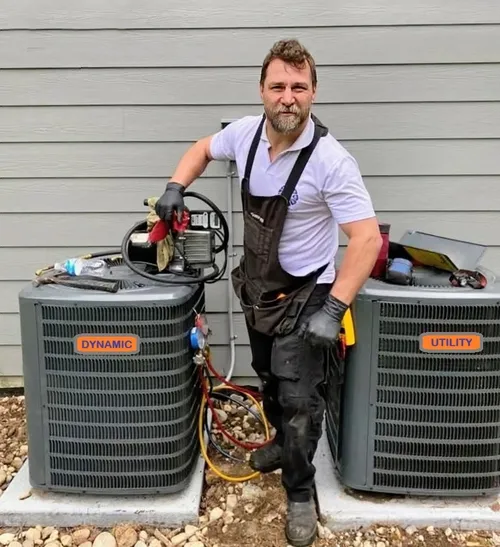
Dynamic Utility Services, Inc.
531 N 188th St, Shoreline, WA 98133
Dynamic Utility Services, Inc. is an HVAC contractor based in Seattle, WA, offering a wide range of heating and cooling services. They handle installation, repair, and maintenance of air conditioning, furnaces, heat pumps, boilers, mini split systems, geothermal heat pumps, and thermostats. The company also provides gas piping, sheet metal work, and fireplace services. Established in 2006, Dynamic Utility Services serves the greater Seattle area and offers 24-hour emergency services for urgent HVAC needs.
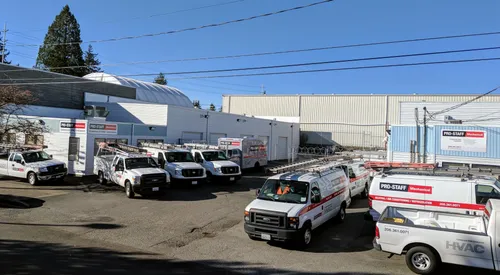
Pro-Staff Mechanical, Inc
902 N 127th St, Seattle, WA 98133
Pro-Staff Mechanical, Inc is a full-service commercial heating, air conditioning, and refrigeration contractor based in Seattle, WA. They offer a wide range of HVAC services including system design, installation, duct work fabrication, and indoor air quality solutions. Serving the Puget Sound area, Pro-Staff Mechanical provides 24-hour emergency service and customized preventive maintenance programs to support their commercial clients.
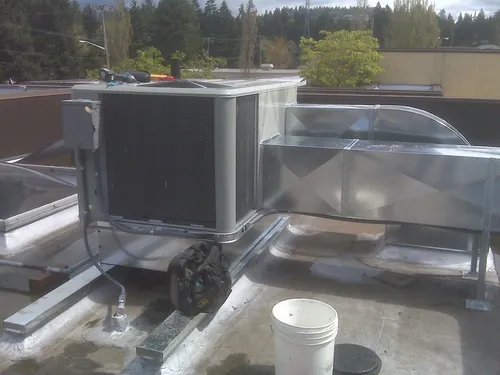
EarthHeat Geothermal, Heat Pumps and Radiant flooring
21002 Ricci Rd, Monroe, WA 98272
EarthHeat Geothermal, Heat Pumps and Radiant Flooring is a geothermal heat pump contractor based in Seattle, WA. They specialize in installing geothermal systems that use the earth's natural heat to provide sustainable heating and cooling solutions. Their services focus on eco-friendly energy options that deliver consistent comfort and energy efficiency.
How Geothermal Systems Work in Sammamish
The core principle of a ground-source heat pump is simple: it uses the earth as a constant temperature source for heat in the winter and a sink to deposit excess heat in the summer. Just a few feet below the surface, the ground in the Pacific Northwest maintains a remarkably stable temperature of approximately 50-60°F throughout the year. This consistency is the key to the system's efficiency.
Here's the local process:
- Ground Loops: A network of pipes, called a ground loop, is buried on your property. A water-based fluid circulates through these pipes, absorbing the earth's consistent thermal energy 1.
- Heat Exchange: In heating mode, the fluid, now warmed by the ground, travels to an indoor heat pump unit. The heat pump concentrates this low-grade heat and transfers it to your home's air or water distribution system. In cooling mode, the process reverses: the system extracts heat from your home and transfers it into the cooler ground loop fluid.
- Distribution: The conditioned air is then distributed through your existing ductwork or via a ductless mini-split system, providing comfortable heating or cooling 2.
This method of exchanging heat with the ground is far more efficient than conventional air-source heat pumps or furnaces that must work harder against fluctuating outdoor air temperatures.
Types of Ground Loop Systems for Your Property
The design of the underground loop field is critical and depends largely on your Sammamish property's characteristics. The two primary configurations are horizontal and vertical loops.
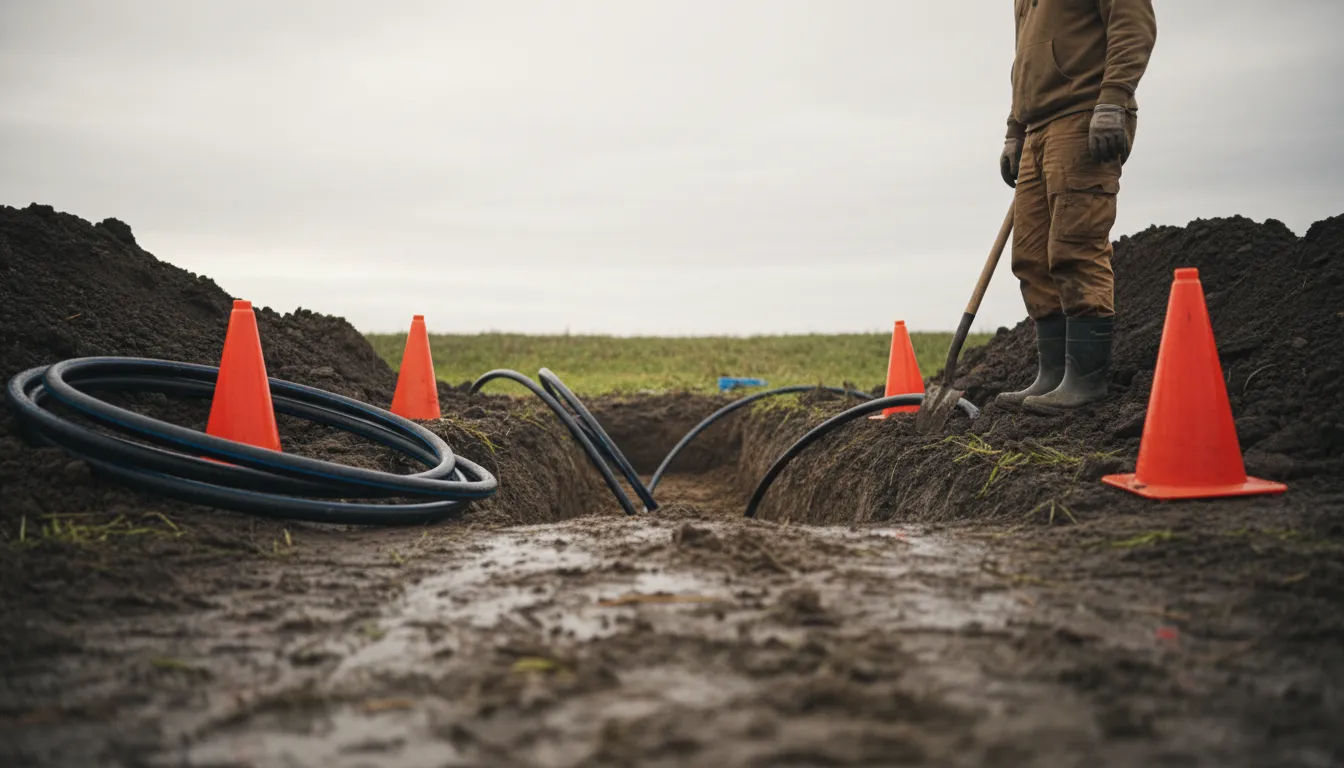
Horizontal Ground Loops This common installation involves digging trenches four to eight feet deep across a sizable area of your yard. Pipes are laid in these trenches in a slinky-coil or straight-run configuration before being backfilled. A horizontal system typically requires a larger, clear plot of land-often about a quarter of an acre for an average home. It's generally less expensive than vertical drilling if you have the space.
Vertical Ground Loops For properties with limited yard space, which is common in many Sammamish neighborhoods, vertical loops are the ideal solution. Contractors use a drilling rig to bore holes 200 to 500 feet deep. U-shaped pipe loops are inserted into each borehole, which are then grouted. This method minimizes landscape disruption and is excellent for achieving high efficiency, though it often involves more specialized equipment and permitting.
Choosing between trenching and drilling requires a professional site evaluation that considers soil composition, lot size, and local geology.
The Local Installation Process: What to Expect
Installing a geothermal heating and cooling system is a significant project that follows a clear, multi-stage process handled by experienced professionals.
- Site Assessment and Design: A certified installer will conduct a detailed survey of your property. This includes a soil thermal conductivity test, a calculation of your home's heating and cooling loads, and evaluation of space to determine the optimal loop type and size.
- Loop Field Installation: This is the major exterior work. For a horizontal system, trenches are excavated. For a vertical system, one or more deep boreholes are drilled. The high-density polyethylene piping is then installed, connected into a manifold, and pressure-tested.
- Indoor Unit Installation: The geothermal heat pump unit is installed inside your home, typically in a basement, utility room, or garage. It is connected to the ground loop manifold and to your home's electrical system and ductwork or hydronic distribution system 3.
- System Commissioning and Restoration: After the indoor and outdoor components are connected, the system is filled, purged, and started. The contractor will then backfill trenches or seal boreholes and restore your landscaping as much as possible 4.
Find the perfect geothermal heat pump contractors for your needs
Get personalized recommendations and expert advice
Key Considerations for Sammamish Homeowners
Several local factors influence the feasibility and design of a geothermal system in our area.
- Soil and Geology: The efficiency of the ground loop depends on the soil's ability to transfer heat. Washington's varied soil types and generally good moisture content can be favorable, but a professional analysis is essential 5 6.
- Property Space and Layout: The available land directly dictates whether a horizontal or vertical loop is possible. Smaller, wooded, or sloped lots often necessitate vertical drilling 7.
- Permits and Regulations: Installing a geothermal system, especially one involving deep drilling, requires specific permits from local authorities in Sammamish and King County. A reputable installer will manage this entire process 8 9.
Understanding Costs, Savings, and Payback
The upfront investment for a geothermal heat pump system is higher than for a conventional HVAC system, primarily due to the cost of drilling or trenching and installing the ground loop. However, the operational savings are substantial.
- Energy Bill Savings: By leveraging the earth's free thermal energy, geothermal systems operate with exceptional efficiency. Homeowners can typically expect to reduce their energy consumption for heating and cooling by 30% to 70% compared to standard air-source heat pumps or conventional systems 10 11 12. This translates to significantly lower monthly utility bills.
- Payback Period: The combination of dramatic energy savings, low maintenance costs, and available federal tax credits and local incentives often leads to a financial payback period of 5 to 10 years. After this point, the ongoing savings contribute directly to your household budget.
- Long-Term Value: Beyond utility savings, a geothermal system increases property value, offers unparalleled quiet operation, and has a long lifespan (often 20+ years for the heat pump and 50+ years for the ground loop).
Environmental Impact and Comfort Benefits
Choosing a ground-source system is one of the most effective decisions a homeowner can make for reducing their carbon footprint. By using electricity primarily to move heat rather than create it, and by drawing on renewable thermal energy from the ground, these systems drastically cut greenhouse gas emissions associated with home comfort 13.
Comfort is also enhanced. Geothermal systems provide consistent, even heating without the cold blasts of air common with furnaces. In summer, they deliver cool, dehumidified air more effectively than standard air conditioners 14 15. The elimination of an outdoor condenser unit also means quieter operation and no exterior hardware susceptible to weather or theft.
Finding the Right Local Professional
Success with geothermal technology hinges on proper design and installation. Look for contractors with specific certification from organizations like the International Ground Source Heat Pump Association (IGSHPA). They should conduct a comprehensive Manual J load calculation for your home and provide a detailed proposal outlining the loop design, equipment specifications, and projected performance. Always ask for references from local installations and verify licensing and insurance.
Frequently asked questions
Sources
Footnotes
-
How Geothermal Heat Pumps Work - https://www.youtube.com/watch?v=XxlTnBukweI&t=37 ↩
-
How a Geothermal Heat Pump Works | This Old House - https://www.youtube.com/watch?v=d5Tbsx3R2T8 ↩
-
Geothermal Heat Pumps | WBDG - https://www.wbdg.org/resources/geothermal-heat-pumps ↩
-
Ground Source Heat Pump Installation - Process & Costs - https://iheat.co.uk/heat-pump-help/ground-source-heat-pump-installation ↩
-
Geothermal Heating, Cooling, and Hot Water Systems - https://igshpa.org/wp-content/uploads/Homeowners-Guide-to-Geothermal.pdf ↩
-
Geothermal heat pumps: The ultimate guide to ground-source ... - https://termo-plus.com/blog/geothermal-ultimate-guide-to-ground-source-heat-pumps/ ↩
-
How Does A Geothermal Heat Pump Work? Complete 2025 ... - https://solartechonline.com/blog/how-does-geothermal-heat-pump-work/ ↩
-
Geothermal Heat Pump Installation: What To Expect For Your ... - https://jomory.com/geothermal-heat-pump-installation-what-to-expect-for-your-property/ ↩
-
Geothermal Heat Pumps, Explained - Bosch Home Comfort - https://www.bosch-homecomfort.com/us/en/residential/connect/blog/geothermal-heat-pumps-go-green-save-green/ ↩
-
About Geothermal - https://igshpa.org/about-geothermal/ ↩
-
Geothermal HVAC Systems: Harnessing the Earth for ... - https://www.iccsafe.org/building-safety-journal/bsj-technical/geothermal-hvac-systems-harnessing-the-earth-for-sustainable-comfort/ ↩
-
Geothermal Heat Pumps - Department of Energy - https://www.energy.gov/energysaver/geothermal-heat-pumps ↩
-
Ground-source pump system for heating and cooling - https://www.sciencedirect.com/science/article/abs/pii/S1364032116310504 ↩
-
All You Need to Know About Home Geothermal Heating & Cooling - Dandelion Energy - https://dandelionenergy.com/all-you-need-to-know-about-home-geothermal-heating-cooling ↩
-
Geothermal Basics | Kliemann Brothers | Tacoma, WA - https://kliemannbros.com/geothermal-basics/ ↩