Find the Best Geothermal Heat Pump Contractors for Your Business
No obligation • Fast responses • Nationwide coverage

Why you can trust HVAC Firms
HVAC Firms is a leading United States resource for evaluating HVAC service providers. Our team researches companies, checks credentials, and reviews customer feedback to present clear, unbiased information. Listings and rankings are based on merit, and companies cannot pay to change our editorial content.
Search providers near you
Top Geothermal Heat Pump Contractors in Everett, Washington Ranked
Geothermal heat pumps, also known as ground-source heat pumps (GSHPs), are a highly efficient method for heating and cooling your home by exchanging heat with the stable temperature of the earth. For Everett residents, this technology offers a path to significant energy savings, enhanced comfort, and reduced environmental impact. This guide explains how geothermal systems work, what installation entails, and how you can connect with qualified local experts to explore this sustainable option for your property.
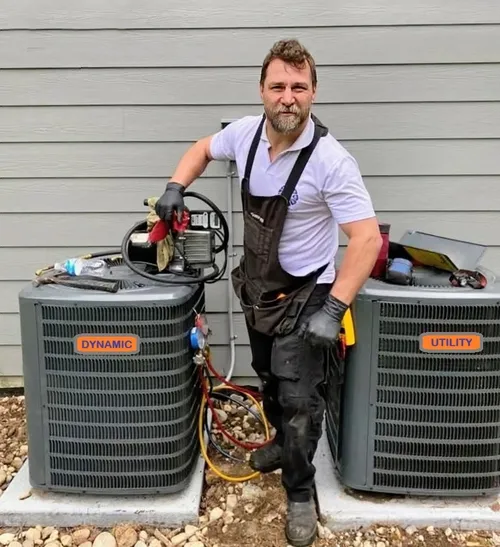
Dynamic Utility Services, Inc.
531 N 188th St, Shoreline, WA 98133
Dynamic Utility Services, Inc. is an HVAC contractor based in Seattle, WA, offering a wide range of heating and cooling services. They handle installation, repair, and maintenance of air conditioning, furnaces, heat pumps, boilers, mini split systems, geothermal heat pumps, and thermostats. The company also provides gas piping, sheet metal work, and fireplace services. Established in 2006, Dynamic Utility Services serves the greater Seattle area and offers 24-hour emergency services for urgent HVAC needs.
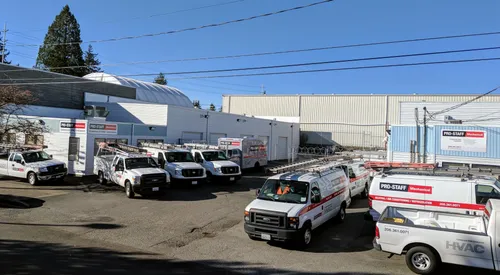
Pro-Staff Mechanical, Inc
902 N 127th St, Seattle, WA 98133
Pro-Staff Mechanical, Inc is a full-service commercial heating, air conditioning, and refrigeration contractor based in Seattle, WA. They offer a wide range of HVAC services including system design, installation, duct work fabrication, and indoor air quality solutions. Serving the Puget Sound area, Pro-Staff Mechanical provides 24-hour emergency service and customized preventive maintenance programs to support their commercial clients.
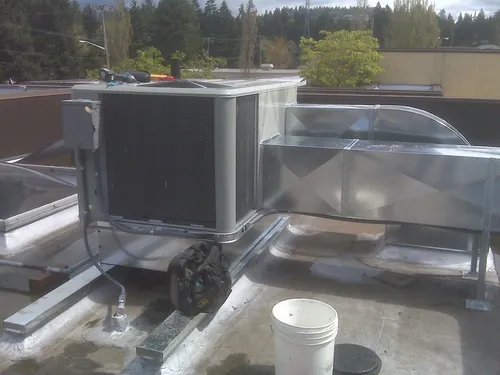
EarthHeat Geothermal, Heat Pumps and Radiant flooring
21002 Ricci Rd, Monroe, WA 98272
EarthHeat Geothermal, Heat Pumps and Radiant Flooring is a geothermal heat pump contractor based in Seattle, WA. They specialize in installing geothermal systems that use the earth's natural heat to provide sustainable heating and cooling solutions. Their services focus on eco-friendly energy options that deliver consistent comfort and energy efficiency.
How Geothermal Heating and Cooling Works
Unlike traditional air-source heat pumps that battle the frigid winter air or sweltering summer heat, a geothermal system uses the earth as a heat source and sink. Just a few feet below the surface, the ground maintains a relatively constant temperature year-round, typically between 45°F and 55°F in Massachusetts. A geothermal heat pump leverages this consistency for remarkable efficiency.
The core of the system is a network of buried pipes, called a ground loop, filled with a water-based fluid. In the winter, this fluid circulates through the loop, absorbing the earth's natural warmth. It then travels to the indoor heat pump unit, where the heat is concentrated and distributed throughout your home via your existing ductwork or radiant floor system. In the summer, the process simply reverses: the system extracts heat from your home and transfers it into the cooler ground, providing air conditioning. This elegant exchange with the stable ground, rather than the volatile outside air, is the secret to the system's superior performance and energy savings.
Types of Ground Loop Systems
The underground loop is the heart of a geothermal installation. There are two primary types of closed-loop systems, and the right choice for your Everett home depends largely on your property's characteristics.
Vertical Closed-Loop Systems This is the most common configuration for homes in Everett and across Massachusetts, particularly where yard space is limited. A vertical loop involves drilling several boreholes, typically 150 to 400 feet deep and about 20 feet apart 1. U-shaped pipes are inserted into each borehole, which are then backfilled with a special grout. This design minimizes surface disruption and is ideal for smaller urban and suburban lots, making it a frequent choice for local installations.
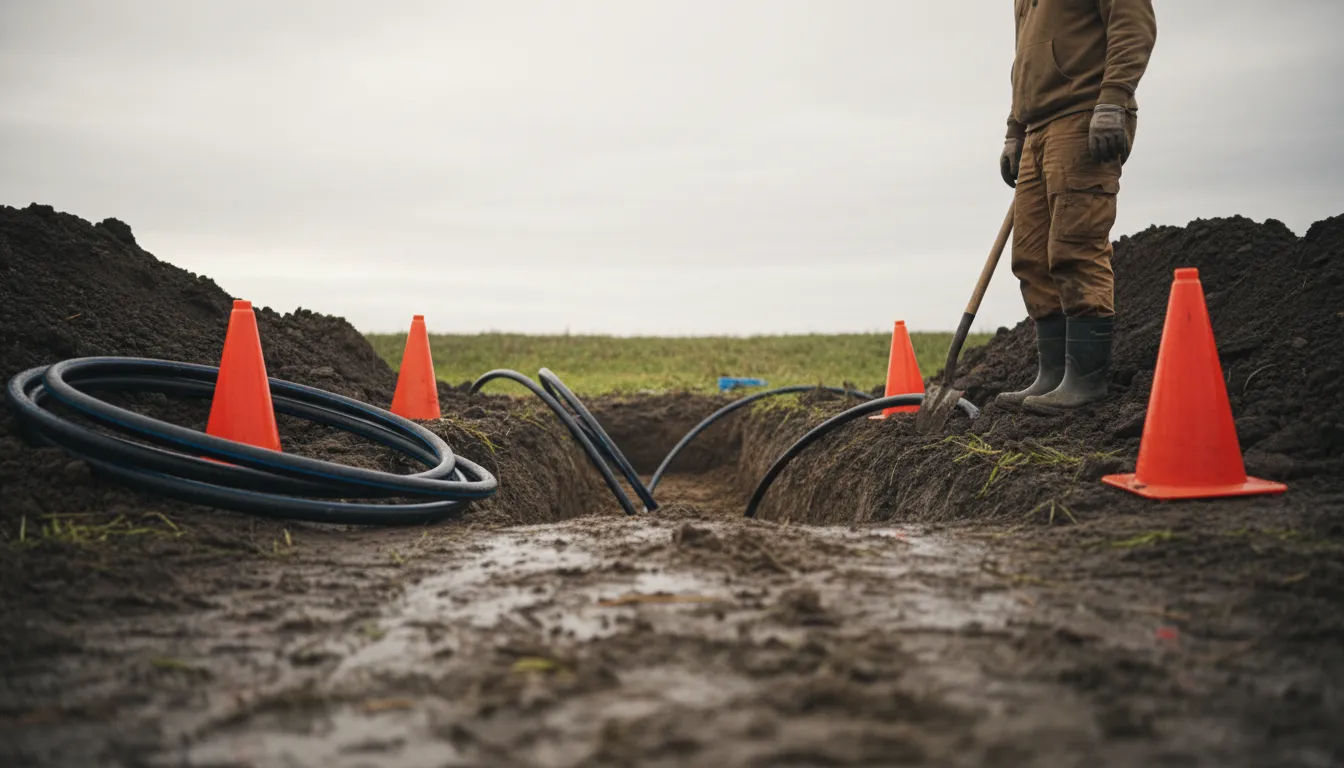
Horizontal Closed-Loop Systems If your property has ample land, a horizontal loop can be a cost-effective alternative. This method requires trenching in long, straight runs or coiled "slinky" patterns in trenches about four to six feet deep 2 3. A horizontal system generally requires more land area-often between a quarter to three-quarters of an acre-but can avoid the cost of deep drilling 4 5. A professional site assessment is crucial to determine which loop type is feasible and optimal for your specific location.
The Geothermal Installation Process in Everett
Installing a ground-source heat pump is a significant project that requires careful planning and expert execution. Understanding the steps can help you prepare.
-
Comprehensive Site Assessment: A qualified installer will first evaluate your property. They will assess soil composition, rock content, available space, and your home's existing heating/cooling distribution system (ductwork or hydronic). This assessment determines the best loop type (vertical or horizontal) and designs the system to meet your home's specific heating and cooling loads.
-
Ground Loop Installation: This is the major excavation phase. For a vertical system, a drilling rig will create the necessary boreholes. For a horizontal system, a backhoe will dig the required trenches. The high-density polyethylene pipe is then placed and connected into a continuous loop 6.
-
Indoor Unit Setup: The geothermal heat pump unit itself is installed inside your home, typically in a basement, utility room, or garage. This unit is comparable in size to a traditional furnace. Your installer will connect it to your home's existing ductwork or radiant heating system 7.
-
System Connection and Commissioning: The underground loop is connected to the indoor heat pump. The entire system is filled with fluid, purged of air, and pressurized. Finally, the system is started, tested, and balanced to ensure it operates at peak efficiency 8.
Find the perfect geothermal heat pump contractors for your needs
Get personalized recommendations and expert advice
Benefits and Long-Term Value for Homeowners
The decision to invest in a geothermal system is driven by its compelling long-term advantages, which are particularly strong in Massachusetts.
- Substantial Energy Savings: By tapping into the earth's consistent temperature, geothermal heat pumps operate with exceptional efficiency. They can reduce energy consumption for heating and cooling by up to 65% compared to conventional systems, leading to dramatically lower utility bills 9.
- Powerful Financial Incentives: The upfront cost is offset by some of the most attractive incentives in the country. The Mass Save® program offers generous rebates for geothermal installations. Additionally, homeowners can take advantage of the federal Residential Clean Energy Tax Credit, which covers 30% of the total system cost, including installation 10 11. These incentives significantly shorten the payback period.
- Quiet, Reliable, and Low-Maintenance: With no noisy outdoor condenser unit, geothermal systems operate very quietly. The underground loop is designed to last for decades, and the indoor heat pump components are protected from the weather, leading to reliable performance and a long system life with relatively minimal maintenance 12 13.
- Environmental Sustainability: By drastically reducing fossil fuel consumption or electricity draw from the grid, a geothermal system lowers your home's carbon footprint. It provides clean, renewable heating and cooling directly from the earth 14.
Is Geothermal Right for Your Home?
Geothermal technology is a superb fit for many Everett properties. It is an especially wise consideration if you are building a new home, replacing an aging or inefficient HVAC system, or are committed to maximizing energy independence and sustainability. The combination of high efficiency, strong state and federal financial support, and long-term operating savings makes ground-source heat pumps a financially and environmentally sound investment for the future.
Frequently asked questions
Sources
Footnotes
-
Geothermal/Hybrid Heating | HVAC Services Boston MA - https://bostonuniqueindoorcomfort.com/products/geothermalhybrid-heating/ ↩
-
Geothermal Heat Pumps - Department of Energy - https://www.energy.gov/energysaver/geothermal-heat-pumps ↩
-
How Does A Geothermal Heat Pump Work? Complete 2025 Guide - https://solartechonline.com/blog/how-does-geothermal-heat-pump-work/ ↩
-
Ground-Source Heat Pumps - Abode Energy Management - https://abodeenergy.com/wp-content/uploads/2022/07/MassCEC_GSHP_GUIDE.pdf ↩
-
Geothermal Heat Pump Installation: What To Expect For Your Property - https://jomory.com/geothermal-heat-pump-installation-what-to-expect-for-your-property/ ↩
-
Geothermal Ground-Source Heat Pump | Mass.gov - https://www.mass.gov/doc/about-geothermal-heat-pumps-handout/download ↩
-
How Geothermal Heat Pumps Work - https://www.youtube.com/watch?v=XxlTnBukweI&t=37 ↩
-
All You Need to Know About Home Geothermal Heating & ... - https://dandelionenergy.com/all-you-need-to-know-about-home-geothermal-heating-cooling ↩
-
5 Things You Should Know about Geothermal Heat Pumps - https://www.energy.gov/cmei/articles/5-things-you-should-know-about-geothermal-heat-pumps ↩
-
Understanding Geothermal System Costs: What Massachusetts Homeowners Should Know - https://energysmartalternatives.com/understanding-geothermal-system-costs-what-massachusetts-homeowners-should-know/ ↩
-
Geothermal Pilot Reference Guide - Eversource - https://www.eversource.com/residential/save-money-energy/clean-energy-options/geothermal-energy/geothermal-pilot-reference-guide ↩
-
Geothermal 101: How Geothermal Heating and Cooling Works - https://energysmartalternatives.com/geothermal-101/ ↩
-
Guide to Geothermal Heat Pumps - https://www.energy.gov/sites/prod/files/guide_to_geothermal_heat_pumps.pdf ↩
-
Ground-Source Heat Pumps - Massachusetts Clean Energy ... - https://goclean.masscec.com/clean-energy-solutions/ground-source-heat-pumps/ ↩