Find the Best Geothermal Heat Pump Contractors for Your Business
No obligation • Fast responses • Nationwide coverage

Why you can trust HVAC Firms
HVAC Firms is a leading United States resource for evaluating HVAC service providers. Our team researches companies, checks credentials, and reviews customer feedback to present clear, unbiased information. Listings and rankings are based on merit, and companies cannot pay to change our editorial content.
Search providers near you
Top Geothermal Heat Pump Contractors in Bremerton, Washington Ranked
Geothermal heat pumps, also known as ground-source heat pumps, are a highly efficient method for heating and cooling your home by leveraging the stable temperatures found underground. For Bremerton residents, this technology offers a reliable way to manage indoor climate year-round while significantly reducing energy consumption and utility bills. This resource connects you with the information needed to understand how these systems work, the installation options available locally, and how to find qualified specialists for your project.
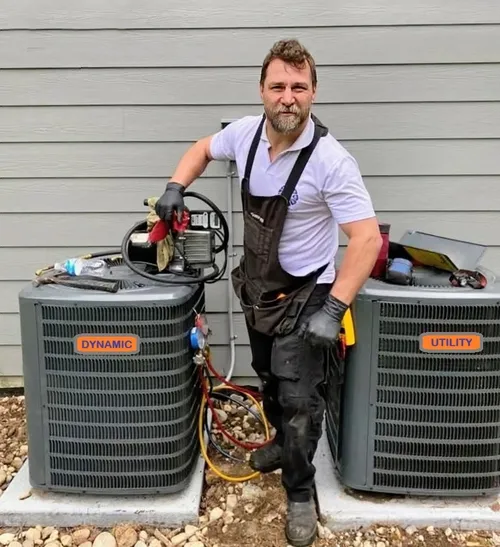
Dynamic Utility Services, Inc.
531 N 188th St, Shoreline, WA 98133
Dynamic Utility Services, Inc. is an HVAC contractor based in Seattle, WA, offering a wide range of heating and cooling services. They handle installation, repair, and maintenance of air conditioning, furnaces, heat pumps, boilers, mini split systems, geothermal heat pumps, and thermostats. The company also provides gas piping, sheet metal work, and fireplace services. Established in 2006, Dynamic Utility Services serves the greater Seattle area and offers 24-hour emergency services for urgent HVAC needs.
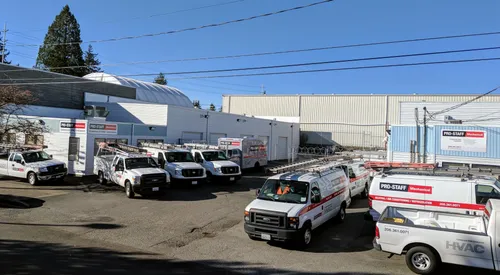
Pro-Staff Mechanical, Inc
902 N 127th St, Seattle, WA 98133
Pro-Staff Mechanical, Inc is a full-service commercial heating, air conditioning, and refrigeration contractor based in Seattle, WA. They offer a wide range of HVAC services including system design, installation, duct work fabrication, and indoor air quality solutions. Serving the Puget Sound area, Pro-Staff Mechanical provides 24-hour emergency service and customized preventive maintenance programs to support their commercial clients.
How Geothermal Systems Work in the Pacific Northwest
The core principle behind a geothermal heating and cooling system is simple: it exchanges heat with the earth, which maintains a remarkably stable temperature just below the surface. Unlike the air temperature in Bremerton, which can swing from chilly, damp winters to mild summers, the ground about 10 feet down remains a consistent 50-60°F throughout the year 1. A geothermal system uses this temperature difference to your advantage.
The process involves three key components:
- The Ground Loop: A network of durable, high-density polyethylene pipes is buried in your yard. A water-based fluid circulates through this closed loop.
- The Heat Pump: This indoor unit acts like a reversible refrigerator. In winter, it concentrates the low-grade heat collected from the fluid in the ground loop and transfers it to your home's ductwork for distribution. In summer, the process reverses: it removes heat from your home and transfers it into the cooler ground loop fluid, effectively providing air conditioning2.
- The Distribution System: The conditioned air is delivered throughout your home via your existing forced-air ductwork or a compatible alternative.
This method of heat exchange is what makes ground-source heat pumps so efficient, often achieving 400-600% efficiency because they move heat rather than generate it through combustion.
Choosing Your Ground Loop Configuration in Bremerton
The design of the underground piping, or loop field, is a critical decision that depends on your property's characteristics. Bremerton's varied lot sizes, from spacious rural properties to more compact urban yards, mean different loop types are suitable for different homes.
Horizontal Closed Loops
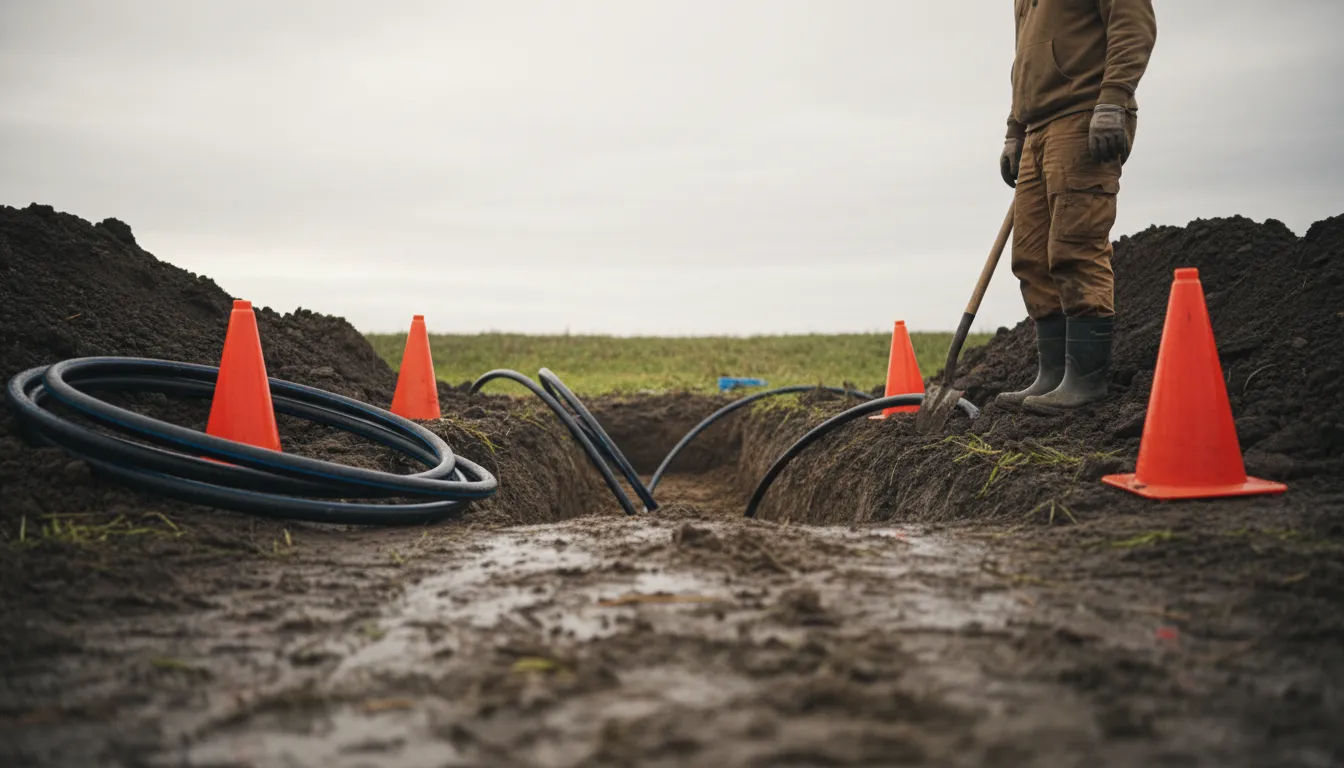
This is often the most cost-effective installation method if space allows. Contractors excavate long, shallow trenches-typically 4 to 6 feet deep-and lay the piping loops horizontally within them 3. This approach requires a significant amount of open land but generally involves lower excavation costs compared to drilling. It's a popular choice for new construction projects or homes with ample yard space.
Vertical Closed Loops
For homes in Bremerton with smaller lots, mature landscaping, or rocky soil, vertical loops are the ideal solution. Specialized drilling equipment bores holes 150 to 450 feet deep 4. U-shaped loop pipes are inserted into each borehole, which are then grouted. While the drilling process is more expensive upfront, it minimizes surface disturbance and requires the least amount of land, making it perfect for established residential areas.
Pond/Lake Loops (If Available)
If your property has access to a sufficiently large and deep pond or lake, this can be an excellent option. Coils of piping are submerged at the bottom of the water body, which acts as a heat source and sink5. This method typically has the lowest installation cost if the water source is suitable and accessible, but it requires a specific set of geographic conditions.
Find the perfect geothermal heat pump contractors for your needs
Get personalized recommendations and expert advice
The Installation Process for a Ground-Source Heat Pump
Installing a geothermal system is a significant project that requires professional expertise. Understanding the steps involved can help you prepare for the process.
- Site Evaluation and Design: A certified geothermal contractor will assess your property, evaluate soil conditions, and calculate your home's heating and cooling loads. This information is used to design the most effective and efficient loop system for your specific situation.
- Excavation or Drilling: For horizontal loops, trenching equipment will dig the necessary network of trenches. For vertical systems, a drill rig will be brought in to create the boreholes. This is typically the most visually disruptive phase of the project6.
- Loop Installation: The durable piping is placed in the trenches or boreholes. All sections are thermally fused together to create a continuous, leak-proof loop. The loop is then pressure-tested and filled with the heat-transfer fluid7.
- Indoor Unit Installation: The geothermal heat pump unit is installed inside your home, usually in place of a traditional furnace. It is connected to your home's electrical system, ductwork, and the ground loop pipes that enter the foundation8.
- System Charging and Startup: The system is charged with refrigerant, and all connections are finalized. The contractor will start the system, check its operation, and balance the airflow in your ducts.
- Backfill and Restoration: The trenches are carefully backfilled, and the yard is restored as closely as possible to its original condition. For vertical systems, the small borehole caps are the only visible signs of the loop field.
Cost, Savings, and Value Considerations
The decision to invest in a geothermal system involves weighing higher initial costs against substantial long-term benefits.
Installation Costs: In Bremerton, a complete geothermal heat pump system for a typical single-family home generally ranges from $20,000 to over $50,0009 10. The final price is highly dependent on the loop type (vertical drilling is more expensive than horizontal trenching), the size and efficiency of the heat pump unit, and the specific characteristics of your property and home.
Operational Savings and Payback: This is where geothermal systems shine. By leveraging the earth's stable temperature, they can reduce energy consumption for heating, cooling, and even hot water production by up to 70% compared to conventional systems like furnaces and standard air conditioners11 12. For many homeowners, these dramatic reductions in monthly utility bills lead to a payback period on the investment within 5 to 10 years13 12. Over the system's exceptionally long lifespan of 25 to 50 years, the cumulative savings can be very significant.
Added Home Value: A geothermal system is considered a permanent upgrade to your property. It often increases resale value, as prospective buyers appreciate the promise of low energy bills, superior comfort, and the system's environmental benefits.
Why Geothermal is a Smart Choice for Bremerton
Bremerton's climate is well-suited for geothermal technology. The moderate ground temperatures provide an excellent heat source in winter and an efficient heat sink in summer, allowing the system to operate at peak efficiency year-round. By choosing a ground-source system, you're investing in decades of reliable comfort, protection from fluctuating fuel prices, and a reduced carbon footprint for your household.
Frequently asked questions
Sources
Footnotes
-
Geothermal heat pumps - U.S. Energy Information Administration - https://www.eia.gov/energyexplained/geothermal/geothermal-heat-pumps.php ↩
-
How a Geothermal Heat Pump Works | This Old House - https://www.youtube.com/watch?v=d5Tbsx3R2T8 ↩
-
Geothermal heat pumps: The ultimate guide to ground-source ... - https://termo-plus.com/blog/geothermal-ultimate-guide-to-ground-source-heat-pumps/ ↩
-
Geothermal heating & cooling, heat pumps, heat exchange ... - https://aztechgeo.com/residential-geothermal/how-it-works/ ↩
-
Geothermal Heating, Cooling, and Hot Water Systems - https://igshpa.org/wp-content/uploads/Homeowners-Guide-to-Geothermal.pdf ↩
-
All You Need to Know About Home Geothermal Heating & ... - https://dandelionenergy.com/all-you-need-to-know-about-home-geothermal-heating-cooling ↩
-
How Geothermal Heat Pumps Work - https://www.youtube.com/watch?v=XxlTnBukweI&t=37 ↩
-
Geothermal Heat Pumps | WBDG - https://www.wbdg.org/resources/geothermal-heat-pumps ↩
-
How Does A Geothermal Heat Pump Work? Complete 2025 Guide - https://solartechonline.com/blog/how-does-geothermal-heat-pump-work/ ↩
-
Geothermal Heat Pump Guide: Installation Costs, Types And Benefits - https://modernize.com/hvac/heating-repair-installation/heat-pump/geothermal ↩
-
How Does a Geothermal System Work? - ClimateMaster - https://www.climatemaster.com/homeowner/side-links/how-it-works ↩
-
Geothermal Heat Pumps - Department of Energy - https://www.energy.gov/energysaver/geothermal-heat-pumps ↩ ↩2
-
Geothermal Basics | Kliemann Brothers | Tacoma, WA - https://kliemannbros.com/geothermal-basics/ ↩