Find the Best Geothermal Heat Pump Contractors for Your Business
No obligation • Fast responses • Nationwide coverage

Why you can trust HVAC Firms
HVAC Firms is a leading United States resource for evaluating HVAC service providers. Our team researches companies, checks credentials, and reviews customer feedback to present clear, unbiased information. Listings and rankings are based on merit, and companies cannot pay to change our editorial content.
Search providers near you
Top Geothermal Heat Pump Contractors in Reading, Pennsylvania Ranked
Geothermal heat pumps are a highly efficient method for heating and cooling your Reading home by leveraging the Earth's stable underground temperature. This technology matters because it can dramatically reduce your energy bills and environmental footprint while providing reliable comfort year-round. If you're exploring this option, you can use this resource to understand the local considerations, system types, and benefits to help you connect with qualified installation experts in the Berks County area.
How Geothermal Systems Work in Reading's Climate
The principle behind a ground-source heat pump is elegantly simple. Just a few feet below the surface, the Earth in Pennsylvania maintains a remarkably stable temperature, typically between 40°F and 80°F, regardless of the summer heat or winter chill above ground. A geothermal system uses this constant temperature as a renewable energy source.
During the winter, a fluid circulating through a loop of pipes buried in your yard absorbs the ground's warmth. This warmed fluid is brought to a heat pump unit inside your home, where the heat is extracted and transferred to your air distribution system 1. In the summer, the process reverses: the system pulls heat from your home's air and deposits it into the cooler ground, effectively providing air conditioning 2. This exchange with the stable earth, rather than the highly variable outside air, is what makes geothermal technology so efficient.
Types of Ground Loop Systems for Your Property
The underground pipe network, or ground loop, is the critical link to the Earth's energy. The right type for your Reading property depends on your land's size, soil composition, and layout. The most common setups are closed-loop systems, which continuously circulate a water-based solution through sealed, high-density polyethylene pipes.
- Vertical Loops: Ideal for smaller residential lots common in many Reading neighborhoods, vertical systems involve drilling boreholes 150 to 400 feet deep 3. U-shaped pipes are inserted into each hole, which are then grouted. This method disturbs very little of your yard but typically involves higher drilling costs.
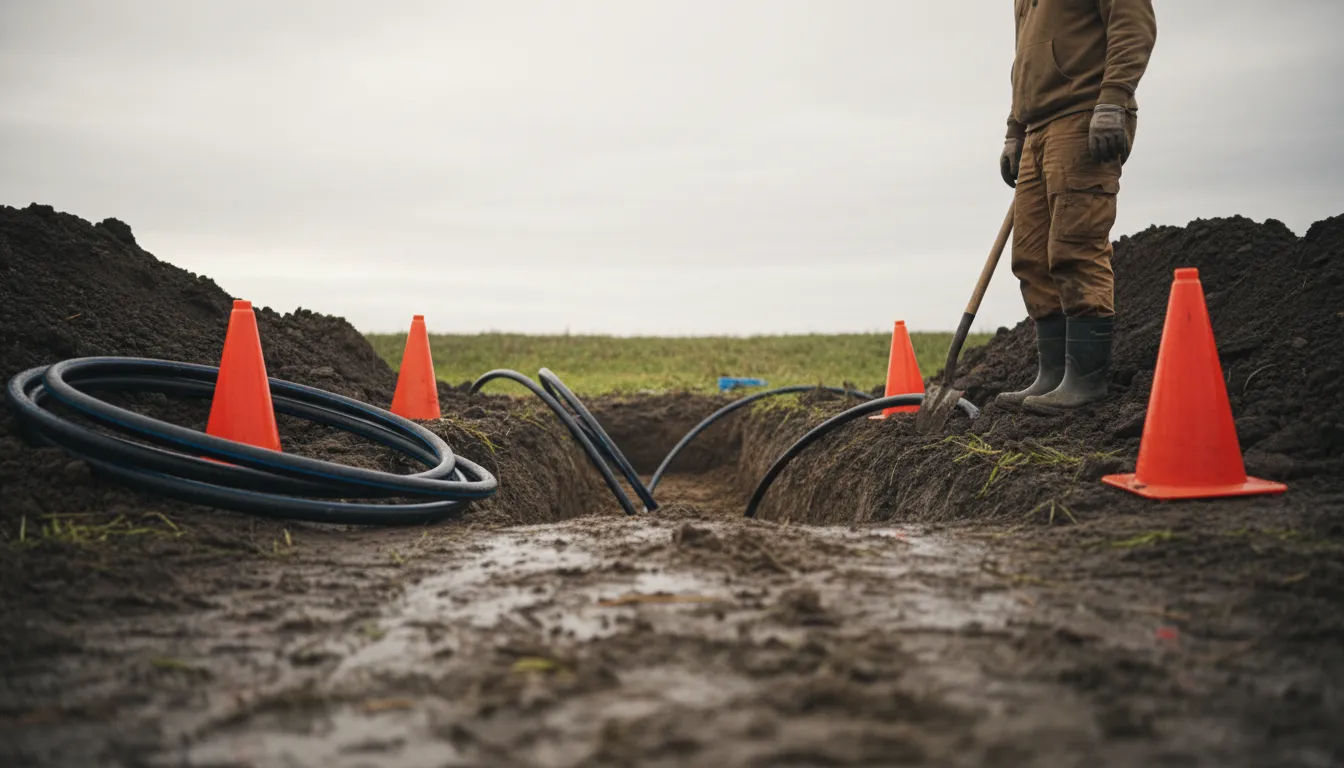
- Horizontal Loops: If you have more available land, a horizontal loop may be a cost-effective choice. Trenches are dug about six feet deep, and pipes are laid in a series of parallel runs 4 5. This requires more square footage of open land but generally has a lower installation cost than vertical drilling.
- Pond/Lake Loops: For properties with a suitable, year-round water body, this can be the most economical option. Coils of pipe are submerged at a depth where water temperatures remain stable, using the pond or lake as a heat source and sink.
- Open-Loop Systems: This system uses groundwater directly from a well. Water is pumped through the heat pump and then discharged back into a second well or a suitable surface discharge point 6. While very efficient, it requires an adequate supply of clean water and compliance with local codes regarding water use and discharge.
The Installation Process: Drilling, Trenching, and Connection
Professional installation of a geothermal system is a multi-stage process that ensures optimal performance and longevity. It begins with a detailed site evaluation to determine the best loop type and size for your home's heating and cooling loads.
For vertical systems, a drilling rig will create the necessary boreholes. For horizontal systems, a backhoe or trencher will excavate the required trenches. Once the loop field is installed and pressure-tested, the trenches or boreholes are backfilled. The next step is to connect the underground loops to the indoor heat pump unit. Finally, the system is integrated with your home's existing ductwork or hydronic distribution system, filled with fluid, and thoroughly tested for efficiency and operation 7.
Find the perfect geothermal heat pump contractors for your needs
Get personalized recommendations and expert advice
The Compelling Benefits for Reading Homeowners
The decision to install a geothermal system is an investment that pays dividends for decades. The most significant advantage is substantial energy savings. By moving heat rather than creating it through combustion, ground-source heat pumps operate with exceptional efficiency, often rated between 300% and 600% 8 9. This can translate to a reduction of 40% to 70% on your heating and cooling bills compared to conventional systems 10 11. For an average home, annual savings can easily exceed $1,000 12 11.
Beyond the monthly utility bill, these systems offer remarkable durability. The underground loop piping often comes with warranties of 25 to 50 years and can last generations, while the indoor heat pump unit typically lasts 20 years or more. Geothermal systems also provide superior comfort with steady, even temperatures and quieter operation, as there is no noisy outdoor condenser unit. Furthermore, by reducing your reliance on fossil fuels, you significantly lower your household's carbon footprint.
Understanding Costs and Long-Term Value
It's important to acknowledge that the initial installation cost for a geothermal heat pump system is higher than that of a standard air-source heat pump or furnace. This premium is primarily due to the ground loop installation, which involves specialized drilling or excavation equipment. However, this upfront cost must be weighed against the lifecycle cost.
The dramatic reduction in operating expenses means the system often pays for itself through energy savings over time. Additionally, homeowners may qualify for federal tax credits and other local incentives that can offset a significant portion of the installation cost, improving the return on investment. When viewed as a long-term home improvement, the combination of energy independence, low maintenance, increased property value, and decades of lower bills makes geothermal a financially sound choice for many in Reading.
Is Your Reading Home a Good Candidate?
Several factors determine if a geothermal system is a good fit. Adequate land is the primary consideration for horizontal loops, while vertical loops can be installed on surprisingly small lots. Soil and rock conditions can affect drilling feasibility and cost. The existing condition of your home's ductwork or radiant heating system is also a factor, as it may need evaluation or upgrades. An experienced local installer can conduct a comprehensive assessment of your property and home to provide a clear recommendation and an accurate estimate of both costs and projected savings.
Frequently asked questions
Sources
Footnotes
-
Geothermal - Montgomery County - https://www.montgomerycountypa.gov/DocumentCenter/View/5052/Renewable-Energy_Geothermal?bidId= ↩
-
Ground Source (Geothermal) Heat Pumps | EGEE 102 ... - https://courses.ems.psu.edu/egee102/node/2091 ↩
-
Ground-Source Heat Pumps - Building America Solution Center - https://basc.pnnl.gov/resource-guides/ground-source-heat-pumps ↩
-
Geothermal Basics | Harrisburg, PA | Heat Pump, HVAC, Cost - https://hlbowman.com/geothermal-basics/ ↩
-
Geothermal Heat Pumps - Department of Energy - https://www.energy.gov/energysaver/geothermal-heat-pumps ↩
-
Geothermal Technology: Sustainable Heating & Cooling in ... - https://midatlanticgeothermal.com/how-geothermal-works/ ↩
-
Heating Up Efficiency: Exploring Heat Pump Options in PA - https://www.youtube.com/watch?v=bz-6Okr9_wU ↩
-
How Does a Geothermal System Work? - ClimateMaster - https://www.climatemaster.com/homeowner/side-links/how-it-works ↩
-
Guide to Geothermal Heat Pumps - https://www.energy.gov/sites/prod/files/guide_to_geothermal_heat_pumps.pdf ↩
-
How Does A Geothermal Heat Pump Work? Complete 2025 Guide - https://solartechonline.com/blog/how-does-geothermal-heat-pump-work/ ↩
-
How to Save 70% on Energy Bills: A Homeowner's Guide to Geothermal Benefits - https://meltek.com/buzz-blogs/how-to-save-70-on-energy-bills-a-homeowners-guide-to-geothermal-benefits ↩ ↩2
-
Addressing Common Misconceptions about Ground Coil Systems - Quality Heating & Cooling - https://qualityheating.com/misconceptions-about-ground-coil-systems/ ↩