Find the Best Geothermal Heat Pump Contractors for Your Business
No obligation • Fast responses • Nationwide coverage

Why you can trust HVAC Firms
HVAC Firms is a leading United States resource for evaluating HVAC service providers. Our team researches companies, checks credentials, and reviews customer feedback to present clear, unbiased information. Listings and rankings are based on merit, and companies cannot pay to change our editorial content.
Search providers near you
Top Geothermal Heat Pump Contractors in Moore, Oklahoma Ranked
A geothermal heat pump is a highly efficient heating and cooling system that leverages the Earth's stable underground temperature. For homeowners in Moore, this technology offers a reliable way to manage Oklahoma's climate while significantly reducing energy consumption and utility costs. This guide explains how these ground-source systems work, what installation entails, and how you can find qualified local professionals to assess your property and provide a tailored solution.
Ingram Mechanical
325 Koloa Ave, Edmond, OK 73034
Ingram Mechanical is an HVAC company serving Oklahoma City, OK, offering a wide range of heating and cooling services. Their expertise includes installation, repair, and maintenance of air conditioners, furnaces, heat pumps, mini splits, and geothermal heat pumps. They also provide tankless water heater services and preventative HVAC maintenance. The company emphasizes doing the job right the first time and uses state-of-the-art diagnostic equipment to efficiently address HVAC issues. Ingram Mechanical has built a reputation for quality service and customer care through years of industry experience.
Hodge Heat and Air LLC
11200 Ashford Dr, Yukon, OK 73099
Hodge Heat and Air LLC provides residential HVAC services in Oklahoma City, OK. They specialize in the installation, repair, and maintenance of air conditioners, furnaces, heat pumps, boilers, mini splits, and geothermal heat pumps. The company offers HVAC tune-up services and is available around the clock to address heating and cooling needs. Their team consists of qualified professionals focused on delivering reliable HVAC solutions for home comfort.
Smart Air Solutions, LLC
10 NE 10th St Suite 209, Oklahoma City, OK 73104
Smart Air Solutions, LLC is an HVAC company serving Oklahoma City, OK, specializing in heating and air conditioning repair, installation, and maintenance. Their services cover air conditioners, furnaces, heat pumps, boilers, mini splits, and geothermal heat pumps. The company provides comprehensive system evaluations and customized solutions to fit different needs and budgets. They also offer preventative maintenance plans to help extend the life of HVAC systems. Smart Air Solutions emphasizes clear communication with customers throughout the service process to ensure transparency and satisfaction.

Infinite Air Solution llc
Oklahoma City, OK
Infinite Air Solution llc is an HVAC contractor based in Oklahoma City, OK, serving residential and commercial clients in Oklahoma City and nearby areas including Norman, Edmond, and Moore. They provide a range of services such as HVAC installation, repair, and maintenance for systems including air conditioners, furnaces, heat pumps, mini splits, and geothermal heat pumps. The company offers 24/7 emergency HVAC repair and specializes in installing ClimateMaster geothermal systems known for their long lifespan and energy efficiency. Indoor air quality services are also available to improve home environments.

A-Better Heat & Air Conditioning
2225 N Moore Ave, Moore, OK 73160
A-Better Heat & Air Conditioning is an HVAC company based in Oklahoma City, OK, serving both homeowners and business owners. They offer a wide range of services including air conditioning repair and installation, furnace repair and installation, ductless mini-split systems, geothermal heat pump services, and HVAC tune-ups. The company is a Carrier Factory Authorized Dealer with NATE certified technicians, providing expertise in diagnosing and performing repairs or installations correctly the first time. Established in 1979, A-Better Heat & Air Conditioning brings decades of experience to the local community.
How Geothermal Heating and Cooling Works
Unlike traditional air-source systems that battle the extreme outdoor air, a geothermal or ground-source heat pump exchanges heat with the earth. Just a few feet below the surface, the ground maintains a nearly constant temperature of 50-60°F year-round. This thermal stability is the system's secret weapon.
The process centers on a closed loop of pipes, called a ground loop, buried in your yard. A water-based fluid circulates through this loop. In the winter, the fluid absorbs the Earth's gentle heat and carries it to the indoor unit. The heat pump then concentrates this warmth and distributes it through your home's ductwork. During Moore's hot summers, the system reverses: it pulls heat from your indoor air and transfers it into the cooler fluid, which then dissipates the heat into the ground. This elegant heat exchange process bypasses the inefficient combustion or compressor-heavy work of conventional systems, leading to substantial energy savings.
Types of Ground Loop Systems
The design of the underground loop is a critical decision in your geothermal installation. The right choice depends on your property's size, soil conditions, and layout. Local contractors will evaluate these factors to recommend the best option.
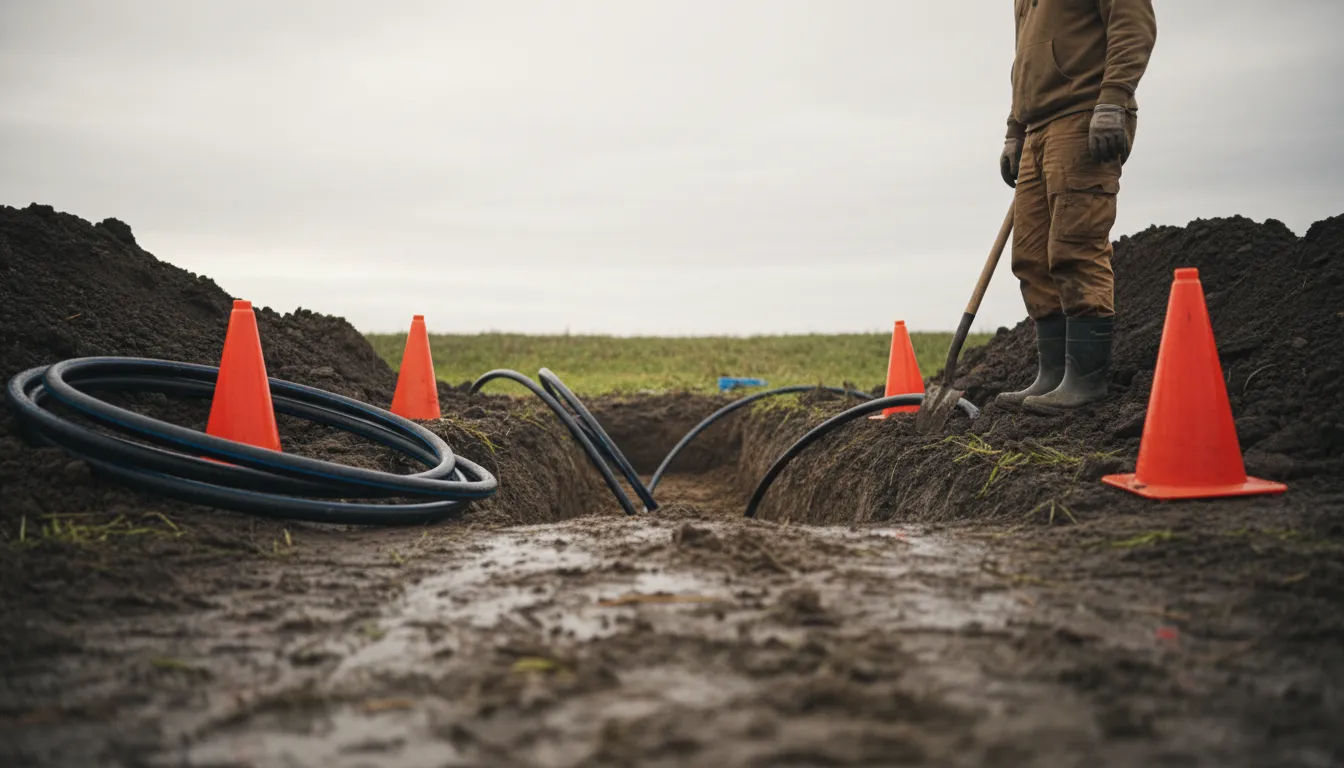
Horizontal Ground Loops This is often the most cost-effective method for properties with sufficient land. Contractors dig trenches several feet deep and hundreds of feet long, laying pipes in a series of parallel rows 1. This approach requires a sizable, open yard and is frequently used in new construction where the landscaping can be planned around the loop field.
Vertical Borehole Loops For homes in Moore with smaller lots, vertical loops are the ideal solution. Contractors use a drilling rig to bore holes 200 to 500 feet deep 2. U-shaped pipe loops are inserted into each borehole, which are then backfilled. While the drilling cost per foot is higher, this method requires minimal surface area and often delivers excellent performance due to the depth and stable temperature 3.
Pond or Lake Loops If your property has a suitable, sufficiently deep body of water, this can be an efficient loop option. Coils of pipe are submerged at the bottom of the pond or lake, utilizing the water as a heat exchange medium 4 5. This method can lower installation costs by eliminating the need for extensive digging or drilling, but it depends entirely on having the right water resource available.
The Geothermal Installation Process in Moore
Installing a residential geothermal system is a significant project that requires professional expertise. Understanding the steps can help you prepare for the process.
- Initial Assessment and Load Calculation: A qualified installer will first conduct a detailed evaluation of your home. This includes performing a Manual J heat load calculation to determine your exact heating and cooling needs. They will also assess your property-examining soil composition, yard size, and accessibility-to design the optimal loop system.
- Loop Field Installation: This is the major earthwork phase. For a horizontal system, trenches are excavated. For a vertical system, a drilling rig creates the boreholes. The high-density polyethylene pipes are then laid or inserted, connected into a continuous loop, and pressure-tested for leaks before being backfilled 6.
- Indoor Unit and Connection: The geothermal heat pump unit, which is typically about the size of a small refrigerator, is installed in your garage, basement, or utility closet. This unit is connected to the ground loop and to your home's existing ductwork or hydronic distribution system. An experienced technician will ensure all electrical and refrigerant connections are secure.
- System Startup and Commissioning: Once everything is connected, the system is filled with fluid, purged of air, and powered on. The contractor will test and calibrate all components, verify the heat exchange is functioning correctly, and ensure the system meets performance and safety standards before handing it over to you 7.
Find the perfect geothermal heat pump contractors for your needs
Get personalized recommendations and expert advice
Evaluating Costs, Savings, and Value
The decision to invest in a geothermal system involves weighing the upfront cost against long-term benefits. In Moore, the economics are often favorable due to the climate and potential energy savings.
Understanding the Investment The total cost for a complete geothermal heat pump system in Moore can range from $20,000 to $40,000 or more. This wide range depends on your home's size, the chosen loop type (vertical drilling is more expensive than horizontal trenching), and the complexity of connecting to your existing ductwork. The ground loop installation itself typically represents a substantial portion of the total project cost.
The Long-Term Payback The primary financial benefit comes from dramatically lower operating costs. Geothermal systems can reduce energy consumption for heating and cooling by up to 70% compared to conventional systems 8 9. For a Moore homeowner, this can translate to savings of hundreds of dollars annually on utility bills. With these savings, the system often pays for itself within a 5- to 10-year timeframe 10 11. Furthermore, the equipment is remarkably durable: the underground loops can last 50 years or more, and the indoor heat pump unit often exceeds 20 years of service-far longer than standard air conditioners and furnaces 12.
Environmental and Comfort Benefits Beyond the financials, a ground-source system offers quiet operation, as there is no loud outdoor condenser unit. It also provides exceptional dehumidification in cooling mode. Environmentally, it reduces your home's carbon footprint by using renewable thermal energy from the ground and electricity much more efficiently 13.
Why Geothermal is a Smart Choice for Moore, OK
Moore's climate presents distinct challenges, with hot, humid summers and cold winters. This is precisely where geothermal technology shines. While air-source heat pumps lose efficiency in extreme cold, a geothermal system's source temperature remains a steady 50-60°F underground all year, allowing it to provide efficient heating even during a winter freeze.
Local geothermal contractors bring essential regional expertise. They understand the local soil conditions, permitting requirements, and the specific heating and cooling demands of homes in central Oklahoma. Companies with experience in the area can accurately size your system and navigate the installation process smoothly, ensuring you get the full benefit of this advanced technology.
Frequently asked questions
Sources
Footnotes
-
All You Need to Know About Home Geothermal Heating & ... - https://dandelionenergy.com/all-you-need-to-know-about-home-geothermal-heating-cooling ↩
-
Geothermal Heat Pumps - Airco Service - https://www.aircoservice.com/services/geothermal-heat-pumps/ ↩
-
Ground source heat pumps: horizontal collectors Vs. vertical boreholes - https://www.mesh-energy.com/insights/ground-source-heat-pumps-horizontal-collectors-vs-vertical-boreholes ↩
-
Geothermal Installation - How It Works - https://ecsgeothermal.com/geothermal-installation-how-it-works/ ↩
-
Geothermal Heat Pumps - Department of Energy - https://www.energy.gov/energysaver/geothermal-heat-pumps ↩
-
Heat Pump vs. Geothermal Systems for Your OKC Home - https://suntechokc.com/blog/heat-pump-vs-geothermal/ ↩
-
Geothermal Heat Pump Installation: What To Expect For Your Property - https://jomory.com/geothermal-heat-pump-installation-what-to-expect-for-your-property/ ↩
-
Geothermal Cooling in Central OK & North TX - https://huntersupertechs.com/air-conditioning/geothermal-cooling/ ↩
-
How Does A Geothermal Heat Pump Work? Complete 2025 Guide - https://solartechonline.com/blog/how-does-geothermal-heat-pump-work/ ↩
-
Geothermal Heat Pump Installation - Suntech Heat & Air Conditioning & Plumbing - https://suntechokc.com/geothermal-heating-cooling-services/geothermal-heat-pump-installation/ ↩
-
Guide to Geothermal Heat Pumps - https://www.energy.gov/sites/prod/files/guide_to_geothermal_heat_pumps.pdf ↩
-
Guide to Geothermal Heat Pumps - https://www.energy.gov/sites/prod/files/guide_to_geothermal_heat_pumps.pdf ↩
-
5 Things You Should Know about Geothermal Heat Pumps - https://www.energy.gov/cmei/articles/5-things-you-should-know-about-geothermal-heat-pumps ↩