Find the Best Geothermal Heat Pump Contractors for Your Business
No obligation • Fast responses • Nationwide coverage

Why you can trust HVAC Firms
HVAC Firms is a leading United States resource for evaluating HVAC service providers. Our team researches companies, checks credentials, and reviews customer feedback to present clear, unbiased information. Listings and rankings are based on merit, and companies cannot pay to change our editorial content.
Search providers near you
Top Geothermal Heat Pump Contractors in Kansas City, Missouri Ranked
A geothermal heat pump is a highly efficient heating and cooling system that leverages the earth's stable underground temperature to regulate your home's climate. For Kansas City residents, this technology offers a powerful way to reduce energy bills and environmental impact while ensuring year-round comfort. This guide explains how these ground-source systems work, what installation involves, and how you can find qualified local experts to assess your property for this sustainable upgrade.
Air Care
10332 W 79th St, Shawnee, KS 66214
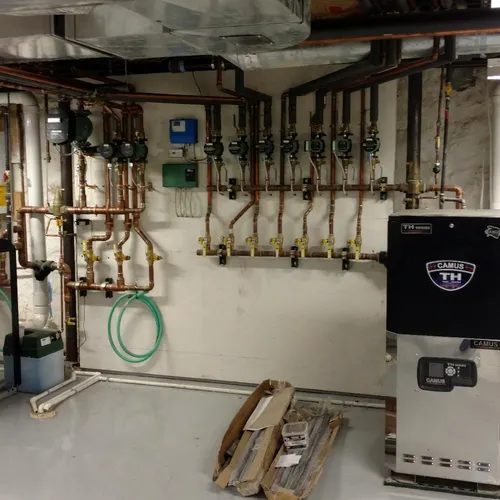
Air Care is an HVAC company serving Kansas City, MO, and the surrounding Shawnee area. Established in 1981, they provide a wide range of heating and cooling services including installation, repair, and maintenance of furnaces, air conditioners, boilers, mini-splits, and geothermal heat pumps. Their NATE-certified technicians handle both residential and light commercial work, with capabilities in duct design and indoor air quality services. Air Care offers 24/7 emergency repair service to address urgent heating or cooling issues.

Lancaster Brothers
19495 Metcalf Ave, Overland Park, KS 66085
Lancaster Brothers is an HVAC company serving Kansas City, MO, since 2000. They provide heating, air conditioning, geothermal heat pump installation and repair, indoor air quality services, and home generator installation. Their team handles residential and commercial projects, including new construction HVAC installations. Lancaster Brothers specializes in geothermal systems and offers same-day service with free estimates. Their licensed and certified technicians focus on delivering long-lasting solutions backed by warranties.
Buckner's Heating, Cooling, and Plumbing
406 W 75th St Ste F, Kansas City, MO 64114
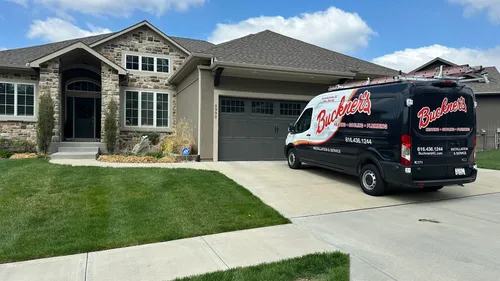
Buckner's Heating, Cooling, and Plumbing has been serving Kansas City, MO, since 1983, offering a wide range of HVAC and plumbing services. Their experienced technicians handle heating and cooling system repairs, installations, and maintenance, including furnaces, heat pumps, geothermal systems, and air conditioning units. They also provide comprehensive plumbing services such as leak repairs, water heater service, and drain cleaning. The company is equipped with well-stocked service vehicles and offers after-hours service for urgent needs.
Anthony Plumbing, Heating, Cooling & Electric
15203 W 99th St, Lenexa, KS 66219
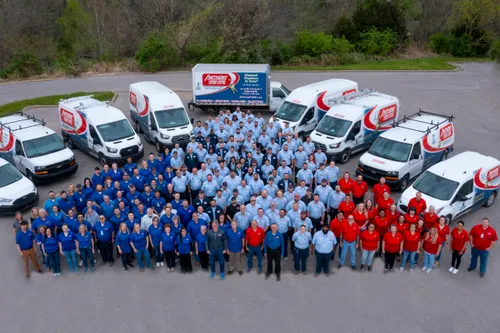
Anthony Plumbing, Heating, Cooling & Electric provides comprehensive HVAC, plumbing, and electrical services in Kansas City, MO. With over 70 years of experience, they offer repair and installation for air conditioners, furnaces, heat pumps, boilers, and geothermal systems. Their technicians are trained annually and vetted for trustworthiness, allowing them to work in homes even without the owner present. The company supports the Greater Kansas City Metro and surrounding areas, offering 24/7 emergency support and specialized capabilities such as Maestro zoning systems and whole-home generator installations.
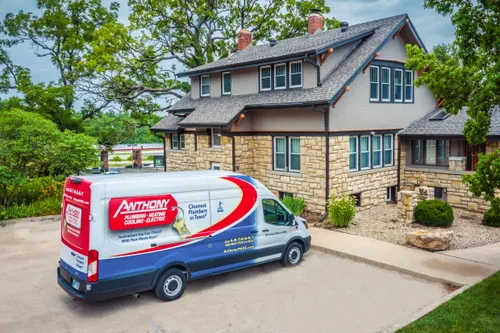
Anthony Plumbing, Heating, Cooling & Electric
17331 East 40th Terrace S Units 111-112, Independence, MO 64055
Anthony Plumbing, Heating, Cooling & Electric provides comprehensive HVAC, plumbing, and electrical services in Kansas City, MO. With over 70 years of experience, they offer repair and installation for air conditioners, furnaces, heat pumps, boilers, geothermal heat pumps, and thermostats. Their technicians are trained annually and vetted for trustworthiness, allowing them to work in customers' homes even when the homeowner is not present. The company also offers 24/7 emergency support and services the broader Kansas City metro area and surrounding communities. One notable capability includes installing Maestro zoning systems for customized home temperature control.
How Geothermal Systems Work in Our Climate
The principle behind a geothermal system, often called a ground-source heat pump, is elegantly simple. Just a few feet below the surface, the earth near Kansas City maintains a remarkably constant temperature between 50-60°F year-round, regardless of summer heat or winter chill. This thermal stability is the system's foundation.
In the winter, the ground is warmer than the outside air. A fluid-typically a water and antifreeze mixture-circulates through a loop of pipes buried underground, absorbing the earth's gentle heat. This warmed fluid is pumped to an indoor heat pump unit, which concentrates the thermal energy and distributes warm air through your home's existing ductwork or radiant floor system 1. In the summer, the process reverses: the system extracts heat from your home and transfers it into the cooler ground, providing efficient air conditioning. This single system seamlessly handles both major climate control needs.
Types of Ground Loop Systems
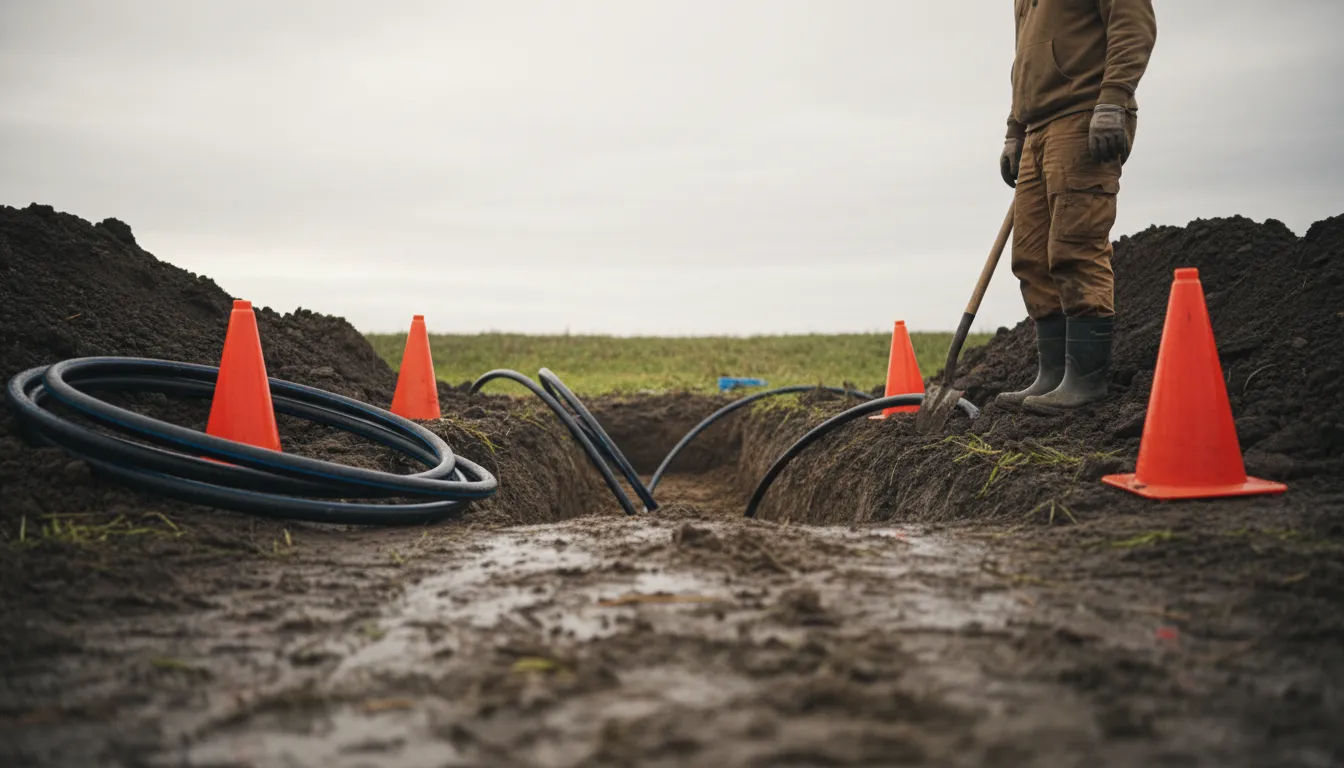
The underground piping, or "ground loop," is the heart of the installation. The right type for your Kansas City home depends on your property's soil composition, size, and layout. The most common configuration is the closed-loop system, where the fluid continuously circulates through sealed, high-density polyethylene pipes.
- Horizontal Closed Loops: This method involves excavating long, shallow trenches about four to six feet deep in your yard 2 3. Pipes are laid in these trenches in a series of parallel runs or slinky coils. This approach is often the most cost-effective for new construction or properties with ample, unobstructed land 4.
- Vertical Closed Loops: For homes with smaller lots, vertical loops are the ideal solution. Using a specialized drilling rig, contractors bore holes 150 to 400 feet deep. U-shaped pipe loops are inserted into each borehole, which are then grouted. This method minimizes landscape disruption and is excellent for rocky soil, but requires specialized drilling equipment.
- Open-Loop Systems: Less common, an open-loop system uses groundwater from a well as the direct heat exchange fluid. After circulating through the heat pump, the water is discharged back into a second well or a suitable surface body of water. This option is highly dependent on having an adequate supply of clean water and meeting local codes for water discharge.
The Installation Process: What to Expect
Installing a geothermal heating and cooling system is a significant project that requires professional expertise. Understanding the steps can help you prepare.
- Site Assessment and Design: A certified installer will first evaluate your property. They'll assess soil conditions, available land, your home's heating and cooling load, and the best loop type. This critical step ensures the system is correctly sized and designed for maximum efficiency.
- Loop Installation: This is the most visible phase. For a horizontal system, excavation equipment will dig the necessary trenches. For a vertical system, a drilling rig will be brought on-site to create the boreholes. While this temporarily disrupts the yard, an experienced crew works to minimize impact and restore the landscape afterward 5.
- Indoor Unit and Connection: The geothermal heat pump unit itself is installed inside your home, often in a basement, utility room, or garage. It's about the size of a traditional furnace. The installer will connect it to the underground loop field and integrate it with your home's existing ductwork or hydronic distribution system 6.
Find the perfect geothermal heat pump contractors for your needs
Get personalized recommendations and expert advice
Financial Benefits and Incentives
The most compelling reason Kansas City homeowners choose geothermal is the long-term financial benefit. While the upfront installation cost is higher than a conventional HVAC system, the operational savings are substantial.
Homeowners typically save 30% to 70% or more on their heating and cooling bills 7 8. For example, a typical 2,000-square-foot home in our area might see annual HVAC costs drop from over $2,000 with a conventional system to between $400 and $800 with a geothermal system 7 9. This often leads to a payback period on the initial investment within 5 to 10 years, after which the savings go directly into your pocket 10.
Significant incentives make the switch more affordable than ever. The federal Residential Clean Energy Credit (under the Inflation Reduction Act) provides a tax credit for 30% of the total installed cost, with no upper limit, through 2032 11 12. It's crucial to discuss all available federal, state, and local utility rebates with your installer to understand the full net cost.
Is a Geothermal System Right for Your Home?
Geothermal heat pumps are a versatile technology suitable for many, but not all, properties. They are an excellent choice if you have the land for a horizontal loop field or the sub-surface conditions suitable for vertical drilling. They pair exceptionally well with energy-efficient home designs and radiant floor heating systems for ultimate comfort 13. For urban lots with very limited space, the feasibility depends entirely on the ability to drill vertical boreholes.
The ideal candidate is a homeowner planning to stay in their home long enough to realize the full payback of the investment, someone interested in dramatically reducing their carbon footprint, or anyone building a new custom home where the loop field can be integrated into the site plan from the start.
Long-Term Performance and Environmental Impact
Beyond savings, geothermal systems offer unparalleled reliability and environmental benefits. The underground loops are designed to last for decades-often 50 years or more-while the indoor heat pump unit has a lifespan comparable to or exceeding traditional equipment. With fewer mechanical parts exposed to the elements, they generally require less maintenance than air-source systems.
By using the renewable thermal energy stored in the earth, a ground-source heat pump drastically reduces your home's reliance on fossil fuels or the electrical grid for temperature control. This translates to a major reduction in greenhouse gas emissions, making it one of the cleanest and most sustainable heating and cooling solutions available for the Kansas City region 14.
Frequently asked questions
Sources
Footnotes
-
Commercial Geothermal Systems: How They Work, Where They Excel, and Why They're Growing - https://jomory.com/commercial-geothermal-systems-how-they-work-where-they-excel-and-why-theyre-growing/ ↩
-
Geothermal Energy and Heat Pump Potential in Kansas - https://kgs.ku.edu/geothermal-energy-and-heat-pump-potential-kansas ↩
-
Geothermal Heat Pump Installation: What To Expect For Your Property - https://jomory.com/geothermal-heat-pump-installation-what-to-expect-for-your-property/ ↩
-
Complete Guide To Geothermal Heat Pump Installation - https://coolwithbowman.com/geothermal-heat-pump-installation/ ↩
-
All You Need to Know About Home Geothermal Heating & ... - https://dandelionenergy.com/all-you-need-to-know-about-home-geothermal-heating-cooling ↩
-
Geothermal System Installation Process Explained - https://www.geothermalkc.com/understanding-the-installation-process-of-geothermal-systems-in-johnson-county-and-surrounding-regions ↩
-
An Introduction To Geothermal Heating And Cooling In Overland Park - https://www.climatecontrolkc.com/blog/heating/introduction-to-geothermal-heating-and-cooling/ ↩ ↩2
-
Air-Source vs. Geothermal Heat Pumps: Choosing the Right System for Your Kansas City Home - https://bucknershc.com/blog/air-source-vs-geothermal-heat-pump ↩
-
Geothermal Heat Pump Guide: Installation Costs, Types And Benefits - https://modernize.com/hvac/heating-repair-installation/heat-pump/geothermal ↩
-
Geothermal Heating and Cooling by GeothermalXperts, Inc. - http://geothermalxperts.com/geothermal-system-faqs.htm ↩
-
Geothermal Heat Pumps - Department of Energy - https://www.energy.gov/energysaver/geothermal-heat-pumps ↩
-
Geothermal Systems Kansas City, MO | Green Heating - https://www.climatecontrolkc.com/air-conditioning/geothermal/ ↩
-
Geothermal and radiant: An energy-efficient powerhouse - https://www.pmmag.com/articles/106687-geothermal-and-radiant-an-energy-efficient-powerhouse ↩
-
Geothermal Heating and Cooling - https://geothermal.colorado.gov/geothermal-heating-and-cooling ↩