
Find the Best Geothermal Heat Pump Contractors for Your Business
No obligation • Fast responses • Nationwide coverage

Why you can trust HVAC Firms
HVAC Firms is a leading United States resource for evaluating HVAC service providers. Our team researches companies, checks credentials, and reviews customer feedback to present clear, unbiased information. Listings and rankings are based on merit, and companies cannot pay to change our editorial content.
Search providers near you
Top Geothermal Heat Pump Contractors in Independence, Missouri Ranked
A geothermal heat pump is a highly efficient heating and cooling system that uses the Earth's stable underground temperature to regulate your home's climate. For Independence homeowners, this technology offers a path to significant energy savings and reduced environmental impact. This guide will help you understand how these ground-source systems work, what installation entails, and how to evaluate if one is right for your property.
Air Care
10332 W 79th St, Shawnee, KS 66214
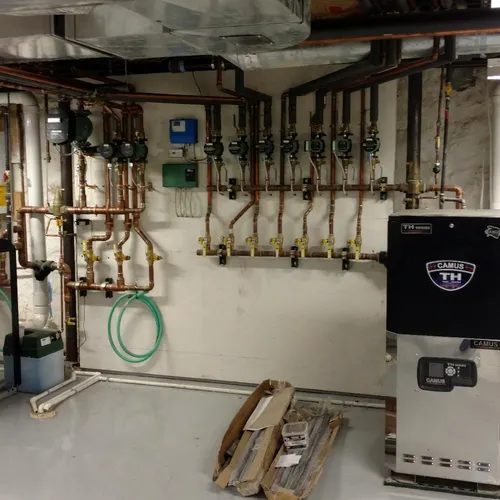
Air Care is an HVAC company serving Kansas City, MO, and the surrounding Shawnee area. Established in 1981, they provide a wide range of heating and cooling services including installation, repair, and maintenance of furnaces, air conditioners, boilers, mini-splits, and geothermal heat pumps. Their NATE-certified technicians handle both residential and light commercial work, with capabilities in duct design and indoor air quality services. Air Care offers 24/7 emergency repair service to address urgent heating or cooling issues.

Lancaster Brothers
19495 Metcalf Ave, Overland Park, KS 66085
Lancaster Brothers is an HVAC company serving Kansas City, MO, since 2000. They provide heating, air conditioning, geothermal heat pump installation and repair, indoor air quality services, and home generator installation. Their team handles residential and commercial projects, including new construction HVAC installations. Lancaster Brothers specializes in geothermal systems and offers same-day service with free estimates. Their licensed and certified technicians focus on delivering long-lasting solutions backed by warranties.
Buckner's Heating, Cooling, and Plumbing
406 W 75th St Ste F, Kansas City, MO 64114
Buckner's Heating, Cooling, and Plumbing has been serving Kansas City, MO, since 1983, offering a wide range of HVAC and plumbing services. Their experienced technicians handle heating and cooling system repairs, installations, and maintenance, including furnaces, heat pumps, geothermal systems, and air conditioning units. They also provide comprehensive plumbing services such as leak repairs, water heater service, and drain cleaning. The company is equipped with well-stocked service vehicles and offers after-hours service for urgent needs.
Anthony Plumbing, Heating, Cooling & Electric
15203 W 99th St, Lenexa, KS 66219
Anthony Plumbing, Heating, Cooling & Electric provides comprehensive HVAC, plumbing, and electrical services in Kansas City, MO. With over 70 years of experience, they offer repair and installation for air conditioners, furnaces, heat pumps, boilers, and geothermal systems. Their technicians are trained annually and vetted for trustworthiness, allowing them to work in homes even without the owner present. The company supports the Greater Kansas City Metro and surrounding areas, offering 24/7 emergency support and specialized capabilities such as Maestro zoning systems and whole-home generator installations.
Anthony Plumbing, Heating, Cooling & Electric
17331 East 40th Terrace S Units 111-112, Independence, MO 64055
Anthony Plumbing, Heating, Cooling & Electric provides comprehensive HVAC, plumbing, and electrical services in Kansas City, MO. With over 70 years of experience, they offer repair and installation for air conditioners, furnaces, heat pumps, boilers, geothermal heat pumps, and thermostats. Their technicians are trained annually and vetted for trustworthiness, allowing them to work in customers' homes even when the homeowner is not present. The company also offers 24/7 emergency support and services the broader Kansas City metro area and surrounding communities. One notable capability includes installing Maestro zoning systems for customized home temperature control.
How Geothermal Heating and Cooling Works
The principle behind a geothermal system, often called a ground-source heat pump, is elegant in its simplicity. Just a few feet below the surface, the Earth maintains a nearly constant temperature of approximately 55°F year-round, regardless of summer heat or winter chill in Missouri 1. A geothermal system taps into this reliable thermal resource.
The process involves a closed loop of pipes, called a ground loop, buried in your yard. A water-based fluid circulates through these pipes, absorbing the Earth's steady warmth in the winter and its relative coolness in the summer 2. This tempered fluid is then pumped to a heat pump unit inside your home. In heating mode, the heat pump concentrates this low-grade thermal energy to provide warm air through your ducts. In cooling mode, the cycle reverses: the system extracts heat from your indoor air and transfers it into the cooler ground loop fluid, which then deposits that heat back into the Earth 3. This exchange with the ground is far more efficient than battling the extreme outdoor air temperatures, which is why geothermal systems deliver exceptional efficiency.
Types of Ground Loop Systems
The buried pipe system is the heart of the installation, and several configurations are available. The right choice for your Independence home depends on your lot size, soil conditions, and budget.
-
Horizontal Closed Loop: This is often the most cost-effective option if space allows. Contractors dig trenches three to ten feet deep and several hundred feet long in which they lay pipes in a series of parallel runs 4. This method requires a substantial amount of available land but typically involves lower excavation costs than drilling.
-
Vertical Closed Loop: For homes with smaller yards, a vertical loop is the standard solution. Using a drilling rig, contractors bore holes 100 to 400 feet deep and insert U-shaped pipe loops into each one. The holes are then grouted. While more expensive per foot due to the specialized drilling equipment, this system minimizes landscape disturbance and is ideal for limited spaces.
-
Pond/Lake Loop: If you have a sufficient body of water on your property, this can be an excellent option. Coils of pipe are submerged at a depth where the water won't freeze. The water itself acts as an excellent heat exchanger, often making this one of the most efficient and lower-cost loop installations 5 6.
-
Open Loop System: This system uses groundwater directly from a well or aquifer. Water is pumped from the source, passes through the heat pump to exchange heat, and is then discharged back into a second well, a pond, or a stream (where local codes permit) 7. It requires an adequate supply of clean water and compliance with local regulations regarding groundwater use.
What to Expect During Installation
Installing a geothermal heat pump is a significant project that requires careful planning and skilled excavation. Understanding the process can help you prepare.
For a horizontal loop installation, expect heavy equipment like trenchers or backhoes to arrive at your property. They will dig long, deep trenches across your yard according to a engineered design. The high-density polyethylene pipes are laid, connected, and pressure-tested before the trenches are carefully backfilled. The surface disruption is considerable but temporary; with proper grading and seeding, your lawn will recover.
A vertical loop installation involves a different kind of activity. A drilling rig, similar to a well-drilling rig, will be brought in to create the deep boreholes. This process is typically slower, taking several days, and creates less widespread surface disturbance-mainly around the drill sites themselves. The drilled holes are grouted to ensure good thermal contact with the earth and to protect groundwater.
Inside your home, the installation is similar to replacing a conventional furnace and air conditioner. The indoor heat pump unit is installed, connected to your existing ductwork, and linked to the new ground loop. The entire process, from site survey to system startup, is managed by experienced professionals to ensure optimal performance and minimal hassle for you.
Find the perfect geothermal heat pump contractors for your needs
Get personalized recommendations and expert advice
Evaluating Costs and Long-Term Savings
The upfront investment for a complete geothermal system in Independence is higher than for a traditional HVAC system. Total costs can range significantly, typically from $12,000 to over $45,000, influenced by your home's size, the chosen loop type, and site-specific challenges.
However, this initial cost is balanced by substantial long-term savings. Homeowners frequently report reductions of 30% to 70% on their heating and cooling utility bills 8 9. This is because a geothermal heat pump can deliver over three units of heating or cooling energy for every one unit of electrical energy it consumes, a measure known as Coefficient of Performance (COP). Furthermore, these systems have fewer mechanical parts exposed to the elements, leading to lower maintenance costs and longer equipment lifespans 10 11.
An often-overlooked benefit is the positive impact on property value. Studies and real estate trends suggest that the added value to a home can be significant, with some estimates indicating an increase of $10 to $25 for every $1 reduction in annual utility costs the system provides 12. When viewed as a long-term investment, a geothermal system offers compelling financial benefits through energy independence, predictable costs, and enhanced home equity.
Is Your Independence Property a Good Candidate?
Several key factors determine if a ground-source heat pump is a viable option for your home:
- Land Availability: Do you have enough usable yard space? Horizontal loops require the most land, while vertical loops are designed for tighter lots. A professional site evaluation is the first step.
- Soil and Rock Composition: The thermal conductivity of your soil affects system efficiency. Clay soils transfer heat well, while sandy soils are less efficient. The presence of bedrock can increase drilling costs for vertical loops but may also offer excellent heat transfer properties 13.
- Existing Ductwork: Most geothermal systems use forced air to distribute conditioned air. If your home already has ductwork, it can usually be adapted. For homes without ducts, "ductless" geothermal options are available but less common.
- Long-Term Perspective: Geothermal is best suited for homeowners who plan to stay in their home for many years to fully realize the return on investment through energy savings.
Maintenance and Longevity
One of the standout advantages of a geothermal system is its durability and low maintenance needs. The indoor heat pump components are housed in a protected environment, and the underground loop is designed to last for decades-often with warranties of 25 to 50 years on the piping itself. Routine maintenance is similar to a traditional system: checking air filters, cleaning coils, and having a professional perform an annual inspection of the pumps, compressor, and electrical connections. This simplicity and reliability contribute greatly to the system's long-term value.
Frequently asked questions
Sources
Footnotes
-
Geothermal Heat Pump Wells - PUB2899 | Missouri Department of Natural Resources - https://dnr.mo.gov/document-search/geothermal-heat-pump-wells-pub2899/pub2899 ↩
-
How a Geothermal Heat Pump Works | This Old House - https://www.youtube.com/watch?v=d5Tbsx3R2T8 ↩
-
How Geothermal Heat Pumps Work - https://www.youtube.com/watch?v=XxlTnBukweI&t=37 ↩
-
Southeast Missouri Geothermal Heating System Services - https://www.dutchenterprises.com/heating/geothermal-systems/ ↩
-
Geothermal Heat Pumps - Department of Energy - https://www.energy.gov/energysaver/geothermal-heat-pumps ↩
-
How Does a Geothermal System Work? - ClimateMaster - https://www.climatemaster.com/homeowner/side-links/how-it-works ↩
-
Geothermal Heat Pump Systems | Missouri Department of Natural Resources - https://dnr.mo.gov/land-geology/businesses-landowners-permittees/technical-assistance/geothermal-heat-pump-systems ↩
-
All You Need to Know About Home Geothermal Heating & ... - https://dandelionenergy.com/all-you-need-to-know-about-home-geothermal-heating-cooling ↩
-
Geothermal | Chapman Heating, Cooling, & Plumbing - https://chapmanhvac.com/geothermal/ ↩
-
How Does A Geothermal Heat Pump Work? Complete 2025 Guide - https://solartechonline.com/blog/how-does-geothermal-heat-pump-work/ ↩
-
Air Source vs Ground Source Heat Pump: Which Is Best? - https://harmonmechanical.com/air-source-vs-ground-source-heat-pump/ ↩
-
Geothermal Heat Pump Guide: Installation Costs, Types And Benefits - https://modernize.com/hvac/heating-repair-installation/heat-pump/geothermal ↩
-
Geothermal Heat Pump Installation: What To Expect For Your ... - https://jomory.com/geothermal-heat-pump-installation-what-to-expect-for-your-property/ ↩