Find the Best Geothermal Heat Pump Contractors for Your Business
No obligation • Fast responses • Nationwide coverage

Why you can trust HVAC Firms
HVAC Firms is a leading United States resource for evaluating HVAC service providers. Our team researches companies, checks credentials, and reviews customer feedback to present clear, unbiased information. Listings and rankings are based on merit, and companies cannot pay to change our editorial content.
Search providers near you
Top Geothermal Heat Pump Contractors in Haverhill, Massachusetts Ranked
Geothermal heat pumps, also known as ground-source heat pumps, are a highly efficient method for heating and cooling your Haverhill home by leveraging the earth's stable underground temperature. This technology matters because it can dramatically reduce your energy bills and environmental footprint, offering a reliable, long-term solution for Massachusetts' varied climate. This guide will help you understand how these systems work, what installation entails, and how to connect with qualified local experts who can assess your property for this innovative technology.
Net Zero Heating & Air Conditioning
55 Ellingwood Ave, Billerica, MA 01821
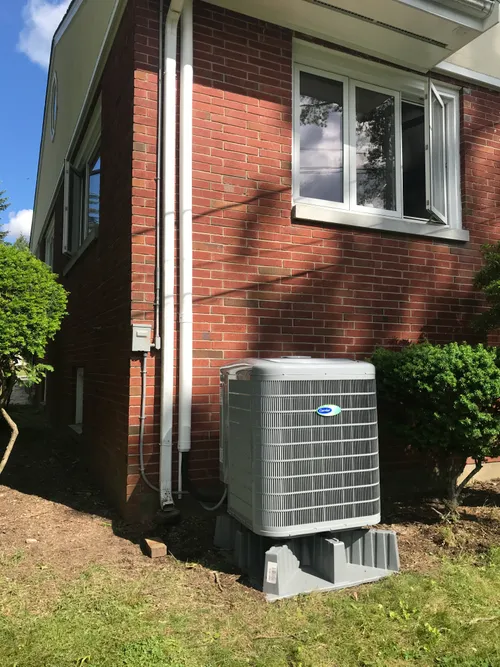
Net Zero Heating & Air Conditioning is an HVAC contractor based in Boston, MA, specializing in the design, installation, maintenance, and repair of heating and cooling systems. They offer services for air conditioners, furnaces, heat pumps, geothermal systems, and high-efficiency water heaters, helping customers improve home energy efficiency and reduce fossil fuel dependency. Their team evaluates each home's needs to recommend and install systems that meet or exceed local energy requirements. Net Zero is certified by NATE, Bryant, and Mitsubishi Diamond, and is a member of 1% for the Planet, reflecting their commitment to environmental goals.
EnergySmart Alternatives, LLC
Boston, MA
EnergySmart Alternatives, LLC is a geothermal heat pump contractor based in Boston, MA. They manage the entire geothermal project process, including site evaluation, design, permitting, installation, and paperwork for incentives. Their services focus on geothermal heating and cooling systems that use the Earth's stable temperature to provide efficient year-round comfort and improved indoor air quality. EnergySmart handles new builds, retrofits, and replacements with certified installers to ensure proper system performance. Their approach reduces fossil fuel use and carbon footprint while offering financial and environmental benefits.
How Geothermal Systems Work: Harnessing the Earth's Energy
The core principle behind a geothermal heating and cooling system is remarkably simple: it uses the ground beneath your property as a constant energy source. Unlike the air temperature, which fluctuates wildly with the seasons, the earth just a few feet below the surface maintains a stable temperature of approximately 50-60°F year-round in Massachusetts. A geothermal system exploits this stability.
The process involves three key components working together:
- The Ground Loop: A network of durable, high-density polyethylene pipes is buried in your yard. A water-based fluid circulates through this closed loop.
- Heat Exchange: In the winter, the fluid in the pipes absorbs the gentle heat from the earth and carries it to the house. In the summer, the system reverses; it extracts heat from your home and transfers it back into the cooler ground 1.
- The Heat Pump: Located inside your home, this unit concentrates the energy gathered from the loop. It uses a refrigeration cycle to amplify the heat for warming your home in winter or to provide chilled air for cooling in summer, typically distributing this conditioned air through your existing ductwork 2 3.
This elegant exchange means your system doesn't create heat by burning fuel; it simply moves it from one place to another, which is why it's so efficient.
Types of Ground Loop Systems for Haverhill Properties
The design of the buried ground loop is critical and depends largely on the characteristics of your Haverhill lot. Local installers will evaluate your soil composition, land area, and landscaping to recommend the best approach.
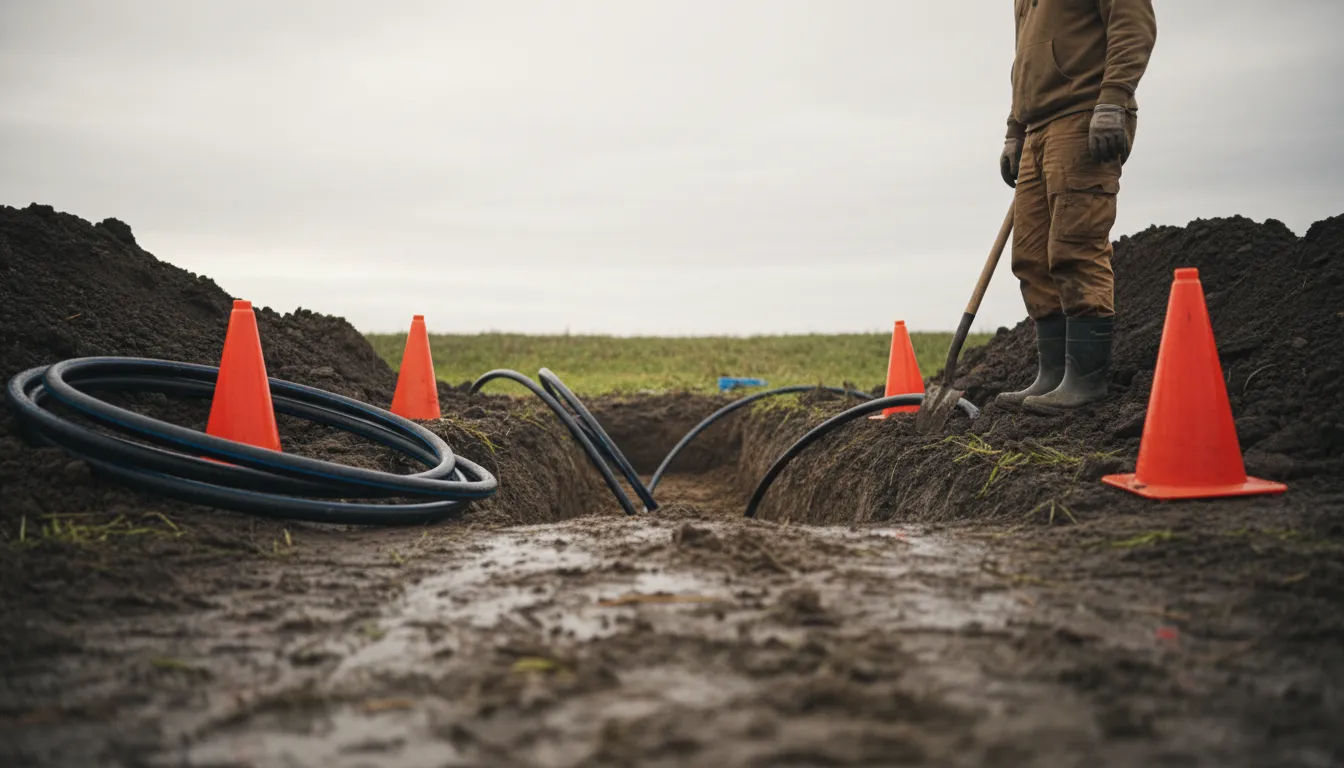
- Horizontal Ground Loops: This is often the most cost-effective option if you have sufficient land. Trenches are dug about six to ten feet deep across a large area of your yard-typically requiring 1,500 to 2,500 square feet of space 4. The pipes are laid in these trenches in a slinky-coil or straight-run configuration. This method is less expensive than drilling but requires a significant amount of open, usable land 5.
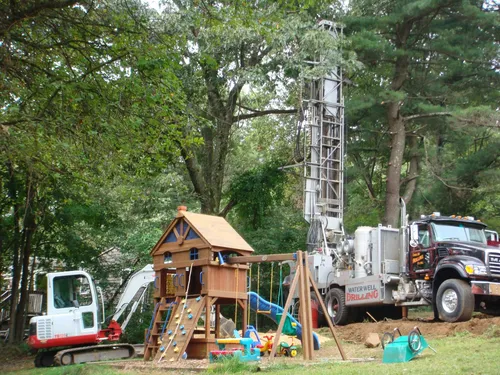
- Vertical Ground Loops: For homes in Haverhill with smaller lots, mature landscaping you wish to preserve, or rocky soil, vertical loops are the ideal solution. Contractors use a drilling rig to bore holes 150 to 400 feet deep. U-shaped loop pipes are inserted into each borehole, which are then grouted. This method minimizes surface disruption, as the holes are only about 4-6 inches in diameter, but it requires specialized drilling equipment and expertise 6.
- Open-Loop Systems: Less common for standard residential installations, an open-loop system uses groundwater from a well or a pond as the direct heat exchange fluid. After passing through the heat pump, the water is returned to a discharge well or the pond. This system can be highly efficient but depends on having an adequate supply of clean water and complying with local codes.
What to Expect During Installation
Installing a geothermal system is a significant project that transforms your property's energy infrastructure. Understanding the process can help you prepare.
Site Assessment & Design: A certified installer will first conduct a thorough evaluation of your property, including a soil analysis and load calculation for your home. They will design the loop field layout and specify the correct indoor heat pump unit.
The Installation Process:
- Loop Field Installation: For a horizontal system, a backhoe will dig long trenches across your yard. For a vertical system, a drilling rig will be brought in to create the boreholes. This phase is the most disruptive and can take several days.
- Pipe Connection & Pressure Testing: The loop pipes are placed in the trenches or boreholes and connected into a continuous circuit. The entire loop is then pressurized and tested for integrity to ensure there are no leaks before it is buried or grouted.
- Trench to House: A separate trench is dug from the loop field to your home's foundation to bring the connecting pipes (the "laterals") into your basement or mechanical room.
- Indoor Unit Installation: The geothermal heat pump unit is installed inside, connected to the ground loop, your ductwork, and your electrical system.
- System Charging & Startup: The loop is filled with its fluid, the system is charged, and the installer will commission and test all components to ensure optimal operation.
Property Restoration: After the heavy machinery leaves, your yard will be graded and seeded. While the initial disturbance is noticeable, lawns typically recover within a growing season.
Find the perfect geothermal heat pump contractors for your needs
Get personalized recommendations and expert advice
The Financial and Environmental Benefits
The decision to install a geothermal system is a long-term investment that pays dividends in multiple ways.
Substantial Energy Savings: This is the most compelling benefit. By moving heat instead of creating it, geothermal heat pumps operate with exceptional efficiency. Homeowners can expect to reduce their energy consumption for heating and cooling by 50 to 70 percent 7. In Haverhill's climate, this often translates to annual savings of over $1,000 on utility bills, quickly offsetting the system's operational costs.
High Upfront Cost, Strong Long-Term Value: The initial investment for a complete geothermal system in Massachusetts typically ranges from $20,000 to $40,000 or more, influenced by loop type, home size, and site conditions 8 9. However, this cost must be viewed in context:
- Incentives: Programs like Mass Save® offer significant rebates for ground-source heat pump installations, which can reduce the upfront cost by thousands of dollars.
- Payback Period: When combining utility bill savings with available incentives, the payback period for the added investment over a conventional system often falls between 5 and 10 years 10.
- Exceptional Lifespan: The indoor heat pump unit has a life expectancy of about 25 years, but the buried ground loop is incredibly durable, often carrying a warranty of 50 years and potentially lasting for generations with minimal maintenance 11.
Reduced Carbon Footprint: By drastically cutting fossil fuel consumption or reliance on less-efficient electric resistance heat, a geothermal system significantly lowers your household's greenhouse gas emissions, contributing to a cleaner environment.
Is a Geothermal System Right for Your Home?
While the benefits are clear, geothermal isn't a one-size-fits-all solution. It's an excellent fit for homeowners who:
- Plan to stay in their home long enough to realize the long-term savings.
- Are building a new home or replacing an aging, inefficient HVAC system.
- Have the property characteristics (land or drilling access) to support a ground loop.
- Are motivated by energy independence, environmental sustainability, and maximizing home comfort.
The key to a successful project is working with an experienced, certified installer who can provide a detailed analysis of your specific situation, including accurate estimates of costs, savings, and the best system design for your Haverhill property.
Frequently asked questions
Sources
Footnotes
-
Ground-Source Heat Pumps - Abode Energy Management - https://abodeenergy.com/wp-content/uploads/2022/07/MassCEC_GSHP_GUIDE.pdf ↩
-
How Geothermal Heat Pumps Work - https://www.youtube.com/watch?v=XxlTnBukweI&t=37 ↩
-
Geothermal and radiant: An energy-efficient powerhouse - https://www.pmmag.com/articles/106687-geothermal-and-radiant-an-energy-efficient-powerhouse ↩
-
Geothermal Heat Pump Installation: What To Expect For Your Property - https://jomory.com/geothermal-heat-pump-installation-what-to-expect-for-your-property/ ↩
-
Geothermal/Hybrid Heating | HVAC Services Boston MA - https://bostonuniqueindoorcomfort.com/products/geothermalhybrid-heating/ ↩
-
Geothermal Heat Pumps: How They Work | AHRI - https://www.ahrinet.org/scholarships-education/education/homeowners/how-things-work/geothermal-heat-pumps-how-they-work ↩
-
Geothermal Ground-Source Heat Pump | Mass.gov - https://www.mass.gov/doc/about-geothermal-heat-pumps-handout/download ↩
-
How Does A Geothermal Heat Pump Work? Complete 2025 Guide - https://solartechonline.com/blog/how-does-geothermal-heat-pump-work/ ↩
-
Ground Source Heat Pumps | Residential - Mass Save - https://www.masssave.com/residential/rebates-offers-services/heating-and-cooling/heat-pumps/ground-source-heat-pumps ↩
-
Geothermal Heat Pumps - Department of Energy - https://www.energy.gov/energysaver/geothermal-heat-pumps ↩
-
The Hidden Costs of HVAC Installations in Massachusetts - https://askgem.com/blog/hidden-costs-of-hvac-installations-in-massachusetts/ ↩