Find the Best Geothermal Heat Pump Contractors for Your Business
No obligation • Fast responses • Nationwide coverage

Why you can trust HVAC Firms
HVAC Firms is a leading United States resource for evaluating HVAC service providers. Our team researches companies, checks credentials, and reviews customer feedback to present clear, unbiased information. Listings and rankings are based on merit, and companies cannot pay to change our editorial content.
Search providers near you
Top Geothermal Heat Pump Contractors in Overland Park, Kansas Ranked
Geothermal heat pumps, also known as ground-source heat pumps, are a highly efficient method for heating and cooling your home by leveraging the earth's stable underground temperature. For Overland Park residents, this technology offers a way to significantly reduce energy bills while enjoying consistent indoor comfort year-round. This guide explains how these systems work, what installation involves, and how you can find qualified local professionals to assess your property and provide a solution tailored to your home.
Air Care
10332 W 79th St, Shawnee, KS 66214
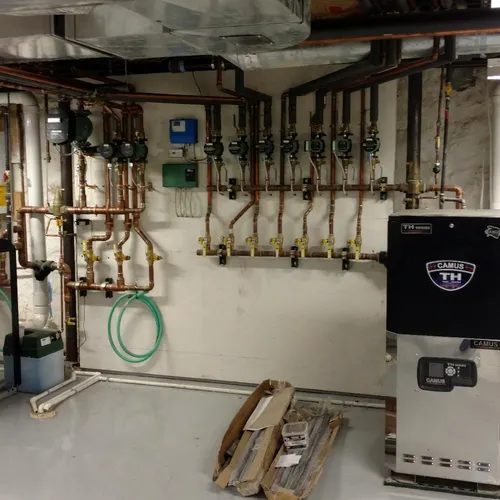
Air Care is an HVAC company serving Kansas City, MO, and the surrounding Shawnee area. Established in 1981, they provide a wide range of heating and cooling services including installation, repair, and maintenance of furnaces, air conditioners, boilers, mini-splits, and geothermal heat pumps. Their NATE-certified technicians handle both residential and light commercial work, with capabilities in duct design and indoor air quality services. Air Care offers 24/7 emergency repair service to address urgent heating or cooling issues.

Lancaster Brothers
19495 Metcalf Ave, Overland Park, KS 66085
Lancaster Brothers is an HVAC company serving Kansas City, MO, since 2000. They provide heating, air conditioning, geothermal heat pump installation and repair, indoor air quality services, and home generator installation. Their team handles residential and commercial projects, including new construction HVAC installations. Lancaster Brothers specializes in geothermal systems and offers same-day service with free estimates. Their licensed and certified technicians focus on delivering long-lasting solutions backed by warranties.
Buckner's Heating, Cooling, and Plumbing
406 W 75th St Ste F, Kansas City, MO 64114
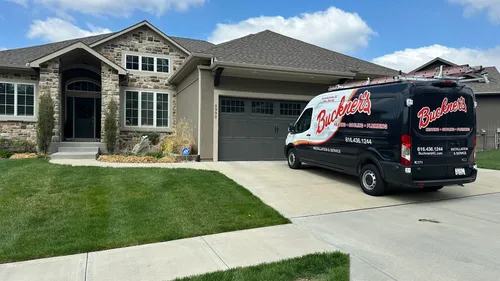
Buckner's Heating, Cooling, and Plumbing has been serving Kansas City, MO, since 1983, offering a wide range of HVAC and plumbing services. Their experienced technicians handle heating and cooling system repairs, installations, and maintenance, including furnaces, heat pumps, geothermal systems, and air conditioning units. They also provide comprehensive plumbing services such as leak repairs, water heater service, and drain cleaning. The company is equipped with well-stocked service vehicles and offers after-hours service for urgent needs.
Anthony Plumbing, Heating, Cooling & Electric
15203 W 99th St, Lenexa, KS 66219
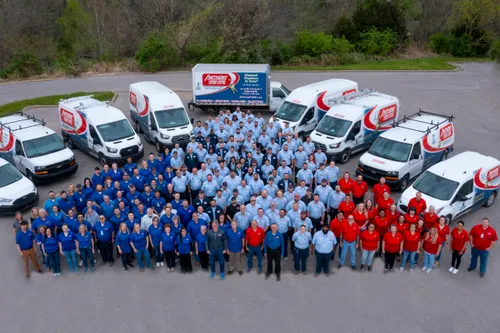
Anthony Plumbing, Heating, Cooling & Electric provides comprehensive HVAC, plumbing, and electrical services in Kansas City, MO. With over 70 years of experience, they offer repair and installation for air conditioners, furnaces, heat pumps, boilers, and geothermal systems. Their technicians are trained annually and vetted for trustworthiness, allowing them to work in homes even without the owner present. The company supports the Greater Kansas City Metro and surrounding areas, offering 24/7 emergency support and specialized capabilities such as Maestro zoning systems and whole-home generator installations.
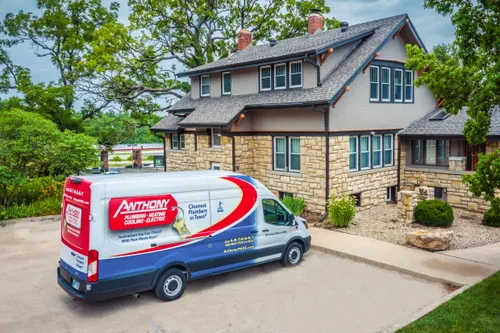
Anthony Plumbing, Heating, Cooling & Electric
17331 East 40th Terrace S Units 111-112, Independence, MO 64055
Anthony Plumbing, Heating, Cooling & Electric provides comprehensive HVAC, plumbing, and electrical services in Kansas City, MO. With over 70 years of experience, they offer repair and installation for air conditioners, furnaces, heat pumps, boilers, geothermal heat pumps, and thermostats. Their technicians are trained annually and vetted for trustworthiness, allowing them to work in customers' homes even when the homeowner is not present. The company also offers 24/7 emergency support and services the broader Kansas City metro area and surrounding communities. One notable capability includes installing Maestro zoning systems for customized home temperature control.
How Geothermal Systems Work in Overland Park
The core principle behind a geothermal heating and cooling system is remarkably simple: it uses the earth as a giant thermal battery. Just a few feet below the surface in Overland Park, the ground maintains a nearly constant temperature between 50 and 60°F throughout the year. A geothermal system, or ground-source heat pump, capitalizes on this stability.
During the winter, the system acts as a heater. A fluid (typically a water and antifreeze mixture) circulates through a loop of pipes buried in the ground, absorbing the earth's natural warmth. This warmed fluid is then pumped to an indoor heat pump unit, which concentrates the heat and distributes it throughout your home via your existing ductwork or radiant floor system.
In the summer, the process reverses for cooling. The indoor heat pump extracts heat and humidity from your home's air. This unwanted heat is transferred to the fluid in the ground loop, which then circulates underground to dissipate the heat into the cooler earth 1. This heat exchange process is what makes geothermal technology so efficient, as it moves heat rather than generating it through combustion or intense electrical resistance.
Types of Ground Loop Systems
The underground piping, or ground loop, is the critical component that exchanges heat with the earth. The right type of loop for your Overland Park home depends primarily on your lot size, soil conditions, and local geology. The most common configuration is a closed-loop system, where the fluid continuously circulates through sealed, high-density polyethylene pipes.
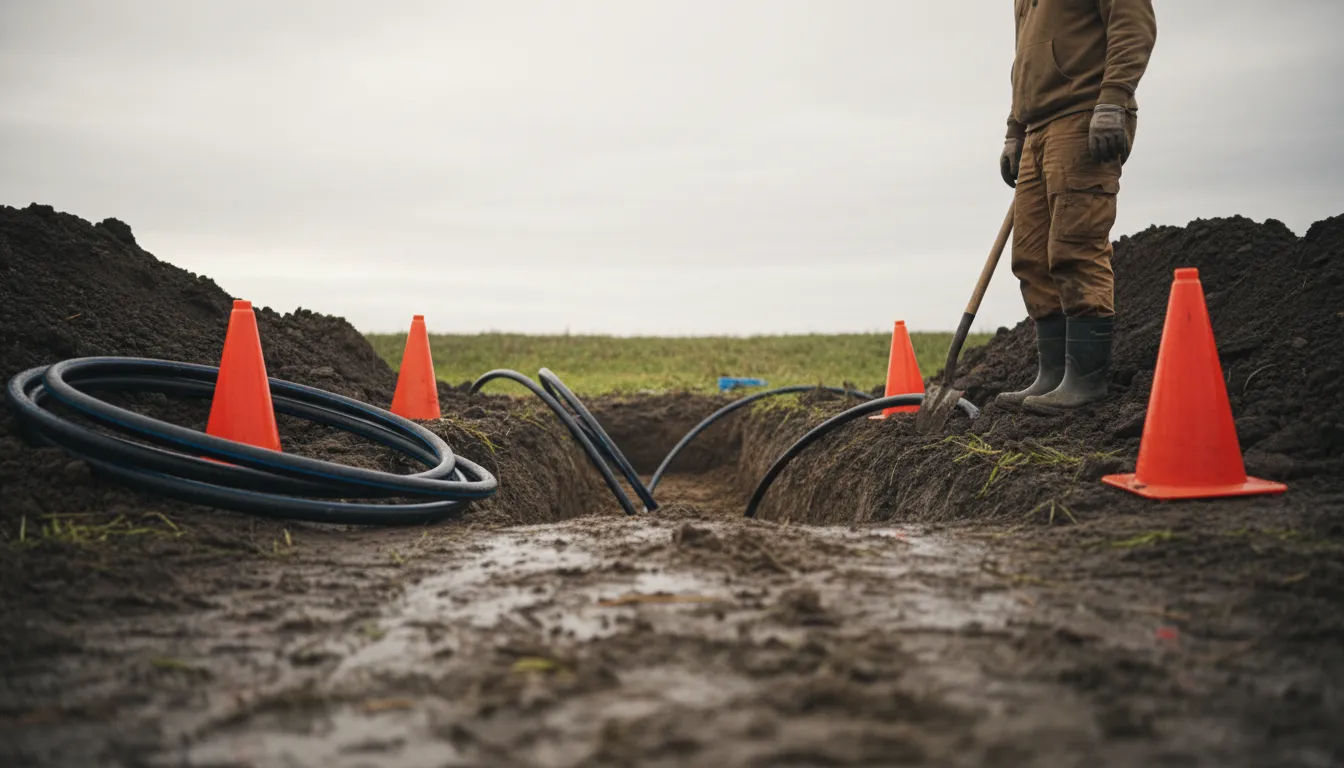
Horizontal Closed-Loop This installation involves digging trenches, usually four to six feet deep, and laying pipes in a series of parallel runs or slinky coils. A horizontal ground loop requires a significant amount of available land, typically at least half an acre or more, to accommodate the trenching 2 3. It is often the most cost-effective option if your property has the space and suitable soil for excavation.
Vertical Closed-Loop For homes with smaller yards, a vertical loop system is the ideal solution. Contractors use a drilling rig to bore holes 200 to 500 feet deep. U-shaped pipe loops are inserted into each borehole, which are then grouted for optimal thermal conductivity. While the drilling process is more specialized, a vertical system requires much less surface area, making it perfect for many residential lots in Overland Park 4.
Open-Loop System Less common in residential settings, an open-loop system uses groundwater from a well as the direct heat exchange fluid. After passing through the heat pump, the water is discharged back into a well, pond, or stream, following local codes. This system can be highly efficient but requires an abundant supply of clean water and is subject to more regulatory considerations.
The Installation Process: What to Expect
Installing a geothermal HVAC system is a significant project that requires careful planning and expert execution. The process generally follows these key stages:
- Site Assessment and Design: A qualified installer will first evaluate your property. They will assess soil composition, rock content, lot layout, and accessibility for heavy equipment. This evaluation determines the best type and size of the ground loop system for your home's heating and cooling loads.
- Loop Field Installation: This is the major outdoor phase. For a horizontal system, a backhoe or trencher will dig the necessary trenches. For a vertical system, a drilling rig will be brought in to create the boreholes. The pipes are then placed, connected into a continuous loop, pressure-tested for leaks, and finally buried or grouted.
- Indoor Unit Installation: Inside your home, the geothermal heat pump unit is installed. This unit, which is typically quieter and more compact than a traditional furnace and air conditioner, is connected to your home's electrical system and ductwork or hydronic distribution system 5.
- Connection and Commissioning: The underground loops are connected to the indoor heat pump via entry lines. The entire system is filled with fluid, purged of air, and started up. The contractor will test and balance the system to ensure it operates at peak efficiency.
Find the perfect geothermal heat pump contractors for your needs
Get personalized recommendations and expert advice
Key Considerations for Overland Park Homes
Before moving forward with a geothermal project, there are several local factors to consider:
- Land Availability: The most straightforward requirement is space. A horizontal loop demands a larger, clear yard area for trenching. Even a vertical loop system needs sufficient space for a large drill rig to access the site and maneuver.
- Soil and Geology: The thermal conductivity of your soil affects system efficiency. Clay soils transfer heat differently than sandy soils. The presence of bedrock can increase drilling costs for vertical loops but may also offer excellent heat transfer properties 6.
- Existing Ductwork: Most geothermal heat pumps use forced-air delivery. Your existing ductwork must be evaluated for compatibility-it needs to be properly sized and sealed to handle the system's airflow requirements for optimal performance.
- Long-Term Landscape Planning: Consider the future use of your yard. The location of the loop field should be documented to avoid future digging that could damage the pipes.
Costs, Savings, and Return on Investment
The upfront cost of a residential geothermal system in Overland Park is a primary consideration for homeowners. Installation, including the ground loop and heat pump unit, typically ranges from $20,000 to $50,000 or more for an average-sized home 7. This investment is significantly higher than that of a standard high-efficiency furnace and air conditioner.
However, the operational savings are where geothermal heat pumps shine. By leveraging the earth's consistent temperature, these systems operate with remarkable efficiency, often leading to a 25% to 70% reduction in heating and cooling bills compared to conventional systems 8 9. Furthermore, geothermal systems are incredibly durable. The indoor heat pump unit often lasts 20 years or more, while the underground polyethylene piping is warrantied for 25-50 years and can potentially last for generations 10 11.
The payback period-the time it takes for energy savings to equal the initial investment-varies but often falls within 5 to 10 years 12. This timeframe can be shortened by available federal tax credits for renewable energy and potential local utility rebates, making the long-term financial picture very attractive for many homeowners.
Frequently asked questions
Sources
Footnotes
-
Geothermal Energy and Heat Pump Potential in Kansas - https://kgs.ku.edu/geothermal-energy-and-heat-pump-potential-kansas ↩
-
Overland Park Ground Source Heat Pump Installation & Repair - https://www.lancasterbrothers.com/geothermal/geothermal-install-and-repair-ground-source-heat/ ↩
-
All You Need to Know About Home Geothermal Heating & ... - https://dandelionenergy.com/all-you-need-to-know-about-home-geothermal-heating-cooling ↩
-
How to Choose the Right System for Your Home - Morrison Inc. - https://morrisongeothermal.com/how-to-choose-the-right-system-for-your-home/ ↩
-
Exploring The Efficiency And Benefits Of Geothermal Heating And ... - https://www.climatecontrolkc.com/blog/geothermal-heating-and-cooling/geothermal-heating-cooling-benefits/ ↩
-
Geothermal Heat Pumps - Department of Energy - https://www.energy.gov/energysaver/geothermal-heat-pumps ↩
-
Air-Source vs. Geothermal Heat Pumps: Choosing the Right System for Your Kansas City Home - https://bucknershc.com/blog/air-source-vs-geothermal-heat-pump ↩
-
5 Things You Should Know about Geothermal Heat Pumps - https://www.energy.gov/cmei/articles/5-things-you-should-know-about-geothermal-heat-pumps ↩
-
Geothermal Heat Pump Guide: Installation Costs, Types And Benefits - https://modernize.com/hvac/heating-repair-installation/heat-pump/geothermal ↩
-
Geothermal Heat Pump - DSO Electric Cooperative - https://dsoelectric.com/geothermal-heat-pump ↩
-
Guide to Geothermal Heat Pumps - https://www.energy.gov/sites/prod/files/guide_to_geothermal_heat_pumps.pdf ↩
-
How Does a Geothermal System Work? - ClimateMaster - https://www.climatemaster.com/homeowner/side-links/how-it-works ↩