Find the Best Geothermal Heat Pump Contractors for Your Business
No obligation • Fast responses • Nationwide coverage

Why you can trust HVAC Firms
HVAC Firms is a leading United States resource for evaluating HVAC service providers. Our team researches companies, checks credentials, and reviews customer feedback to present clear, unbiased information. Listings and rankings are based on merit, and companies cannot pay to change our editorial content.
Search providers near you
Top Geothermal Heat Pump Contractors in Tinley Park, Illinois Ranked
A geothermal heat pump is a highly efficient heating and cooling system that leverages the earth's constant underground temperature to regulate your home's climate. For Tinley Park residents, this technology offers a sustainable way to achieve year-round comfort while significantly reducing energy consumption and utility costs. This guide explains how these ground-source systems work, what installation entails, and how you can find qualified local professionals to assess your property for this long-term investment.
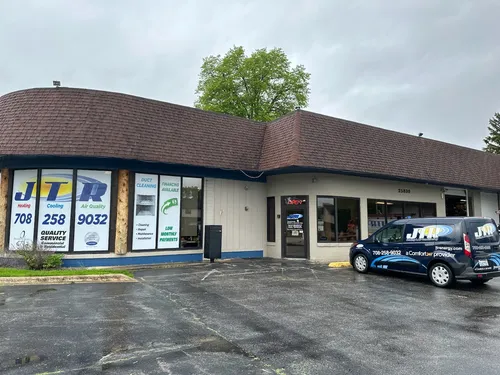
JTR Heating & Air Conditioning
25830 S Governors Hwy, Monee, IL 60449
JTR Heating & Air Conditioning is an HVAC company serving Chicago, IL, and nearby communities including Bourbonnais, Monee, and Peotone. They provide a range of heating and cooling services such as air conditioning and furnace repair, installation, geothermal heat pump systems, duct cleaning, and HVAC tune-ups. With over 30 years of experience, the company supports both residential and commercial customers. They have been recognized with the Carrier President's Award for their service in consecutive years.
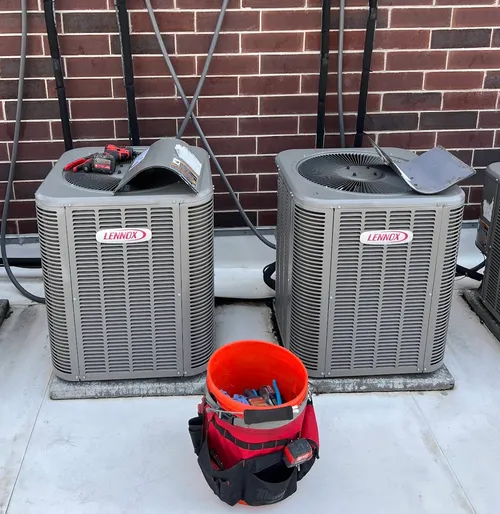
Y-Tech Heating & Air Conditioning
701 Devon Ave, Park Ridge, IL 60068
Y-Tech Heating & Air Conditioning is a licensed HVAC contractor serving Chicago, IL, and the surrounding communities. They provide a range of services including installation, repair, and maintenance of air conditioners, furnaces, heat pumps, boilers, mini split systems, geothermal heat pumps, and indoor air quality products. With over 50 years of experience, Y-Tech offers professional HVAC tune-ups and maintenance agreements to help keep systems running efficiently. They also provide 24/7 emergency service to address urgent heating and cooling needs.
How Geothermal Systems Work: Tapping into the Earth's Energy
The core principle behind a geothermal system, often called a ground-source heat pump, is remarkably simple. Just a few feet below the surface, the earth maintains a stable temperature between 50-55°F year-round, unaffected by Tinley Park's summer heat or winter chill. A geothermal system acts as a thermal energy mover, using this constant temperature as a source of heat in the winter and a place to reject heat in the summer.
The process involves three key components:
- The Ground Loop: A network of pipes buried underground circulates a water-based fluid. In winter, this fluid absorbs the earth's natural warmth.
- The Heat Pump Unit: Located inside your home, this unit concentrates the low-grade heat from the fluid, raising it to a temperature suitable for heating your living space via your existing ductwork or radiant floor system.
- The Exchange Process: In cooling mode, the system reverses, pulling heat from your home and transferring it into the cooler ground loop fluid, which then dissipates the heat into the earth 1 2.
This method of transferring existing thermal energy, rather than creating it by burning fuel, is what leads to the exceptional efficiency of geothermal heating and cooling.
Types of Ground Loops: Choosing the Right System for Your Property
The underground pipe system, or ground loop, is the heart of the installation. The right type for your Tinley Park home depends on your lot size, soil composition, and local geology. The two primary categories are closed-loop and open-loop systems.
Closed-Loop Systems This is the most common residential configuration, where a sealed mixture of water and antifreeze circulates continuously through buried high-density polyethylene pipes. There are two main designs:
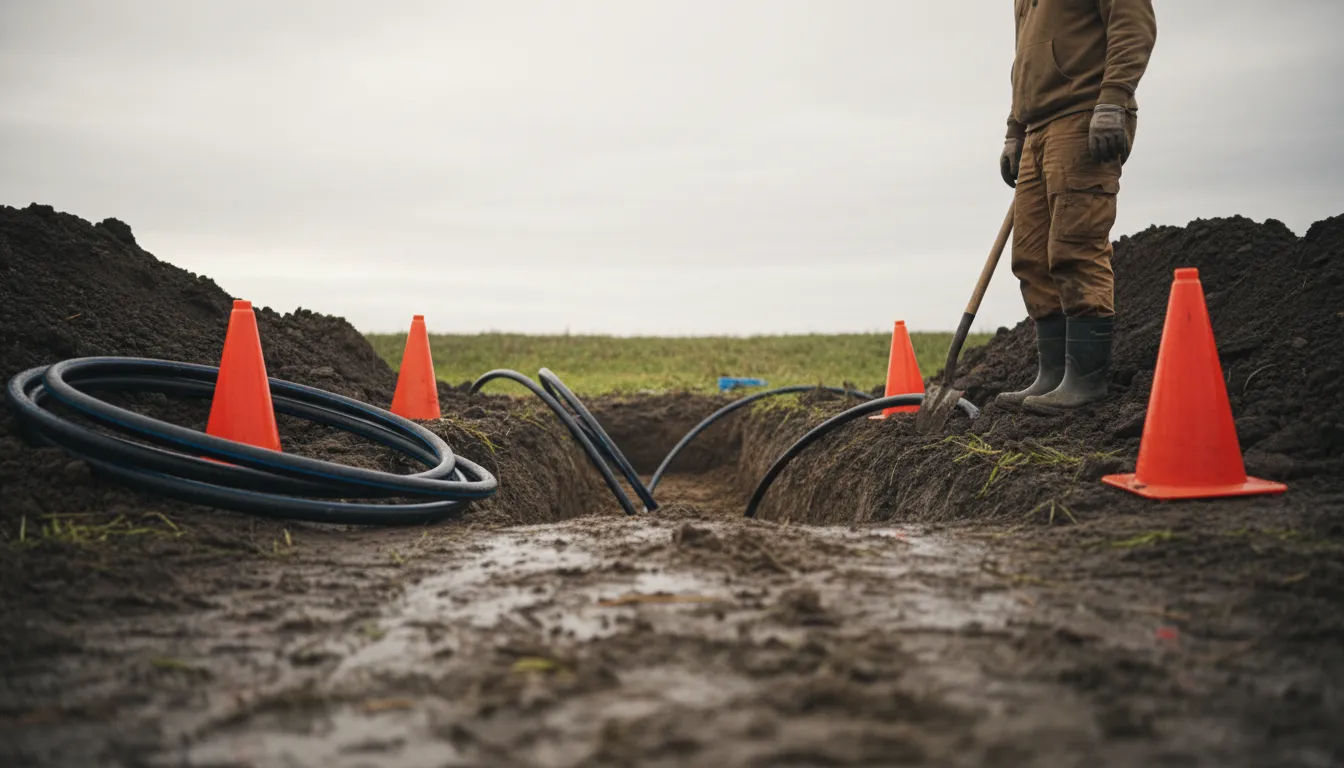
- Horizontal Closed-Loop: Pipes are laid in trenches typically 4 to 6 feet deep. This design requires a larger amount of available land but is often less expensive to install than vertical systems where trenching is feasible.
- Vertical Closed-Loop: For properties with limited space, like many suburban lots, vertical loops are ideal. Contractors drill boreholes 150 to 450 feet deep and insert U-shaped loop pipes into each hole 3. This method minimizes landscape disturbance and is well-suited to the clay and rock profiles common in Illinois.
Open-Loop Systems This configuration uses groundwater from a well or a pond as the direct heat exchange fluid. After passing through the heat pump, the water is returned to a second well or discharged on the surface (where local codes permit) 4 5. While potentially very efficient, open-loop systems require an adequate, consistent water supply and strict adherence to local environmental regulations, making them less common than closed-loop options.
Find the perfect geothermal heat pump contractors for your needs
Get personalized recommendations and expert advice
The Installation Process: From Site Assessment to Comfort
Installing a geothermal system is a significant project that requires professional expertise. The process ensures the system is designed and built for optimal, long-term performance.
-
Professional Site Assessment: The first step is a thorough evaluation by a qualified installer. They will assess your property's characteristics, including soil and rock composition (which affects thermal conductivity), available space, and your home's heating and cooling load requirements 6. This assessment is crucial for designing an effective and efficient loop field.
-
Ground Loop Installation: This is the most substantial part of the project. For a horizontal system, excavation equipment digs the necessary trenches. For a vertical system, a drilling rig creates the deep boreholes. The pipes are then placed, connected, and pressure-tested before the trenches or boreholes are backfilled 7 8 9. The specific geology of Tinley Park can influence drilling speed and cost, but materials like clay and dense rock offer excellent heat transfer properties once installed.
-
Indoor Unit Installation: Inside your home, typically in a basement, utility room, or garage, the geothermal heat pump unit is installed. This unit is connected to your home's ductwork or hydronic distribution system. The refrigerant lines and controls are also connected to the ground loop pipes that enter the home.
Understanding Costs and Long-Term Value
The upfront investment for a geothermal heat pump system is higher than for a conventional furnace and air conditioner. For a typical Tinley Park home, total installed costs can range significantly, often between $20,000 and $40,000 or more, with the ground loop accounting for a substantial portion of the expense 10 11.
However, this initial cost must be weighed against the substantial operational savings and long-term value:
- Dramatic Energy Savings: Geothermal systems can reduce energy use for heating and cooling by 30% to 70% compared to conventional systems 12 13. For a 2,000-square-foot home, this can translate to $1,000 to $2,000 or more in annual utility bill savings 14 15.
- Financial Incentives: Federal tax credits are available to help offset the installed cost of qualifying geothermal systems, improving the financial payback.
- Exceptional Longevity: The indoor heat pump unit typically lasts 20 years or more, while the underground polyethylene piping often carries warranties of 50 years and can last for generations with no maintenance 16.
- Payback Period: With energy savings and incentives, many homeowners see a full return on their investment through lower bills within 5 to 15 years. Over the system's life, the total cost of ownership can be lower than maintaining and replacing conventional systems multiple times.
Benefits Beyond the Bottom Line
While financial savings are a major advantage, geothermal systems offer other compelling benefits for homeowners:
- Quiet Operation: With no noisy outdoor condenser unit (like a traditional air conditioner), the system operates very quietly.
- Improved Comfort: Geothermal systems provide steady, even heating and cooling without the drafts or temperature swings associated with fossil fuel systems.
- Safety and Cleanliness: There is no combustion, meaning no risk of carbon monoxide poisoning, no pilot light, and no need for a fuel tank or chimney.
- Low Maintenance: The system has fewer mechanical components exposed to the weather, and the ground loop requires virtually no maintenance.
- Environmental Impact: By using renewable thermal energy from the ground and electricity, a geothermal system drastically reduces your home's carbon footprint associated with heating and cooling.
Frequently asked questions
Sources
Footnotes
-
All You Need to Know About Home Geothermal Heating & ... - https://dandelionenergy.com/all-you-need-to-know-about-home-geothermal-heating-cooling ↩
-
How Geothermal Heating and Cooling Systems Work | Belle Air - https://www.belleairservices.com/how-geothermal-heating-and-cooling-systems-work/ ↩
-
Geothermal Ground Loop Design | Comfortworks, Inc. - https://comfort.works/ground-loop-design/ ↩
-
Geothermal Heating and Cooling - Open Energy Information - https://openei.org/wiki/GeoBridge/Heating_and_Cooling ↩
-
Types of Geothermal Systems | Energy | Illinois Extension | UIUC - https://extension.illinois.edu/energy/types-geothermal-systems ↩
-
Geothermal Heating and Cooling - Ecology Action Center - https://ecologyactioncenter.org/energy-home/geothermal-heating-and-cooling/ ↩
-
Geothermal heating & cooling, heat pumps, heat exchange ... - https://aztechgeo.com/residential-geothermal/how-it-works/ ↩
-
All About Geothermal Installation for Your Home | Scott-Lee - https://scottleeheating.com/all-about-geothermal-installation-for-your-home/ ↩
-
Explainer: Ground source heat pumps - https://knowledgehub.ice.org.uk/cpd/energy/ground-source-heat-pumps/ ↩
-
Geothermal Heat Pump: How It Works, How Long It Lasts, and How ... - https://dandelionenergy.com/geothermal-heat-pump-how-it-works-how-long-it-lasts-and-how-much-it-costs ↩
-
Ground Source Heat Pump Cost: How Much Will You Pay in 2025? - https://www.energysage.com/heat-pumps/costs-benefits-geothermal-heat-pumps/ ↩
-
Geothermal Heat Pumps - EnergySmart CNY - https://www.energysmartcny.org/heat-pumps/geothermal/ ↩
-
Geothermal Heat Pumps - Department of Energy - https://www.energy.gov/energysaver/geothermal-heat-pumps ↩
-
Guide to Geothermal Heat Pumps - https://www.energy.gov/sites/prod/files/guide_to_geothermal_heat_pumps.pdf ↩
-
Everything You Need to Know About Geothermal Heat Pumps - https://www.familyhandyman.com/article/everything-you-need-to-know-about-geothermal-heat-pumps/ ↩
-
Air Source vs Ground Source Heat Pump: Which Is Best? - https://harmonmechanical.com/air-source-vs-ground-source-heat-pump/ ↩