Find the Best Geothermal Heat Pump Contractors for Your Business
No obligation • Fast responses • Nationwide coverage

Why you can trust HVAC Firms
HVAC Firms is a leading United States resource for evaluating HVAC service providers. Our team researches companies, checks credentials, and reviews customer feedback to present clear, unbiased information. Listings and rankings are based on merit, and companies cannot pay to change our editorial content.
Search providers near you
Top Geothermal Heat Pump Contractors in Skokie, Illinois Ranked
A geothermal heat pump is a highly efficient heating and cooling system that leverages the Earth's stable underground temperature. For Skokie homeowners, this technology offers a path to dramatically lower energy bills and a reduced carbon footprint. This guide explains how these systems work, what to consider for your property, and how to connect with qualified local experts for installation and service.
Bill's Heating And Air Conditioning Inc.
1855 Holste Rd, Northbrook, IL 60062
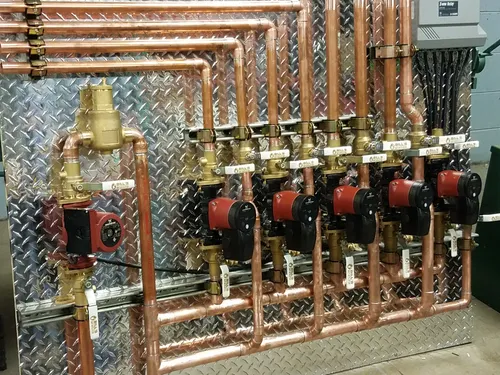
Bill's Heating And Air Conditioning Inc. provides HVAC repair, maintenance, and installation services for residential and commercial clients in Chicago, IL. Their offerings include air conditioning, furnace, and boiler services, as well as geothermal heat pump installation and indoor air quality improvements. The company is equipped to handle zoning and control systems and offers 24/7 emergency service throughout the Chicago area. They focus on accurate diagnosis and timely repairs, often fixing broken parts rather than replacing entire systems. Bill's Heating And Air Conditioning Inc. serves multiple nearby communities including Skokie, Glenview, and Evanston.
Western Heating And Air Conditioning
6925 N Greenview Ave, Chicago, IL 60626
Western Heating And Air Conditioning is an HVAC contractor based in Chicago, IL, providing a wide range of heating, cooling, and indoor air quality services. They handle installation, repair, and maintenance for air conditioners, furnaces, heat pumps, mini splits, and geothermal systems. The company also offers duct cleaning, thermostat installation, and HVAC tune-ups. Known for capabilities such as smart thermostat integration and energy-efficient HVAC solutions, Western Heating And Air Conditioning supports both residential and commercial clients in the Chicago area.
Next Step Heating & Cooling
8206 N McCormick Blvd, Skokie, IL 60076
Next Step Heating & Cooling is an HVAC contractor serving Chicago, IL, and the North Shore area. They provide installation, repair, and maintenance services for heating and cooling systems including furnaces, boilers, air conditioners, geothermal heat pumps, ductless mini splits, and thermostats. The company specializes in geothermal system installations, offering efficient heating and cooling solutions for both residential and commercial properties. Next Step Heating & Cooling is a member of the Geothermal Alliance of Illinois and Comed Energy Efficiency Service providers, emphasizing environmentally friendly and cost-effective HVAC options.
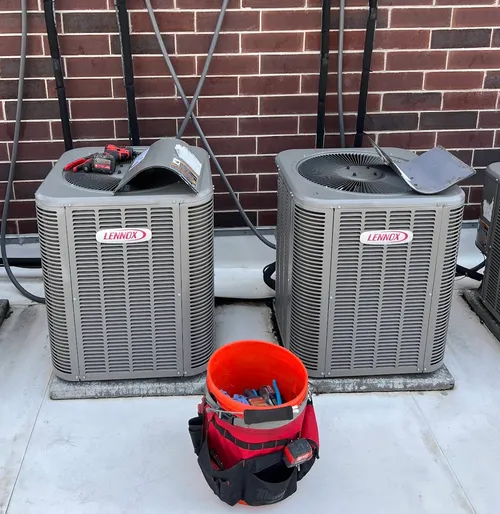
Y-Tech Heating & Air Conditioning
701 Devon Ave, Park Ridge, IL 60068
Y-Tech Heating & Air Conditioning is a licensed HVAC contractor serving Chicago, IL, and the surrounding communities. They provide a range of services including installation, repair, and maintenance of air conditioners, furnaces, heat pumps, boilers, mini split systems, geothermal heat pumps, and indoor air quality products. With over 50 years of experience, Y-Tech offers professional HVAC tune-ups and maintenance agreements to help keep systems running efficiently. They also provide 24/7 emergency service to address urgent heating and cooling needs.
How Geothermal Systems Work: Harnessing the Earth's Energy
Unlike conventional furnaces or air conditioners that burn fuel or battle outdoor air temperatures, a ground-source heat pump simply moves heat. The ground just a few feet below the surface in Skokie maintains a relatively constant temperature of around 50°F year-round. A geothermal system uses this as a massive, free battery for thermal energy.
The process involves two main components:
- The Ground Loop: A sealed network of pipes, called a loop, is buried in your yard. A water-based solution circulates through these pipes, absorbing the Earth's gentle heat in the winter and carrying excess heat from your home back into the ground in the summer 1.
- The Heat Pump Unit: Located inside your home, this unit concentrates the collected heat from the fluid to warm your house. In cooling mode, it works in reverse, extracting heat from your indoor air and depositing it into the loop fluid to be cooled underground. This heated or cooled air is then distributed through your existing ductwork.
This "heat exchange" process is incredibly efficient because it transfers existing heat rather than generating it through combustion, leading to significant energy savings.
Types of Ground Loop Systems for Skokie Properties
The design of the underground loop is the most critical site-specific part of a geothermal installation. The right choice depends on your lot size, soil conditions, and local geology. There are three primary configurations:
Closed-Loop Systems This is the most common type for residential properties. The fluid continuously circulates through a sealed, buried pipe network. There are two main designs:
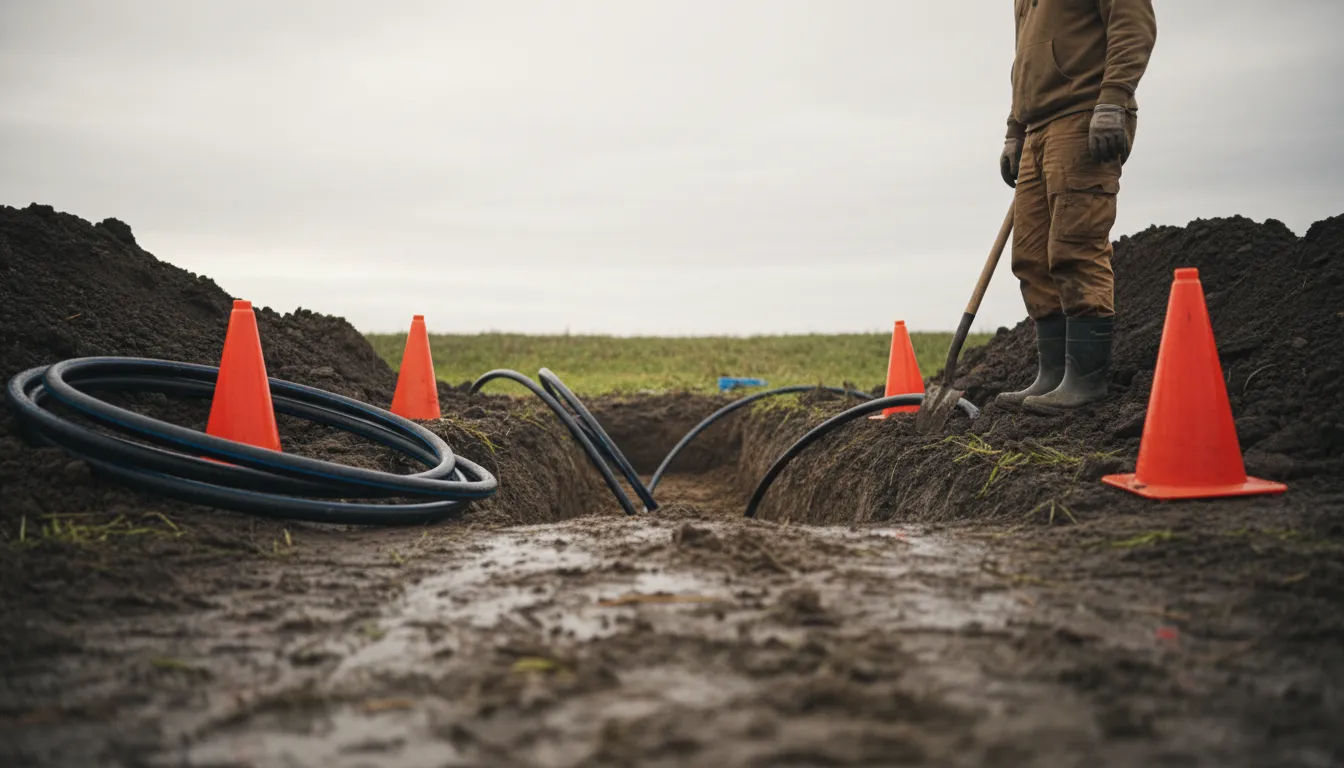
- Horizontal: Pipes are laid in trenches about four to six feet deep. This requires a larger amount of available land but is often less expensive to install than vertical systems where space allows.
- Vertical: Pipes are run through deep boreholes (typically 150 to 450 feet). This is ideal for smaller lots, like many in Skokie, and minimizes landscape disruption, though drilling can increase the upfront cost2 3.
Open-Loop Systems This system uses groundwater from a well as the heat exchange fluid. After circulating through the heat pump, the water is discharged to a pond, stream, or recharge well. This can be highly efficient but depends on having an adequate supply of clean water and is subject to local codes regarding water discharge4 5.
Pond/Lake Loop If you have a sufficiently deep pond or lake on your property, coils of pipe can be submerged at the bottom. The water body acts as the heat source and sink. This is often the most cost-effective loop option when available6.
A qualified installer will assess your property to determine the best and most efficient loop type, considering factors like soil composition, rock content, and available space.
Benefits of Installing a Geothermal Heat Pump
Switching to a geothermal system, or ground-source heat pump, offers compelling advantages beyond just temperature control.
- Exceptional Efficiency & Lower Bills: Geothermal heat pumps are 300% to over 600% efficient, meaning they move three to six units of heat for every one unit of electricity used7. This can translate to a reduction of 40% to 70% on your heating and cooling bills compared to traditional systems8 9. For many Skokie homes, this means annual savings of $1,000 or more.
- Long-Term Reliability & Low Maintenance: The majority of the system is protected underground, sheltered from weather extremes. The indoor heat pump components have fewer moving parts than a conventional furnace and air conditioner, leading to a longer lifespan (often 20+ years for the indoor unit and 50+ years for the ground loop) with relatively simple maintenance.
- Year-Round Comfort: A single system provides both quiet, even heating in winter and effective, dehumidifying cooling in summer. It eliminates the need for separate outdoor air conditioning condensers.
- Environmental Sustainability: By using renewable thermal energy from the ground and electricity, geothermal systems drastically reduce your home's reliance on fossil fuels and lower its carbon emissions10.
- Increased Home Value: The promise of permanently low utility costs and modern, sustainable technology is an attractive feature for future home buyers.
Find the perfect geothermal heat pump contractors for your needs
Get personalized recommendations and expert advice
Understanding Costs, Incentives, and Return on Investment
The upfront investment for a geothermal system is higher than for a standard HVAC system, primarily due to the cost of installing the ground loop. For a typical Skokie home, total installed costs often range from $20,000 to $40,000 before incentives11. However, significant financial incentives and ongoing energy savings make the long-term economics very favorable.
Available Incentives:
- Federal Tax Credit: The Inflation Reduction Act (IRA) provides a tax credit for 30% of the total installed cost of a qualifying geothermal heat pump system, with no upper limit 12. This can directly reduce your federal tax liability by thousands of dollars.
- ComEd Rebates: As a resident of Northern Illinois, you may be eligible for direct rebates from ComEd. These can be substantial, sometimes offering $1,500 per ton of system capacity. Your installer can help you apply for these rebates.
Calculating Payback: The combination of incentives and monthly savings leads to a compelling return on investment (ROI). For example, a system costing $30,000 might see $10,000 in combined tax credits and rebates, bringing the net cost to $20,000. If the system saves $1,750 annually on energy bills, the simple payback period would be roughly 11.5 years on the net cost13. Given the system's long life, you enjoy many years of virtually free heating and cooling after the payback period.
Choosing a Local Skokie Geothermal Installer
Professional design and installation are non-negotiable for a geothermal system to perform as expected. When looking for a provider, seek out companies with specific experience in ground-source heat pumps serving the Chicago suburbs. They will understand local soil conditions, drilling regulations, and utility incentive programs. Look for installers who are accredited by organizations like the International Ground Source Heat Pump Association (IGSHPA) and who provide detailed site assessments, system designs, and lifetime performance estimates.
Frequently asked questions
Sources
Footnotes
-
5 Things You Should Know about Geothermal Heat Pumps - https://www.energy.gov/cmei/articles/5-things-you-should-know-about-geothermal-heat-pumps ↩
-
Geothermal Heating and Cooling - Ecology Action Center - https://ecologyactioncenter.org/energy-home/geothermal-heating-and-cooling/ ↩
-
All You Need to Know About Home Geothermal Heating & Cooling - Dandelion Energy - https://dandelionenergy.com/all-you-need-to-know-about-home-geothermal-heating-cooling ↩
-
About Geothermal - https://www.gaoi.org/about-geothermal ↩
-
How Does a Geothermal System Work? - ClimateMaster - https://www.climatemaster.com/homeowner/side-links/how-it-works ↩
-
Geothermal heating & cooling, heat pumps, heat exchange ... - https://aztechgeo.com/residential-geothermal/how-it-works/ ↩
-
A Comprehensive Review of Geothermal Heat Pump Systems - https://www.mdpi.com/2227-9717/13/7/2142 ↩
-
Geothermal Heat Pumps - EnergySmart CNY - https://www.energysmartcny.org/heat-pumps/geothermal/ ↩
-
Geothermal Heating and Cooling - Open Energy Information - https://openei.org/wiki/GeoBridge/Heating_and_Cooling ↩
-
Guide to Geothermal Heat Pumps - https://www.energy.gov/sites/prod/files/guide_to_geothermal_heat_pumps.pdf ↩
-
Geothermal Heat Pump Guide: Installation Costs, Types And Benefits - https://modernize.com/hvac/heating-repair-installation/heat-pump/geothermal ↩
-
Geothermal Heat Pumps - Department of Energy - https://www.energy.gov/energysaver/geothermal-heat-pumps ↩
-
Quad Cities Geothermal Heat Pump Services | Installation & Repair - https://www.scheblerhvac.com/geothermal-heat-pumps/ ↩