Find the Best Geothermal Heat Pump Contractors for Your Business
No obligation • Fast responses • Nationwide coverage

Why you can trust HVAC Firms
HVAC Firms is a leading United States resource for evaluating HVAC service providers. Our team researches companies, checks credentials, and reviews customer feedback to present clear, unbiased information. Listings and rankings are based on merit, and companies cannot pay to change our editorial content.
Search providers near you
Top Geothermal Heat Pump Contractors in Lombard, Illinois Ranked
A geothermal heat pump, or ground-source system, is a highly efficient method for heating and cooling your Lombard home by tapping into the earth's stable underground temperature. This technology can dramatically reduce your energy bills and environmental footprint. This guide explains how these systems work, what installation involves, and how you can connect with qualified local experts to explore your options.
Bill's Heating And Air Conditioning Inc.
1855 Holste Rd, Northbrook, IL 60062
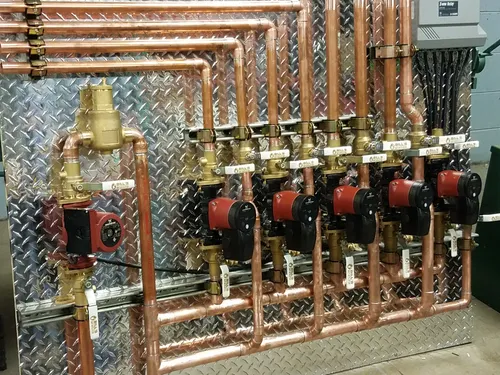
Bill's Heating And Air Conditioning Inc. provides HVAC repair, maintenance, and installation services for residential and commercial clients in Chicago, IL. Their offerings include air conditioning, furnace, and boiler services, as well as geothermal heat pump installation and indoor air quality improvements. The company is equipped to handle zoning and control systems and offers 24/7 emergency service throughout the Chicago area. They focus on accurate diagnosis and timely repairs, often fixing broken parts rather than replacing entire systems. Bill's Heating And Air Conditioning Inc. serves multiple nearby communities including Skokie, Glenview, and Evanston.
Western Heating And Air Conditioning
6925 N Greenview Ave, Chicago, IL 60626
Western Heating And Air Conditioning is an HVAC contractor based in Chicago, IL, providing a wide range of heating, cooling, and indoor air quality services. They handle installation, repair, and maintenance for air conditioners, furnaces, heat pumps, mini splits, and geothermal systems. The company also offers duct cleaning, thermostat installation, and HVAC tune-ups. Known for capabilities such as smart thermostat integration and energy-efficient HVAC solutions, Western Heating And Air Conditioning supports both residential and commercial clients in the Chicago area.
Next Step Heating & Cooling
8206 N McCormick Blvd, Skokie, IL 60076
Next Step Heating & Cooling is an HVAC contractor serving Chicago, IL, and the North Shore area. They provide installation, repair, and maintenance services for heating and cooling systems including furnaces, boilers, air conditioners, geothermal heat pumps, ductless mini splits, and thermostats. The company specializes in geothermal system installations, offering efficient heating and cooling solutions for both residential and commercial properties. Next Step Heating & Cooling is a member of the Geothermal Alliance of Illinois and Comed Energy Efficiency Service providers, emphasizing environmentally friendly and cost-effective HVAC options.
Y-Tech Heating & Air Conditioning
701 Devon Ave, Park Ridge, IL 60068
Y-Tech Heating & Air Conditioning is a licensed HVAC contractor serving Chicago, IL, and the surrounding communities. They provide a range of services including installation, repair, and maintenance of air conditioners, furnaces, heat pumps, boilers, mini split systems, geothermal heat pumps, and indoor air quality products. With over 50 years of experience, Y-Tech offers professional HVAC tune-ups and maintenance agreements to help keep systems running efficiently. They also provide 24/7 emergency service to address urgent heating and cooling needs.
How Geothermal Heating and Cooling Works
The principle behind a ground-source heat pump is elegant in its simplicity. Just a few feet below the surface, the ground in Lombard maintains a nearly constant temperature of 50-60°F year-round, regardless of summer heat or winter chill. A geothermal system uses this stable temperature as a renewable energy source.
Here's the basic process:
- Heat Exchange: A fluid, typically a water and antifreeze mixture, circulates through a loop of pipes buried in your yard.
- Winter Heating: In heating mode, the fluid absorbs the earth's warmth as it travels through the underground loop. This slightly warmed fluid returns to an indoor heat pump unit.
- Concentration and Delivery: The heat pump uses a refrigeration cycle to concentrate this low-grade thermal energy, then delivers it as warm air through your home's ductwork or as hot water through a radiant system.
- Summer Cooling: The process reverses for cooling. The system extracts heat from your home's air, transfers it to the circulating fluid, and then dissipates it into the cooler earth.
This method of moving existing heat, rather than generating it through combustion, is what makes geothermal technology so efficient. These systems can deliver 300% to 600% efficiency, meaning they move three to six units of heat for every one unit of electricity used to run the system.
Types of Geothermal Loop Systems
The underground pipe network, or "ground loop," is the critical component that exchanges heat with the earth. The right type for your Lombard property depends on soil conditions, land availability, and local water regulations.
Closed-Loop Systems
This is the most common configuration, where the heat transfer fluid is permanently sealed within a continuous loop of high-density polyethylene pipe.
- Vertical Closed-Loop: This is often the best choice for smaller residential lots in Lombard. Contractors drill boreholes 60 to 140 meters deep and insert U-shaped loops of pipe into each hole 1. While drilling costs can be higher, this method requires minimal surface area and is effective in most soil and rock types.
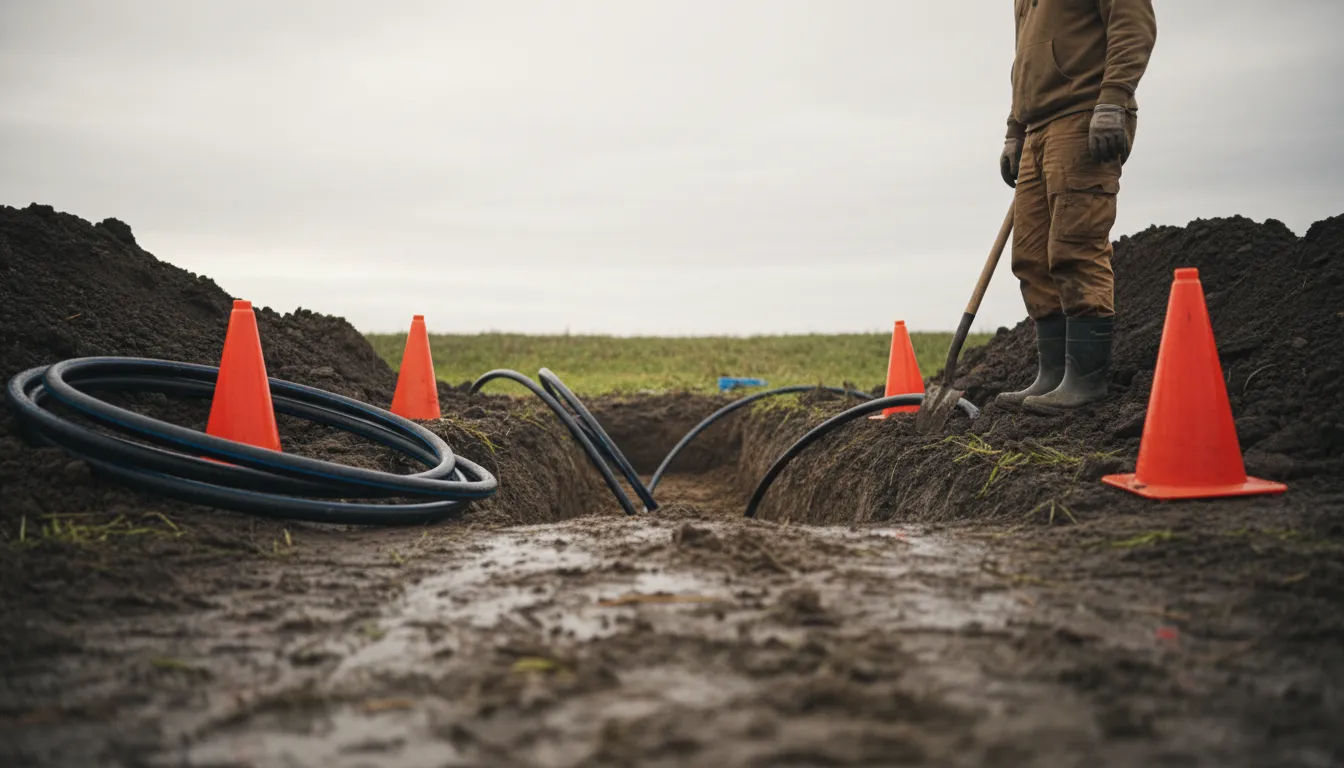
- Horizontal Closed-Loop: If you have ample yard space, this can be a cost-effective option. Contractors excavate trenches three to six feet deep and lay loops of pipe horizontally 2. This method typically has lower excavation costs than vertical drilling but requires a significantly larger plot of land.
Open-Loop Systems
An open-loop system uses groundwater from a well or a suitable surface water body as the heat exchange fluid directly. After passing through the heat pump, the water is returned to the ground via a discharge well or approved method 3. This system can be highly efficient but is only feasible where there is an abundant, clean supply of water and where local codes permit it.
The Installation Process for Lombard Homes
Installing a residential geothermal system is a significant project that requires careful planning and professional execution. Understanding the steps can help you prepare.
- Site Assessment and Design: A qualified installer will evaluate your property's soil composition, available space, and bedrock depth. They will also perform a detailed calculation of your home's heating and cooling loads to properly size the system.
- Loop Field Installation: This is the major earthwork phase. For a vertical system, a well-drilling rig will create the necessary boreholes. For a horizontal system, a backhoe or trencher will excavate the required trenches. The pipe is then placed, connected, and pressure-tested.
- Indoor Unit Installation: The geothermal heat pump unit, which is about the size of a traditional furnace, is installed in your basement, utility room, or garage. It connects to your existing ductwork or hydronic distribution system.
- Connection and Commissioning: The underground loops are connected to the indoor unit via buried service lines. The system is filled with fluid, purged of air, and started. The contractor will test and balance the entire system to ensure optimal performance.
Find the perfect geothermal heat pump contractors for your needs
Get personalized recommendations and expert advice
Trenching vs. Drilling: What Lombard Homeowners Should Know
The method used to install the ground loops has major implications for cost, timeline, and landscape impact.
- Horizontal Trenching: This approach generally has a lower upfront cost for the excavation work itself 4 5. However, it requires a large, clear area of land and results in significant surface disruption, which can affect landscaping. It is often most economical when performed during new home construction or as part of a major landscaping overhaul.
- Vertical Drilling: Drilling is the preferred method for smaller, established lots common in many Lombard neighborhoods. While the drilling cost per foot is higher, it minimizes surface disruption, often leaving your yard mostly intact after the boreholes are grouted 6 7. The feasibility and cost can be influenced by local soil conditions and the depth to bedrock 8.
Long-Term Value and Energy Savings
The upfront investment in a geothermal heat pump is offset by substantial long-term savings and benefits.
- Utility Bill Reduction: Homeowners typically see a 65% to 70% reduction in heating, cooling, and hot water costs compared to systems using propane, oil, or standard electric resistance heat 9 10. This can translate to savings of hundreds of dollars each month during peak seasons.
- Payback Period and Lifespan: While a complete geothermal system in Lombard might range from $20,000 to $40,000 or more installed, the dramatic energy savings often lead to a payback period of 5 to 10 years 11 12. Furthermore, the system components are incredibly durable. The indoor heat pump unit often lasts 20 years or more, while the underground polyethylene piping can have a lifespan exceeding 50 years 13 12.
- Comfort and Quiet: These systems provide exceptionally even, draft-free heating and cooling. They also operate very quietly, with no noisy outdoor condenser unit.
- Environmental Impact: By using renewable thermal energy from the ground and electricity primarily as a power source for moving heat, geothermal systems significantly reduce a home's carbon footprint.
Frequently asked questions
Sources
Footnotes
-
Everything You Need to Know About Geothermal Heat Pumps - https://www.familyhandyman.com/article/everything-you-need-to-know-about-geothermal-heat-pumps/ ↩
-
Geothermal Heating and Cooling - Open Energy Information - https://openei.org/wiki/GeoBridge/Heating_and_Cooling ↩
-
Ground-Source Heat Pump Loops - Burlington Electric ... - https://www.burlingtonelectric.com/gshp-loops/ ↩
-
Geothermal heat pumps: The ultimate guide to ground-source ... - https://termo-plus.com/blog/geothermal-ultimate-guide-to-ground-source-heat-pumps/ ↩
-
Exploring Geothermal Systems: Advantages and Considerations - https://dilandroandrews.com/understanding-geothermal-systems/ ↩
-
All You Need to Know About Home Geothermal Heating & ... - https://dandelionenergy.com/all-you-need-to-know-about-home-geothermal-heating-cooling ↩
-
How Geothermal Heating and Cooling Systems Work | Belle Air - https://www.belleairservices.com/how-geothermal-heating-and-cooling-systems-work/ ↩
-
Geothermal Heating & Cooling Systems - https://www.sre.coop/sites/default/files/geothermalbrochure.pdf ↩
-
How It Works: Geothermal Heat Pump 101 - GeoComfort Blog - https://geocomfort.com/blog/how-it-works-geothermal-heat-pump-101 ↩
-
5 Things You Should Know about Geothermal Heat Pumps - https://www.energy.gov/cmei/articles/5-things-you-should-know-about-geothermal-heat-pumps ↩
-
How Does a Geothermal System Work? - ClimateMaster - https://www.climatemaster.com/homeowner/side-links/how-it-works ↩
-
Geothermal Heat Pump Guide: Installation Costs, Types And Benefits - https://modernize.com/hvac/heating-repair-installation/heat-pump/geothermal ↩ ↩2
-
Guide to Geothermal Heat Pumps - https://www.energy.gov/sites/prod/files/guide_to_geothermal_heat_pumps.pdf ↩