Find the Best Geothermal Heat Pump Contractors for Your Business
No obligation • Fast responses • Nationwide coverage

Why you can trust HVAC Firms
HVAC Firms is a leading United States resource for evaluating HVAC service providers. Our team researches companies, checks credentials, and reviews customer feedback to present clear, unbiased information. Listings and rankings are based on merit, and companies cannot pay to change our editorial content.
Search providers near you
Top Geothermal Heat Pump Contractors in Buckeye, Arizona Ranked
Geothermal heat pumps are a highly efficient method for heating and cooling your home by leveraging the stable temperature of the earth. In Buckeye, this technology is particularly effective, offering significant energy savings and long-term cost benefits compared to traditional air-source systems. This guide explains how these ground-source systems work, the installation options available locally, and how you can connect with qualified professionals to explore this sustainable solution for your home.
How Geothermal Heating and Cooling Works
At its core, a geothermal system, often called a ground-source heat pump, operates on a simple principle of heat exchange. Unlike conventional HVAC that battles the extreme outdoor air temperatures, a geothermal unit uses the earth's remarkably stable subsurface temperature as a source of heat in winter and a place to reject heat in summer 1.
The process involves a closed loop of pipes, called a ground loop, buried in your property. A water-based fluid circulates through this loop. In the winter, this fluid absorbs the gentle warmth from the earth (which remains a relatively constant 40-70°F in Buckeye) and carries it to the heat pump unit inside your home. The heat pump concentrates this low-grade heat and distributes warm air through your ducts. In the summer, the system reverses: it extracts heat from your home's air and transfers it into the cooler ground loop, leaving you with cool, conditioned air. This elegant exchange with the constant ground temperature is what makes geothermal technology so efficient.
Types of Ground Loop Systems for Buckeye Properties
Choosing the right loop configuration is a critical decision that depends on your lot size, soil conditions, and budget. Local installers will conduct a site assessment to recommend the best option for your Buckeye home.
Horizontal Closed Loops
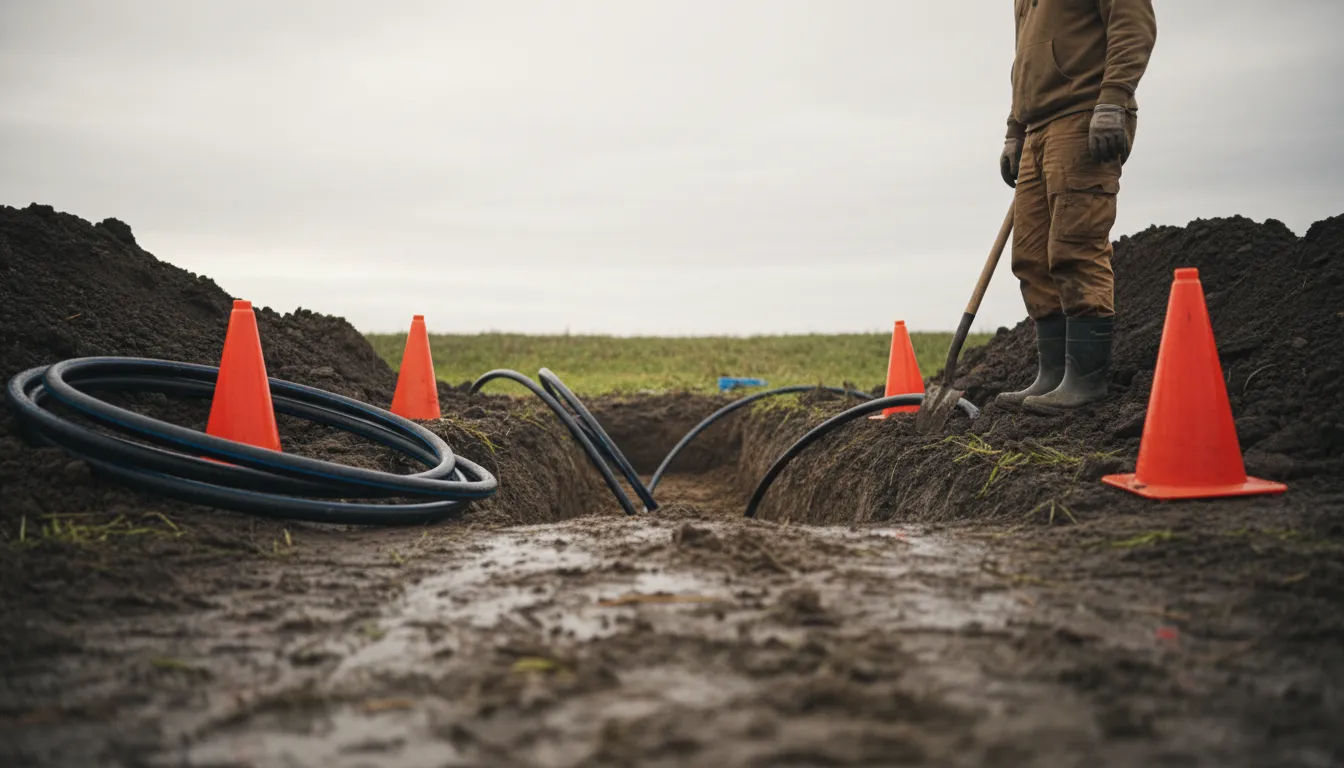
This is often the most cost-effective installation method for new construction where ample land is available. Contractors excavate trenches four to six feet deep and lay pipes in a series of parallel runs or slinky coils. This approach requires a significant amount of open space but generally involves lower excavation costs than deep drilling.
Vertical Closed Loops
For homes with smaller lots, which is common in many established Buckeye neighborhoods, vertical loops are the ideal solution. Installers use a drilling rig to bore holes 150 to 450 feet deep. U-shaped pipe loops are inserted into each borehole, which are then backfilled. This method minimizes landscape disturbance and is excellent for retrofit projects, though the drilling equipment can increase the upfront cost 2.
Pond/Lake Loops
If your property has access to a suitable pond or lake, this can be the lowest-cost loop option. Coils of pipe are submerged at the bottom of the water body, which acts as a consistent heat source and sink 3. The viability depends entirely on water availability, depth, and quality.
Open Loop Systems
An open loop system uses groundwater directly from a well as the heat exchange fluid. After passing through the heat pump, the water is discharged to a pond, stream, or recharge well. This system can be very efficient but requires an adequate, consistent supply of clean water and compliance with local codes regarding water discharge.
Key Considerations for Installation in the Desert
Installing a geothermal system in Buckeye involves specific local factors that professional installers are trained to evaluate.
- Excavation and Drilling: The installation process is more involved than swapping out a traditional AC unit. Horizontal loops require trenching equipment, while vertical loops need a drilling rig capable of penetrating the local soil and rock formations 4. The choice impacts the project timeline and cost structure.
- Land Requirements: Your available land directly dictates your loop options. A sprawling rural property may accommodate a horizontal field, while a standard suburban lot will likely necessitate vertical bores.
- Upfront Investment and Payback: The initial cost for a complete geothermal system is higher than for a conventional system, often ranging from $10,000 to $40,000 or more, depending on system size and loop type 5. However, the dramatically lower operating costs create a compelling financial payback. Homeowners can often recoup this investment through energy savings in 4 to 15 years, after which the savings contribute directly to your household budget.
- Local Site Factors: A professional will assess your soil's thermal conductivity, the accessibility for heavy equipment, your home's heating and cooling load, and local permitting requirements. All these elements influence the final design and cost estimate 6.
Find the perfect geothermal heat pump contractors for your needs
Get personalized recommendations and expert advice
The Long-Term Benefits for Buckeye Homeowners
The decision to install a geothermal heat pump is an investment in long-term comfort, savings, and sustainability.
- Substantial Energy Savings: By moving heat rather than creating it through combustion, geothermal systems are incredibly efficient. They can deliver 25% to 65% savings on heating and cooling energy bills compared to traditional systems 7 8 9. For every unit of electricity they use, they can move three to five units of heat energy, a measure known as Coefficient of Performance (COP) 10.
- Lower Operating Costs: The significant reduction in energy consumption translates directly to lower monthly utility bills. This predictable cost saving helps offset the higher initial installation price over time.
- Enhanced Comfort: These systems provide consistent, even heating and cooling without the cold blasts or hot streaks common with fossil fuel furnaces and standard air conditioners. They also typically include dehumidification for greater comfort during Buckeye's drier months.
- Durability and Quiet Operation: The ground loop is often warranted for 50+ years and can last generations. The indoor heat pump components also tend to have longer lifespans than conventional equipment because they are protected from outdoor weather. Additionally, with no noisy outdoor condenser unit, operation is very quiet.
- Environmental Impact: Geothermal systems have a much smaller carbon footprint. They use renewable thermal energy from the ground and, when powered by electricity from increasingly green grids, can provide nearly emission-free home conditioning.
What to Expect During a Geothermal Installation
A professional installation is a multi-step process. It begins with a comprehensive home evaluation and load calculation. The installer will then design the loop field and secure any necessary permits. For a vertical loop system, a drilling rig will create the boreholes, after which the polyethylene pipe is inserted and the holes are grouted. For horizontal loops, trenches are dug and the pipe is laid 11.
The pipes from the ground loop are connected to the indoor heat pump unit, which is then integrated with your home's ductwork or hydronic distribution system. After pressure testing, charging, and system startup, the contractor will calibrate the system for optimal performance and walk you through its operation. The entire process requires skilled technicians familiar with both plumbing/earthwork and HVAC principles.
Frequently asked questions
Sources
Footnotes
-
Geothermal Heating & Cooling - Department of Energy - https://www.energy.gov/eere/geothermal/geothermal-heating-cooling ↩
-
Geothermal Heat Pumps - Department of Energy - https://www.energy.gov/energysaver/geothermal-heat-pumps ↩
-
Geothermal Heating, Cooling, and Hot Water Systems - https://igshpa.org/wp-content/uploads/Homeowners-Guide-to-Geothermal.pdf ↩
-
How Does A Geothermal Heat Pump Work? Complete 2025 Guide - https://solartechonline.com/blog/how-does-geothermal-heat-pump-work/ ↩
-
Geothermal HVAC Installations: All You Need to Know - https://coastalhvac.biz/articles/geothermal-hvac-installations-all-need-know ↩
-
Geothermal heating & cooling, heat pumps, heat exchange loops - How it works - https://aztechgeo.com/residential-geothermal/how-it-works/ ↩
-
Geothermal Heat Pumps - EnergySmart CNY - https://www.energysmartcny.org/heat-pumps/geothermal/ ↩
-
5 Things You Should Know about Geothermal Heat Pumps - https://www.energy.gov/cmei/articles/5-things-you-should-know-about-geothermal-heat-pumps ↩
-
Everything You Need to Know About Geothermal Heat Pumps - https://www.familyhandyman.com/article/everything-you-need-to-know-about-geothermal-heat-pumps/ ↩
-
Guide to Geothermal Heat Pumps - https://www.energy.gov/sites/prod/files/guide_to_geothermal_heat_pumps.pdf ↩
-
Geothermal Heat Pumps: How They Work | AHRI - https://www.ahrinet.org/scholarships-education/education/homeowners/how-things-work/geothermal-heat-pumps-how-they-work ↩