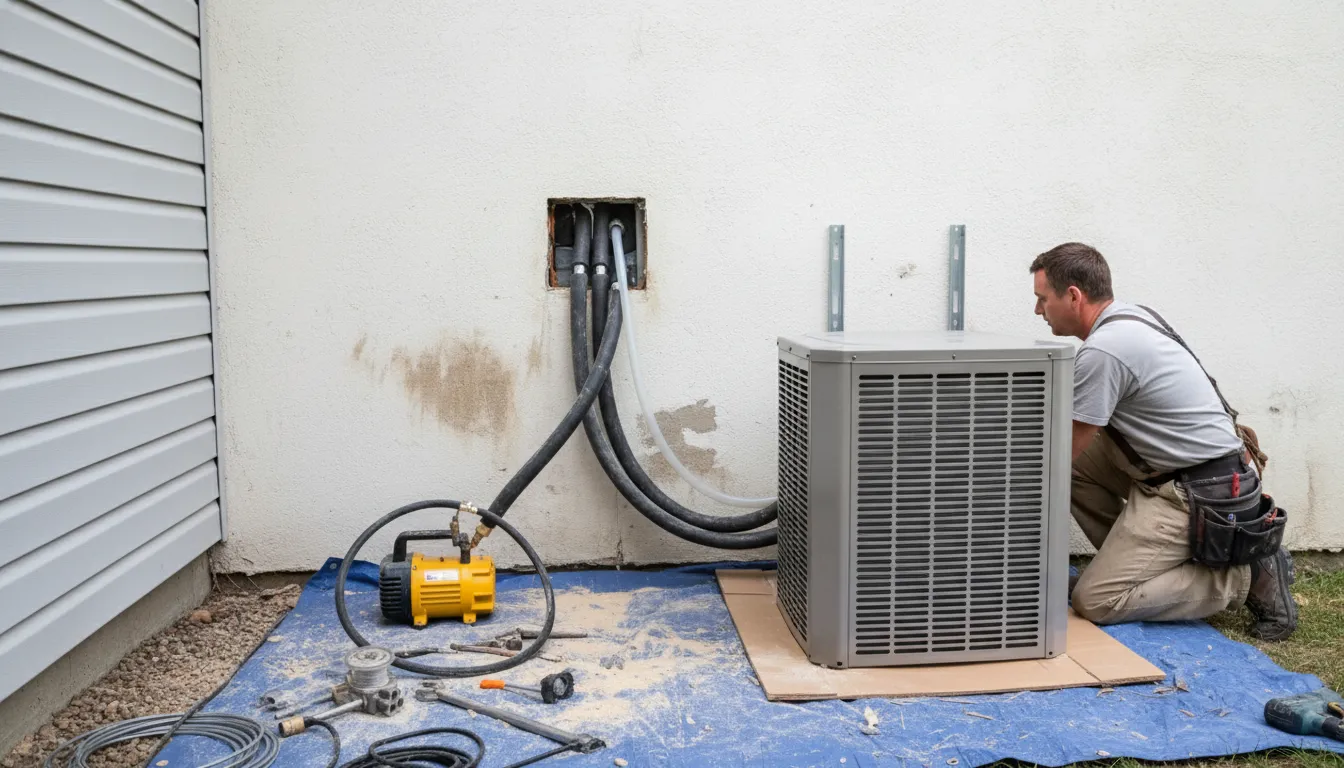
Find the Best Heat Pump Installation & Replacement Contractors for Your Business
No obligation • Fast responses • Nationwide coverage

Why you can trust HVAC Firms
HVAC Firms is a leading United States resource for evaluating HVAC service providers. Our team researches companies, checks credentials, and reviews customer feedback to present clear, unbiased information. Listings and rankings are based on merit, and companies cannot pay to change our editorial content.
Search providers near you
Top Heat Pump Installation & Replacement Contractors in Greenville, North Carolina Ranked
Upgrading your home's heating and cooling system with a heat pump is a smart investment in year-round comfort and energy efficiency. For Greenville residents, these versatile systems are particularly well-suited to our climate, providing both efficient heating in mild winters and powerful cooling during humid summers. This guide will help you understand the types of systems available, key considerations for our area, and how to connect with qualified local professionals to get accurate quotes for your project.
Why Choose a Heat Pump for Your Greenville Home?
Greenville's climate, characterized by hot, humid summers and relatively mild winters, is ideal for air-source heat pump technology 1. Unlike traditional systems that require separate furnaces and air conditioners, a heat pump handles both heating and cooling with one unit. It works by transferring heat-moving it indoors during winter and expelling it outdoors during summer. This process is inherently more energy-efficient than generating heat through combustion, which can lead to significant savings on utility bills over time. For many homes in Pitt County, a properly sized and installed heat pump can be the most cost-effective and comfortable HVAC solution available.
Types of Heat Pump Systems
Understanding the different system types is the first step in choosing the right one for your home's layout and needs.
Central Air-Source Heat Pumps
This is the most common type of heat pump installation, especially in homes with existing ductwork. A central, or ducted, system uses an outdoor unit connected to an indoor air handler to distribute conditioned air throughout your home via ducts. It's an excellent choice for whole-home heating and cooling replacement, particularly if you are upgrading from an old central air conditioner and furnace combo.
Ductless Mini-Split Heat Pumps
Ductless systems are a fantastic solution for homes without existing ducts, for room additions, or for creating "zones" with independent temperature control 2. A mini-split consists of an outdoor compressor/condenser and one or more indoor air-handling units mounted on walls or ceilings. They are highly efficient and allow you to heat or cool only the rooms you are using. This makes them popular for bonus rooms, sunrooms, or older homes where installing ductwork would be prohibitively expensive.
Geothermal Heat Pumps
While less common due to higher upfront costs, geothermal (or ground-source) systems offer the highest efficiency available 3. They use the stable temperature of the earth to exchange heat, making them incredibly effective in both summer and winter. Installation involves burying loops of pipe in your yard, which requires significant excavation. The long-term energy savings can be substantial, but the initial investment is a key consideration for Greenville homeowners.
Efficiency Ratings: Understanding SEER and HSPF
When comparing heat pumps, you'll encounter two critical efficiency ratings: SEER and HSPF. Higher numbers indicate greater efficiency and lower operating costs.
- SEER (Seasonal Energy Efficiency Ratio): Measures cooling efficiency. Modern heat pumps in North Carolina typically range from 14 SEER (standard efficiency) to 21+ SEER (ultra-high efficiency).
- HSPF (Heating Seasonal Performance Factor): Measures heating efficiency. Look for ratings typically between 7.5 (standard) and 10+ (high efficiency).
Investing in a unit with higher SEER and HSPF ratings will cost more initially but can pay for itself over time through reduced energy consumption, especially given Greenville's long cooling season and regular heating needs.
Cost Factors for Heat Pump Installation in Greenville
The total cost of your heat pump project can vary widely based on several factors. Getting multiple detailed quotes from local contractors is the only way to know the exact price for your home 4.
System Type and Size: The capacity of the unit (measured in tons) must be correctly calculated for your home's square footage, insulation, and window exposure. An oversized or undersized system will perform poorly and inefficiently 5 6. Central systems typically range from $3,000 to over $10,000 installed, while ductless mini-splits can range from $3,500 to $10,000 for a single-zone system, and $10,000 to $25,000+ for multi-zone setups 7 8 9.
Ductwork Modifications: If you're installing a central system, the condition of your existing ducts is crucial. Repairing, resealing, or replacing old ductwork can add significantly to the project cost but is essential for system performance and efficiency 10.
Installation Complexity: The difficulty of the installation job affects labor costs. Factors include the location of the outdoor unit, electrical upgrades needed, and whether any structural modifications are required 11.
Equipment Efficiency: As mentioned, higher-efficiency models (with higher SEER and HSPF ratings) come with a higher purchase price but offer long-term savings 12.
Find the perfect heat pump installation & replacement contractors for your needs
Get personalized recommendations and expert advice
The Importance of Professional Sizing and Installation
A heat pump is a significant investment, and its performance hinges entirely on proper sizing and expert installation. A qualified Greenville HVAC contractor will perform a Manual J load calculation. This is not a simple guess based on square footage; it's a detailed analysis that considers your home's insulation, air leakage, window types, roof color, and even local climate data. Installing the wrong size unit is a common and costly mistake that leads to short cycling, inadequate comfort, and higher energy bills.
Professional installation ensures the refrigerant lines are properly charged and sealed, the electrical connections are safe and to code, and the entire system is calibrated for optimal performance. Always verify that the contractors you are considering are licensed, insured, and have experience specifically with heat pump installations in Eastern North Carolina.
Navigating Permits and Incentives
Most heat pump installations in Greenville will require a permit from the City of Greenville or Pitt County. A reputable contractor will typically handle this process for you. Furthermore, it's worth investigating available rebates and tax credits. Federal tax credits for high-efficiency residential energy products, including heat pumps, are available and can offset a portion of your investment. Your local HVAC professional should be informed about current federal, state, and even utility-specific incentives that can make your upgrade more affordable.
Maintaining Your New Heat Pump System
To protect your investment and ensure it operates at peak efficiency for its full lifespan (typically 10-15 years), regular maintenance is key. This includes simple tasks you can do yourself, like keeping the outdoor unit clear of leaves, grass, and debris, and changing the indoor air filters regularly. It also involves professional bi-annual maintenance-a tune-up in the spring before cooling season and another in the fall before heating season. A technician will check refrigerant levels, clean coils, inspect electrical components, and ensure the system is running safely and efficiently. Many local HVAC companies offer affordable maintenance plans for this purpose.
Frequently asked questions
Sources
Footnotes
-
North Carolina Heating Showdown: Heat Pumps and Furnaces - https://caseyserviceshvac.com/blog/north-carolina-heating-showdown-heat-pumps-and-furnaces/ ↩
-
Heat Pump Price Guides - Heat Pump Prices and Replacement Costs - https://heatpumppriceguides.com/ ↩
-
Heat Pump Costs and Installation Costs [2026 Data] | Angi - https://www.angi.com/articles/how-much-does-heat-pump-cost.htm ↩
-
How Much Do Heat Pumps Cost? (2024 Price Estimate Guide) - https://jarboes.com/knowledge-center/how-much-do-heat-pumps-cost/ ↩
-
Heat Pump Replacement Cost | Casey Services HVAC Inc - https://caseyserviceshvac.com/blog/heat-pump-replacement-cost/ ↩
-
Factors to Consider When Choosing an HVAC System for Your ... - https://cityairexperts.com/blog/factors-to-consider-when-choosing-an-hvac-system/ ↩
-
How much does it cost for a heat pump - Comfort Temp - https://comforttemp.com/how-much-does-it-cost-for-a-heat-pump/ ↩
-
Heat Pump Replacement Cost: A Complete Guide for Wake Forest/ ... - https://caseyserviceshvac.com/blog/heat-pump-replacement-cost-a-complete-guide-for-wake-forest-raleigh-homeowners/ ↩
-
Is Replacing a Heat Pump Expensive in North Carolina? - https://www.yourcomfortfirst.com/blog/is-replacing-a-heat-pump-expensive-in-north-carolina/ ↩
-
Heat Pump Installation Guide NC | Piedmont HVAC - https://piedmonthvacpc.com/heat-pump-installation-guide/ ↩
-
Heat Pump Cost & Replacement Cost Guide - Rahn Industries - https://rahnindustries.com/2023/08/08/heat-pump-replacement-cost-guide/ ↩
-
Cost of a Heat Pump Installation in 2025 - https://www.cabshvac.com/heat-pump-installation-cost/ ↩